Mushroom Nootropic Stacks
3 mechanisms
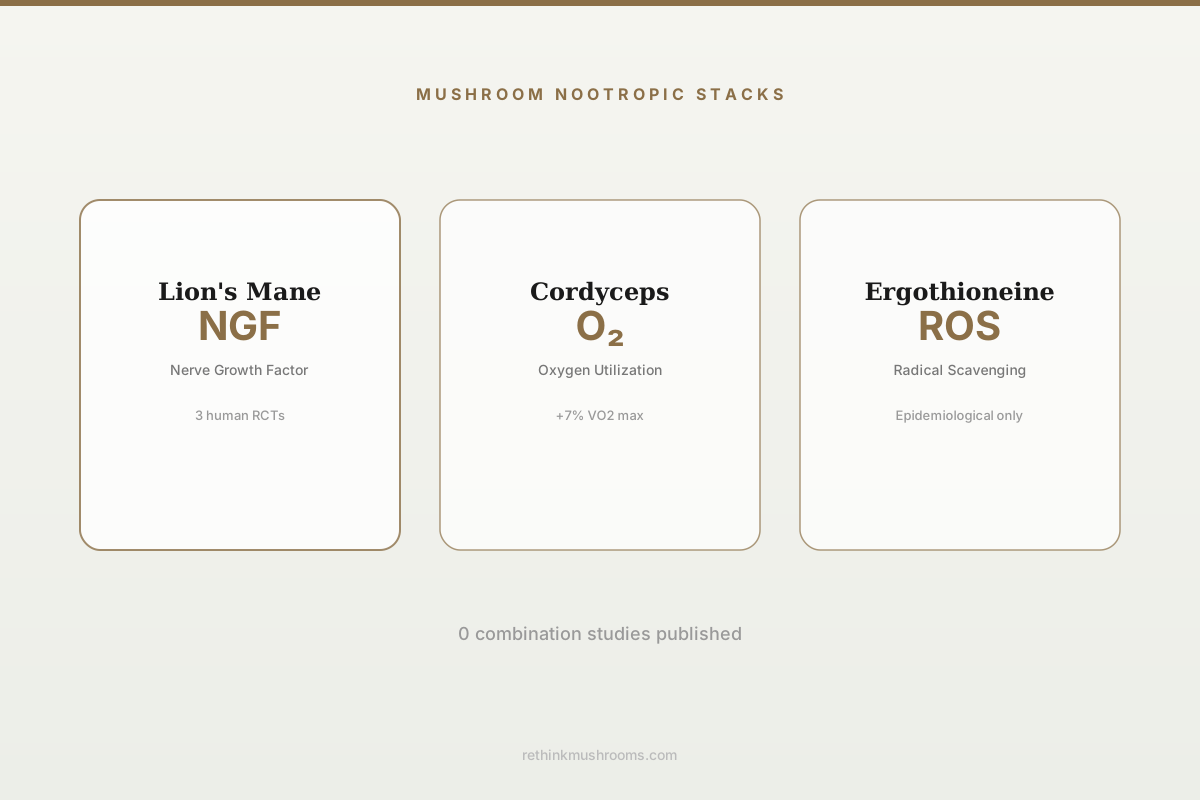
Lion's Mane promotes nerve growth factor synthesis, Cordyceps increases cellular oxygen utilization, and ergothioneine scavenges reactive oxygen species in brain tissue. Three distinct pathways, zero combination studies.
Mori et al., 2009; Chen et al., 2010; Cheah et al., 2016
NGF
stimulated by hericenones and erinacines
VO2 Max
improved 7% in elderly with Cordyceps Cs-4
0
human trials testing mushroom combinations
Mori et al., 2009; Chen et al., 2010; Cheah et al., 2016
 View as image ↗
The idea of a mushroom nootropic stack, combining Lion's Mane, Cordyceps, and ergothioneine-rich mushrooms for cognitive enhancement, is one of the most popular concepts in the functional mushroom space. The logic is appealing: Lion's Mane provides nerve growth factor stimulation, Cordyceps enhances oxygen delivery and cellular energy, and ergothioneine protects neurons from oxidative damage. Three complementary mechanisms targeting different aspects of brain function. The problem is that no published study has tested this combination. Every claim about synergistic mushroom stacks is extrapolated from research on individual species, and extrapolation is where nutritional science most often goes wrong. For a broader look at evidence-based mushroom combinations, see Best mushroom nootropic stacks: evidence-based combinations.
Key Takeaways
- Lion's Mane (Hericium erinaceus) improved cognitive function in a 16-week double-blind RCT in Japanese adults with mild cognitive impairment, with benefits reversing after supplementation stopped (Mori et al., 2009)
- A 2023 double-blind study found Lion's Mane improved stress and cognitive performance in healthy young adults after 28 days, with acute effects detectable at 60 minutes post-dose (Docherty et al., 2023)
- Cordyceps sinensis (Cs-4) improved VO2 max by 7% and ventilatory threshold by 8.5% in healthy older adults after 12 weeks of supplementation versus placebo (Chen et al., 2010)
- Blood ergothioneine levels decline after age 60 and correlate with cognitive decline in memory, executive function, and attention (Cheah et al., 2016)
- Mushrooms contain 0.4 to 2.0 mg/g dry weight of ergothioneine, with species variation spanning a 5-fold range (Kalaras et al., 2017)
- Zero published studies have tested Lion's Mane, Cordyceps, and ergothioneine in combination; all stack recommendations are extrapolated from individual-species research
Lion's Mane: The NGF Pathway
Lion's Mane (Hericium erinaceus) is the most studied mushroom for cognitive effects. Its mechanism centers on two compound families, hericenones (found in the fruiting body) and erinacines (found in the mycelium), both of which stimulate nerve growth factor (NGF) synthesis in cell and animal models.
Mori et al. (2009) conducted the foundational human trial: a 16-week, double-blind, placebo-controlled study in 30 Japanese adults (ages 50-80) diagnosed with mild cognitive impairment. Participants receiving 250 mg tablets of Lion's Mane powder three times daily (750 mg/day of powdered fruiting body) showed significant improvement on the Revised Hasegawa Dementia Scale compared to placebo at weeks 8, 12, and 16.[1]
The study included a critical detail: cognitive scores declined after supplementation stopped at week 16, returning toward baseline by week 20. This suggests Lion's Mane's cognitive effects require continued intake rather than producing lasting neurological changes. It also argues against a pure placebo explanation, since placebo effects typically persist after treatment ends rather than reversing on a predictable timeline.
Saitsu et al. (2019) provided partial replication in 31 healthy Japanese adults (ages 50+). Oral Lion's Mane intake for 12 weeks improved cognitive function scores, though the study design had methodological limitations including a small sample size.[2]
Docherty et al. (2023) extended the evidence to younger, healthy adults. In a double-blind, parallel-groups pilot study, Lion's Mane supplementation for 28 days reduced subjective stress and improved cognitive performance compared to placebo. The study also detected acute effects at 60 minutes post-dose, suggesting both immediate and cumulative mechanisms.[3]
Surendran et al. (2025) further confirmed acute cognitive effects of a standardized Lion's Mane extract in a controlled setting, providing additional evidence for rapid-onset nootropic activity beyond the chronic supplementation timeframe.[4]
The human evidence for Lion's Mane is stronger than for most mushroom nootropics, but remains preliminary. All studies are small (30-50 participants), short (8-28 weeks), and conducted across different populations, doses, and preparations. The NGF mechanism is well-established in cell and animal models but has not been directly confirmed in humans (measuring NGF in the human brain is invasive and rarely done).
Cordyceps: The Oxygen and Energy Pathway
Cordyceps approaches cognitive enhancement from the opposite direction: rather than acting directly on neurons, it targets cellular energy production and oxygen delivery, which secondarily affect brain function.
Chen et al. (2010) conducted a 12-week, double-blind, placebo-controlled trial of Cs-4 (Cordyceps sinensis extract) in 20 healthy older adults (ages 50-75). The Cordyceps group showed a 7% improvement in maximal oxygen consumption (VO2 max) and an 8.5% improvement in ventilatory threshold compared to placebo.[5]
These are exercise performance metrics, not cognitive outcomes. The relevance to nootropic stacking is indirect: the brain consumes approximately 20% of the body's oxygen despite comprising only 2% of body mass. Improvements in oxygen delivery and utilization could theoretically enhance cognitive function, particularly under conditions of fatigue or sustained mental effort. This is plausible but unproven in the specific context of cognitive performance.
Hirsch et al. (2017) demonstrated that Cordyceps militaris improved tolerance to high-intensity exercise after both acute (single dose) and chronic (3-week) supplementation in young adults.[6] Song et al. (2015) documented anti-fatigue activities of Cordyceps militaris extract in mouse models, showing increased endurance swimming time and reduced fatigue biomarkers.[7]
Cordycepin (3'-deoxyadenosine), the primary bioactive in Cordyceps militaris, also shows neuroprotective properties. Zhang et al. (2021) demonstrated that natural cordycepin reduced neuroinflammation and protected dopaminergic neurons in a rotenone-induced Parkinson's disease model, acting through anti-inflammatory mechanisms independent of its metabolic effects.[8]
The Cordyceps evidence is thus split between two pathways: a metabolic/oxygen pathway supported by human exercise trials, and a neuroprotective/anti-inflammatory pathway supported only by animal models. Both could contribute to cognitive enhancement, but neither has been tested as a cognitive intervention in humans. For related research on Cordyceps timing and dosing, see Best time to take Cordyceps: morning, pre-workout, or evening?.
Ergothioneine: The Neuroprotective Antioxidant
Ergothioneine adds a third mechanism: selective antioxidant protection in tissues with high oxidative stress. Unlike general antioxidants (vitamin C, vitamin E), ergothioneine accumulates specifically in tissues expressing the SLC22A4 transporter, which includes the brain, red blood cells, and kidneys.
Cheah et al. (2016) documented that whole blood ergothioneine levels decline in humans after age 60. In their elderly cohort, lower ergothioneine levels were associated with faster cognitive decline across memory, executive function, attention, visuomotor speed, and language domains.[9]
Kalaras et al. (2017) measured ergothioneine content across 13 mushroom species, finding concentrations ranging from 0.4 to 2.0 mg/g dry weight. Porcini mushrooms contained the highest levels. King oyster, maitake, and shiitake also ranked among richer sources. White button mushrooms contained lower but measurable amounts.[10]
The ergothioneine evidence is epidemiological, not interventional. Lower levels correlate with worse cognitive outcomes, and mushrooms are the primary dietary source, but no study has tested whether increasing ergothioneine intake through mushroom consumption or supplementation improves cognition in humans. The correlation-causation gap remains wide. For a detailed examination of ergothioneine and mortality data, see Blood ergothioneine levels and all-cause mortality risk.
The Combination Gap
The fundamental problem with mushroom nootropic stacks is the absence of combination research. The rationale for stacking is based on complementary mechanisms:
| Component | Primary Mechanism | Evidence Level | Cognitive Data |
|---|---|---|---|
| Lion's Mane | NGF stimulation via hericenones/erinacines | 3 small human RCTs | Direct cognitive improvement measured |
| Cordyceps | Oxygen utilization, cellular ATP, anti-neuroinflammation | Human exercise trials + animal neuro studies | Cognitive effects inferred, not measured |
| Ergothioneine | Selective ROS scavenging in brain tissue via SLC22A4 | Epidemiological correlation | Decline correlates with cognitive decline |
The theoretical case for combining these three is reasonable. NGF stimulation (growth), improved oxygen/energy supply (fuel), and antioxidant protection (defense) target non-overlapping aspects of neuronal health. If each contributes independently, a combination should produce additive benefits.
But biological systems regularly violate additive logic. Compounds can compete for absorption, alter each other's metabolism, produce overlapping downstream effects that plateau rather than sum, or interact in ways that cancel beneficial mechanisms. Without combination data, any claimed synergy is speculation.
The practical reality is that most commercial mushroom nootropic stacks contain all three ingredients at doses lower than those used in the individual studies cited above. Mori et al. (2009) used 750 mg/day of Lion's Mane powder. Chen et al. (2010) used 1,050 mg/day of Cs-4 extract. Many combination supplements provide 200-300 mg per ingredient, well below the studied doses.
Dose and Preparation Variables
The commercial mushroom nootropic market introduces additional uncertainty through wide variation in product formulation. Products differ in whether they use fruiting body, mycelium, or mycelium-on-grain (which dilutes active compounds with starch substrate). They differ in extraction method: hot water extraction concentrates polysaccharides, ethanol extraction concentrates terpenoids and hericenones, and dual extraction captures both. Unextracted powders deliver compounds in their native matrix but at lower concentrations.
For Lion's Mane specifically, the distinction between fruiting body and mycelium matters for the nootropic application. Hericenones are concentrated in the fruiting body, while erinacines are concentrated in the mycelium. Both stimulate NGF, but through different molecular pathways. A product using only fruiting body extract may contain hericenones but minimal erinacines, and vice versa. The Mori et al. (2009) study used whole fruiting body powder, not a standardized extract.[1]
For Cordyceps, the distinction between C. sinensis and C. militaris matters. The Chen et al. (2010) exercise study used Cs-4, a fermented mycelium of C. sinensis.[5] The Hirsch et al. (2017) study used C. militaris.[6] C. militaris contains significantly more cordycepin than C. sinensis, but C. sinensis has the longer traditional use history and more clinical data. Most commercial supplements use C. militaris because wild C. sinensis is prohibitively expensive and Cs-4 fermentation is proprietary.
Ergothioneine content depends entirely on mushroom species and growing conditions. A supplement claiming to provide ergothioneine from a mushroom blend may deliver anywhere from trace amounts to meaningful doses depending on species selection, growing substrate, and extraction. Without standardization to specific ergothioneine content, the neuroprotective component of a stack is the least controllable variable.
What the Evidence Supports
Taken individually, the evidence for each component ranges from "preliminary but promising" (Lion's Mane cognitive trials) to "mechanistically plausible but unproven in humans" (Cordyceps for cognition, ergothioneine supplementation for neuroprotection).
Lion's Mane has the strongest direct cognitive evidence: replicated improvements in mild cognitive impairment and healthy adults, with a reversibility pattern that argues against pure placebo. The acute effects documented by Docherty et al. (2023) and Surendran et al. (2025) suggest a genuine pharmacological signal.
Cordyceps has strong evidence for physical performance and preliminary evidence for neuroprotection, but no direct cognitive trials. The leap from "improves VO2 max" to "improves thinking" requires assumptions about how systemic metabolic improvements translate to neural function.
Ergothioneine has epidemiological associations linking blood levels to cognitive health, but the intervention evidence is absent. Eating more mushrooms correlates with better cognitive aging, but the causal agent (or agents) within mushrooms has not been isolated.
For the broader landscape of how mushrooms compare to synthetic cognitive enhancers, see Mushroom nootropics vs. synthetic nootropics: how they compare. For research on stress adaptation effects that complement cognitive enhancement, see Adaptogenic mushrooms for stress: reishi, Cordyceps, and the HPA axis.
The Bottom Line
Lion's Mane, Cordyceps, and ergothioneine target three distinct biological mechanisms relevant to brain function: nerve growth factor stimulation, cellular oxygen utilization, and selective antioxidant protection. Each has some evidence supporting its individual role, with Lion's Mane having the strongest direct cognitive data from small human trials. No published study has tested any two- or three-component mushroom nootropic combination, making all synergy claims extrapolation rather than evidence.
Frequently Asked Questions
Sources & References
- 1RTHM-00165·Mori, Koichiro et al. (2009). “Improving effects of the mushroom Yamabushitake (Hericium erinaceus) on mild cognitive impairment: a double-blind placebo-controlled clinical trial..” Phytotherapy research : PTR.Study breakdown →PubMed →↩
- 2RTHM-00585·Saitsu, Yuusuke et al. (2019). “Improvement of cognitive functions by oral intake of Hericium erinaceus..” Biomedical research (Tokyo.Study breakdown →PubMed →↩
- 3RTHM-00821·Docherty, Sarah et al. (2023). “The Acute and Chronic Effects of Lion's Mane Mushroom Supplementation on Cognitive Function, Stress and Mood in Young Adults: A Double-Blind, Parallel Groups, Pilot Study..” Nutrients.Study breakdown →PubMed →↩
- 4RTHM-00952·Surendran, Geyan et al. (2025). “Acute effects of a standardised extract of Hericium erinaceus (Lion's Mane mushroom) on cognition and mood in healthy younger adults: a double-blind randomised placebo-controlled study..” Frontiers in nutrition.Study breakdown →PubMed →↩
- 5RTHM-00176·Chen, Steve et al. (2010). “Effect of Cs-4 (Cordyceps sinensis) on exercise performance in healthy older subjects: a double-blind, placebo-controlled trial..” Journal of alternative and complementary medicine (New York.Study breakdown →PubMed →↩
- 6RTHM-00473·Hirsch, Katie R et al. (2017). “Cordyceps militaris Improves Tolerance to High-Intensity Exercise After Acute and Chronic Supplementation..” Journal of dietary supplements.Study breakdown →PubMed →↩
- 7RTHM-00401·Song, Jingjing et al. (2015). “Studies on the Antifatigue Activities of Cordyceps militaris Fruit Body Extract in Mouse Model..” Evidence-based complementary and alternative medicine : eCAM.Study breakdown →PubMed →↩
- 8RTHM-00735·Zhang, Xiao-Ling et al. (2021). “Anti-inflammatory and neuroprotective effects of natural cordycepin in rotenone-induced PD models through inhibiting Drp1-mediated mitochondrial fission..” Neurotoxicology.Study breakdown →PubMed →↩
- 9RTHM-00420·Cheah, Irwin K et al. (2016). “Ergothioneine levels in an elderly population decrease with age and incidence of cognitive decline; a risk factor for neurodegeneration?.” Biochemical and biophysical research communications.Study breakdown →PubMed →↩
- 10RTHM-00476·Kalaras, Michael D et al. (2017). “Mushrooms: A rich source of the antioxidants ergothioneine and glutathione..” Food chemistry.Study breakdown →PubMed →↩