Adaptogenic Mushrooms for Stress
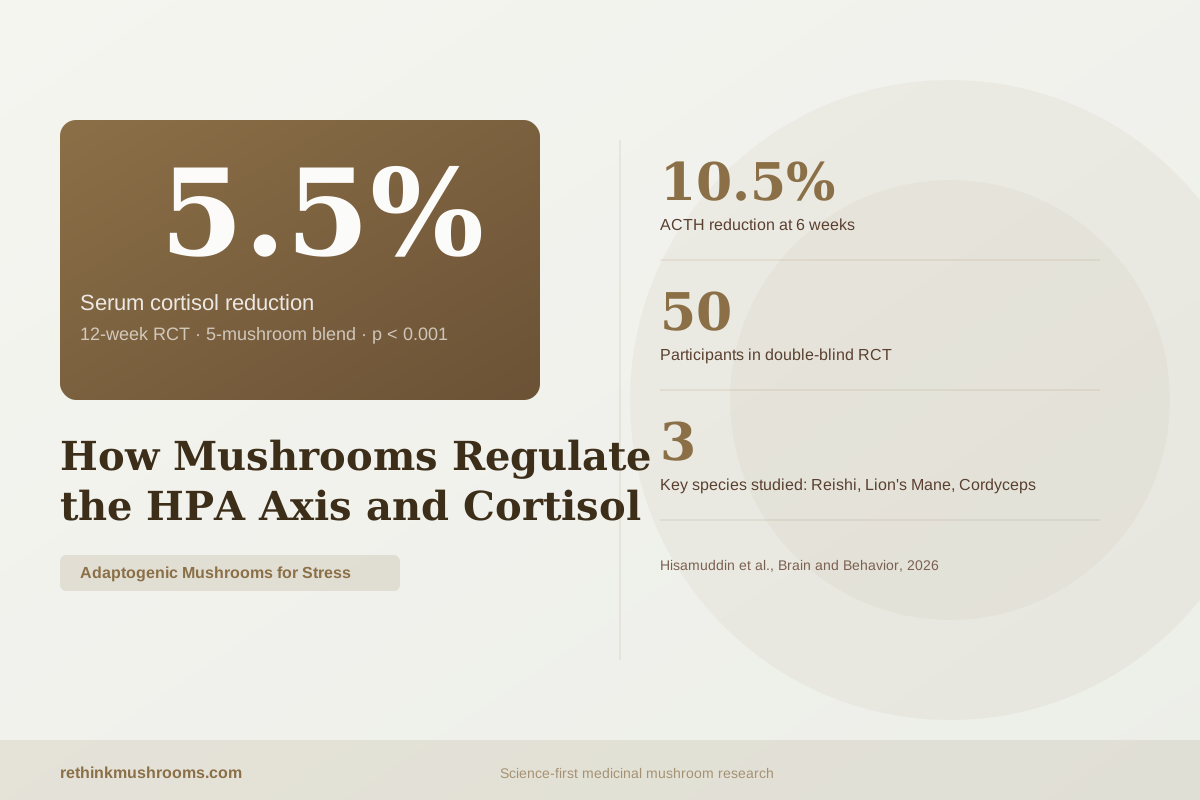
5.5% cortisol
A 12-week double-blind trial found a five-mushroom blend reduced serum cortisol by 5.5% and the pituitary signaling hormone ACTH by 8.1%. It remains the only human RCT to measure mushroom-driven HPA axis hormones directly, it tested five species at once, and it was funded by the supplement's manufacturer.
Hisamuddin et al., Brain and Behavior, 2026
10.5%
ACTH reduction at week 6, the largest hormone shift recorded
+0.8%
cortisol change in the placebo arm over the same 12 weeks
5
species in the blend, so no effect can be traced to one mushroom
Hisamuddin et al., Brain and Behavior, 2026
 View as image ↗
When the body perceives a threat, a three-gland cascade fires in sequence: the hypothalamus releases corticotropin-releasing hormone, the pituitary responds with ACTH, and the adrenal glands flood the bloodstream with cortisol. This is the hypothalamic-pituitary-adrenal (HPA) axis, the body's central stress regulatory system. When it stays activated too long, the downstream consequences range from disrupted sleep to immune dysregulation. Adaptogenic mushrooms, particularly reishi, lion's mane, and cordyceps, are frequently promoted as HPA axis modulators. Until recently, that claim rested almost entirely on animal data and theoretical mechanisms. A 2026 randomized controlled trial changed the evidence picture, at least partially. This article examines what that trial found, what species-specific research shows, where the evidence holds up, and where it does not.
This piece is part of a broader series on adaptogenic mushrooms for stress. For a species comparison across the full stress category, see best mushrooms for stress relief.
Key Takeaways
- A 12-week double-blind RCT found a five-mushroom blend reduced serum cortisol by 5.5% and ACTH by 8.1%, both significant against placebo at p < 0.001 (Hisamuddin et al., 2026)
- In absolute terms that cortisol change was 169.0 to 162.6 ng/mL, while the placebo arm barely moved (+0.8%), so the effect is real but small
- That trial was funded by the company that makes and supplied the supplement, which does not invalidate it but does warrant the usual caution applied to manufacturer-funded research
- ACTH fell 10.5% at the six-week mark, suggesting the effect begins upstream at the pituitary level before continuing through week 12
- Lion's mane extract protected PC-12 neurons against high-dose corticosterone-induced oxidative stress in vitro, through adenosine and herierin III compounds (Lew et al., 2020)
- Cordyceps sinensis extract actually stimulates corticosteroid synthesis in rat adrenal cells via PKC activation, a mechanistically distinct effect from cortisol reduction (Wang et al., 1998)
- A 4-week trial in 30 menopausal women found lion's mane cookies lowered depression scores versus each woman's own baseline; only two symptom subscales beat placebo directly (Nagano et al., 2010)
- Every human trial to date has used mushroom blends, making it impossible to attribute HPA effects to any single species
What the HPA Axis Is and Why Dysregulation Matters
The HPA axis operates as a feedback loop. Under stress, the hypothalamus releases corticotropin-releasing hormone (CRH). CRH travels to the anterior pituitary, which secretes adrenocorticotropic hormone (ACTH). ACTH enters circulation and signals the adrenal cortex to produce cortisol. Cortisol then feeds back to inhibit both the hypothalamus and pituitary, dampening further CRH and ACTH release. This negative feedback is what keeps the system self-limiting under acute stress.
Chronic stress breaks this regulation. Persistent cortisol elevation eventually blunts the sensitivity of glucocorticoid receptors in the hippocampus and hypothalamus, impairing the feedback mechanism. The HPA axis can become tonically hyperactive, generating cortisol at elevated baseline levels even without acute stressors.[8]
The consequences are broad. Chronically elevated cortisol is associated with impaired declarative memory, immune suppression, disrupted sleep architecture, and accelerated cellular aging. In some depressive subtypes, HPA hyperactivity is considered a primary pathophysiological driver rather than a secondary feature.[8]
Understanding this pathway matters for evaluating mushroom research because different interventions could theoretically act at different points: reducing CRH release from the hypothalamus, blunting pituitary ACTH output, protecting against cortisol-induced cellular damage, or restoring glucocorticoid receptor sensitivity.
Evidence reach · by cascade step
Where mushrooms are said to act — and what actually supports each claim
The cascade itself is settled physiology. The mushroom-specific arrows into it are not: the only human trial that measured these hormones tested five species at once, so its two arrows cannot be assigned to any single mushroom.
HypothalamusCRH
releases corticotropin-releasing hormone
Lower inflammatory drive on CRH releaseCell / animal onlyReishi triterpenes·Meta-analysis of 23 preclinical studies; no human data
Restore serotonergic feedback via 5-HTPMechanistically inferredEdible mushrooms generally·Review-level proposal, untested in humans
PituitaryACTH
releases adrenocorticotropic hormone
Reduce ACTH outputHuman trial (blend only)Five-species blend·−10.5% at week 6, −8.1% at week 12 (n = 50)
Adrenal cortexCortisol
releases cortisol
Reduce circulating cortisolHuman trial (blend only)Five-species blend·−5.5% at week 12 vs +0.8% placebo (n = 50)
Directly stimulate steroidogenesis via PKCCell / animal onlyCordyceps sinensis·Isolated rat adrenal cells; opposite direction
Protect neurons from cortisol-driven oxidative damageCell / animal onlyLion's mane·PC-12 cells at 400 µM corticosterone
Cortisol also feeds back onto the hypothalamus and pituitary to shut the cascade down. No mushroom study to date has measured whether supplementation restores that feedback sensitivity, which is the step most directly implicated in chronic stress.
Sources: Hisamuddin et al. (2026); Lew et al. (2020); Wang et al. (1998); Pozzobon et al. (2026); Fijałkowska et al. (2022).
The Adaptogenic Framework and Its Molecular Basis
The term "adaptogen" originated in Soviet pharmacology in the 1940s and was defined operationally: substances that increase the body's nonspecific resistance to stress without disrupting normal biological function. Contemporary research has clarified some of the molecular mechanisms behind this effect.[6]
A key mechanism involves heat shock protein 70 (Hsp70), a molecular chaperone that plays a central role in cellular stress survival. Adaptogenic compounds appear to upregulate Hsp70 expression, which in turn inhibits the nitric oxide synthase II gene and interacts with glucocorticoid receptors through the JNK pathway. The net effect is modulation of circulating cortisol and nitric oxide levels. Prevention of stress-induced nitric oxide rise correlates with preserved ATP production and reduced fatigue.[7]
Panossian et al. (2021) describe a biphasic dose-response characteristic of adaptogens: at low doses they function as mild stress-mimetics, activating adaptive stress-response signaling pathways that build resilience over time.[6] The specific mediators named in this literature, including the forkhead transcription factor DAF-16 and stress-activated JNK1 alongside Hsp70, cortisol, and nitric oxide, come from the earlier mechanistic review.[7] The proposed distinction is from anxiolytic drugs, which suppress stress responses acutely without building underlying capacity.
An important caveat travels with this entire framework: it was built on botanical adaptogens, and the clinical evidence Panossian graded as strong was for Rhodiola rosea, Schisandra chinensis, and Eleutherococcus senticosus.[7] None of it was mushroom evidence.
Medicinal mushrooms are considered part of the broader adaptogen category, though the mechanistic literature on mushrooms is considerably thinner than the literature on botanical adaptogens like Rhodiola and Eleutherococcus.
The Only Human Trial Measuring Cortisol Directly
In January 2026, Hisamuddin et al. published a randomized, double-blind, placebo-controlled trial in Brain and Behavior examining a proprietary five-mushroom blend called Restake.[1] The blend contained Hericium erinaceus (lion's mane), Cordyceps militaris, Ganoderma lucidum (reishi), Lentinula edodes (shiitake), and Grifola frondosa (maitake).
Fifty moderately to severely stressed adults were randomized to Restake or placebo for 12 weeks, with assessments at baseline, 6 weeks, and 12 weeks. Serum biomarkers measured by ELISA included cortisol, ACTH, norepinephrine, melatonin, and CRP.
Hisamuddin et al. (2026) · Brain and Behavior
- Population
- 50 moderately to severely stressed adults, Klang Valley, Malaysia
- Intervention
- Restake, a five-species blend (lion's mane, Cordyceps militaris, reishi, shiitake, maitake), 2 capsules daily for 12 weeks
- Comparator
- Matched placebo, double-blind
- Finding
- Serum cortisol fell 5.5% and ACTH 8.1% from baseline by week 12, against a placebo arm that moved +0.8% and −0.2%. Anxiety, depression, fatigue, and sleep scores also improved more than placebo.
preliminary Real between-group separation on a pre-specified primary biomarker, but a single small trial of a five-species blend, funded by the manufacturer and never replicated.
Hisamuddin et al. (2026), Brain and Behavior, Tables 1–2
The cortisol findings separated from placebo: the Restake group showed a 4.4% reduction by week 6 and a 5.5% reduction by week 12. ACTH fell 10.5% at week 6 and 8.1% at week 12. The p < 0.001 figures attached to both hormones come from the between-group comparison of percent change from baseline; the within-group trajectory for cortisol was more modest (p = 0.007 by repeated-measures ANOVA), while ACTH was significant within group as well (p < 0.001). The fact that ACTH reduction was larger at week 6 than week 12 while cortisol reduction continued to grow is an interesting asymmetry, possibly indicating early pituitary-level effects followed by downstream adrenal changes. The study did not test for this mechanistic explanation.
Measured values · 2026 RCT
What the cortisol and ACTH numbers actually looked like
The percentage headline is real, but small. Plotting the measured concentrations shows the active arm moving while the placebo arm stayed flat — which is what makes the between-group difference credible, even though the shift itself is modest.
Serum cortisol
ng/mL · between-group change p < 0.001
ACTH
pg/mL · between-group change p < 0.001
Read the axis carefully: the y-axis is zoomed to the observed range, not anchored at zero, so a change of a few ng/mL fills a large share of the panel. In absolute terms the Restake arm’s mean cortisol moved from 169.0 to 162.6 ng/mL over 12 weeks. Within-group p-values come from repeated-measures ANOVA; the between-group p-value compares percent change from baseline across arms (independent-samples t-test). n = 50 total, randomised, double-blind, placebo-controlled.
Source: Hisamuddin et al. (2026), Brain and Behavior, Table 2. Trial funded by the supplement manufacturer.
The placebo arm is the most useful comparison in the whole trial. Its cortisol was essentially unchanged across 12 weeks (168.8 to 168.9 ng/mL, p = 0.980) and its ACTH barely moved (p = 0.330). A flat placebo arm on the hormone measures is what makes the active-arm change credible rather than a regression-to-the-mean artifact. On the questionnaires, though, the placebo group improved substantially on its own: perceived stress fell 10.1% and Hamilton anxiety scores fell 13.1% without any active ingredient. The Restake group beat those numbers (17.8% and 33.5% respectively), but the size of the placebo response is a reminder of how much of a stress intervention's felt benefit is expectation.
Secondary outcomes were also favorable: anxiety scores (STAI-S, HAM-A) improved at both timepoints, depression scores (BDI) improved, and sleep quality (PSQI) improved. CRP fell (p = 0.042), suggesting a parallel anti-inflammatory effect.
The central limitation is the blend design. With five species combined, there is no statistical or mechanistic way to attribute the cortisol and ACTH changes to any one ingredient. It is not possible to determine whether all five species contributed, whether one drove the effect, or whether the combination creates a synergistic effect that no single species would produce. Every conclusion about "which mushroom reduces cortisol" in the existing human literature is extrapolated from studies where species were never isolated.
The second limitation is one the article you are reading should state plainly: the trial was funded by NexusWise Sdn Bhd, the company that makes Restake, and the same company supplied the product used in the study.[1] This is disclosed in the paper and is entirely normal for supplement research, where almost no other funding source exists. It does not make the results wrong, and the design features that matter most, randomization, double-blinding, a matched placebo, and pre-specified biomarker endpoints, were all in place. It does mean the finding carries the weight of a manufacturer-funded single trial rather than that of independently replicated evidence, and industry-funded nutrition trials report favorable results more often than independent ones. The appropriate response is to treat the result as a promising first measurement awaiting independent replication, not as a settled fact.
Interpreting it also depends on a detail the trial could not control: the composition of Restake itself is proprietary. Without published per-species doses, even a reader who wanted to replicate the protocol with individual mushrooms would not know what quantities to use.
Lion's Mane: Neuroprotection Against the Cortisol Cascade
Lion's mane (Hericium erinaceus) has the most human clinical data of any single mushroom species in the stress and mood category, though the studies remain small and exploratory.
The mechanistic foundation for lion's mane and cortisol-related pathways comes from a 2020 in vitro study by Lew et al.[3] PC-12 cells, a rat neuronal cell line used as a model of corticosterone-induced stress, were exposed to 400 micromolar corticosterone to simulate glucocorticoid excess. Pre-treatment with a standardized lion's mane aqueous extract (HESAE) at concentrations of 0.25 to 1 mg/mL significantly reversed the damage. HESAE restored cell viability, reduced LDH release (a marker of cell death), enhanced superoxide dismutase and catalase activity, restored mitochondrial membrane potential, and reduced intracellular reactive oxygen species. Two compounds isolated from HESAE, adenosine and herierin III, were identified as likely contributors to the neuroprotective effect.
This study demonstrates that lion's mane compounds can protect neurons against the downstream consequences of cortisol excess. It does not demonstrate that lion's mane reduces cortisol production in humans.
On the clinical side, two small trials provide evidence of mood and stress effects. Nagano et al. (2010) enrolled 30 women, recruited for a study of menopausal symptoms, and randomized them to lion's mane cookies or placebo cookies for 4 weeks.[4] The comparison structure here is worth reading carefully, because it is frequently reported inaccurately. Scores on the CES-D depression scale and the Indefinite Complaints Index fell significantly after lion's mane intake relative to each participant's own pre-treatment baseline. The head-to-head comparison against placebo was narrower: only two Indefinite Complaints subscales, "insentive" (a Japanese term approximating emotional numbness) and "palpitatio" (heart palpitations), were significantly lower in the lion's mane group than in the placebo group, with "concentration," "irritating," and "anxious" merely trending in that direction. So the trial supports a mood effect, but the strongest numbers in it are before-and-after comparisons, which in a 4-week study of 30 people cannot be separated from natural fluctuation. The authors noted that the mechanism appeared distinct from lion's mane's known NGF-stimulating action, suggesting a separate pathway exists.
Docherty et al. (2023) enrolled 41 healthy young adults in a parallel-groups, double-blind pilot comparing 1.8 g lion's mane to placebo over 28 days.[2] The primary findings were an acute improvement in processing speed on the Stroop task at 60 minutes post-dose (p = 0.005) and a trend toward reduced subjective stress at day 28 (p = 0.051). The stress effect did not reach conventional statistical significance. The authors appropriately flagged the small sample size as a limiting factor and characterized the findings as preliminary.
Together, these studies suggest lion's mane has biological activity relevant to stress pathways, but the evidence for direct HPA axis modulation in humans is thin.
For a deeper look at the reishi side of this pairing, see adaptogenic mushrooms for stress: reishi, cordyceps, and the HPA axis.
Cordyceps: A Surprising Finding About Adrenal Function
The common framing of cordyceps in the stress space is that it modulates stress response and reduces stress markers. A 1998 study by Wang et al. complicates that framing in an important way.[5]
Using primary rat adrenal cortex cell cultures, Wang et al. found that a water-soluble Cordyceps sinensis extract stimulated corticosterone production in a dose-dependent manner, reaching maximum effect at 25 micrograms per milliliter. The effect appeared within 1 hour of treatment and persisted for 24 hours. Crucially, the mechanism was independent of ACTH signaling: intracellular cAMP levels did not rise in response to Cordyceps (cAMP elevation is the classic ACTH-driven pathway). Instead, the effect was blocked by calphostin C, a protein kinase C (PKC) inhibitor, indicating that Cordyceps activates steroidogenesis through a PKC-dependent mechanism.
This is mechanistically the opposite of reducing cortisol. Cordyceps stimulates adrenal steroid synthesis directly, bypassing the upstream HPA signaling.
How to reconcile this with the clinical evidence showing stress improvement when Cordyceps is part of a blend? The context matters. The Wang 1998 study used isolated adrenal cells under controlled in vitro conditions. In a chronically stressed individual with adrenal fatigue or blunted cortisol response, stimulating adrenal steroid synthesis might actually normalize rather than elevate cortisol. The same compound could have different net effects depending on baseline adrenal function.
This does not mean the clinical outcomes from the Hisamuddin 2026 blend were driven by Cordyceps. The Cordyceps contribution could have been minimal relative to reishi or lion's mane in that formulation. The point is that the mechanism is not unidirectionally "cortisol-lowering" across all contexts.
Cordyceps also appears relevant to endurance and VO2max research, where its effects on mitochondrial energy metabolism may interact with HPA axis function during sustained physical stress.
Reishi and the Neuroinflammatory Connection
Reishi (Ganoderma lucidum) is the species most frequently associated with stress relief in traditional use and in contemporary supplement marketing. The human clinical data on reishi and cortisol specifically is limited, but the mechanistic picture involves two converging pathways: anti-inflammatory effects and serotonergic precursor activity.
Triterpene compounds in reishi, particularly ganoderic acids, inhibit NF-kB signaling, a central mediator of inflammatory gene expression. A 2026 systematic review and meta-analysis pooled 23 preclinical studies of Ganoderma lucidum triterpenes and found consistent reductions in TNF-alpha, IL-6, and nitric oxide, primarily through downregulation of the MAPK and TLR-4/NF-kB pathways.[10] That review is worth quoting precisely on its scope: it excluded clinical trials by design, so it establishes the mechanism in cells and animals and says nothing about humans.
This is relevant to HPA axis function because inflammation and the stress axis are bidirectionally linked. A systemic inflammatory response activates the HPA axis as one of its downstream programs, and stress hormones can in turn promote production of IL-1, IL-6, and TNF-alpha and activate CRH signaling, so each arm can drive the other.[11] An anti-inflammatory intervention that breaks this cycle could in principle reduce HPA axis activity indirectly, without acting on cortisol production directly. No study has yet demonstrated that reishi does this in a living human.
Fijałkowska et al. (2022) reviewed the neuroendocrine connection between stress and serotonergic transmission, noting that chronic HPA hyperactivity reduces serotonin receptor sensitivity.[8] Medicinal mushrooms, including reishi, contain 5-hydroxy-L-tryptophan (5-HTP), a direct serotonin precursor. If mushroom-derived 5-HTP contributes to serotonin availability, this could help restore HPA negative feedback through the serotonergic modulation of CRH release.
Lazur et al. (2023) further characterize the antidepressant mechanisms of medicinal mushrooms as multifactorial: anti-neuroinflammatory effects, antioxidant activity, BDNF modulation, neurogenesis support, and gut-brain axis influences all converge to affect mood and stress regulatory systems.[9] Population-level data suggests mushroom consumption is associated with lower odds of depression, though causality cannot be established from epidemiological patterns.
For the complete reishi evidence review, including sleep and immune data, see reishi for stress: the calming mushroom research review.
What the Evidence Can and Cannot Tell Us
The overall evidence picture for mushrooms and the HPA axis has several structural limitations worth understanding directly.
Fact Check
“Mushrooms lower your cortisol”
The claim
“Adaptogenic mushrooms like reishi and lion's mane lower cortisol and rebalance the HPA axis.”
Extrapolated from a botanical adaptogen framework built on Rhodiola and Eleutherococcus, then applied to mushrooms in supplement marketing well before any mushroom trial measured a stress hormone.
What research shows
OverstatedExactly one randomized trial has measured cortisol and ACTH after mushroom supplementation. It found reductions of 5.5% and 8.1% over 12 weeks against a flat placebo arm. It tested five species simultaneously and was funded by the product's manufacturer.
The claim is directionally supported at the level of 'a mushroom blend', and unsupported at the level of any named species. Cordyceps, in isolated adrenal cells, stimulates steroid production rather than suppressing it, so the category is not even uniform in direction.
Hisamuddin et al. (2026); Wang et al. (1998); Panossian et al. (2009)
Blend designs dominate the literature. The only human RCT to directly measure cortisol and ACTH used a five-species blend.[1] There are no published randomized controlled trials isolating a single mushroom species and measuring serum cortisol as a primary endpoint.
Sample sizes are small. The Nagano 2010 trial had 30 participants.[4] The Docherty 2023 pilot enrolled 41.[2] Neither was powered to detect small effect sizes reliably, and neither measured cortisol biomarkers directly.
In vitro findings have limited translational value. The Lew 2020 corticosterone protection findings were in PC-12 cells, not human neurons.[3] The Wang 1998 steroidogenesis findings were in isolated rat adrenal cells.[5] Neither can be used to predict what happens to HPA axis hormones in a living human taking mushroom supplements.
Population specificity matters. The Hisamuddin 2026 trial enrolled moderately to severely stressed adults.[1] Effects in low-stress populations may differ. The Nagano 2010 trial enrolled women going through menopause, a period with its own hormonal dynamics.[4]
Cortisol measurement methodology varies. Serum cortisol (used in Hisamuddin 2026), salivary cortisol, and urinary free cortisol measure different things at different points in the diurnal cycle. Studies using different measurement approaches are difficult to compare directly.
The pivotal trial is manufacturer-funded and unreplicated. The single study carrying the entire human evidence base for this topic was funded by the company selling the product it tested.[1] No independent group has repeated it. In a literature this thin, one industry-funded trial is a starting point, not a conclusion.
- Cell studiescompleted
Lion's mane protects PC-12 neurons from corticosterone damage; Cordyceps stimulates steroidogenesis in rat adrenal cells; reishi triterpenes suppress NF-kB inflammatory signaling
- Animal studiescompleted
Reishi triterpene anti-inflammatory effects confirmed in vivo across rodent models in a 23-study meta-analysis
- Case reportsmissing
Not a meaningful step for this question
- Small human trialscurrent
One 50-person RCT measured cortisol and ACTH, using a five-species blend, funded by the manufacturer. Two other small trials measured mood and stress but never measured a hormone
- Large RCTsmissing
No adequately powered trial exists, and none isolating a single species with cortisol as the primary endpoint
- Meta-analysis of human trialsmissing
Impossible at present: there is only one human trial with hormone endpoints to pool
The mechanistic tiers are well populated and the human tier is nearly empty. A single small manufacturer-funded blend trial is the entire clinical evidence base for mushrooms and HPA axis hormones, which is why no species-level claim can be supported.
Hisamuddin et al. (2026); Docherty et al. (2023); Nagano et al. (2010); Lew et al. (2020); Wang et al. (1998); Pozzobon et al. (2026)
The adaptogenic concept itself remains scientifically contested. Panossian et al. (2009) documented strong evidence for specific plant adaptogens (Rhodiola, Schisandra, Eleutherococcus) but the transfer of that mechanistic framework to medicinal mushrooms requires its own evidence base, which is still being built.[7]
How the Mechanisms Fit Together
The current evidence suggests at least three non-exclusive pathways through which medicinal mushrooms might affect HPA axis function.
The first is upstream modulation via Hsp70 and glucocorticoid receptor effects, described for botanical adaptogens and proposed to extend to fungal ones. This pathway could affect cortisol at the level of receptor sensitivity rather than production.[7]
The second is indirect HPA dampening through neuroinflammation reduction. By reducing NF-kB-driven inflammatory cytokine production, triterpene-containing mushrooms may reduce the inflammatory signals that drive CRH release.[9]
The third is neuroprotection against glucocorticoid-induced oxidative stress. Even if cortisol levels remain elevated, compounds that protect hippocampal and prefrontal neurons from glucocorticoid damage could preserve the negative feedback sensitivity that keeps the HPA axis from chronic hyperactivation.[3]
These pathways are not mutually exclusive, and they may operate simultaneously at different points in the HPA axis cascade. Understanding them separately matters because different species appear to have different primary mechanisms, which makes blend-based trials difficult to interpret and species-specific single-arm trials a priority for future research.
Understanding the beta-glucan immune mechanisms also provides useful context, since immune-HPA crosstalk is part of why anti-inflammatory mushroom effects may have HPA consequences.
Before you act on this
ModerateAbnormal cortisol is a medical finding, not a supplement problem
Concern
Persistently high or low cortisol can reflect Cushing's syndrome, Addison's disease, pituitary or adrenal tumors, thyroid disease, or medication effects. Reading about a 5.5% supplement-driven change can make cortisol feel like something to self-manage, which risks delaying the diagnosis of a condition that needs treatment.
What the research says
If you have symptoms that prompted you to look into cortisol, such as unexplained weight change, persistent fatigue, muscle weakness, easy bruising, blood pressure changes, or irregular menstrual cycles, get evaluated rather than supplemented. Diagnostic cortisol testing is interpreted against collection time and often requires dynamic testing, which a single home sample cannot replicate.
Particularly relevant for: Anyone with diagnosed adrenal, pituitary, or thyroid disease; anyone taking corticosteroids; people who are pregnant or breastfeeding; and anyone on immunosuppressants, given that mushroom beta-glucans are immunologically active
What to do
Treat mushroom supplements as a wellness experiment with a small measured effect, not as treatment for a suspected hormonal disorder, and tell your clinician what you are taking.
This article is educational and is not medical advice. Hormone abnormalities require clinical evaluation.
The Bottom Line
One randomized controlled trial has directly measured cortisol and ACTH following mushroom supplementation, finding reductions of 5.5% and 8.1% respectively over 12 weeks in stressed adults taking a five-species blend, against a placebo arm whose hormone levels stayed flat. That flat placebo arm is what makes the result credible; the trial's manufacturer funding, its single unreplicated status, and the small absolute size of the change are what keep it preliminary. Species-specific human trials measuring HPA hormones do not exist, so no claim about reishi, lion's mane, or cordyceps individually lowering cortisol is currently supported. Mechanistic research suggests at least three plausible pathways: adaptogenic Hsp70 effects on glucocorticoid receptors, anti-inflammatory NF-kB reduction, and neuroprotection against cortisol-induced oxidative stress. All three remain preclinical. The honest summary is that the direction of effect has one decent human measurement behind it and the magnitude, the mechanism, and the responsible species all remain open.
Frequently Asked Questions
Sources & References
- 1RTHM-00959·Hisamuddin, Ahmad Safiyyu'd-Din et al. (2026). “Adaptogenic Effects of Mushroom Blend Supplementation on Stress, Fatigue, and Sleep: A Randomised, Double-Blind, and Placebo-Controlled Trial..” Brain and behavior.Study breakdown →PubMed →↩
- 2RTHM-00821·Docherty, Sarah et al. (2023). “The Acute and Chronic Effects of Lion's Mane Mushroom Supplementation on Cognitive Function, Stress and Mood in Young Adults: A Double-Blind, Parallel Groups, Pilot Study..” Nutrients.Study breakdown →PubMed →↩
- 3RTHM-01233·Lew, Sze Yuen et al. (2020). “Neuroprotective effects of Hericium erinaceus (Bull.: Fr.) Pers. against high-dose corticosterone-induced oxidative stress in PC-12 cells..” BMC complementary medicine and therapies.Study breakdown →PubMed →↩
- 4RTHM-00194·Nagano, Mayumi et al. (2010). “Reduction of depression and anxiety by 4 weeks Hericium erinaceus intake..” Biomedical research (Tokyo.Study breakdown →PubMed →↩
- 5RTHM-00027·Wang, S M et al. (1998). “Effects of a water-soluble extract of Cordyceps sinensis on steroidogenesis and capsular morphology of lipid droplets in cultured rat adrenocortical cells..” Journal of cellular biochemistry.Study breakdown →PubMed →↩
- 6RTHM-00711·Panossian, Alexander G et al. (2021). “Evolution of the adaptogenic concept from traditional use to medical systems: Pharmacology of stress- and aging-related diseases..” Medicinal research reviews.Study breakdown →PubMed →↩
- 7RTHM-00168·Panossian, Alexander et al. (2009). “Evidence-based efficacy of adaptogens in fatigue, and molecular mechanisms related to their stress-protective activity..” Current clinical pharmacology.Study breakdown →PubMed →↩
- 8RTHM-01514·Fijałkowska, Agata et al. (2022). “Edible Mushrooms as a Potential Component of Dietary Interventions for Major Depressive Disorder..” Foods (Basel.Study breakdown →PubMed →↩
- 9RTHM-00837·Lazur, Jan et al. (2023). “Discovering the Potential Mechanisms of Medicinal Mushrooms Antidepressant Activity: A Review..” Antioxidants (Basel.Study breakdown →PubMed →↩
- 10RTHM-02241·Pozzobon, Rafaela Guedes et al. (2026). “Anti-Inflammatory Potential of Ganoderma lucidum Triterpenes: A Systematic Review and Meta-Analysis of Preclinical Evidence..” Pharmaceuticals (Basel.Study breakdown →PubMed →↩
- 11RTHM-02377·Elenkov, Ilia J et al. (2005). “Cytokine dysregulation, inflammation and well-being..” Neuroimmunomodulation.Study breakdown →PubMed →↩