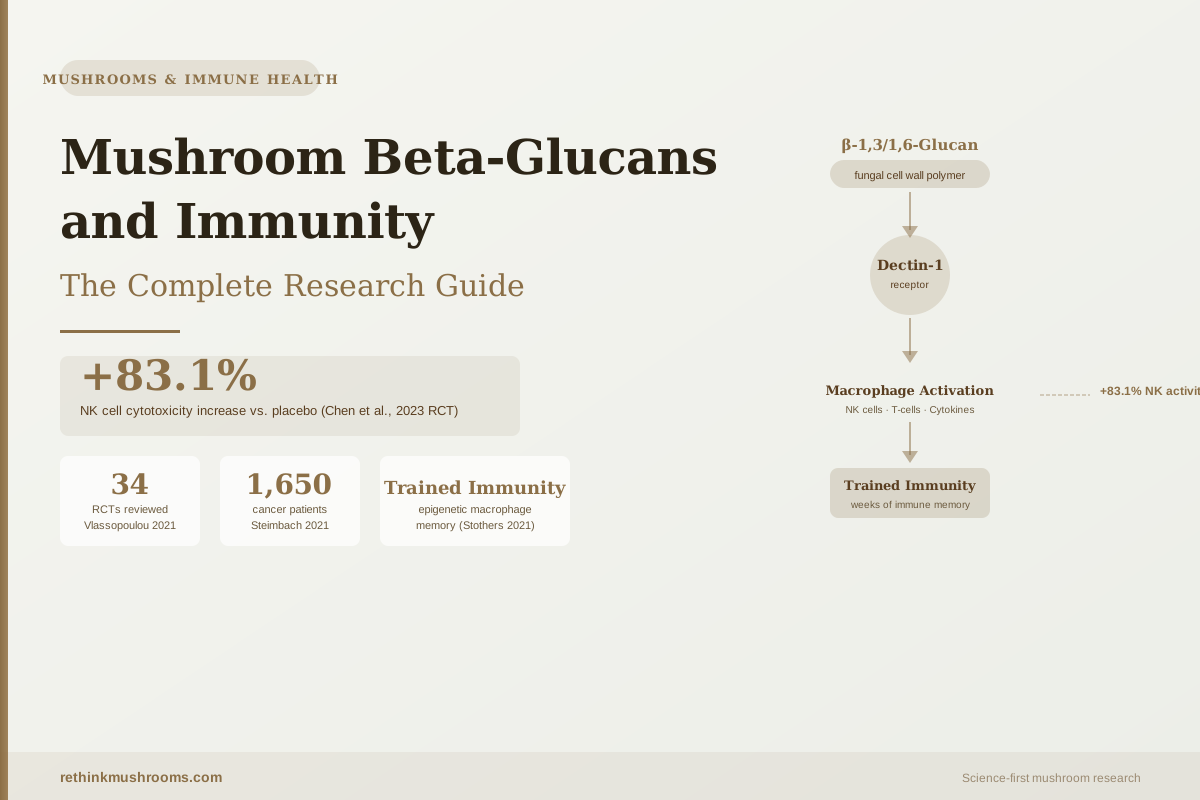
Mushrooms & Immune Health
83.1% increase in NK cell cytotoxicity vs. placebo
A 2023 randomized, double-blind trial gave 126 healthy adults 200 mg of purified reishi beta-glucan daily for 84 days, and found significant enhancement of NK cells, CD3+, CD4+ and CD8+ T-lymphocytes compared to placebo.
Chen et al., Foods, 2023
34 RCTs
randomized controlled trials of fungal beta-glucans pooled in a 2021 systematic review — most used yeast, not mushrooms
1,650
cancer patients across 16 clinical trials where beta-glucans were tested as immune adjuvants
Trained immunity
durable reprogramming of macrophages that creates lasting innate immune memory — shown in mice and human cells, not yet in human outcomes
Chen et al., Foods, 2023
 View as image ↗
A 2023 placebo-controlled trial put a number on something researchers had been observing for decades. In 126 healthy adults taking 200 mg of purified beta-glucan derived from reishi mushrooms daily for 84 days, NK cells — the immune system's first line of defense against virally infected and cancerous cells — increased their killing activity by 83.1 percent, against a 4.5 percent decline in the placebo group. CD3+, CD4+ and CD8+ T-lymphocytes also increased significantly. That's a specific, measurable immune change in healthy people from a well-characterized fungal compound.[6]
But the mechanism behind that number is more interesting than the number itself — and the number carries more uncertainty than a single headline figure suggests. Understanding how mushroom beta-glucans support immunity requires a concept that most consumer content completely ignores: the idea that the innate immune system can develop a form of memory, and that beta-glucans are one of the most studied triggers of that memory. This article covers what beta-glucans are, how they interact with the immune system, what 34 randomized controlled trials collectively show, and where the honest evidence gaps remain.
Mushroom beta-glucans are polysaccharides found in fungal cell walls, characterized by β-1,3-linked glucose chains with β-1,6 side branches. They activate immunity through receptors including Dectin-1 and complement receptor 3, triggering macrophage activation, NK cell enhancement, and a durable trained immune state that can persist after exposure ends. A 2021 review by Cerletti and colleagues in Nutrients surveyed the evidence, describing immunomodulatory and anti-inflammatory effects tested in recurrent respiratory infection, surgical recovery, cancer adjuvant therapy, and cardiovascular health.[1]
One framing point is worth setting up front, because it shapes everything that follows. Most of the clinical evidence filed under "beta-glucan immunity" was not generated with mushrooms. The most-cited systematic review in this space drew on five source organisms, and yeast (Saccharomyces cerevisiae) is the most common source in that trial record.[4] Mushroom-specific human data is a smaller subset than the marketing implies.
Evidence Provenance · What Organism Was Actually Tested
Much of the “mushroom beta-glucan” evidence is yeast evidence
Beta-glucan research is routinely cited as one body of evidence. It is not. Yeast and mushroom glucans share the β-1,3/1,6 configuration but are different molecules, tested in different studies. Here is where each headline claim in this article actually comes from.
This is not an argument that yeast beta-glucan evidence is worthless — it is often the better-designed research. It is an argument that a mushroom product cannot claim it without saying so, because the molecules differ in size, branching and solubility, and potency varies significantly with those properties.
Sources: Vlassopoulou et al. (2021); Chen et al. (2023); Steimbach et al. (2021); Dharsono et al. (2019); Stothers et al. (2021); Case et al. (2024); De Marco Castro et al. (2021)
View as image ↗Safety
ModerateBeta-glucans are immune-active, and the trial record excludes most sensitive groups
Concern
Beta-glucans engage immune signaling directly. The clinical evidence summarized in this article comes almost entirely from healthy adults and from cancer patients receiving chemotherapy or radiotherapy. People with autoimmune disease, people taking immunosuppressive drugs, organ transplant recipients, and pregnant or breastfeeding people have not been meaningfully studied.
What the research says
The absence of trials in these groups is an absence of evidence, not evidence of safety. Nothing in the current literature establishes whether beta-glucan supplementation is safe or unsafe in an active autoimmune condition.
Particularly relevant for: Autoimmune disease, immunosuppressive therapy, transplant recipients, active infection, pregnancy or breastfeeding
What to do
Talk to your physician before taking a beta-glucan supplement if any of these apply to you. This article summarizes published research and is not medical advice.
Vlassopoulou et al., Food & Function, 2021; Motta et al., J Autoimmunity, 2021
Key Takeaways
- A 2023 RCT in 126 healthy adults found 200 mg/day of reishi β-1,3/1,6-glucan for 84 days increased NK cell cytotoxicity by 83.1% (vs. −4.5% on placebo) and enhanced CD3+, CD4+, and CD8+ T-lymphocytes (Chen 2023) — though the ±30% standard deviation shows the response varied widely between individuals
- A systematic review of 34 randomized controlled trials found fungal beta-glucans reduced the incidence and symptoms of colds, flu and other respiratory infections at doses from 2.5 to 1,000 mg/day — but also found the underlying cellular and molecular immune changes were inconsistent across trials (Vlassopoulou 2021)
- Most of that clinical record is not mushroom-derived: the 34 trials drew on five organisms, with baker's/brewer's yeast the most common source (Vlassopoulou 2021)
- Beta-glucans induce "trained immunity" — a durable shift in macrophage metabolism and gene expression that outlasts the exposure. In mice, a single course protected against Pseudomonas aeruginosa for more than 7 days, and, unexpectedly, the effect did not require Dectin-1 or TLR-2 (Stothers 2021)
- A 2024 study found β-glucans from common white button mushrooms (Agaricus bisporus) also trained mouse macrophages and human monocytes, though the response was modest compared with yeast-derived beta-glucans (Case 2024)
- A systematic review of 16 clinical trials covering 1,650 cancer patients found beta-glucans safe and well-tolerated, with most trials reporting reduced treatment-related immune depression — though some found no difference versus control, which the authors call a controversial result (Steimbach 2021)
- Beta-glucans are best described as immunomodulators rather than simple immune stimulants, but the same review that catalogues their mechanisms concludes the evidence remains insufficient to justify treating human disease with mushroom extracts (Motta 2021)
What Mushroom Beta-Glucans Are — and Why the Immune System Cares
Mushrooms are fungi, and fungi have cell walls built partly from a polymer called beta-glucan. The specific configuration that matters for immune activation is a backbone of glucose molecules linked through β-1,3 bonds, with side branches connected through β-1,6 bonds. That branching pattern, the "1,3/1,6" you see on supplement labels, is what the human immune system is designed to recognize as foreign fungal material.
Cerletti and colleagues draw the structural line precisely in their 2021 review: mushroom cell walls are rich in β-glucans with both β-1,3 and β-1,6 linkages, where the 1,3 bonds form the linear backbone and the 1,6 bonds create the branching. Beta-glucans from cereals such as oats and barley, by contrast, have no 1,6 linkages and no branching structures at all.[1] That single structural difference is why oat fiber and mushroom extract end up in completely different chapters of the research literature — a point the FAQ at the end of this article returns to.
Motta and colleagues add the practical caveat about variability: mushroom strain, growing conditions, developmental stage, which part of the mushroom is used, extraction method, and storage conditions all influence the compounds present in a finished product, and inadequate standardization across studies is one reason results differ.[5]
The immune system did not evolve to respond to mushroom supplements. It evolved to detect pathogens. Beta-glucans happen to be a reliable molecular signature of fungi, and the immune system has detection systems specifically tuned to that signature. When those detection systems encounter beta-glucan, they treat it the way they would treat fungal infection: they activate. The key detection receptor for beta-glucan from fungi is called Dectin-1.
For a complete explanation of the Dectin-1 receptor and how it recognizes beta-glucan structures, see The Dectin-1 Receptor: How Your Body Recognizes Mushroom Beta-Glucans.
How Beta-Glucans Travel Through the Body and Signal the Immune System
The journey from swallowing a beta-glucan to a systemic immune response involves more steps than most people realize. Chan and colleagues described the trafficking route in 2009, drawing on animal studies of oral administration.[3]
The β-1,3 linear backbone resists digestion. Most beta-glucans reach the proximal small intestine intact, where some are captured by macrophages — immune cells that patrol the gut wall for foreign material. Those macrophages internalize and fragment the molecules, then transport the fragments to the bone marrow and the endothelial reticular system. The smaller fragments are eventually released and taken up by other immune cells, producing immune responses at sites far from the gut.
This is the step worth flagging honestly: that route was mapped in animals. It is the standard working model, and it is consistent with what human trials observe downstream, but the trafficking itself has not been directly traced in humans.
The receptor landscape is also broader than Dectin-1 alone. Akramiene and colleagues list complement receptor 3 (CR3, CD11b/CD18), lactosylceramide, selected scavenger receptors, and Dectin-1 as the recognition systems involved.[2] Chan's review adds TLR-2/6 to that set.[3] Dectin-1 is the best-characterized pathway, but as the trained immunity section below shows, it is not required for every beta-glucan effect.
De Marco Castro and colleagues reviewed where this leaves the human evidence in 2021. Their assessment is worth quoting in spirit: pre-clinical work suggests β-1,3/1,6-glucan may offer increased immune surveillance, but the human evidence is weaker than the pre-clinical evidence, and considerable uncertainty remains.[11] Their review focuses specifically on yeast-derived glucans — another reminder of how much of this mechanistic picture was built on Saccharomyces, not mushrooms.
For the complete step-by-step mechanism — from molecular structure to receptor binding to downstream immune cell activation — see How 1,3/1,6 Beta-Glucans Activate Your Immune System.
Which Immune Cells Beta-Glucans Activate — and How
The immune activation triggered by beta-glucan exposure is not diffuse or general. Specific cell types respond, through specific mechanisms, producing specific outcomes. A 2007 review by Akramiene and colleagues documented the main targets: macrophage activation, NK cell enhancement, and complement system engagement.[2]
Macrophages are the primary responders. These are the large immune cells that patrol tissues, engulf foreign material, and signal other immune cells to join the response. Beta-glucan-stimulated macrophages produce cytokines (the chemical messengers that coordinate immune activity), increase their phagocytic activity (the ability to engulf and destroy pathogens), and can present foreign material to T-cells to trigger adaptive immune responses.
NK cells — natural killer cells — are the innate immune system's specialized cell type for destroying virally infected cells and tumor cells without requiring prior exposure to those specific threats. Chan and colleagues reviewed beta-glucan effects on human immune and cancer cells in 2009, and their conclusion is more careful than it is often reported to be. Based largely on in vitro work, beta-glucans engage macrophages, neutrophils, monocytes, NK cells and dendritic cells and can enhance both opsonic and non-opsonic phagocytosis. But the same review warns that beta-glucans of different sizes and branching patterns "may have significantly variable immune potency," and states plainly that no good-quality clinical trial data was then available on purified beta-glucans in cancer patients.[3]
So the honest reading is not "beta-glucans reliably raise NK activity." It is that beta-glucans reach NK cells and can activate them, with potency that depends heavily on the specific molecule. The Chen 2023 RCT is valuable precisely because it pins one well-characterized preparation to one measured number: an 83.1% increase in NK cell cytotoxicity in the reishi beta-glucan group, against a 4.5% decline on placebo.[6]
T-cells bridge innate and adaptive immunity. The CD4+ T-helper cells that increased in Chen's trial coordinate other immune responses. The CD8+ cytotoxic T-cells are killers, like NK cells but with antigen-specific recognition. Their enhancement suggests beta-glucan activation extends from the innate immune system into the adaptive immune arm.
The 34-RCT Evidence Summary: What the Pooled Trials Actually Found
For questions about clinical efficacy, the individual trial data matters less than the aggregate. Vlassopoulou and colleagues screened 917 records and identified 34 randomized controlled trials of orally administered fungal β-1,3/1,6-d-glucans, published as a systematic review in Food & Function in 2021.[4]
The first thing to notice is what "fungal" covered. The source organisms across those 34 trials were Saccharomyces cerevisiae (baker's and brewer's yeast), Aureobasidium pullulans (a yeast-like fungus), Pleurotus ostreatus (oyster mushroom), Lentinula edodes (shiitake), and Ganoderma lucidum (reishi). Only the last three are mushrooms. Anyone citing "34 RCTs" as evidence for a mushroom supplement is borrowing heavily from yeast research.
The dose range was equally wide: 2.5 mg/day to 1,000 mg/day — a 400-fold span — administered for periods up to 6.5 months. Despite that variation, the primary outcome across most interventions was immunomodulation, expressed as (a) strengthened immune defense that reduced the incidence and symptoms of cold, flu and other respiratory infections, and (b) improvement of allergic symptoms. The review also noted improvements in reported mood and general wellbeing, potential usefulness as a complement to cancer therapy, and possible benefit for obesity-associated comorbidities. No adverse events were causally attributed to the glucans.
But the review contains a finding that rarely survives the trip into consumer content: while the clinical outcomes trended positive, the findings on immune response alterations were inconsistent at the cellular and molecular levels. In other words, people reported fewer and milder infections, but the blood markers that were supposed to explain why did not line up reliably across trials. That gap between outcome and mechanism is the honest center of the beta-glucan evidence base.
Because different trials used different organisms, extraction methods, and doses spanning two orders of magnitude, identifying an optimal protocol from this synthesis is not possible. What the review establishes is a generally positive signal for immune defense outcomes across a wide range of parameters. It does not resolve which preparation or dose is most effective.
The 2023 RCT: Reishi Beta-Glucan in Healthy Adults
The Chen 2023 trial deserves a standalone section because it is the most precisely characterized human trial of a mushroom-derived beta-glucan currently available.[6]
Chen et al. (2023) · Foods
- Population
- 126 healthy volunteers aged 18–55, recruited in Taipei, Taiwan. Smokers, pregnant or nursing women, and people with current respiratory illness, hypertension or vascular disease were excluded.
- Intervention
- 200 mg/day purified β-1,3;1,6-D-glucan from Ganoderma lucidum (reishi), one capsule daily for 84 days
- Comparator
- 200 mg/day dextrose monohydrate capsule, randomized and double-blinded
- Finding
- NK cell cytotoxicity rose 83.1 ± 30.0% in the beta-glucan group versus −4.5% on placebo (p = 0.0001). NK cell counts rose 19.5 ± 6.4% vs −2.0%, the CD4/CD8 ratio rose 12.9 ± 11.2% vs −2.2% (both p = 0.0001), and serum IgA rose 10.0 ± 38.3% vs 2.1% (p = 0.031). No significant changes in kidney or liver function markers in either group.
positive Well-designed and well-reported, but a single trial at a single site. The ±30.0% standard deviation on the headline result means individual responses varied enormously — the average participant improved substantially, and some participants will have moved very little.
Chen et al., Foods, 2023 (PMID 36766186); ISRCTN-registered
Several things make this trial worth citing precisely rather than just as "a study showing immune benefits." It used a well-characterized purified preparation rather than a crude mushroom extract, allowing some mechanistic inference. It measured multiple immune cell types simultaneously rather than a single marker. And the NK cytotoxicity measurement is a functional assay — it measures what the cells can actually do, not just how many of them are present.
Two things temper it. The first is that spread: 83.1 ± 30.0% is a large mean effect wrapped around large individual variation, and a headline that reports only the 83.1% is telling you about the average participant rather than about you. The second is that this is one trial. It has not yet been independently replicated at another site with another batch of material.
Beta-Glucans and Colds: A Double-Blind Trial
The most practical question most people bring to the beta-glucan research is whether it reduces the chance or severity of catching colds. Dharsono and colleagues tested this directly in a 2019 double-blind, randomized, placebo-controlled trial using yeast-derived 1,3/1,6-beta-glucan — and the answer is more specific, and more limited, than it is usually reported to be.[8]
The design was solid: 299 generally healthy adults who reported at least three upper respiratory infections in the previous year, randomized to 900 mg/day of brewers' yeast beta-glucan or placebo for 16 weeks across a winter season. Symptom severity was captured with the validated WURSS-21 questionnaire and the Jackson scale, with clinical confirmation by an investigator.
Here is what it found. Seventy placebo subjects and seventy-one beta-glucan subjects experienced at least one clinically confirmed infection — essentially identical. Global symptom severity was also not different between groups (p = 0.5267). What did move was narrower: the severity of physical symptoms was significantly lower in the beta-glucan group across every interval measured through day 7 (p values from 0.0465 to 0.0248). The authors' own conclusion states it plainly — subjects benefited from reduced severity of physical symptoms during the first week of an episode, "even though the incidence and global severity of common colds could not be altered in comparison to placebo."
That is a real finding, and it is not the finding usually attributed to this trial. Beta-glucan did not stop people catching colds, and it did not make their colds globally milder. It made the physical symptoms of the first week measurably less severe. The trial also recorded a significant increase in the "joy" subscore of a perceived stress questionnaire and a small reduction in systolic blood pressure.
Two further caveats. Dharsono's trial used yeast beta-glucan, not mushroom beta-glucan — the 1,3/1,6 structural configuration is shared, but the molecules are not identical. And symptom severity is self-reported, not a laboratory-confirmed viral load.
Fact Check
Myth vs. evidence
The claim
“Clinical trials show beta-glucan makes colds shorter and less severe.”
Supplement marketing routinely cites the Dharsono 2019 trial as proof that beta-glucan reduces both the severity and the duration of colds.
What research shows
OverstatedIn that trial (299 adults, 900 mg/day yeast beta-glucan, 16 winter weeks), the number of clinically confirmed infections was nearly identical between groups (71 vs 70), and global symptom severity did not differ (p = 0.5267). The authors state that incidence and global severity 'could not be altered in comparison to placebo.' Duration was not a demonstrated benefit.
What the trial did show is narrower and still real: the severity of physical symptoms was significantly lower in the beta-glucan group throughout the first seven days of an episode. The pooled 34-RCT review reports reduced infection incidence and symptoms in aggregate, but also reports that the underlying cellular and molecular immune changes were inconsistent across trials.
Dharsono et al., J Am Coll Nutr, 2019 (PMID 30198828); Vlassopoulou et al., Food & Function, 2021
The Cancer Adjuvant Evidence: 16 Trials, 1,650 Patients
The most extensive clinical dataset on fungal beta-glucans comes from cancer treatment research. Steimbach and colleagues screened 1,018 articles and assembled 16 clinical trials that used fungal beta-glucans as adjuvants alongside chemotherapy or radiotherapy, covering 1,650 patients across nine cancer types, published between 1992 and 2018.[7] The beta-glucan sources were yeast (Saccharomyces cerevisiae), shiitake (Lentinula edodes), split-gill mushroom (Schizophyllum commune), and some non-described fungal sources.
One finding is unambiguous: administration of beta-glucan was safe and well-tolerated. That holds across all 16 trials and 1,650 patients.
The efficacy finding is genuinely more mixed than it is usually presented, and the review says so directly. Most of the trials reported that giving beta-glucan concurrently with chemotherapy or radiotherapy reduced the immune depression caused by those treatments and/or accelerated the recovery of white blood cell counts. But some trials found no statistically significant difference between beta-glucan and control groups — which, in the authors' own words, "gives a controversial conclusion about the β-glucan effects."
The review also could not perform meaningful statistical pooling. Arm sizes ranged from 9 to 200 patients, methods varied widely, and reporting was often insufficient, so the authors resorted to a narrative summary and concluded that further evidence is required to determine whether beta-glucans are effective as a cancer treatment adjuvant.
Context matters here in one more way. These trials tested beta-glucans as immune-supportive adjuvants, not as cancer treatments. Nothing in this literature claims that beta-glucans treat cancer. The claim under investigation is narrower: that they may help preserve and restore immune function in patients undergoing treatment — clinically meaningful in a population where immune depression is a serious and dose-limiting complication, and still not settled.
- Cell studiescompleted
Extensive. Dectin-1, CR3, TLR-2/6 and scavenger receptor engagement; macrophage, neutrophil, monocyte, NK and dendritic cell activation. Potency varies sharply with molecular size and branching (Chan 2009; Akramiene 2007).
- Animal studiescompleted
Extensive. Oral trafficking from gut to bone marrow mapped in animals (Chan 2009); trained immunity protecting mice from Pseudomonas aeruginosa for more than 7 days (Stothers 2021); mushroom-powder gavage shifting progenitor populations (Case 2024).
- Small human trialscompleted
126 healthy adults on reishi beta-glucan, 84 days: NK cytotoxicity +83.1% vs placebo (Chen 2023). 299 adults on yeast beta-glucan, 16 weeks: physical URTI symptoms reduced through day 7, incidence and global severity unchanged (Dharsono 2019).
- Large, replicated RCTs of mushroom beta-glucanmissing
No large, independently replicated trial of a standardized mushroom beta-glucan against a clinical endpoint. The reishi result is a single trial at a single site.
- Pooled quantitative synthesismissing
The 34-RCT and 16-trial reviews are both narrative. Heterogeneity in organism, dose, preparation and endpoint prevented statistical pooling in each case (Vlassopoulou 2021; Steimbach 2021).
Mechanism is well established in cells and animals. Human trials are real but small, largely yeast-based, and unreplicated for mushroom-specific preparations. Neither major systematic review was able to pool results quantitatively — which is why no honest source can give you an optimal dose.
Chan 2009; Akramiene 2007; Stothers 2021; Case 2024; Chen 2023; Dharsono 2019; Vlassopoulou 2021; Steimbach 2021
Trained Immunity: The Concept That Changes How You Think About Beta-Glucans
Here is the concept that is almost completely absent from consumer content on mushrooms and immunity — and that may be the most important thing to understand about beta-glucans.
The innate immune system was traditionally described as having no memory. Adaptive immunity — T-cells and B-cells — maintains memory of specific pathogens for years after exposure. Innate immunity was thought to respond identically to each new threat, without learning.
That understanding has been revised. Trained immunity describes a durable functional reprogramming of innate immune cells — monocyte and macrophage biology is altered so the cells mount a more effective response to a later, unrelated challenge. De Marco Castro and colleagues describe it as a newly recognized phenomenon in their 2021 review, and it is the mechanism most often invoked to explain why beta-glucan effects outlast beta-glucan exposure.[11]
Stothers and colleagues, publishing in the Journal of Immunology in 2021, provided one of the clearest demonstrations of what that reprogramming does — and delivered a genuine surprise along the way.[9]
Working in mice, they showed that beta-glucan protected animals against Pseudomonas aeruginosa infection by improving recruitment of innate leukocytes to the infection site and local bacterial clearance — an effect that persisted more than seven days. Critically, they then transferred macrophages trained with beta-glucan into naive mice and reproduced a comparable level of protection, which establishes that the macrophages themselves carry the trained state rather than merely reflecting it.
What the trained macrophages looked like is specific: enhanced phagocytosis and reactive oxygen species production, alongside sustained increases in both glycolytic and oxidative metabolism, greater mitochondrial mass, and higher membrane potential. Broad transcriptomic changes followed a distinctive arc — early inflammatory activation, then sustained shifts in genes governing metabolism, cellular differentiation and antimicrobial function. Trained macrophages constitutively secreted CCL chemokines and responded far more robustly to a later LPS challenge.
Then the surprise: induction of this trained phenotype was independent of Dectin-1 and TLR-2, the two classic beta-glucan receptors. This matters for how you read the rest of this article. Dectin-1 is the best-characterized recognition pathway and it clearly drives acute activation — but it is not the whole story, and at least one durable, protective beta-glucan effect runs through something else entirely.
The practical significance of trained immunity is its duration. This is not an activation that fades within hours; the reprogramming persists in macrophage populations, and trained immunity in general is described as persisting for weeks to months. Subsequent challenges meet a better-prepared defensive line.
Case and colleagues published a 2024 study that extended trained immunity to an unlikely source: common white button mushrooms (Agaricus bisporus).[10] Mouse macrophages pre-treated with whole mushroom powder responded more strongly to later TLR stimulation, and were particularly sensitive to TLR-2 ligands. The trained response was modest compared with yeast-derived beta-glucans, and it tracked the amount of available beta-glucan in the powder — enriching for beta-glucan content, either by simulated digestion or chemical fractionation, retained and boosted the effect. The preparations also trained human monocytes in culture. In a final in-vivo arm, mice given whole mushroom powder by oral gavage showed shifted bone-marrow progenitor dynamics toward myeloid-committed cells, and macrophages derived from those mice again showed enhanced responses.
Two honest qualifications. That dietary arm was oral gavage in mice, not a human feeding study — it is suggestive that ordinary mushroom consumption could contribute to innate immune training, but it does not demonstrate it in people. And two of the authors are scientists at Monaghan Mushrooms, the company that supplied the mushroom products, which the paper discloses.
Evidence Reach · Trained Immunity
How far the trained immunity evidence actually travels
Trained immunity is the strongest mechanistic story beta-glucans have. It is also the claim most often stretched past its evidence. Each row below is a different model system and a different question — the boundary sits between the fourth and sixth rows.
Disclosure noted in the source: two authors of the button mushroom study are employed by Monaghan Mushrooms, which supplied the mushroom products used in that work.
Sources: Stothers et al. (J Immunol, 2021); Case et al. (Front Nutr, 2024); De Marco Castro et al. (Mol Nutr Food Res, 2021); Vlassopoulou et al. (Food & Function, 2021)
View as image ↗Immunomodulator, Not Immune Booster
The language in mushroom supplement marketing tends toward "immune booster" or "immune support." The research literature, when it uses precise language, calls medicinal mushrooms immunomodulators. The distinction matters.
An immune booster, in the colloquial sense, implies uniformly more immune activity. An immunomodulator adjusts immune activity — it can increase activity when the immune system is underperforming, or balance and regulate it when it is overactive.
Motta and colleagues reviewed mushrooms and immunity in the Journal of Autoimmunity in 2021, working through the biochemical changes induced by mushroom compounds — glucans, lectins, fungal immunomodulatory proteins, ribosome-inactivating proteins, ribonucleases and laccases — across macrophages, dendritic cells, T cells and NK cells.[5]
Two things in that review deserve more weight than they usually get. The first is the balance of evidence: numerous studies have been performed on cell lines and murine models, while only a few clinical trials have been conducted. Human studies, in their words, provide a minority of the available data. The second is their conclusion. Given the number of variables involved and inadequate standardization, they judge the available evidence "insufficient to justify the treatment of human diseases with mushrooms extracts."
That is a considered assessment from a review published in an autoimmunity journal, and it belongs in any honest summary of this field. It does not mean mushroom beta-glucans do nothing. It means the mechanistic literature has run well ahead of the clinical literature, and the gap has not closed.
The trained immunity concept reinforces why "modulator" is the better word. Training the innate immune system to be more responsive and capable is different from simply increasing cytokine output. A well-trained response is fast, targeted, and self-regulating; that is not the same thing as an inflamed, overactive one.
For anyone with an autoimmune condition, this distinction is medically significant and warrants real caution rather than reassurance. The current evidence does not establish whether mushroom beta-glucan supplementation is safe or unsafe in the context of active autoimmune disease. That question has not been adequately tested in controlled trials, and the "immunomodulator, not booster" framing should not be read as a guarantee that these compounds are safe for an overactive immune system.
What the Clinical Research Still Cannot Answer
Vlassopoulou's 2021 systematic review was explicit about its own limitations, and those limitations describe the honest state of the evidence.[4]
Dose remains unresolved. The 34 trials used doses ranging from 2.5 mg/day to 1,000 mg/day. That 400-fold range doesn't mean all doses are equally effective. It means the research hasn't converged on an optimal dose, and comparing trials using such different quantities is methodologically difficult. The two best-characterized trials in this article illustrate the point: Chen used 200 mg/day of a purified reishi glucan, Dharsono used 900 mg/day of a yeast glucan, and they measured entirely different endpoints.
Duration varies too. Supplementation across the reviewed trials ran for periods up to 6.5 months, with the two anchor trials here at 84 days and 16 weeks. Whether benefits persist with longer use, whether the trained state requires re-dosing to maintain, or whether anything changes over years of supplementation — none of these questions have been answered.
Species and preparation standardization is absent. Different trials used different organisms, extraction methods, and purity levels. Motta's review lists strain, growing conditions, developmental stage, part of the mushroom used, extraction method and storage as variables that all influence the finished product. An extract from shiitake, one from reishi, and one from yeast — all labeled "beta-glucan supplement" — may differ substantially in what they contain and what they do.
The mechanism-outcome gap is the deepest problem. Vlassopoulou's review found clinical outcomes trending positive while the cellular and molecular immune measurements were inconsistent across trials. Cell and animal work explains beautifully how beta-glucans could work; the human biomarker data does not consistently confirm that this is how they do work.
Finally, most clinical trials enrolled healthy adults, or cancer patients receiving conventional treatment. The data says something about those populations. It says very little about whether beta-glucans help or harm people with autoimmune conditions, immunodeficiency, transplant history, or active infection.
Across the Species and Deeper Into the Mechanisms
This article covers the core evidence for beta-glucan immune effects. The cluster articles go deeper on specific aspects:
-
How 1,3/1,6 Beta-Glucans Activate Your Immune System — the step-by-step mechanism from gut absorption through Dectin-1 recognition to systemic immune cell priming, including the two-receptor system and the 2023 structural biology finding that glucan architecture determines signaling strength
-
The Dectin-1 Receptor: How Your Body Recognizes Mushroom Beta-Glucans — structural biology of Dectin-1, which immune cells express it, the full Syk/CARD9 signaling cascade, and the trained immunity link at the molecular level
-
Beta-Glucan Structure and Immune Potency: Why Molecular Weight and Branching Matter — why beta-glucans from different sources produce different immune responses, and what the structure-activity relationship means for supplement selection
-
Beta-Glucans from Mushrooms vs. Yeast vs. Oats: Which Are Most Effective? — comparative analysis of the three main beta-glucan sources by molecular structure, receptor affinity, and clinical evidence
For species-specific beta-glucan content and research, see Reishi Bioactive Compounds: Triterpenes, Polysaccharides, and Sterols and Maitake Bioactive Compounds: D-Fraction, MD-Fraction, and Beta-Glucans, which covers Maitake's D-fraction, one of the most clinically studied specific beta-glucan preparations.
The Bottom Line
Mushroom beta-glucans are β-1,3-linked glucose chains with β-1,6 branches, recognized by Dectin-1, complement receptor 3 and other innate receptors. Animal work maps a route from gut macrophage capture to bone marrow, priming NK cells, T-cells and macrophages systemically. The strongest single human result is Chen 2023: 126 healthy adults, 200 mg/day reishi beta-glucan for 84 days, NK cell cytotoxicity up 83.1% versus a 4.5% decline on placebo — impressive, but one unreplicated trial with a ±30% standard deviation. A systematic review of 34 RCTs found reduced incidence and symptoms of respiratory infection at doses from 2.5 to 1,000 mg/day, while explicitly noting that the underlying cellular and molecular changes were inconsistent (Vlassopoulou 2021); most of those trials used yeast rather than mushrooms. A review of 16 cancer adjuvant trials in 1,650 patients found beta-glucans consistently safe, with most but not all trials showing reduced treatment-related immune depression (Steimbach 2021). Trained immunity is the most interesting mechanism: in mice, beta-glucan reprogrammed macrophage metabolism and gene expression and protected against Pseudomonas for more than 7 days — independently of Dectin-1 and TLR-2 (Stothers 2021) — and white button mushroom powder trained mouse macrophages and human monocytes, though more weakly than yeast glucan (Case 2024). The honest gaps: no large replicated trial of a standardized mushroom preparation, no resolved dose, a persistent mechanism-to-outcome gap, and essentially no data in autoimmune or immunocompromised populations.
Frequently Asked Questions
Sources & References
- 1RTHM-00676·Cerletti, Chiara et al. (2021). “Edible Mushrooms and Beta-Glucans: Impact on Human Health..” Nutrients.Study breakdown →PubMed →↩
- 2RTHM-00110·Akramiene, Dalia et al. (2007). “Effects of beta-glucans on the immune system..” Medicina (Kaunas.Study breakdown →PubMed →↩
- 3RTHM-00151·Chan, Godfrey Chi-Fung et al. (2009). “The effects of beta-glucan on human immune and cancer cells..” Journal of hematology & oncology.Study breakdown →PubMed →↩
- 4RTHM-01451·Vlassopoulou, Marigoula et al. (2021). “Effects of fungal beta-glucans on health - a systematic review of randomized controlled trials..” Food & function.Study breakdown →PubMed →↩
- 5RTHM-00709·Motta, Francesca et al. (2021). “Mushrooms and immunity..” Journal of autoimmunity.Study breakdown →PubMed →↩
- 6RTHM-01673·Chen, Shiu-Nan et al. (2023). “Evaluation of Immune Modulation by β-1,3; 1,6 D-Glucan Derived from Ganoderma lucidum in Healthy Adult Volunteers, A Randomized Controlled Trial..” Foods (Basel.Study breakdown →PubMed →↩
- 7RTHM-00719·Steimbach, Laiza et al. (2021). “Fungal beta-glucans as adjuvants for treating cancer patients - A systematic review of clinical trials..” Clinical nutrition (Edinburgh.Study breakdown →PubMed →↩
- 8RTHM-00550·Dharsono, Tanita et al. (2019). “Effects of Yeast (1,3)-(1,6)-Beta-Glucan on Severity of Upper Respiratory Tract Infections: A Double-Blind, Randomized, Placebo-Controlled Study in Healthy Subjects..” Journal of the American College of Nutrition.Study breakdown →PubMed →↩
- 9RTHM-00721·Stothers, Cody L et al. (2021). “β-Glucan Induces Distinct and Protective Innate Immune Memory in Differentiated Macrophages..” Journal of immunology (Baltimore.Study breakdown →PubMed →↩
- 10RTHM-00867·Case, Sarah et al. (2024). “β-glucans from Agaricus bisporus mushroom products drive Trained Immunity..” Frontiers in nutrition.Study breakdown →PubMed →↩
- 11RTHM-01345·De Marco Castro, Elena et al. (2021). “β-1,3/1,6-Glucans and Immunity: State of the Art and Future Directions..” Molecular nutrition & food research.Study breakdown →PubMed →↩