Beta-Glucan Immunity
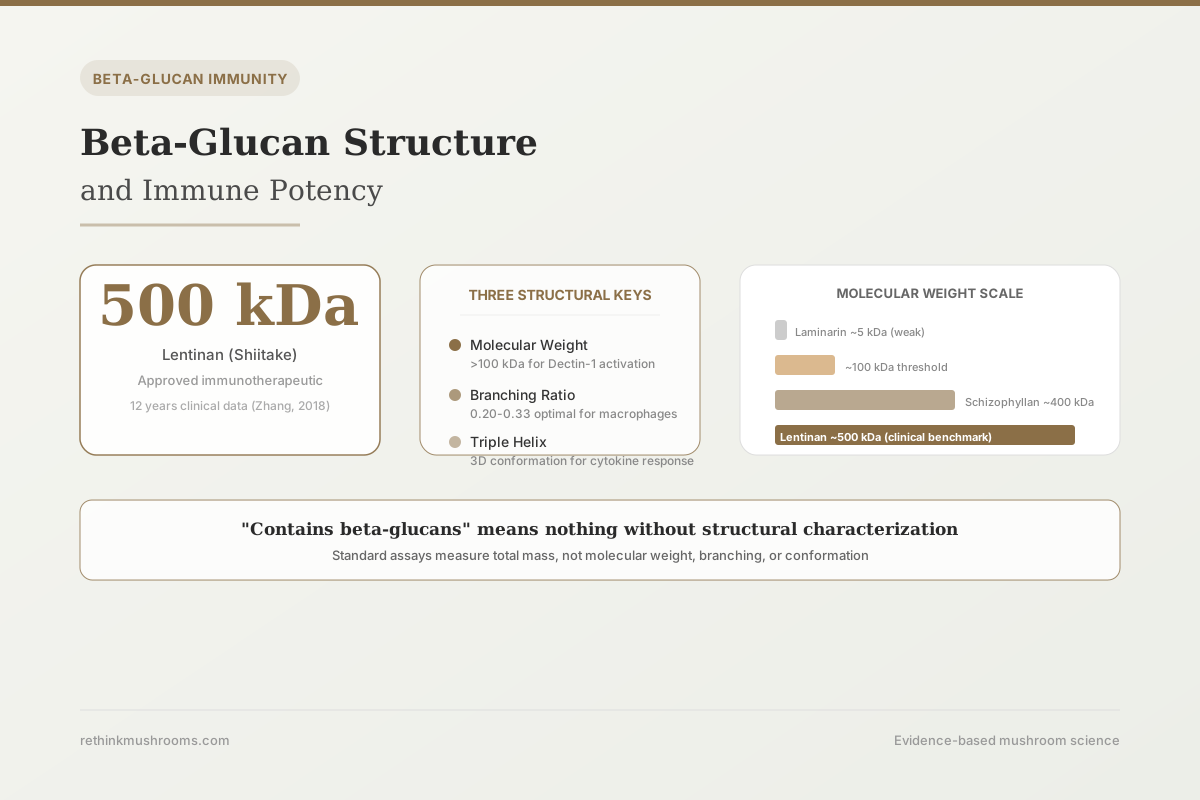
500 kDa
Lentinan, the beta-glucan from shiitake mushrooms used as an approved immunotherapeutic in Asia, has a molecular weight around 500,000 Da. Smaller beta-glucans like laminarin (~5 kDa) fail to trigger the same immune response.
Falch et al., Carbohydrate Research, 2000
Triple Helix
3D conformation required for cytokine activation
1:3 Branch
optimal branching ratio for immune potency
12 Years
of lentinan clinical data in lung cancer
Falch et al., Carbohydrate Research, 2000
 View as image ↗
Two beta-glucan extracts can have the same chemical formula, the same source species, and completely different biological activity. The difference is structural: molecular weight, branching density, and three-dimensional conformation determine whether a beta-glucan molecule activates immune cells or passes through the body without effect. This is why "contains beta-glucans" on a supplement label is nearly meaningless without structural characterization.
For context on why mushroom beta-glucans differ from oat and yeast sources, the companion article covers the branching architecture. This article goes deeper into the structural variables within fungal beta-glucans that determine immune potency.
Key Takeaways
- Scleroglucan lost its ability to stimulate TNF-alpha secretion from human monocytes when its molecular weight dropped below 100 kDa, and only samples with triple helix conformation produced strong cytokine responses (Falch et al., Carbohydrate Research, 2000)
- Dectin-1 receptor clustering on immune cell surfaces depends directly on beta-glucan particle size and surface exposure; short chains fail to trigger full signaling (Anaya et al., Biophysical Journal, 2023)
- Lentinan (shiitake beta-glucan, ~500 kDa) has been used as an approved immunotherapy adjunct in Asian lung cancer treatment for over 12 years, with clinical studies showing improved survival when combined with chemotherapy (Zhang et al., J Cancer Research and Clinical Oncology, 2018)
- A low molecular weight polysaccharide (LMPAB) from Agaricus blazei showed anti-metastatic activity through a different mechanism than high-MW glucans, downregulating metalloproteinase-9 (Niu et al., American Journal of Chinese Medicine, 2009)
- Beta-glucans with branching ratios between 0.20 and 0.33 (one branch per 3-5 backbone units) produce the strongest macrophage activation, while unbranched 1,3-glucan chains show minimal activity (Akramiene et al., Medicina, 2007)
- Beta-glucan immunological effects are mediated through Dectin-1, complement receptor 3, and toll-like receptors, with the specific receptor engaged depending on the glucan's size, solubility, and conformation (Goodridge et al., Immunological Reviews, 2009)
Size Matters: The Molecular Weight Threshold
Molecular weight refers to how large a beta-glucan polymer is. A single glucose molecule weighs 180 daltons (Da). A short chain of 30 glucose units weighs about 5,000 Da (5 kDa). Lentinan, the clinically used beta-glucan from shiitake mushrooms, weighs approximately 500,000 Da (500 kDa). That is a 100-fold difference in size between a small beta-glucan and a clinically active one.
Falch and colleagues published a landmark study in Carbohydrate Research in 2000 that established the relationship between molecular weight and immune activation.[1] They tested scleroglucan, a 1,3-beta-glucan with 1,6-branches, at different molecular weights. The native polymer (MW > 1,000 kDa) strongly stimulated TNF-alpha secretion from cultured human monocytes. When the molecular weight was reduced by sonication, immune-stimulating activity declined progressively. Samples below approximately 100 kDa showed dramatically reduced cytokine stimulation.
The study also demonstrated that molecular weight alone was not sufficient. When scleroglucan was denatured (its three-dimensional structure disrupted) at any molecular weight, cytokine stimulation dropped. Both high molecular weight and intact three-dimensional conformation were required for full immune activation.
This finding has practical implications for mushroom supplements. Extraction methods that fragment beta-glucan polymers (excessive heat, acid hydrolysis, high-pressure processing) can reduce molecular weight below the threshold for immune activation. A supplement may test positive for "beta-glucan content" by chemical assay while containing fragments too small to engage immune receptors.
The Triple Helix: Why 3D Shape Determines Activity
Many fungal beta-glucans, including lentinan, schizophyllan, and scleroglucan, naturally form a triple helix structure. Three beta-glucan chains wrap around each other, creating a rod-like superstructure with a specific diameter and surface chemistry. This conformation is not a curiosity; it is the biologically active form.
Falch et al. (2000) directly demonstrated this by comparing native (triple helix) and denatured (single chain) scleroglucan.[1] The denatured form, despite having the same chemical composition and similar molecular weight, produced significantly weaker TNF-alpha stimulation. The triple helix conformation creates a specific surface topology that immune receptors recognize. When the helix unwinds into individual chains, that recognition surface is lost.
The clinical significance of this is established through lentinan. Ren and colleagues (2018) characterized lentinan extracted from Lentinus edodes mycelia, confirming the 1,3-beta-glucan backbone with 1,6-branches at every third residue and determining its molecular weight and structural properties.[2] The structurally characterized lentinan showed antiviral activity, which the authors attributed to its intact triple helix conformation and high molecular weight.
Akramiene and colleagues (2007) reviewed the broader context, noting that beta-glucan immunomodulatory properties depend on molecular weight, degree of branching, polymer conformation, and solubility. They reported that particulate, high-molecular-weight beta-glucans with intact three-dimensional structure consistently showed stronger immune effects than their smaller or denatured counterparts.[3]
Branching Density: The Sweet Spot
Not all branching patterns are equal. The frequency of 1,6-branches along the 1,3-backbone influences receptor binding, solubility, and immune activation strength.
Research has identified an optimal branching ratio window. Beta-glucans with branching ratios between 0.20 and 0.33 (one branch per 3-5 backbone units) produce the strongest macrophage activation.[3] Lentinan has one branch per three backbone units (ratio 0.33). Schizophyllan has a similar branching frequency. These are among the most immunologically potent beta-glucans characterized.
Below this range, the beta-glucan surface becomes too smooth for optimal receptor engagement. A purely linear 1,3-beta-glucan without any branches does not activate macrophages effectively. Above this range (very densely branched), the backbone is sterically hindered and the molecule may fold differently, reducing receptor access.
Goodridge and colleagues (2009) reviewed how Dectin-1 recognizes these structural features.[4] The receptor's binding groove requires a minimum length of uninterrupted 1,3-backbone to dock. The 1,6-branches modulate the overall polymer shape but do not directly contact the Dectin-1 binding site. Too few branches and the polymer is too flexible; too many and the backbone is inaccessible.
Anaya and colleagues (2023) added biophysical precision to this picture. They demonstrated that Dectin-1 multimerization (clustering of multiple receptors to amplify the immune signal) depends on the physical size and surface exposure of the beta-glucan particle.[5] Larger particles with more exposed glucan surfaces drove more extensive receptor clustering and stronger downstream signaling. This means a high-molecular-weight, well-branched beta-glucan presents more binding sites per particle and triggers more robust immune activation than the same mass of smaller fragments.
Lentinan: The Clinical Benchmark
Lentinan is the most clinically studied mushroom beta-glucan. It has a 1,3-beta-glucan backbone with 1,6-branches at every third glucose unit, molecular weight around 500 kDa, and adopts a triple helix conformation in solution. It is an approved pharmaceutical in Japan and China.
Zhang and colleagues (2018) reviewed 12 years of clinical studies on lentinan as an immunotherapeutic for lung cancer in China.[6] They found that lentinan combined with standard chemotherapy improved overall survival, quality of life, and immune markers (including NK cell activity and T-cell counts) compared to chemotherapy alone across multiple trials. The review covered both non-small cell and small cell lung cancer patients.
The mechanism is not direct tumor killing. Lentinan activates multiple arms of innate immunity. Batbayar and colleagues (2012) reviewed how fungal beta-glucans signal through Dectin-1 to activate macrophages, stimulate phagocytosis, and trigger pro-inflammatory cytokine cascades.[7] Brown (2007) established the structural basis for this recognition, showing how Dectin-1's C-type lectin domain binds the 1,3-glucan backbone.[8]
Ahn and colleagues (2017) found that lentinan from shiitake selectively attenuated AIM2 and non-canonical inflammasome pathways, revealing that its immune effects are not simply "pro-inflammatory" but involve nuanced modulation of specific inflammatory cascades.[9] This selective modulation may explain why lentinan improves immune function in cancer patients without causing the dangerous over-inflammation seen with some immune-stimulating drugs.
The clinical success of lentinan serves as a proof of concept: a beta-glucan with defined molecular weight (~500 kDa), defined branching (1:3 ratio), and intact triple helix conformation produces measurable immune effects in humans. Lentinan in clinical use is administered intravenously, bypassing the gastrointestinal tract entirely. Whether oral mushroom supplements deliver beta-glucan with comparable structural integrity to the bloodstream is a separate and largely unresolved question. Gastric acid, digestive enzymes, and the intestinal barrier all present challenges to preserving the triple helix conformation of an orally consumed beta-glucan.
When Smaller Beta-Glucans Still Work
The molecular weight threshold is not absolute. Some low-molecular-weight beta-glucans produce biological effects through different mechanisms than their larger counterparts.
Niu and colleagues (2009) isolated a low molecular weight polysaccharide (LMPAB) from Agaricus blazei and demonstrated anti-metastatic effects in hepatic cancer cells.[10] The mechanism was distinct from high-MW beta-glucan immune activation: LMPAB downregulated metalloproteinase-9 (MMP-9, an enzyme that helps cancer cells invade tissue) and upregulated Nm23-H1 (a metastasis suppressor). This was not an immune-mediated effect but a direct cell-signaling effect.
Chan and colleagues (2009) reviewed the broader landscape, noting that beta-glucans affect both immune cells and cancer cells directly, with the specific mechanism depending on the beta-glucan's molecular characteristics.[11] Some smaller, soluble beta-glucan fragments can prime complement receptor 3 (CR3) on neutrophils, enabling them to target iC3b-coated tumor cells. This "priming" mechanism does not require the high molecular weight needed for Dectin-1 clustering.
This means the narrative "bigger is always better" oversimplifies the biology. High-MW beta-glucans with triple helix conformation produce the strongest Dectin-1-mediated immune activation. But low-MW fragments can work through alternative pathways. The clinical relevance of these alternative pathways in oral supplementation is less established than the Dectin-1 pathway.
What This Means for Mushroom Supplements
The structural research creates a clear framework for evaluating beta-glucan quality:
Molecular weight matters. Beta-glucans below ~100 kDa show reduced Dectin-1-mediated immune activation.[1] Extraction methods that fragment polymers (excessive heat, harsh chemicals) can produce supplements that test positive for beta-glucan content by chemical assay but contain mostly low-MW fragments with reduced immune potency.
Branching density matters. The optimal 0.20-0.33 branching ratio means supplements derived from species with naturally low branching (or from the wrong tissue) may underperform. Different mushroom species produce beta-glucans with different branching architectures.
Conformation matters. The triple helix is sensitive to processing conditions. Denaturation by extreme pH, excessive heat, or organic solvents can unwind the helix irreversibly, reducing immunological activity without changing chemical composition.[1]
Chemical assays are insufficient. A standard beta-glucan content assay (like the Megazyme enzymatic method) measures total beta-glucan mass. It does not distinguish between high-MW triple helix beta-glucan and low-MW fragments. Two supplements with identical "30% beta-glucan" labels can have dramatically different immune-activating potential depending on the molecular weight distribution of their beta-glucan content.
For practical guidance on testing approaches, the how to test for beta-glucans in mushroom supplements article covers what consumers can verify. For the basic chemistry behind 1,3/1,6 beta-glucan structure and function, the foundational article provides context.
To understand how your body recognizes these structures at the receptor level, see the Dectin-1 receptor. For a complete overview of the immune evidence, the mushroom beta-glucans and immunity research guide synthesizes the clinical and preclinical data. The question of how 1,3/1,6 beta-glucans activate immune cells is covered in the dedicated signaling article.
The Bottom Line
Beta-glucan immune potency depends on three structural variables: molecular weight (above ~100 kDa for strong Dectin-1 activation), branching density (0.20-0.33 ratio optimal), and three-dimensional conformation (triple helix required for full cytokine stimulation). Lentinan from shiitake, with ~500 kDa molecular weight and 1:3 branching, is the clinical benchmark with 12 years of human trial data. Standard chemical assays for beta-glucan content do not capture these structural details, meaning supplement labels may not reflect immune-activating potential.
Frequently Asked Questions
Sources & References
- 1RTHM-00032·Falch, B H et al. (2000). “The cytokine stimulating activity of (1-->3)-beta-D-glucans is dependent on the triple helix conformation..” Carbohydrate research.Study breakdown →PubMed →↩
- 2RTHM-00528·Ren, Guangming et al. (2018). “Structural characterization and antiviral activity of lentinan from Lentinus edodes mycelia against infectious hematopoietic necrosis virus..” International journal of biological macromolecules.Study breakdown →PubMed →↩
- 3RTHM-00110·Akramiene, Dalia et al. (2007). “Effects of beta-glucans on the immune system..” Medicina (Kaunas.Study breakdown →PubMed →↩
- 4RTHM-00154·Goodridge, Helen S et al. (2009). “Beta-glucan recognition by the innate immune system..” Immunological reviews.Study breakdown →PubMed →↩
- 5RTHM-00814·Anaya, Eduardo U et al. (2023). “Dectin-1 multimerization and signaling depends on fungal β-glucan structure and exposure..” Biophysical journal.Study breakdown →PubMed →↩
- 6RTHM-00538·Zhang, Yiran et al. (2018). “Lentinan as an immunotherapeutic for treating lung cancer: a review of 12 years clinical studies in China..” Journal of cancer research and clinical oncology.Study breakdown →PubMed →↩
- 7RTHM-00244·Batbayar, Sainkhuu et al. (2012). “Immunomodulation of Fungal β-Glucan in Host Defense Signaling by Dectin-1..” Biomolecules & therapeutics.Study breakdown →PubMed →↩
- 8RTHM-00111·Brown, James et al. (2007). “Structure of the fungal beta-glucan-binding immune receptor dectin-1: implications for function..” Protein science : a publication of the Protein Society.Study breakdown →PubMed →↩
- 9RTHM-00459·Ahn, Huijeong et al. (2017). “Lentinan from shiitake selectively attenuates AIM2 and non-canonical inflammasome activation while inducing pro-inflammatory cytokine production..” Scientific reports.Study breakdown →PubMed →↩
- 10RTHM-00166·Niu, Ying-Cai et al. (2009). “A low molecular weight polysaccharide isolated from Agaricus blazei Murill (LMPAB) exhibits its anti-metastatic effect by down-regulating metalloproteinase-9 and up-regulating Nm23-H1..” The American journal of Chinese medicine.Study breakdown →PubMed →↩
- 11RTHM-00151·Chan, Godfrey Chi-Fung et al. (2009). “The effects of beta-glucan on human immune and cancer cells..” Journal of hematology & oncology.Study breakdown →PubMed →↩