Mushrooms & Immune Health
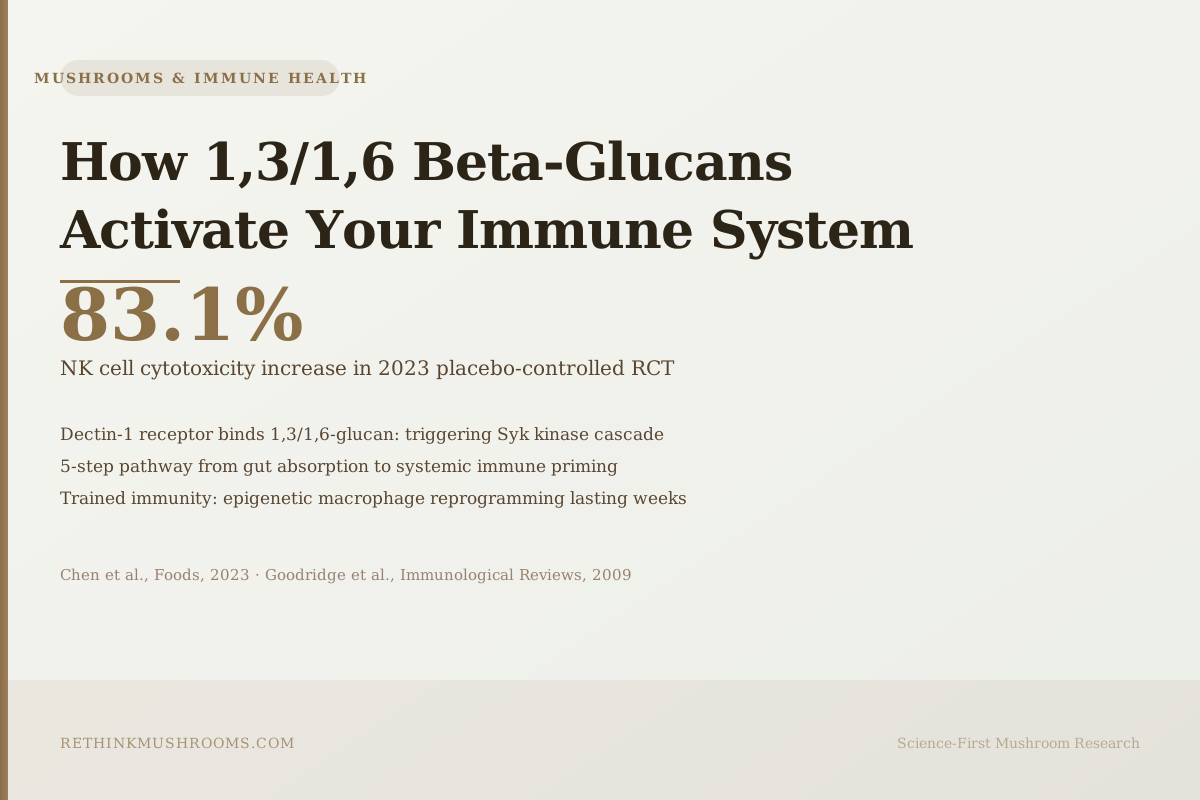
83.1% NK cell cytotoxicity increase
A 2023 placebo-controlled trial found reishi beta-1,3/1,6-glucan increased natural killer cell cytotoxicity by 83.1% in healthy adults. The mechanism behind this result is a precise molecular pathway from gut absorption to immune cell activation — not a vague 'immune boost.'
Chen et al., Foods, 2023
2
primary immune receptors recognizing beta-glucan (Dectin-1 and CR3)
5+
steps from swallowing to systemic immune activation
2022
year trained immunity was formally linked to Dectin-1 signaling
Chen et al., Foods, 2023
 View as image ↗
In 2023, Chen and colleagues ran a placebo-controlled trial in healthy adults testing reishi-derived beta-1,3/1,6-glucan against a placebo.[1] The glucan group ended the trial with significantly more CD3+, CD4+, and CD8+ T-lymphocytes than the placebo group. Their natural killer (NK) cell cytotoxicity — the ability of these cells to destroy infected or abnormal cells — increased by 83.1% compared to placebo.
That number is unusually large for a clinical nutrition trial. To understand why it happens requires tracing the molecular mechanism from the moment a mushroom beta-glucan enters the digestive system to the moment immune cells change their behavior. That is what this article does.
This is the mechanistic companion to Mushroom Beta-Glucans and Immunity: The Complete Research Guide, which covers the full clinical evidence base. This article focuses on the biology.
Key Takeaways
- "1,3/1,6" describes the molecular architecture of the beta-glucan chain: a β-1,3-linked glucose backbone with β-1,6-linked side branches; early work by Okazaki et al. (1995) established that this structural configuration directly determines immune-stimulating potency
- Beta-glucans are not absorbed intact; they are recognized by receptors in the intestinal wall, transported to lymph nodes and spleen, then degraded into smaller fragments that bind a second receptor (CR3) on NK cells and neutrophils throughout the body (De Marco Castro et al., 2021)
- Dectin-1 is the primary receptor recognizing fungal beta-glucans; when it binds a beta-glucan chain, it activates Syk kinase inside the cell, which triggers a signaling chain ending in cytokine production and phagocytosis (Goodridge et al., 2009)
- A 2023 structural biology study showed that Dectin-1 signaling strength depends directly on beta-glucan chain length, branching frequency, and surface exposure — not all 1,3/1,6 glucans signal equally (Anaya et al., Biophysical Journal, 2023)
- Trained immunity: Dectin-1 activation by beta-glucans triggers epigenetic changes in macrophage gene accessibility, programming them to respond more aggressively to future immune threats for weeks after the initial exposure (Mata-Martínez et al., Frontiers in Immunology, 2022)
- The Chen 2023 RCT (+83.1% NK cytotoxicity) is the human confirmation point; the preclinical mechanism explains why the effect is biologically plausible
What 1,3/1,6 Actually Means: The Molecular Architecture That Determines Immune Activity
Beta-glucan is a polymer made of glucose molecules. It is different from the glucose in sugar or starch, not because the building blocks are different (they are both glucose), but because of how those glucose units are connected.
In most starches, glucose units link at their 1 and 4 carbon positions. The result is a chain the human digestive system can break down and use for energy. In beta-glucans, the primary linkage is at the 1 and 3 carbon positions. Human enzymes cannot break this bond efficiently. The chain passes intact into the gut where immune cells, not digestive enzymes, are the relevant recipients.
The "1,6" in the name refers to the branching points. At every few backbone connections, a side chain branches off at the 1 and 6 position. The result is a three-dimensional structure: a long 1,3-linked spine with short 1,6-linked arms protruding from it at intervals.
This architecture matters because of how immune receptors work. Innate immune cells evolved to detect structural patterns associated with pathogens. The specific 1,3/1,6 branching configuration appears on fungal cell walls. It does not appear on mammalian cells. That asymmetry is what makes it a reliable signal of fungal presence — and exactly why the immune system evolved to recognize it.
How much branching there is, and how long the backbone chains are, affects potency. A 1995 study by Okazaki and colleagues published in Biological & Pharmaceutical Bulletin was among the first to demonstrate this directly: different conformations and molecular weights of β-1,3-glucan produced different levels of cytokine induction from macrophages.[2] More branched structures produced stronger signals. Higher molecular weight was associated with stronger activation up to a point.
A 2018 comprehensive review by Jin and colleagues in Vaccine formalized this into a structure-activity relationship for beta-glucan immune adjuvants.[3] The key variables: degree of branching, molecular weight, water solubility, and chain conformation. All affect how well the immune system responds. The practical implication: mushroom beta-glucan products differ in potency not just because of dose, but because of structural differences in the glucan chains themselves. For the research on how these structural variables compare across mushroom, yeast, and oat sources, see Beta-Glucan Structure and Immune Potency: Why Molecular Weight and Branching Matter.
How Beta-Glucans Travel from Your Gut to Your Immune Cells: The Step-by-Step Pathway
One of the most commonly misunderstood aspects of beta-glucan biology is that these chains are not absorbed into the bloodstream intact. The activation pathway is more specific than that.
De Marco Castro and colleagues published a comprehensive review of this pathway in Molecular Nutrition & Food Research in 2021.[4] The sequence works like this:
- Ingestion. Beta-glucan chains (as part of food or a supplement) enter the stomach and small intestine.
- GI survival. Beta-glucans resist digestion by human enzymes. The 1,3-linkage is stable in the human gut environment.
- Intestinal recognition. Macrophages and dendritic cells embedded in the intestinal wall detect beta-glucan chains via surface receptors, primarily Dectin-1 (covered in the next section).
- Cellular uptake and transport. The intestinal immune cells engulf the beta-glucan chains and transport them through the intestinal barrier into the lymphatic and circulatory systems.
- Distribution. The beta-glucan-loaded immune cells travel to lymph nodes, spleen, and bone marrow.
- Fragmentation. In these secondary lymphoid organs, the beta-glucan chains are broken down into smaller fragments inside macrophages.
- Systemic priming. These smaller fragments are released and bind to complement receptor 3 (CR3), a second immune receptor expressed on the surface of NK cells, neutrophils, and monocytes throughout the body.
- Enhanced killing. CR3-primed NK cells and neutrophils are now in a heightened state of readiness, more capable of killing infected cells, tumor cells, or pathogens when they encounter them.
This two-step system — Dectin-1 for initial gut-level recognition, CR3 for systemic priming of circulating killer cells — is the complete absorption-to-activation pathway. It explains why the immune effect of beta-glucans is not localized to the gut but extends throughout the body.
Dectin-1: The Receptor Your Immune Cells Use to Detect Fungal Cell Wall Material
Dectin-1 (Dendritic Cell-Associated C-type Lectin 1) is a pattern recognition receptor found on the surface of macrophages, dendritic cells, neutrophils, and monocytes. "Pattern recognition" means it does not need to be pre-trained to a specific pathogen — it recognizes a structural class of molecules.
The structural class Dectin-1 is tuned to: the β-1,3/1,6-glucan configuration found in fungal cell walls.
Goodridge and colleagues published a comprehensive mechanistic review of this receptor in Immunological Reviews in 2009.[5] When a beta-glucan chain contacts the Dectin-1 receptor, the receptor undergoes a conformational change. This physical change inside the receptor activates two signaling proteins: Syk kinase (an enzyme that kicks off a cascade of intracellular signals) and Raf-1 (another kinase that contributes to cytokine regulation).
The result is phagocytosis of the beta-glucan (the cell engulfs it), production of reactive oxygen species (a direct antimicrobial weapon), and secretion of cytokines — the signaling proteins that coordinate the broader immune response.
The three key cytokines produced: TNF-alpha (tumor necrosis factor, which drives inflammation and macrophage activation), IL-6 (interleukin-6, which activates T cells and B cells), and IL-12 (which drives the maturation of naive T cells toward the Th1 response profile, important for fighting intracellular pathogens).
Dectin-1 is primarily expressed by innate immune cells. This means the activation it triggers does not require prior exposure to a specific pathogen — it responds to the structural signature of fungal cell walls as a class, regardless of whether the immune system has encountered that specific fungus before. For a full deep-dive into Dectin-1 biology including its role in trained immunity, see The Dectin-1 Receptor: How Your Body Recognizes Mushroom Beta-Glucans.
The Signaling Cascade: What Happens Inside the Cell in the Seconds After Dectin-1 Binds
The binding of beta-glucan to Dectin-1 starts a cascade of molecular events that unfolds over seconds to minutes inside the immune cell.
Batbayar and colleagues published a detailed map of this cascade in Biomolecules & Therapeutics in 2012.[6] The sequence:
Step 1: Syk kinase activation. Dectin-1's cytoplasmic tail (the part that hangs inside the cell) contains a docking site. When beta-glucan binds the outside of Dectin-1, the cytoplasmic tail recruits and activates Syk kinase. Syk is the first domino in the signaling chain.
Step 2: CARD9 recruitment. Syk kinase phosphorylates (chemically tags) an adapter protein called CARD9. This tag is the signal that tells CARD9 to relay the activation signal further into the cell.
Step 3: NF-kB activation. CARD9 activates a transcription factor called NF-kB (nuclear factor kappa B). A transcription factor is a protein that enters the cell nucleus and determines which genes get switched on. When NF-kB enters the nucleus, it switches on genes for pro-inflammatory cytokines: TNF-alpha, IL-6, IL-12, and IL-23.
Step 4: Cytokine production and secretion. The cell manufactures and releases these cytokines. TNF-alpha recruits more immune cells to the site and activates macrophages. IL-6 activates adaptive immune cells. IL-12 drives T cell development toward a type suited for fighting pathogens.
Step 5: Downstream immune coordination. The cytokines released by the beta-glucan-activated macrophage communicate with NK cells, neutrophils, T cells, and B cells, coordinating a broader immune response.
Lee and Kim published a review specifically mapping this process in medicinal mushroom beta-glucans in the International Journal of Medicinal Mushrooms in 2014.[7] They traced the NF-kB, MAPK (another signaling pathway), and IRF (interferon regulatory factor) cascades activated downstream of Dectin-1 in the context of mushroom polysaccharides, confirming the same pathway operates specifically for the beta-glucan structures found in medicinal mushrooms.
The 2023 Insight: Why Not All 1,3/1,6 Beta-Glucans Signal Equally
If Dectin-1 recognizes the 1,3/1,6 configuration, why do different mushroom beta-glucan products produce different immune effects? The answer lies in the details of molecular structure.
Anaya and colleagues published a study in Biophysical Journal in 2023 specifically examining how Dectin-1 multimerization (the clustering of multiple Dectin-1 receptors together) depends on the beta-glucan structure.[8]
The key finding: Dectin-1 signaling potency is not binary. It does not simply fire or not fire. It fires more strongly when beta-glucan chains have certain physical properties: longer backbone chains, higher branching frequency, and greater surface exposure on the glucan source.
The mechanism involves how many Dectin-1 receptors cluster together on the cell surface when beta-glucan is present. A longer, more branched beta-glucan chain can bridge and cluster more Dectin-1 receptors simultaneously. More receptors clustered together means a stronger combined signal sent into the cell.
This explains several observations that were previously puzzling:
- Why yeast-derived beta-glucans tend to produce stronger immune effects than oat-derived beta-glucans, despite both being beta-glucans: the yeast version has a higher branching frequency.
- Why the same mushroom species can produce different immune effects depending on extraction method: methods that break up or shorten the glucan chains reduce their ability to cluster Dectin-1 receptors.
- Why molecular weight varies in importance: too small and the chain cannot cluster enough receptors; too large and it may not be soluble enough to contact the receptor efficiently.
The practical implication for evaluating mushroom supplements: chain length and branching, not just the presence of beta-glucan, determine how strongly the immune signal fires. For a detailed comparison of how extraction methods and source species affect beta-glucan structure, see Beta-Glucans from Mushrooms vs. Yeast vs. Oats: Which Are Most Effective?.
Trained Immunity: How Beta-Glucans Reprogram Macrophages for Weeks
The classical understanding of immune memory was that only adaptive immune cells (T and B lymphocytes) could form lasting memory. Innate immune cells — macrophages, NK cells, neutrophils — were thought to respond the same way every time, with no memory of prior activation.
This view changed. Beta-glucans are the primary evidence for a phenomenon called trained immunity: the capacity of innate immune cells to form a type of functional memory after certain stimulations.
Mata-Martínez and colleagues published a comprehensive 2022 review in Frontiers in Immunology specifically examining the connection between Dectin-1 signaling and trained immunity.[9]
The mechanism: when Dectin-1 is activated by beta-glucan, the downstream signaling cascade does not simply trigger cytokine production and stop. In some circumstances, particularly in macrophages, the signaling reaches the nucleus and triggers epigenetic changes in gene regulatory regions.
Epigenetic changes are modifications to the physical accessibility of DNA, without changing the DNA sequence itself. When a gene regulatory region becomes more physically open (accessible), the genes it controls are more easily switched on. When the region becomes less accessible, those genes are harder to activate.
Beta-glucan exposure via Dectin-1 increases the accessibility of gene regulatory regions that control immune response genes. This change persists for weeks after the initial beta-glucan exposure. The result: a macrophage that was exposed to beta-glucan three weeks ago is faster and stronger in its cytokine response when it encounters a bacterial or fungal challenge today than a macrophage that was never exposed.
This is trained immunity: innate immune cells that have been epigenetically reprogrammed to respond more aggressively to future threats, without needing to learn anything specific about those threats.
The Mata-Martínez 2022 review frames this in the context of Dectin-1 signaling specifically. The molecular pathway is: beta-glucan binds Dectin-1, Syk/CARD9 signaling activates Akt and mTOR kinases (metabolic regulators that influence epigenetic enzyme activity), which in turn modify histone proteins around immune gene regulatory regions, increasing their accessibility. The macrophage is functionally reprogrammed.
For the deeper science on how this epigenetic reprogramming works and what it means for long-term immune function, see Trained Immunity and Mushroom Beta-Glucans: Reprogramming Innate Immune Memory.
What Happens in Real Human Immune Systems: Clinical Evidence
The mechanistic pathway above is built on in-vitro and in-vivo animal work. The question is whether the same cascade produces measurable effects in human immune systems.
The Chen 2023 RCT (RTHM-00925) is the strongest single piece of clinical evidence for the mechanism's human relevance.[1] Healthy adult volunteers were randomized to receive reishi-derived beta-1,3/1,6-D-glucan or placebo. After the supplementation period:
- CD3+ T lymphocyte counts increased significantly in the glucan group
- CD4+ helper T cell counts increased
- CD8+ cytotoxic T cell counts increased
- NK cell counts increased
- NK cell-mediated cytotoxicity increased by 83.1% in the glucan group versus placebo
This is not an outcome in sick people who needed immune support. These were healthy adults whose immune cell populations expanded and whose NK cell killing ability nearly doubled. The result directly demonstrates that the Dectin-1 pathway and its downstream cascade operate in human immune systems under real-world supplementation conditions.
Akramiene and colleagues, in an earlier 2007 review of beta-glucan immunology in Medicina (Kaunas), summarized the pre-existing evidence base supporting the mechanism: beta-glucans activate the complement system (a protein cascade in blood that marks pathogens for destruction), enhance macrophage phagocytosis and cytokine production, and increase NK cell activity.[10] The Chen 2023 RCT adds human controlled trial data to confirm what the mechanistic studies predicted.
The honest limitation: Chen 2023 used reishi-derived beta-glucan specifically. Whether other mushroom species with different beta-glucan structures produce equivalent effects in healthy adults has not been tested in similarly designed trials. The mechanism is the same across species, but the structural differences that Anaya 2023 identified as affecting signaling strength mean the potency may vary.
The Bottom Line
Beta-1,3/1,6-glucans activate immunity through a precise multi-step pathway: gut macrophages recognize the specific branching structure via Dectin-1 receptors, triggering Syk kinase signaling and downstream cytokine production; smaller fragments are transported to lymph nodes and spleen where they prime NK cells and neutrophils via a second receptor (CR3); and in macrophages, the Dectin-1 activation cascade can trigger epigenetic reprogramming that persists for weeks, creating trained innate immune memory. The structural features of the beta-glucan chain (branching frequency, chain length, surface exposure) directly determine how strongly Dectin-1 signals. A 2023 RCT in healthy adults showed that reishi beta-1,3/1,6-glucan increased NK cell cytotoxicity by 83.1%, providing human confirmation of the mechanistic pathway.
Frequently Asked Questions
Sources & References
- 1RTHM-01673·Chen, Shiu-Nan et al. (2023). “Evaluation of Immune Modulation by β-1,3; 1,6 D-Glucan Derived from Ganoderma lucidum in Healthy Adult Volunteers, A Randomized Controlled Trial..” Foods (Basel.Study breakdown →PubMed →↩
- 2RTHM-00017·Okazaki, M et al. (1995). “Structure-activity relationship of (1-->3)-beta-D-glucans in the induction of cytokine production from macrophages, in vitro..” Biological & pharmaceutical bulletin.Study breakdown →PubMed →↩
- 3RTHM-00513·Jin, Yiming et al. (2018). “β-glucans as potential immunoadjuvants: A review on the adjuvanticity, structure-activity relationship and receptor recognition properties..” Vaccine.Study breakdown →PubMed →↩
- 4RTHM-01345·De Marco Castro, Elena et al. (2021). “β-1,3/1,6-Glucans and Immunity: State of the Art and Future Directions..” Molecular nutrition & food research.Study breakdown →PubMed →↩
- 5RTHM-00154·Goodridge, Helen S et al. (2009). “Beta-glucan recognition by the innate immune system..” Immunological reviews.Study breakdown →PubMed →↩
- 6RTHM-00244·Batbayar, Sainkhuu et al. (2012). “Immunomodulation of Fungal β-Glucan in Host Defense Signaling by Dectin-1..” Biomolecules & therapeutics.Study breakdown →PubMed →↩
- 7RTHM-00333·Lee, Dong Hee et al. (2014). “Innate immunity induced by fungal β-glucans via dectin-1 signaling pathway..” International journal of medicinal mushrooms.Study breakdown →PubMed →↩
- 8RTHM-00814·Anaya, Eduardo U et al. (2023). “Dectin-1 multimerization and signaling depends on fungal β-glucan structure and exposure..” Biophysical journal.Study breakdown →PubMed →↩
- 9RTHM-01584·Mata-Martínez, Pablo et al. (2022). “Dectin-1 Signaling Update: New Perspectives for Trained Immunity..” Frontiers in immunology.Study breakdown →PubMed →↩
- 10RTHM-00110·Akramiene, Dalia et al. (2007). “Effects of beta-glucans on the immune system..” Medicina (Kaunas.Study breakdown →PubMed →↩