Beta-Glucan Structure & Sources
3 source types
Mushroom, yeast, and oat beta-glucans share a name but differ in linkage chemistry, receptor binding, solubility, and documented health effects.
Cerletti et al., Nutrients, 2021
1,3/1,6 Linkages
mushroom and yeast beta-glucans
1,3/1,4 Linkages
oat and barley beta-glucans
25% Fewer Colds
yeast beta-glucan in 162-person RCT
Cerletti et al., Nutrients, 2021
 View as image ↗
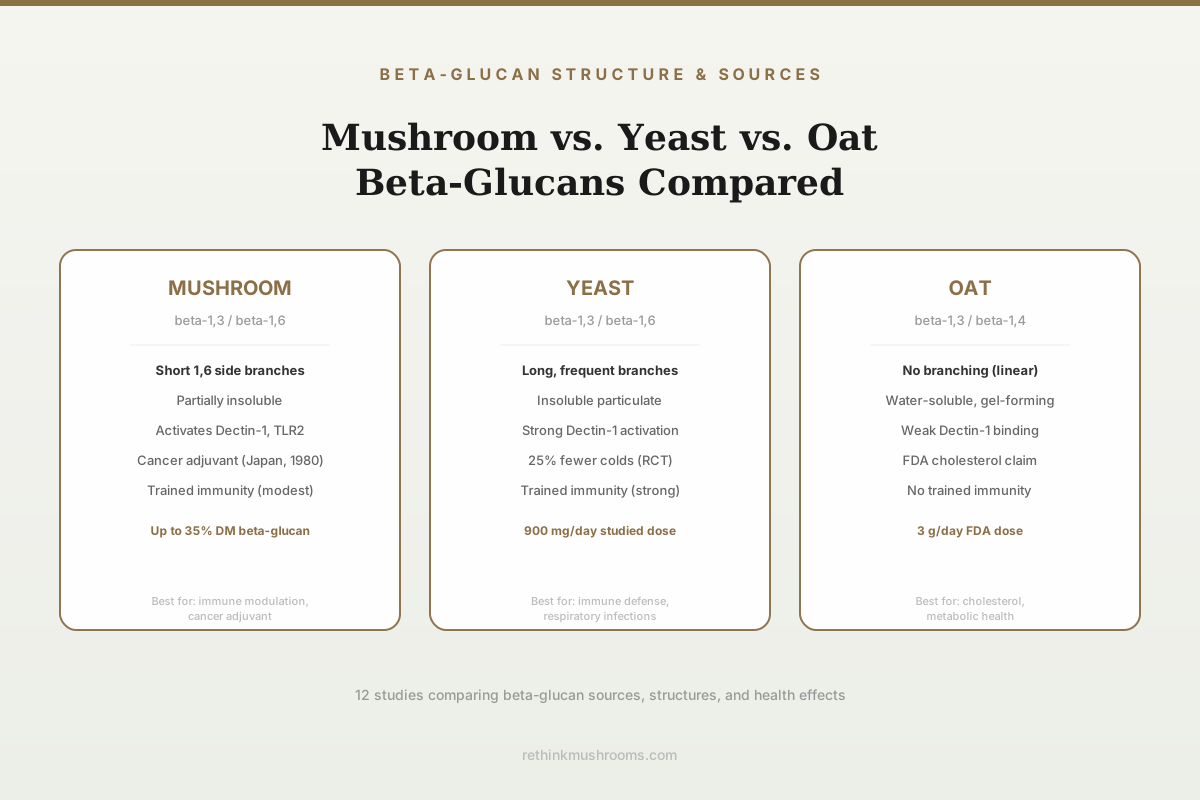
"Beta-glucan" is not one molecule. It is a family of glucose polymers with different linkage patterns, branching architectures, and biological effects depending on whether they come from mushrooms, yeast, or cereal grains. Cerletti et al. (2021) described the key structural divide: mushroom beta-glucans have beta-1,3 linear backbones with beta-1,6 side branches, while cereal beta-glucans (oat, barley) have mixed beta-1,3 and beta-1,4 linkages with no branching.[1] Yeast beta-glucans share the 1,3/1,6 linkage pattern with mushrooms but have longer, more complex branching networks. These structural differences determine which immune receptors each type activates, whether they lower cholesterol or stimulate innate immunity, and how the body processes them. This article compares all three head-to-head.
For detailed coverage of how branching patterns affect immune potency, see beta-glucan structure and immune potency. For molecular weight effects, see beta-glucan molecular weight and biological activity.
Key Takeaways
- Mushroom and yeast beta-glucans share 1,3/1,6 linkages and activate immune receptors (Dectin-1, CR3); oat beta-glucans have 1,3/1,4 linkages and primarily affect cholesterol and glucose metabolism (Cerletti et al., 2021)
- Yeast-derived beta-glucan stimulated phagocytic activity and release of 7 cytokines (IL-1, IL-2, IL-4, IL-6, IL-8, IL-13, TNF-alpha), outperforming lentinan from shiitake on several immune measures (Vetvicka et al., 2008)
- Yeast beta-glucan (900 mg/day) reduced common cold infections by 25% in a 162-person, 16-week RCT (P = 0.041) (Auinger et al., 2013)
- Branching ratio and molecular weight are the two primary structural factors determining cytokine production from macrophages (Okazaki et al., 1995)
- Wild mushrooms contain up to 35% beta-glucan by dry matter, with Tricholoma portentosum highest at 34.97 g/100 g (Mirończuk-Chodakowska & Witkowska, 2020)
- The FDA authorizes a cholesterol-lowering health claim for oat beta-glucans (3 g/day) but not for mushroom or yeast sources (Cerletti et al., 2021)
Structural Chemistry: Three Different Molecules
The term "beta-glucan" describes any polysaccharide made of glucose units connected by beta-glycosidic bonds. The position and pattern of those bonds creates fundamentally different molecules.
Mushroom beta-glucans have a linear backbone of beta-1,3-linked glucose units with short side chains attached through beta-1,6 bonds. These branches are typically short (one to three glucose units) and relatively infrequent. The resulting structure is partially insoluble and maintains a tertiary conformation that enables immune receptor binding.[1]
Yeast beta-glucans (from Saccharomyces cerevisiae) share the 1,3/1,6 linkage pattern but have longer and more frequent branches, creating a more complex, highly branched network. This branching density affects receptor binding and immune activation intensity.[2]
Oat and barley beta-glucans are structurally distinct from both. They have mixed beta-1,3 and beta-1,4 linkages with no beta-1,6 branches at all. This produces a linear, unbranched polymer that is water-soluble and forms viscous gels. These gels trap bile acids and cholesterol in the gut, which is why oat beta-glucans lower cholesterol, an effect mushroom and yeast beta-glucans have not replicated in human trials.[1][3]
Goodridge et al. (2009) reviewed how these structural differences determine receptor recognition. Dectin-1, the primary immune receptor for beta-glucans, recognizes the 1,3/1,6-linked structures found in mushroom and yeast sources. Oat beta-glucans, lacking the 1,6 branching, do not bind Dectin-1 with the same affinity and do not trigger the same immune activation cascade.[4]
Head-to-Head: Yeast vs. Mushroom Immune Effects
Vetvicka et al. (2008) conducted the most direct comparison. They tested yeast-derived beta-glucan (Betamune) against lentinan (from shiitake mushroom) using two administration routes (intraperitoneal and oral) in two animal models. The yeast-derived beta-glucan caused stimulation of phagocytic activity and potentiated synthesis and release of seven cytokines: IL-1, IL-2, IL-4, IL-6, IL-8, IL-13, and TNF-alpha. The yeast preparation also inhibited tumor cell growth in vivo and affected gene expression in breast cancer cells.[5]
Lentinan showed some immune effects but was outperformed by the yeast preparation on multiple measures. The authors attributed the difference to structural characteristics: the yeast beta-glucan's more extensive branching network provides more binding sites for immune receptors.[5]
However, this comparison has limitations. Lentinan is a single purified polysaccharide from one mushroom species. Other mushroom beta-glucans, particularly from Agaricus bisporus, Grifola frondosa (maitake), and Trametes versicolor (turkey tail), have different branching patterns and may perform differently. Case et al. (2024) showed that A. bisporus beta-glucans trained both mouse macrophages and human monocytes, with the training response correlating directly with beta-glucan content in the preparation. The response was modest compared to purified yeast beta-glucan but present and dose-dependent.[6]
Volman et al. (2010) showed that immune activation varies substantially even between mushroom species. A. bisporus extracts stimulated nitric oxide production in bone marrow macrophages, while A. blazei and Phellinus linteus extracts had no effect at similar concentrations. The difference tracked with beta-glucan branching patterns rather than total beta-glucan content.[7]
The Structure-Activity Relationship
Okazaki et al. (1995) established the foundational structure-activity rules for beta-glucan immunology. Testing gel-forming 1,3-beta-D-glucans from Grifola frondosa (grifolan) against other glucan sources, they found that branching ratio and molecular weight are the two critical factors determining cytokine production from macrophages.[8]
Key findings:
Molecular weight matters. The highest molecular weight fraction of grifolan (Mr greater than 45,000) produced the strongest TNF-alpha release. Lower molecular weight fractions were less active.[8]
Branching ratio matters, but not in the direction you might expect. High-molecular-weight SSG (Mr greater than 2,000,000) did not induce cytokine production. But when SSG was chemically modified to remove some side-chain glucose residues (debranching), it gained TNF-alpha-inducing activity. This means beta-glucans with lower branching ratios and high molecular weight are the most potent cytokine inducers. Heavily branched structures may actually shield the 1,3-backbone from receptor recognition.[8]
Triple-helix conformation does not affect activity. The ultrastructure of gel-forming glucans (triple-helix vs. single-helix) did not determine cytokine-inducing capacity.[8]
This complicates the simple narrative that "more branching = more activity." The relationship is non-linear: some branching is necessary for solubility and receptor access, but excessive branching may reduce bioactivity. For more on how molecular weight influences biological effects, see how 1,3/1,6 beta-glucans activate your immune system.
Different Strengths: What Each Source Does Best
Oat Beta-Glucans: Cholesterol and Metabolic Health
Oat beta-glucans have the strongest human clinical evidence base, but for metabolic effects, not immune function. The FDA authorized a health claim that 3 g/day of oat or barley beta-glucan reduces cardiovascular risk. Sima et al. (2018) reviewed the cholesterol-lowering mechanisms: soluble beta-glucans increase chyme viscosity, physically trapping bile acids and reducing their reabsorption. This forces the liver to use circulating cholesterol to synthesize new bile acids.[3]
Oat beta-glucans do not activate Dectin-1 or other immune pattern recognition receptors with the same potency as fungal sources. Their health benefits are primarily mechanical (gel formation in the gut) and metabolic (SCFA production), not immunological.[1]
Yeast Beta-Glucans: Immune Defense
Yeast beta-glucans have the most clinical evidence for immune function. Auinger et al. (2013) conducted a double-blind, randomized, placebo-controlled trial in 162 healthy subjects. Insoluble yeast 1,3/1,6-beta-glucan at 900 mg/day for 16 weeks reduced common cold infections by 25% compared to placebo (P = 0.041). Sleep difficulties caused by cold episodes were also reduced (P = 0.028).[9]
Dharsono et al. (2019) replicated and extended these findings in a larger RCT (n = 299). Yeast beta-glucan at 900 mg/day did not reduce overall cold incidence, but physical symptom severity during the first week of infection was lower across all measured time intervals up to 7 days (P values ranging from 0.025 to 0.047). Mood and blood pressure also improved.[10]
Mushroom Beta-Glucans: Immune Modulation and Beyond
Mushroom beta-glucans occupy a middle ground: they share the immune-activating 1,3/1,6 linkage pattern with yeast but are delivered in a whole-food matrix containing additional bioactive compounds (ergothioneine, polyphenols, chitin, triterpenes). Murphy et al. (2020) reviewed beta-glucan clinical applications, noting that two mushroom-derived beta-glucans (lentinan and schizophyllan) were licensed as drugs in Japan in 1980 for cancer adjuvant therapy, making them the earliest clinical applications of beta-glucan immunomodulation.[11]
Mirończuk-Chodakowska and Witkowska (2020) quantified beta-glucan content across 21 mushroom species. Wild mushrooms contained up to 34.97 g/100 g dry matter (Tricholoma portentosum), comparable to or exceeding beta-glucan concentrations in commercial supplements. Commercial mushrooms (A. bisporus, L. edodes, P. ostreatus) contained lower but still substantial amounts.[12]
The limitation for mushroom beta-glucans: human immune clinical trials are sparse compared to yeast sources. The cancer adjuvant trials use purified mushroom polysaccharides, not whole mushroom consumption. For the emerging evidence on mushroom beta-glucan immune training, see beta-glucans and innate immune memory. For a broader view of the mushroom immune research landscape, see mushroom beta-glucans and immunity: the complete research guide.
The Bottom Line: Different Tools for Different Jobs
The question "which beta-glucan is most effective?" has no single answer because effectiveness depends on the outcome being measured.
For cholesterol reduction: oat beta-glucans have the strongest evidence and an FDA-authorized health claim. Mushroom beta-glucans show preclinical promise but lack human clinical confirmation for lipid outcomes.
For immune defense against respiratory infections: yeast beta-glucans have the best human RCT evidence, with two trials showing reduced cold severity and/or incidence at 900 mg/day.
For immune modulation and cancer adjuvant therapy: mushroom-derived beta-glucans (lentinan, schizophyllan) have the longest clinical history, licensed as drugs in Japan since 1980.
For trained immunity: both mushroom and yeast beta-glucans can reprogram innate immune cells, though yeast preparations produce stronger training responses in head-to-head comparisons.
These are not competing molecules. They are complementary tools with distinct mechanisms arising from their structural chemistry. For Dectin-1 receptor biology, see the Dectin-1 receptor: how your body recognizes mushroom beta-glucans.
The Bottom Line
Mushroom, yeast, and oat beta-glucans are structurally distinct molecules with different biological activities. Mushroom and yeast beta-glucans (1,3/1,6 linkages) activate immune receptors like Dectin-1 and drive trained immunity; oat beta-glucans (1,3/1,4 linkages) lower cholesterol through viscous gel formation in the gut. In head-to-head immune comparisons, yeast beta-glucans produce stronger acute responses than mushroom sources, though mushroom-derived preparations have the longest clinical track record as licensed cancer adjuvant drugs. The key takeaway: beta-glucan source determines function, and "beta-glucan" on a label without source specification tells you very little about what it will do.
Frequently Asked Questions
Sources & References
- 1RTHM-00676·Cerletti, Chiara et al. (2021). “Edible Mushrooms and Beta-Glucans: Impact on Human Health..” Nutrients.Study breakdown →PubMed →↩
- 2RTHM-00513·Jin, Yiming et al. (2018). “β-glucans as potential immunoadjuvants: A review on the adjuvanticity, structure-activity relationship and receptor recognition properties..” Vaccine.Study breakdown →PubMed →↩
- 3RTHM-00531·Sima, Petr et al. (2018). “β-glucans and cholesterol (Review)..” International journal of molecular medicine.Study breakdown →PubMed →↩
- 4RTHM-00154·Goodridge, Helen S et al. (2009). “Beta-glucan recognition by the innate immune system..” Immunological reviews.Study breakdown →PubMed →↩
- 5RTHM-00148·Vetvicka, Vaclav et al. (2008). “Immunological effects of yeast- and mushroom-derived beta-glucans..” Journal of medicinal food.Study breakdown →PubMed →↩
- 6RTHM-00867·Case, Sarah et al. (2024). “β-glucans from Agaricus bisporus mushroom products drive Trained Immunity..” Frontiers in nutrition.Study breakdown →PubMed →↩
- 7RTHM-00200·Volman, Julia J et al. (2010). “Effects of mushroom-derived beta-glucan-rich polysaccharide extracts on nitric oxide production by bone marrow-derived macrophages and nuclear factor-kappaB transactivation in Caco-2 reporter cells: can effects be explained by structure?.” Molecular nutrition & food research.Study breakdown →PubMed →↩
- 8RTHM-00017·Okazaki, M et al. (1995). “Structure-activity relationship of (1-->3)-beta-D-glucans in the induction of cytokine production from macrophages, in vitro..” Biological & pharmaceutical bulletin.Study breakdown →PubMed →↩
- 9RTHM-00278·Auinger, Annegret et al. (2013). “Yeast (1,3)-(1,6)-beta-glucan helps to maintain the body's defence against pathogens: a double-blind, randomized, placebo-controlled, multicentric study in healthy subjects..” European journal of nutrition.Study breakdown →PubMed →↩
- 10RTHM-00550·Dharsono, Tanita et al. (2019). “Effects of Yeast (1,3)-(1,6)-Beta-Glucan on Severity of Upper Respiratory Tract Infections: A Double-Blind, Randomized, Placebo-Controlled Study in Healthy Subjects..” Journal of the American College of Nutrition.Study breakdown →PubMed →↩
- 11RTHM-00639·Murphy, Emma J et al. (2020). “β-Glucan Metabolic and Immunomodulatory Properties and Potential for Clinical Application..” Journal of fungi (Basel.Study breakdown →PubMed →↩
- 12RTHM-00637·Mirończuk-Chodakowska, Iwona et al. (2020). “Evaluation of Polish wild Mushrooms as Beta-Glucan Sources..” International journal of environmental research and public health.Study breakdown →PubMed →↩