Trained Immunity & Beta-Glucans
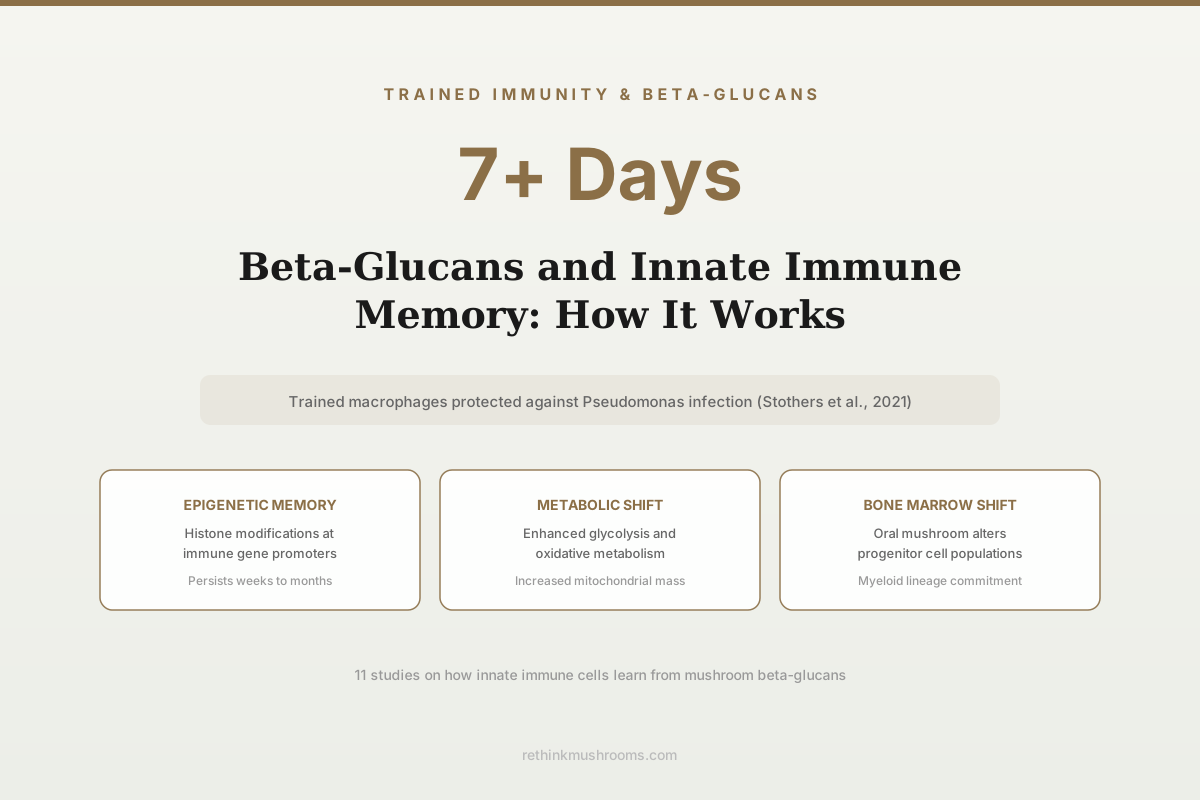
7+ days protection
Beta-glucan-trained macrophages protected mice from Pseudomonas aeruginosa infection for more than 7 days after a single exposure.
Stothers et al., Journal of Immunology, 2021
Epigenetic Memory
histone modifications persist weeks
Bone Marrow Shift
oral mushroom changed progenitor cells
Dectin-1 Independent
trained immunity bypasses classic receptor
Stothers et al., Journal of Immunology, 2021
 View as image ↗
Classical immunology taught that only adaptive immune cells (T cells, B cells) could remember past threats. Innate immune cells like macrophages and monocytes were considered generic responders with no capacity for memory. That model is wrong. A 2021 study in the Journal of Immunology demonstrated that beta-glucan reprograms macrophages into a trained state with enhanced phagocytosis, reactive oxygen species production, and sustained metabolic changes that persist for more than 7 days and protect against bacterial infections.[1] In 2024, Case et al. showed that beta-glucans from common Agaricus bisporus (white button mushrooms) can drive this same trained immunity, and that oral mushroom consumption alters bone marrow progenitor cell populations in mice.[2]
For how beta-glucan structure influences immune activation, see beta-glucan molecular weight and biological activity. For anti-tumor applications, see beta-glucans and anti-tumor immunity.
Key Takeaways
- Beta-glucan-trained macrophages adopted an antimicrobial phenotype with enhanced phagocytosis, ROS production, and sustained glycolytic and oxidative metabolism for over 7 days (Stothers et al., 2021)
- White button mushroom (Agaricus bisporus) beta-glucans trained both mouse macrophages and human monocytes, with enhanced responses to TLR2 restimulation (Case et al., 2024)
- Oral mushroom powder shifted bone marrow hematopoietic stem and progenitor cells toward myeloid-committed lineages in mice, altering immune cell production at the source (Case et al., 2024)
- Trained immunity was independent of the classical beta-glucan receptors Dectin-1 and TLR-2, proceeding through alternative pathways (Stothers et al., 2021)
- Agaricus blazei activated the NLRP3 inflammasome in human macrophages via multiple mechanisms including ATP release, cathepsin B, ROS generation, and potassium efflux (Huang et al., 2012)
- Beta-glucan branching structure determines immune-stimulating activity: Agaricus bisporus extracts activated bone marrow macrophages while Agaricus blazei extracts at similar concentrations did not (Volman et al., 2010)
What Is Trained Immunity?
For most of immunology's history, the innate immune system was considered a blunt instrument. Macrophages, monocytes, neutrophils, and natural killer cells responded to threats but could not learn from them. Only T and B cells of the adaptive immune system could build lasting memory through clonal expansion and antibody production.
Trained immunity overturns this framework. When innate immune cells encounter certain stimuli, including beta-glucans from fungal cell walls, they undergo epigenetic and metabolic reprogramming that enhances their response to future, unrelated challenges. This is not antigen-specific memory like a vaccine produces. It is a general state of heightened readiness that makes the trained cell a more effective defender against a broad range of pathogens.[1]
Beta-glucan is the most studied inducer of trained immunity. Murphy et al. (2020) reviewed the dual nature of beta-glucan biology: these polysaccharides act both as metabolic fibers in the gut and as immune signals recognized by innate immune receptors. Their capacity to reprogram innate immune cells has been investigated as potential therapy for infections, cancer adjuvant treatment, and immune recovery after surgery.[3]
For how this trained immunity concept applies to whole mushroom species, see mushrooms and trained immunity: the new frontier. For the epigenetic details, see how beta-glucans epigenetically reprogram immune cells.
How Beta-Glucans Reprogram Macrophages
Stothers et al. (2021) mapped the reprogramming process in differentiated macrophages. After exposure to beta-glucan, mouse bone marrow-derived macrophages assumed an antimicrobial phenotype with three measurable changes.[1]
Enhanced antimicrobial function. Trained macrophages showed increased phagocytosis and reactive oxygen species (ROS) production. These are the cell's core weapons against bacteria and fungi.
Metabolic reprogramming. Trained macrophages displayed sustained enhancements in both glycolytic and oxidative metabolism, along with increased mitochondrial mass and membrane potential. This metabolic shift provides the energy needed to maintain the heightened functional state.[1]
Altered transcriptome. Beta-glucan induced broad transcriptomic changes: early activation of inflammatory response genes, followed by sustained alterations in transcripts associated with metabolism, cellular differentiation, and antimicrobial function. Trained macrophages constitutively secreted CCL chemokines and produced robust proinflammatory cytokines (TNF-alpha, IL-6) upon LPS rechallenge.[1]
The functional proof: adoptive transfer of beta-glucan-trained macrophages into naive mice conferred protection against Pseudomonas aeruginosa infection comparable to that seen in mice that received beta-glucan directly. The macrophages alone carried the protective memory.[1]
Mushroom Beta-Glucans Drive Trained Immunity
Most trained immunity research uses purified yeast-derived beta-glucan. The question for this site: do mushroom-derived beta-glucans do the same thing?
Case et al. (2024) answered with the first direct evidence. Using various powdered forms of Agaricus bisporus (white button mushroom), they found that whole mushroom powder (WMP) trained mouse macrophages to display enhanced responses when restimulated with TLR ligands. The trained cells were particularly sensitive to TLR2 stimulation using synthetic lipopeptides.[2]
Three findings from this study stand out:
The training response correlated with beta-glucan content. The trained response from WMP was modest compared to purified yeast beta-glucan, but it correlated directly with the amount of available beta-glucans in the preparation. Enriching for beta-glucans using either simulated in-vitro digestion or chemical fractionation retained and boosted the trained response, respectively.[2]
Human monocytes were also trained. Both WMP and digestion-simulated preparations trained human monocytes (not just mouse cells) and enhanced their responses to restimulation. NMR analysis confirmed that beta-glucans were retained through the digestion process.[2]
Oral mushroom altered bone marrow progenitors. When mice received WMP by oral gavage, flow cytometric analysis of bone marrow revealed alterations in hematopoietic stem and progenitor cell populations, with a shift toward myeloid-committed multipotent progenitor cells. Mature bone marrow-derived macrophages from these mice displayed enhanced responses to restimulation. This means dietary mushroom consumption reprogrammed immune cell production at its source.[2]
From Receptor to Response: The Recognition Pathway
Innate immune cells detect beta-glucans through pattern recognition receptors. Goodridge et al. (2009) reviewed the primary beta-glucan receptors on macrophages and dendritic cells: Dectin-1, complement receptor 3, and TLR-2/6. Dectin-1 is the most extensively studied, translating beta-glucan recognition into intracellular signaling and orchestrating adaptive immune responses.[4]
Lee et al. (2014) detailed the Dectin-1 signaling cascade specific to fungal beta-glucans. Upon binding beta-glucan, Dectin-1 activates Syk kinase, which triggers NF-kB and NFAT transcription factors. These drive production of pro-inflammatory cytokines (IL-4, IL-6, TNF-alpha) that activate both innate and adaptive immune cells. Water-insoluble beta-glucans showed stronger immunostimulating activities than water-soluble forms.[5]
Batbayar et al. (2012) described how fungal beta-glucans, despite their large size, are taken up by M cells of Peyer's patches in the gut, interact with macrophages or dendritic cells, and activate systemic immune responses. Dectin-1 performs dual functions on these cells: internalizing beta-glucan particles and transmitting activation signals into the nucleus.[6]
A surprising finding from Stothers et al. (2021): the induction of trained immunity was independent of Dectin-1 and TLR-2, the two classic beta-glucan receptors. This means trained immunity and acute immune activation proceed through different pathways. The receptor(s) responsible for trained immunity remain unidentified.[1]
Species-Specific Immune Activation
Different mushroom species activate innate immune cells to different degrees. The structural details of their beta-glucans determine the response.
Volman et al. (2010) tested polysaccharide extracts from five edible mushroom species on bone marrow-derived macrophages and intestinal Caco-2 cells. Agaricus bisporus extracts stimulated nitric oxide production by macrophages, while extracts from Coprinus comatus and Ganoderma lucidum spores had only minor effects. Agaricus blazei and Phellinus linteus extracts had no effect at all. Structural analysis suggested that branching of the beta-glucan chain is essential for immune-stimulating activity.[7]
Smiderle et al. (2011) compared polysaccharides from A. bisporus and A. brasiliensis on human THP-1 monocytes. Despite major differences in composition (A. bisporus had more mannogalactan, A. brasiliensis had more beta-glucan), both species induced comparable increases in transcription of IL-1beta, TNF-alpha, and COX-2. The A. brasiliensis extract reduced LPS-induced cytokine production when added simultaneously, suggesting programmable immunomodulation.[8]
Huang et al. (2012) documented a specific activation pathway for Agaricus blazei in human THP-1 macrophages: the NLRP3 inflammasome. A. blazei water extract triggered NLRP3 inflammasome-mediated IL-1beta secretion through multiple mechanisms, including ATP release and binding to the P2X7 receptor, cathepsin B release, ROS generation, and potassium efflux. Cells deficient in NLRP3 or the adaptor protein ASC showed markedly reduced IL-1beta secretion.[9]
Martins et al. (2017) showed that Agaricus brasiliensis polysaccharides enhanced human monocyte capture of Candida albicans cells, upregulated TLR2 and TLR4 expression, and increased production of TNF-alpha and IL-1beta. TLR4 expression correlated with TNF-alpha production, while TLR2 correlated with IL-1beta.[10] For more on Agaricus species immunity, see Agaricus blazei bioactive compounds and Agaricus blazei for immune-compromised patients.
Functional Outcomes: What Trained Cells Do
The practical test of trained immunity is whether reprogrammed cells actually fight infections better.
Stothers et al. (2021) showed that beta-glucan protected mice from Pseudomonas aeruginosa infection by augmenting recruitment of innate leukocytes to the site of infection and facilitating local bacterial clearance. This protection persisted for more than 7 days after the initial beta-glucan exposure.[1]
Masterson et al. (2020) tested purified lentinan (beta-glucan from shiitake mushroom) against multidrug-resistant Klebsiella pneumoniae in a rodent pneumonia model. Intravenous lentinan administered 1 hour post-infection decreased bacterial colony counts in bronchoalveolar lavage, reduced protein concentration (a marker of lung injury), and improved physiological parameters compared to controls. The effect was attributed to immunomodulation rather than direct antibacterial activity.[11]
For how trained immunity may contribute to anti-tumor defense, see beta-glucans and anti-tumor immunity. For duration and practical implications, see trained immunity: why mushroom benefits may be long-lasting.
Where the Evidence Stands
The trained immunity field is young (the term was coined in 2011), and the mushroom-specific evidence is younger still. Case et al. (2024) is the first and, as of this writing, only study to directly demonstrate trained immunity from mushroom-derived beta-glucans. Most trained immunity research uses purified yeast (Saccharomyces cerevisiae) or Candida-derived beta-glucans.
No human clinical trials have tested whether dietary mushroom consumption induces measurable trained immunity in people. The Case et al. study showed that oral mushroom powder altered bone marrow progenitor populations in mice, and that mushroom preparations trained human monocytes in vitro. The gap between these findings and clinical proof is substantial.
The mechanistic foundation is strong: beta-glucan recognition, epigenetic reprogramming, metabolic rewiring, and enhanced antimicrobial function are well-documented across multiple labs and model systems. What remains unknown is whether the beta-glucan doses achievable through dietary mushroom consumption are sufficient to induce meaningful trained immunity in humans.
The Bottom Line
Beta-glucans reprogram innate immune cells through epigenetic and metabolic changes that persist for weeks. This "trained immunity" gives macrophages and monocytes a form of memory previously thought exclusive to adaptive immune cells. The 2024 Agaricus bisporus study demonstrates that common edible mushrooms can drive this process, with oral consumption altering bone marrow progenitor cell populations in mice. The molecular mechanisms are well-characterized, but human clinical evidence for mushroom-induced trained immunity does not yet exist.
Frequently Asked Questions
Sources & References
- 1RTHM-00721·Stothers, Cody L et al. (2021). “β-Glucan Induces Distinct and Protective Innate Immune Memory in Differentiated Macrophages..” Journal of immunology (Baltimore.Study breakdown →PubMed →↩
- 2RTHM-00867·Case, Sarah et al. (2024). “β-glucans from Agaricus bisporus mushroom products drive Trained Immunity..” Frontiers in nutrition.Study breakdown →PubMed →↩
- 3RTHM-00639·Murphy, Emma J et al. (2020). “β-Glucan Metabolic and Immunomodulatory Properties and Potential for Clinical Application..” Journal of fungi (Basel.Study breakdown →PubMed →↩
- 4RTHM-00154·Goodridge, Helen S et al. (2009). “Beta-glucan recognition by the innate immune system..” Immunological reviews.Study breakdown →PubMed →↩
- 5RTHM-00333·Lee, Dong Hee et al. (2014). “Innate immunity induced by fungal β-glucans via dectin-1 signaling pathway..” International journal of medicinal mushrooms.Study breakdown →PubMed →↩
- 6RTHM-00244·Batbayar, Sainkhuu et al. (2012). “Immunomodulation of Fungal β-Glucan in Host Defense Signaling by Dectin-1..” Biomolecules & therapeutics.Study breakdown →PubMed →↩
- 7RTHM-00200·Volman, Julia J et al. (2010). “Effects of mushroom-derived beta-glucan-rich polysaccharide extracts on nitric oxide production by bone marrow-derived macrophages and nuclear factor-kappaB transactivation in Caco-2 reporter cells: can effects be explained by structure?.” Molecular nutrition & food research.Study breakdown →PubMed →↩
- 8RTHM-00234·Smiderle, Fhernanda R et al. (2011). “Polysaccharides from Agaricus bisporus and Agaricus brasiliensis show similarities in their structures and their immunomodulatory effects on human monocytic THP-1 cells..” BMC complementary and alternative medicine.Study breakdown →PubMed →↩
- 9RTHM-00249·Huang, Tsung-Teng et al. (2012). “The anti-tumorigenic mushroom Agaricus blazei Murill enhances IL-1β production and activates the NLRP3 inflammasome in human macrophages..” PloS one.Study breakdown →PubMed →↩
- 10RTHM-00483·Martins, Priscila Raquel et al. (2017). “Agaricus brasiliensis polysaccharides stimulate human monocytes to capture Candida albicans, express toll-like receptors 2 and 4, and produce pro-inflammatory cytokines..” The journal of venomous animals and toxins including tropical diseases.Study breakdown →PubMed →↩
- 11RTHM-00636·Masterson, C H et al. (2020). “Purified β-glucans from the Shiitake mushroom ameliorates antibiotic-resistant Klebsiella pneumoniae-induced pulmonary sepsis..” Letters in applied microbiology.Study breakdown →PubMed →↩