Agaricus blazei and Immune Function
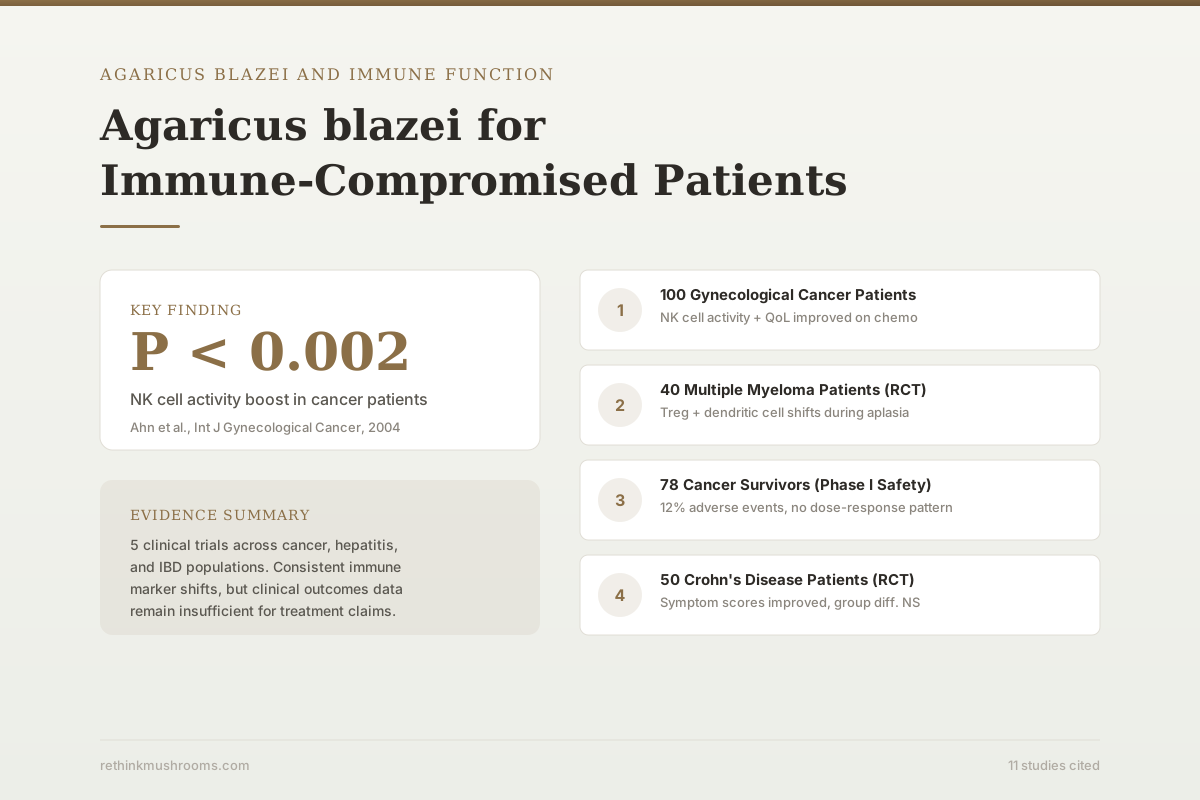
P < 0.002 NK Boost
In 100 gynecological cancer patients on chemotherapy, those who consumed Agaricus blazei extract had significantly higher natural killer cell activity than those on chemo alone.
Ahn et al., International Journal of Gynecological Cancer, 2004
5 Human Trials
cancer, hepatitis, IBD populations
Treg + DC Shift
myeloma patients on AndoSan extract
12% Adverse Rate
mostly GI, no dose-dependent pattern
Ahn et al., International Journal of Gynecological Cancer, 2004
 View as image ↗
Immune suppression is one of the most dangerous consequences of cancer treatment. Chemotherapy drugs kill tumor cells, but they also destroy white blood cells, leaving patients vulnerable to infections during the recovery window. The same problem applies to patients with chronic viral hepatitis, autoimmune conditions on immunosuppressive drugs, and other states where the immune system operates below capacity. Agaricus blazei Murill (ABM), a Brazilian-origin medicinal mushroom rich in beta-glucan polysaccharides, has been tested in several of these populations across at least five clinical trials. The results range from significant NK cell boosts in cancer patients to modest cytokine shifts in inflammatory bowel disease. None of these trials were large enough to establish ABM as a standard treatment, but they provide a clearer picture than exists for most medicinal mushrooms in immunocompromised humans. This research connects directly to how ABM activates NK cells at the molecular level and to the broader question of whether ABM is the most immunostimulating mushroom.
Key Takeaways
- In 100 gynecological cancer patients on chemotherapy, oral ABM extract raised NK cell activity significantly (P < 0.002) compared to chemo alone, and reduced side effects including appetite loss, hair loss, and weakness (Ahn et al., Int J Gynecological Cancer, 2004)
- A randomized, double-blind trial in 40 multiple myeloma patients found that the ABM-based extract AndoSan increased regulatory T cells, plasmacytoid dendritic cells, and Killer Immunoglobulin Receptor gene expression during high-dose chemotherapy (Tangen et al., BioMed Research International, 2015)
- A Phase I safety trial in 78 cancer survivors taking 1.8 to 5.4 g ABM daily for 6 months reported adverse events in only 12% of participants, mostly GI-related, with no dose-dependent pattern (Ohno et al., Evidence-Based Complementary and Alternative Medicine, 2011)
- In 4 chronic hepatitis C patients, ABM extract produced a slight but non-significant decrease in viral load after 1 week, with changes in immune gene expression in peripheral blood cells (Grinde et al., International Immunopharmacology, 2006)
- ABM extract normalized liver enzyme levels (AST, ALT) over 12 months in patients with chronic hepatitis B in an open-label pilot study (Hsu et al., Journal of Alternative and Complementary Medicine, 2008)
- In 50 Crohn's disease patients, 21 days of AndoSan consumption reduced symptom scores (from 5.52 to 4.08, P < 0.001), though the difference between treatment and placebo groups did not reach significance (Therkelsen et al., PLOS ONE, 2016)
Why Researchers Study ABM in Immune-Compromised Populations
The rationale for testing ABM in immunocompromised patients comes from two converging lines of evidence. First, ABM is one of the richest natural sources of beta-glucans, polysaccharides that bind to pattern recognition receptors (particularly Dectin-1 and complement receptor 3) on innate immune cells like macrophages, dendritic cells, and neutrophils.[5] This binding triggers a cascade: dendritic cells produce IL-12, which stimulates IFN-gamma production, which activates NK cells.[6] Second, the patients who stand to benefit most from immune stimulation are those whose immunity is already suppressed, whether from disease (cancer, chronic infection) or from treatment (chemotherapy, immunosuppressive drugs).
An integrative review by Lima and colleagues examined the full body of ABM immune research available through 2010 and concluded that while ABM demonstrates "relevant immunomodulatory properties" across in vitro, animal, and early human studies, randomized clinical trials with adequate sample sizes remained scarce.[10] A more recent 2020 review by Hetland and colleagues confirmed that the evidence base had grown but still consisted mostly of small pilot studies and single-center trials.[11]
The bioactive compounds in ABM, including beta-glucans and blazein, are covered in detail in a separate article.
Cancer Patients on Chemotherapy
The largest clinical trial of ABM in immunocompromised patients enrolled 100 women with cervical, ovarian, or endometrial cancer who were undergoing chemotherapy with either carboplatin plus VP16 or carboplatin plus taxol.[1] Thirty-nine patients received oral ABM extract (Agaricus blazei Murill Kyowa, or ABMK) alongside chemotherapy, while 61 received chemotherapy alone.
The results showed:
- NK cell activity was significantly higher in the ABMK group (P < 0.002)
- Chemotherapy side effects, specifically appetite loss, alopecia, emotional instability, and general weakness, were all reduced in the ABMK group
- Quality of life scores improved in patients taking the mushroom extract
This was not a blinded or placebo-controlled trial, which limits the strength of its conclusions. Patients knew whether they were taking ABM, and the groups were unequal in size (39 vs. 61). The quality-of-life improvements could reflect placebo effects. But the NK cell activity measurements are objective laboratory values, making them harder to explain through expectation alone.
The mechanism connecting ABM to NK cell activation has been mapped in preclinical studies. Yuminamochi and colleagues showed in 2007 that oral ABM augmented NK cytotoxicity in wild-type mice but failed to do so in IFN-gamma-deficient mice, establishing that ABM's NK cell stimulation requires the IL-12/IFN-gamma axis.[6] This finding is explored in depth in the NK cell activation research review.
For a broader look at ABM alongside conventional cancer treatment, see the article on Agaricus blazei and chemotherapy as adjunct treatment.
Multiple Myeloma and Stem Cell Transplantation
The strongest-designed trial comes from Tangen and colleagues, who published a randomized, double-blind study in 2015 involving 40 patients with multiple myeloma scheduled for high-dose chemotherapy with autologous stem cell support.[2] Nineteen patients received the ABM-based extract AndoSan (containing 82% Agaricus blazei Murill), and 21 received placebo. Treatment began on the day of stem cell mobilizing chemotherapy and continued for approximately seven weeks through the end of aplasia.
The immunological findings were notable:
- In leukapheresis products harvested after stem cell mobilization, patients receiving AndoSan had increased percentages of regulatory T cells (Tregs) and plasmacytoid dendritic cells
- Serum levels of IL-1ra, IL-5, and IL-7 were significantly elevated at end of treatment in the AndoSan group
- Whole genome microarray analysis showed increased expression of immunoglobulin genes, Killer Immunoglobulin Receptor (KIR) genes, and HLA genes
These are meaningful immune markers. Tregs help prevent autoimmune damage during immune reconstitution. Plasmacytoid dendritic cells are critical for antiviral defense. KIR genes regulate NK cell function. The fact that these changes appeared during the most immunologically vulnerable period, the aplastic phase after high-dose chemotherapy, suggests ABM may support immune recovery when it matters most.
The trial did not find significant differences in treatment response, overall survival, or time to new treatment between the two groups. With only 40 patients and a seven-week intervention window, it was not powered to detect clinical outcome differences. What it demonstrated is that ABM can shift immune cell populations and gene expression even in severely immunosuppressed patients.
Cancer Survivors in Remission
Two studies by Ohno and colleagues examined ABM in cancer patients after treatment ended.
The Phase I safety study enrolled 78 cancer survivors in remission who took ABM granulated powder at one of three doses (1.8, 3.6, or 5.4 g/day) for 6 months.[3] Adverse events occurred in 9 patients (12%), primarily digestive symptoms like nausea and diarrhea. One patient developed a liver dysfunction-related food allergy. None of these events followed a dose-dependent pattern, suggesting they were idiosyncratic rather than toxicity-related. Laboratory parameters remained normal across all dose levels. This was the first formal safety evaluation of ABM in an immunocompromised population, and the results were reassuring.
A follow-up study from the same group measured quality of life in cancer patients consuming ABM extract and found improvements in both physical and mental health components.[4] The study was longitudinal but lacked a placebo control, so these improvements could reflect natural recovery after cancer treatment rather than ABM effects.
Chronic Viral Hepatitis
Two small studies tested ABM in patients with chronic viral hepatitis, a condition where the immune system fails to clear an infection and liver damage accumulates over years.
Grinde and colleagues gave ABM extract to 4 patients with chronic hepatitis C and measured viral load and immune gene expression in peripheral blood cells after one week of treatment.[8] Viral load decreased slightly but not significantly. The gene expression analysis showed immune-related changes in blood cells, but with only 4 patients and a one-week treatment window, these results are preliminary at best. The study's value lies in demonstrating that ABM has measurable biological effects in hepatitis C patients, not in proving efficacy.
Hsu and colleagues conducted a longer open-label pilot study in patients with chronic hepatitis B, administering 1,500 mg of ABM extract daily for 12 months.[9] They reported normalization of liver enzyme levels (AST and ALT), which, if replicated in a controlled trial, would suggest ABM reduces hepatic inflammation. Without a placebo group, however, spontaneous fluctuations in liver enzymes cannot be ruled out. Hepatitis B viral loads naturally fluctuate, and liver enzymes can normalize during periods of immune tolerance.
Both hepatitis studies are relevant to the broader topic of Agaricus blazei liver protection research.
Inflammatory Bowel Disease
Therkelsen and colleagues tested AndoSan in 50 patients with symptomatic Crohn's disease in a randomized, single-blinded, placebo-controlled design.[7] Patients consumed the extract or placebo daily for 21 days.
Within the AndoSan group:
- Symptom scores dropped from a baseline mean of 5.52 to 4.48 at day 14 and 4.08 at day 21 (P < 0.001)
- Health-related quality of life improved for bodily pain and vitality at day 21
But the critical comparison, AndoSan versus placebo, did not reach statistical significance (P = 0.106). This means the placebo group also improved over the 21-day period, and the difference between groups was not large enough to rule out chance. A marginal effect was observed in men (P = 0.054), but subgroup analysis in a 50-patient trial should be interpreted cautiously.
Cytokine measurements from the same trial showed that AndoSan consumption reduced pro-inflammatory markers including IL-2, IL-17, and IL-8 in Crohn's disease patients. This anti-inflammatory cytokine shift is consistent with ABM's known Th1/Th2 modulation, a mechanism reviewed by Hetland and colleagues.[5]
IBD patients are relevant to the immune-compromised category because many take immunosuppressive drugs (azathioprine, methotrexate, anti-TNF biologics) that deliberately lower immune function to control inflammation. The question of whether ABM interacts with these drugs remains unanswered. For known drug interaction concerns with Agaricus blazei, see the dedicated article.
Safety Concerns in Vulnerable Populations
The safety picture for ABM in immunocompromised patients is mixed. The Ohno Phase I trial (78 patients, 6 months) found a 12% adverse event rate with no dose-response pattern, which is reassuring.[3] The Tangen myeloma trial (40 patients, 7 weeks) reported no safety signals during a period of severe immunosuppression.[2]
However, case reports have documented serious adverse events. A published case described drug-induced liver injury (DILI) associated with ABM consumption that closely mimicked autoimmune hepatitis on liver biopsy. The patient's liver injury resolved after stopping ABM and receiving corticosteroid treatment. This is particularly concerning for immunocompromised patients who may have altered hepatic function or who are taking hepatotoxic medications.
The 2020 review by Hetland and colleagues noted that ABM's immunostimulatory properties could theoretically be harmful in certain autoimmune conditions, where immune activation is part of the disease process rather than a therapeutic goal.[11] No clinical trial has specifically tested ABM in autoimmune populations receiving immunosuppression, which represents a gap in the safety data.
For questions about appropriate dosing of Agaricus blazei, see the dosage guide.
How ABM Modulates Compromised Immunity
The consistent finding across trials is that ABM affects innate immune cells rather than adaptive immunity directly. The beta-glucans in ABM bind to receptors on macrophages and dendritic cells, triggering a cascade that upregulates NK cells, shifts cytokine profiles, and modifies T cell subsets like Tregs.[5]
In immunocompromised patients specifically:
- During chemotherapy: ABM appears to partially restore NK cell function that chemotherapy suppresses (Ahn 2004)
- During stem cell recovery: ABM shifts immune cell ratios toward Tregs and plasmacytoid dendritic cells, possibly supporting controlled immune reconstitution (Tangen 2015)
- In chronic infection: ABM may alter cytokine profiles and immune gene expression, though viral load reductions have not been demonstrated (Grinde 2006)
- In inflammatory bowel disease: ABM reduces pro-inflammatory cytokines, potentially through Th1/Th2 rebalancing (Therkelsen 2016)
This pattern, consistent immune modulation without dramatic clinical endpoints, is characteristic of the ABM evidence base. The mushroom changes measurable immune parameters, but whether those changes translate to fewer infections, longer remissions, or better survival remains unproven. The research on whether ABM can enhance vaccine responses in immunocompromised patients is a natural extension of this question.
The Bottom Line
Five clinical trials have tested Agaricus blazei in patients with suppressed immune function, spanning gynecological cancer, multiple myeloma, chronic hepatitis B and C, and Crohn's disease. The most consistent finding is that ABM shifts measurable immune markers, including NK cell activity, Treg percentages, dendritic cell populations, and inflammatory cytokines, in directions that suggest immune support. The strongest trial design (Tangen 2015, randomized double-blind) confirmed immune cell changes during severe chemotherapy-induced immunosuppression. Safety data from 78 cancer survivors over 6 months showed a 12% adverse event rate with no dose-dependent pattern. What remains missing is evidence that these immune shifts translate to better clinical outcomes: fewer infections, longer survival, or reduced disease progression.
Frequently Asked Questions
Sources & References
- 1RTHM-00066·Ahn, W-S et al. (2004). “Natural killer cell activity and quality of life were improved by consumption of a mushroom extract, Agaricus blazei Murill Kyowa, in gynecological cancer patients undergoing chemotherapy..” International journal of gynecological cancer : official journal of the International Gynecological Cancer Society.Study breakdown →PubMed →↩
- 2RTHM-00404·Tangen, Jon-Magnus et al. (2015). “Immunomodulatory effects of the Agaricus blazei Murrill-based mushroom extract AndoSan in patients with multiple myeloma undergoing high dose chemotherapy and autologous stem cell transplantation: a randomized, double blinded clinical study..” BioMed research international.Study breakdown →PubMed →↩
- 3RTHM-00229·Ohno, Satoshi et al. (2011). “Phase I Clinical Study of the Dietary Supplement, Agaricus blazei Murill, in Cancer Patients in Remission..” Evidence-based complementary and alternative medicine : eCAM.Study breakdown →PubMed →↩
- 4RTHM-00299·Ohno, Satoshi et al. (2013). “Quality of life improvements among cancer patients in remission following the consumption of Agaricus blazei Murill mushroom extract..” Complementary therapies in medicine.Study breakdown →PubMed →↩
- 5RTHM-00133·Hetland, G et al. (2008). “Effects of the medicinal mushroom Agaricus blazei Murill on immunity, infection and cancer..” Scandinavian journal of immunology.Study breakdown →PubMed →↩
- 6RTHM-00125·Yuminamochi, Eri et al. (2007). “Interleukin-12- and interferon-gamma-mediated natural killer cell activation by Agaricus blazei Murill..” Immunology.Study breakdown →PubMed →↩
- 7RTHM-00451·Therkelsen, Stig Palm et al. (2016). “Effect of the Medicinal Agaricus blazei Murill-Based Mushroom Extract, AndoSanTM, on Symptoms, Fatigue and Quality of Life in Patients with Crohn's Disease in a Randomized Single-Blinded Placebo Controlled Study..” PloS one.Study breakdown →PubMed →↩
- 8RTHM-00097·Grinde, B et al. (2006). “Effects on gene expression and viral load of a medicinal extract from Agaricus blazei in patients with chronic hepatitis C infection..” International immunopharmacology.Study breakdown →PubMed →↩
- 9RTHM-00137·Hsu, Chung-Hua et al. (2008). “The mushroom Agaricus blazei Murill extract normalizes liver function in patients with chronic hepatitis B..” Journal of alternative and complementary medicine (New York.Study breakdown →PubMed →↩
- 10RTHM-00224·Lima, Cristiane Urcina Joanna Oliveira et al. (2011). “Does the Agaricus blazei Murill mushroom have properties that affect the immune system? An integrative review..” Journal of medicinal food.Study breakdown →PubMed →↩
- 11RTHM-00620·Hetland, Geir et al. (2020). “Antitumor, Anti-Inflammatory and Antiallergic Effects of Agaricus blazei Mushroom Extract and the Related Medicinal Basidiomycetes Mushrooms, Hericium erinaceus and Grifola frondosa: A Review of Preclinical and Clinical Studies..” Nutrients.Study breakdown →PubMed →↩