Agaricus blazei and Immune Function
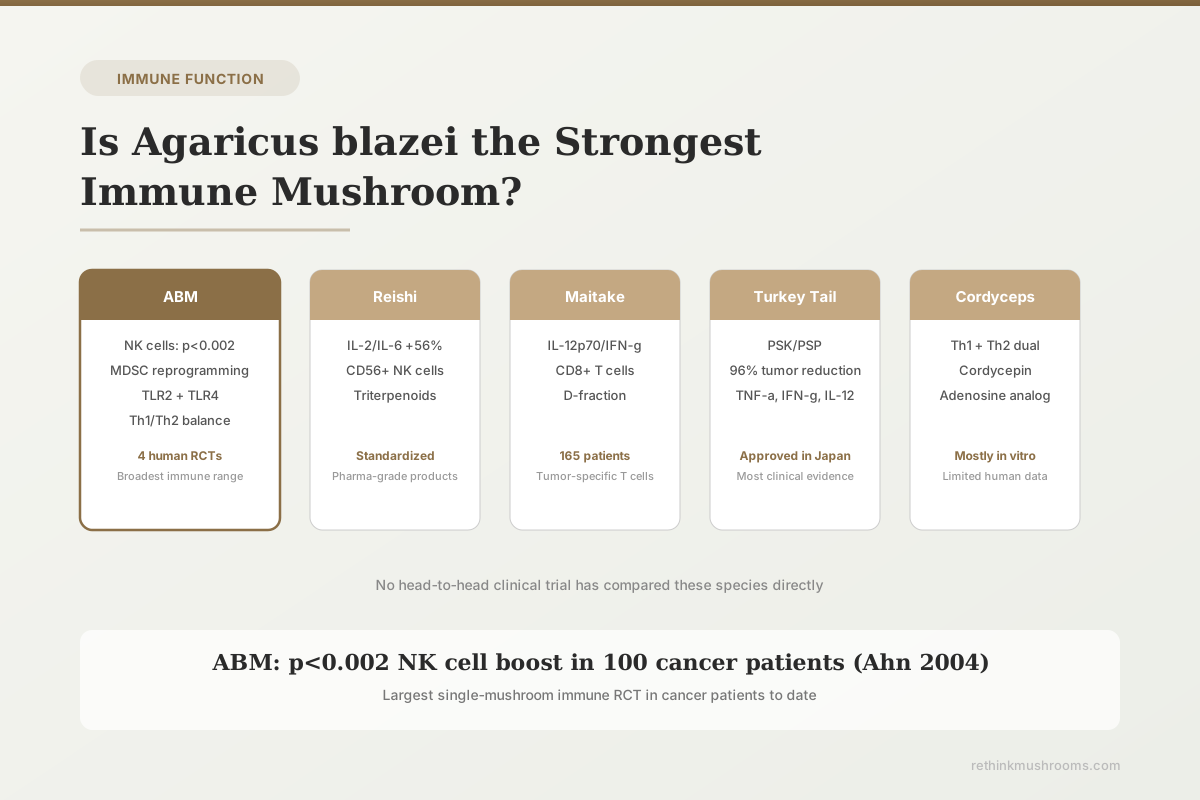
p<0.002 NK Boost
In a controlled study of 100 gynecological cancer patients undergoing chemotherapy, the group receiving Agaricus blazei extract showed significantly higher natural killer cell activity than placebo.
Ahn et al., Int J Gynecological Cancer, 2004
4 Human RCTs
cancer, elderly, and healthy volunteer studies
5 Species Compared
ABM vs reishi, maitake, turkey tail, cordyceps
No Head-to-Head
no direct comparison trial between species
Ahn et al., Int J Gynecological Cancer, 2004
 View as image ↗
Agaricus blazei Murill (ABM) has been called the most potent immunostimulating mushroom in the research literature. A 2014 review in Integrative Medicine examined five major medicinal mushrooms and found that all five increase Th1 cytokine production, but ABM stood out for its breadth of immune activation across innate and adaptive pathways.[1] The claim has some basis in the data, but it also has limits. No direct head-to-head clinical trial has ever compared ABM against reishi, maitake, turkey tail, or cordyceps in the same patient population. The ranking comes from comparing results across separate studies with different designs, doses, populations, and endpoints. This article examines what the evidence supports and where the gaps are, using data from the TLR activation pathway research, NK cell studies, and vaccine response enhancement that underpin the claim.
Key Takeaways
- In 100 gynecological cancer patients on chemotherapy, ABM extract significantly increased NK cell activity versus placebo (p < 0.002) and improved appetite, alopecia, emotional stability, and weakness (Ahn et al., Int J Gynecological Cancer, 2004)
- A five-mushroom comparative review found ABM, reishi, maitake, turkey tail, and cordyceps all boost Th1 cytokines, with no clear winner in head-to-head comparisons (Guggenheim et al., Integrative Medicine, 2014)
- In 40 multiple myeloma patients, ABM-based AndoSan increased regulatory T cells (11.8% vs 9.0%, p = 0.04) and plasmacytoid dendritic cells (1.1% vs 0.7%, p = 0.04) but did not improve survival (Tangen et al., BioMed Research International, 2015)
- ABM polysaccharide reprogrammed immunosuppressive M2-type MDSCs to pro-inflammatory M1 via TLR2, a mechanism not documented for other medicinal mushroom species (Liu et al., Immunology, 2015)
- In 66 NSCLC patients post-surgery, ABM-containing supplement showed better T cell preservation (p = 0.026) and B cell preservation (p = 0.001) versus placebo, though NK cell recovery was not statistically significant (Kim et al., Biomedicines, 2025)
- Oral ABM polysaccharides significantly increased pan T cells, CD4+ helper T cells, and CD8+ cytotoxic T cells in mouse spleens (Mizuno et al., Bioscience Biotechnology Biochemistry, 1998)
What "Most Immunostimulating" Would Mean
Ranking mushrooms by immune potency requires defining what you are measuring. The immune system is not a single dial. A mushroom could be the strongest activator of NK cells but weak at stimulating macrophage phagocytosis. It could drive Th1 polarization powerfully but have minimal effect on trained immunity. The question "which is most immunostimulating" is actually dozens of separate questions.
Guggenheim and colleagues (2014) attempted the comparison by reviewing five major species across their effects on innate immunity (macrophages, NK cells, dendritic cells), adaptive immunity (T cells, B cells), and cytokine production.[1] Their assessment:
- ABM: Strongest documented effects on macrophage activation, broad cytokine induction (IL-12, TNF-alpha, IFN-gamma, IL-6), NK cell activation in cancer patients
- Reishi (Ganoderma lucidum): Elevated IL-2, IL-6, and IFN-gamma by 56% in advanced lung cancer patients; increased CD56+ NK cells
- Maitake (Grifola frondosa): Consistently increased IL-12p70 and IFN-gamma; elevated tumor-specific CD8+ and CD4+ T cells with reduced regulatory T cells
- Turkey tail (Trametes versicolor): PSK formulation combined with trastuzumab achieved 96% tumor growth reduction; enhanced TNF-alpha, IFN-gamma, and IL-12
- Cordyceps: Modulates both Th1 and Th2 responses; evidence primarily in vitro
The review did not declare a winner. Each mushroom has a different evidence profile, and the study designs are too heterogeneous to rank them.
The NK Cell Evidence in Cancer Patients
The single most cited study supporting ABM's immune potency is Ahn and colleagues (2004).[2] They enrolled 100 women with gynecological cancers (cervical, ovarian, endometrial) undergoing chemotherapy and randomized them to receive ABM extract (Agaricus blazei Murill Kyowa) or placebo.
Results:
- NK cell activity was significantly higher in the ABM group (ANOVA, n = 39 evaluable, p < 0.002)
- Chemotherapy side effects improved: appetite, alopecia, emotional stability, and general weakness all showed better scores in the ABM group
- Quality of life measures favored ABM supplementation
This remains one of the largest randomized studies of any single medicinal mushroom in cancer patients. For comparison, the most-cited turkey tail clinical study (Torkelson 2012) enrolled 11 breast cancer patients. The most-cited reishi cancer study (Gao 2003) enrolled 34 patients. ABM's sample size gives it a statistical advantage in discussions of evidence strength, though 100 patients is still a small trial by pharmaceutical standards.
The limitation: NK cell activity was a composite measure, not a direct comparison against other mushroom species. We know ABM increased NK activity versus placebo. We do not know whether reishi or maitake would have produced the same or greater increase in the same population.
Human Trials Beyond Cancer
Multiple Myeloma (Tangen 2015)
Tangen and colleagues conducted a randomized, double-blind study of 40 multiple myeloma patients receiving high-dose chemotherapy with autologous stem cell transplantation.[3] Patients received either AndoSan (an ABM-based extract containing 82% ABM plus Hericium erinaceus and Grifola frondosa) or placebo for approximately seven weeks.
Immune changes in the AndoSan group:
- Regulatory T cells increased in the leukapheresis product (11.8% vs 9.0%, p = 0.04)
- Plasmacytoid dendritic cells increased (1.1% vs 0.7%, p = 0.04)
- Serum IL-1ra, IL-5, and IL-7 levels were elevated
- Immunoglobulin genes and KIR (killer immunoglobulin receptor) genes were upregulated
Clinical outcomes: no significant difference in treatment response or overall survival. There was a non-significant trend toward longer time to next treatment (37.3 vs 31.4 months, p = 0.49).
This study demonstrates immune modulation in a severely immunocompromised population, which is relevant to the immune-compromised patients article. The caveat: AndoSan contains three mushroom species, so the effects cannot be attributed solely to ABM.
NSCLC Post-Surgical Recovery (Kim 2025)
The most recent human trial randomized 66 non-small-cell lung cancer patients who underwent curative surgical resection to receive either an ABM-containing multivitamin complex or placebo for 28 days.[4]
Results:
- NK cell activity recovery was greater in the treatment group (17.8% vs 9.9%) but not statistically significant (p = 0.104)
- T cell preservation was significantly better (p = 0.026)
- B cell preservation was significantly better (p = 0.001)
- Monocyte reduction was greater in the treatment group (p = 0.031)
The pattern: immune cell populations that typically decline after major surgery were better maintained with ABM supplementation. The NK cell finding approached significance but did not reach it, possibly due to the small sample size or the confounding presence of multivitamins alongside ABM.
Elderly Women (Lima 2012)
Lima and colleagues randomized elderly women to ABM or placebo and measured inflammatory mediators.[5] The study found changes in IL-6, IFN-gamma, and TNF-alpha levels, demonstrating that ABM modulates cytokine profiles in non-disease states. This matters because most ABM immune data comes from cancer populations, and the elderly women study shows effects in a healthier (though immunosenescent) population.
The Preclinical Case for ABM Superiority
MDSC Reprogramming
Liu and colleagues (2015) showed that ABM polysaccharide reprogrammed immunosuppressive M2-type myeloid-derived suppressor cells into pro-inflammatory M1 cells through TLR2 signaling.[6] This mechanism has not been documented for reishi, maitake, or turkey tail polysaccharides in the same experimental model. If this mechanism translates to humans, it would represent a qualitative difference, not just a quantitative one: ABM would not merely activate more immune cells but would reverse a specific immunosuppressive program that other mushrooms do not address.
The caveat is substantial: "not documented" is not the same as "does not occur." Other mushroom polysaccharides may reprogram MDSCs through mechanisms that have not been tested. The absence of evidence is not evidence of absence.
T Cell Subset Expansion
Mizuno and colleagues (1998) demonstrated that oral ABM polysaccharides significantly increased the percentages of pan T cells (Thy1.2+), helper T cells (CD4+), and cytotoxic T cells (CD8+) in mouse spleens.[7] The expansion was dose-dependent and occurred after oral administration, confirming that gut-associated immune activation can drive systemic T cell changes.
Broad Cytokine Activation
Johnson and colleagues (2009) tested ABM extract (AndoSan) on human blood ex vivo and found significant increases in a wide range of cytokines, chemokines, and growth factors: TNF-alpha, IL-1beta, IL-6, IL-8, MCP-1, MIP-1alpha, MIP-1beta, G-CSF, and VEGF.[8] The breadth of this response exceeds what has been reported for most individual mushroom species, though direct comparisons using the same assay conditions are lacking.
Full-Range Immune Effects
Tang and colleagues (2009) showed that ABM extract promoted splenocyte proliferation, increased macrophage phagocytosis in a dose-dependent manner, and elevated IL-6 and IFN-gamma levels in normal (non-disease) BALB/c mice.[9] The dose-dependent phagocytosis increase is relevant because macrophage function is a core measure of innate immune potency.
Trained Immunity: A Newer Dimension
Case and colleagues (2024) demonstrated that beta-glucans from Agaricus species drive trained immunity in human monocytes, reprogramming their epigenetic and metabolic profiles for enhanced secondary responses.[10] Trained immunity has also been demonstrated for beta-glucans from Saccharomyces cerevisiae (baker's yeast) and Candida albicans. Whether ABM-derived beta-glucans produce stronger trained immunity than those from other mushroom species has not been tested.
This is an area where the beta-glucan structural differences between species may matter. ABM beta-glucans have a specific branching pattern (beta-1,3 backbone with beta-1,6 branches) that differs from the beta-glucans in turkey tail (PSK/PSP have protein-bound polysaccharides) or maitake (D-fraction has a different molecular weight profile). Whether structural differences translate to differences in trained immunity potency is an open question.
Where ABM Falls Short Compared to Others
Clinical Evidence Volume
Turkey tail (PSK/PSP) has the largest body of clinical evidence. In Japan, PSK has been an approved pharmaceutical adjunct to cancer chemotherapy since 1977, with large trials involving thousands of patients. ABM has four small-to-medium RCTs. By sheer clinical evidence volume, turkey tail has a stronger foundation for claims of clinical efficacy.
Anti-tumor Clinical Outcomes
While ABM improved NK cell activity and quality of life in cancer patients, it has not demonstrated improved survival in any trial. Turkey tail's PSK improved survival in gastric and colorectal cancer in Japanese trials with hundreds of patients. Maitake D-fraction improved tumor regression rates in combination with chemotherapy in a non-randomized study of 165 patients.
Standardization
Reishi and turkey tail have pharmaceutical-grade standardized extracts (PSK, PSP, reishi spore oil) with defined chemical compositions. ABM extracts vary widely in beta-glucan content and composition depending on substrate, cultivation method, and extraction technique. This makes ABM research harder to compare across studies because the "ABM extract" in one study may be substantially different from another.
The Honest Assessment
Hetland and colleagues (2011) summarized ABM's immunological profile in a comprehensive review: antitumor, anti-infection, antiallergic, and anti-inflammatory effects mediated through modulation of innate immunity and correction of Th1/Th2 imbalance.[11] This breadth of action across multiple immune pathways is ABM's strongest claim to distinction. Most other mushrooms show strong effects in one or two areas. ABM shows effects across innate immunity (macrophages, NK cells, dendritic cells), adaptive immunity (T cells, B cells), cytokine regulation (Th1/Th2 balance), and immune cell reprogramming (MDSCs).
Whether this makes ABM "the most immunostimulating mushroom" depends on definitions. By breadth of documented immune activation: arguably yes. By depth of clinical evidence in any single application: no, turkey tail leads. By mechanism novelty (MDSC reprogramming via TLR2): ABM has a unique finding that other species lack. By practical availability of standardized clinical-grade products: reishi and turkey tail are ahead.
The question itself may be less useful than understanding which specific immune pathways each mushroom activates most effectively. For the full profile of ABM's bioactive compounds beyond beta-glucans, including blazein, ergosterol, and proteoglucans, a separate article breaks down the non-polysaccharide contributors to immune activation.
The Bottom Line
Agaricus blazei Murill activates a broader range of immune pathways than most individual medicinal mushrooms, including NK cell activation, MDSC reprogramming, T cell expansion, and trained immunity. Four human RCTs show immune modulation in cancer patients, post-surgical patients, and elderly volunteers. No head-to-head trial has directly compared ABM against reishi, maitake, or turkey tail in the same population, and turkey tail has more extensive clinical outcome data. The "most immunostimulating" label depends on which immune measure you prioritize.
Frequently Asked Questions
Sources & References
- 1RTHM-00323·Guggenheim, Alena G et al. (2014). “Immune Modulation From Five Major Mushrooms: Application to Integrative Oncology..” Integrative medicine (Encinitas.Study breakdown →PubMed →↩
- 2RTHM-00066·Ahn, W-S et al. (2004). “Natural killer cell activity and quality of life were improved by consumption of a mushroom extract, Agaricus blazei Murill Kyowa, in gynecological cancer patients undergoing chemotherapy..” International journal of gynecological cancer : official journal of the International Gynecological Cancer Society.Study breakdown →PubMed →↩
- 3RTHM-00404·Tangen, Jon-Magnus et al. (2015). “Immunomodulatory effects of the Agaricus blazei Murrill-based mushroom extract AndoSan in patients with multiple myeloma undergoing high dose chemotherapy and autologous stem cell transplantation: a randomized, double blinded clinical study..” BioMed research international.Study breakdown →PubMed →↩
- 4RTHM-00928·Kim, Jiwon et al. (2025). “Immunomodulatory Effects of Multivitamin Complexes Containing Agaricus blazei in Patients Undergoing Curative Resection for Non-Small-Cell Lung Cancer: A Randomized, Double-Blind, Placebo-Controlled Multicenter Pilot Trial..” Biomedicines.Study breakdown →PubMed →↩
- 5RTHM-00254·Lima, C U J O et al. (2012). “Agaricus blazei Murrill and inflammatory mediators in elderly women: a randomized clinical trial..” Scandinavian journal of immunology.Study breakdown →PubMed →↩
- 6RTHM-00395·Liu, Yi et al. (2015). “Polysaccharide Agaricus blazei Murill stimulates myeloid derived suppressor cell differentiation from M2 to M1 type, which mediates inhibition of tumour immune-evasion via the Toll-like receptor 2 pathway..” Immunology.Study breakdown →PubMed →↩
- 7RTHM-00026·Mizuno, M et al. (1998). “Polysaccharides from Agaricus blazei stimulate lymphocyte T-cell subsets in mice..” Bioscience.Study breakdown →PubMed →↩
- 8RTHM-00157·Johnson, E et al. (2009). “Effect of an extract based on the medicinal mushroom Agaricus blazei murill on release of cytokines, chemokines and leukocyte growth factors in human blood ex vivo and in vivo..” Scandinavian journal of immunology.Study breakdown →PubMed →↩
- 9RTHM-00171·Tang, Nou-Ying et al. (2009). “Effects of Agaricus blazei Murill extract on immune responses in normal BALB/c mice..” In vivo (Athens.Study breakdown →PubMed →↩
- 10RTHM-00867·Case, Sarah et al. (2024). “β-glucans from Agaricus bisporus mushroom products drive Trained Immunity..” Frontiers in nutrition.Study breakdown →PubMed →↩
- 11RTHM-00215·Hetland, Geir et al. (2011). “The Mushroom Agaricus blazei Murill Elicits Medicinal Effects on Tumor, Infection, Allergy, and Inflammation through Its Modulation of Innate Immunity and Amelioration of Th1/Th2 Imbalance and Inflammation..” Advances in pharmacological sciences.Study breakdown →PubMed →↩