Agaricus blazei and Cancer
NK Cell Activity Increased
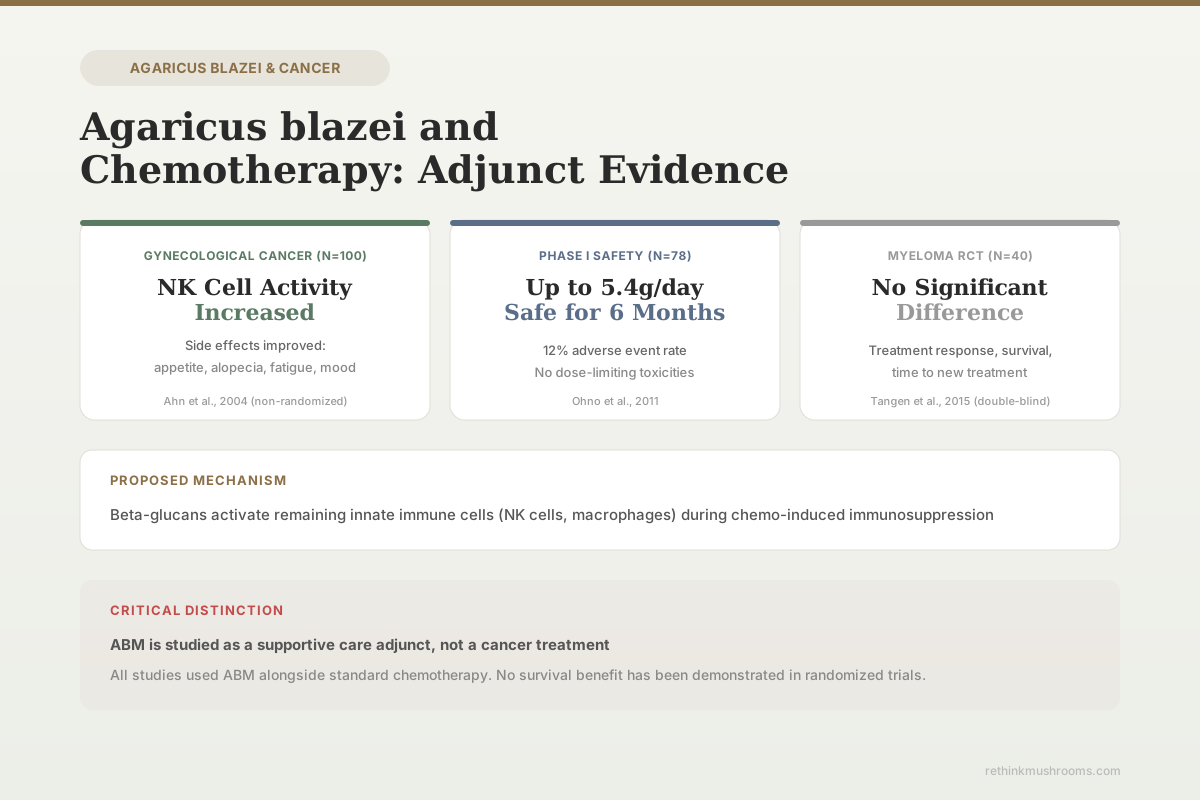
A study of 100 gynecological cancer patients found Agaricus blazei Murill extract significantly increased natural killer cell activity during chemotherapy. Chemotherapy side effects including appetite loss, hair loss, and general weakness were also improved.
Ahn et al., International Journal of Gynecological Cancer, 2004
100 Patients
gynecological cancer, during chemotherapy
Phase I Complete
safety confirmed up to 5.4g/day for 6 months
Beta-Glucan Driven
innate immune cell activation
Ahn et al., International Journal of Gynecological Cancer, 2004
 View as image ↗
Chemotherapy kills cancer cells but also suppresses the immune system. Natural killer (NK) cells, which are the body's primary defense against cancer cells that survive treatment, decline sharply during chemotherapy cycles. This creates a vulnerability window where remaining cancer cells can proliferate without immune surveillance. The question for mushroom immunology: can Agaricus blazei Murill (ABM) support NK cell activity during chemotherapy without interfering with treatment?
Three types of human evidence exist: a gynecological cancer trial showing improved NK cell activity during chemotherapy, a Phase I dose-escalation safety study in cancer survivors, and a randomized trial in multiple myeloma patients undergoing high-dose chemotherapy. The evidence is mixed but directionally positive. For the broader cancer research from Brazil and Japan and the mechanism by which ABM activates anti-tumor immunity, those topics get their own articles.
Key Takeaways
- A study of 100 gynecological cancer patients found ABM extract significantly increased NK cell activity during chemotherapy compared to control (Ahn et al., International Journal of Gynecological Cancer, 2004)
- Chemotherapy side effects (appetite loss, alopecia, emotional instability, general weakness) were all improved in the ABM-treated group (Ahn et al., 2004)
- A Phase I study of 78 cancer patients in remission confirmed safety of ABM at doses up to 5.4g/day for 6 months, with adverse events in 12% of patients (Ohno et al., Evidence-Based Complementary and Alternative Medicine, 2011)
- A randomized, double-blind trial in 40 multiple myeloma patients found no significant differences in treatment response or survival with ABM adjunct, but the study may have been underpowered (Tangen et al., Scandinavian Journal of Immunology, 2015)
- ABM enhanced doxorubicin-induced cancer cell death in hepatocellular carcinoma cells via NF-kB-mediated increased drug accumulation (Lee et al., International Journal of Oncology, 2011)
- All studies used ABM as an adjunct alongside standard chemotherapy, not as a replacement
The Gynecological Cancer Trial
Ahn and colleagues published the most cited clinical study of ABM in cancer patients in 2004.[1] The study enrolled 100 patients with cervical, ovarian, or endometrial cancer who were undergoing standard chemotherapy. Patients were divided into a group receiving ABM extract (Agaricus blazei Murill Kyowa, ABMK) alongside chemotherapy and a control group receiving chemotherapy alone.
NK cell activity: The ABMK-treated group had significantly higher NK cell activity compared to the untreated control group. NK cells are innate immune cells that recognize and kill cancer cells without prior sensitization. During chemotherapy, NK cell counts and activity typically drop, creating a window of reduced immune surveillance. ABM appeared to counteract this immunosuppressive effect.
Side effect improvement: The ABMK group reported improvements in multiple chemotherapy-associated side effects:
- Appetite (improved food intake during treatment)
- Alopecia (hair loss was less severe)
- Emotional stability (improved psychological well-being)
- General weakness (reduced fatigue and physical debilitation)
These quality-of-life improvements are clinically meaningful. Chemotherapy side effects are a major reason patients discontinue treatment, reduce doses, or refuse additional cycles. An adjunct that reduces side effects while supporting immune function addresses two problems simultaneously.
Limitations: The study was not randomized or blinded. Patients self-selected into the ABM group. There was no placebo control. The improvements in side effects could reflect placebo effects, differences in baseline health between groups, or unmeasured confounders. The NK cell findings are more objective but still subject to selection bias.
Phase I Safety Study
Ohno and colleagues conducted the formal dose-escalation safety study that any adjunct treatment requires.[2] Published in 2011, the Phase I trial enrolled cancer patients in remission (not actively undergoing chemotherapy) and tested three dose levels of ABM granulated powder: 1.8g, 3.6g, and 5.4g per day for 6 months.
Safety results across 78 assessed patients:
- Adverse events occurred in 9 patients (12%)
- Most events were digestive (nausea, diarrhea); none occurred in a dose-dependent manner
- One patient developed a liver dysfunction-related food allergy (drug lymphocyte product)
- No dose-limiting toxicities were identified
The 12% adverse event rate is comparable to many dietary supplements. The authors concluded that ABM at doses up to 5.4g/day for 6 months does not cause problems in most patients within laboratory parameters, excluding possible allergic reaction. This safety data is essential because cancer patients are a vulnerable population, and any immune-modulating supplement carries theoretical risks (autoimmune flare, interference with treatment, hepatotoxicity).
One ongoing concern with ABM is that it contains agaritine, a hydrazine compound with mutagenic potential in vitro. The Ohno trial did not directly assess genotoxicity or cancer recurrence; it was an open-label safety study tracking standard hematology and chemistry panels and NCI-CTCAE adverse events for 6 months. It also was not powered to detect rare adverse events.
The Multiple Myeloma Randomized Trial
Tangen and colleagues conducted the most rigorous study: a randomized, double-blind, placebo-controlled trial in 40 patients with multiple myeloma undergoing high-dose chemotherapy with autologous stem cell transplantation.[3] The mushroom extract AndoSan (containing 82% Agaricus blazei Murill) was given for approximately 7 weeks, continuing through the aplasia period (when the immune system is at its lowest after transplant).
Results: There were no statistically significant differences between the ABM and placebo groups in treatment response, overall survival, or time to new treatment.
This null result requires context. Forty patients is a small sample for detecting differences in survival outcomes. High-dose chemotherapy with stem cell transplant is an aggressive treatment that profoundly suppresses immunity. Whether any oral immunomodulator can meaningfully influence outcomes in this setting, where the immune system is deliberately obliterated and then rebuilt from transplanted stem cells, is debatable.
The Tangen trial does not contradict the Ahn trial. They tested different clinical scenarios. Ahn tested standard-dose chemotherapy in solid tumors (gynecological cancers) where the immune system remains partially functional. Tangen tested ablative chemotherapy in a hematological cancer where immune function is intentionally destroyed. The ABM mechanism (innate immune activation) has more opportunity to operate when immune cells still exist.
The Doxorubicin Synergy Finding
Lee and colleagues published a mechanistic study in 2011 that suggests ABM may do more than just support immunity during chemotherapy. It may enhance the chemotherapy drug itself.[4]
In human hepatocellular carcinoma (liver cancer) cells, ABM extract enhanced doxorubicin-induced apoptosis (programmed cell death). The mechanism: ABM increased intracellular accumulation of doxorubicin through NF-kB-mediated pathways. In simpler terms, ABM appeared to help cancer cells absorb more of the chemotherapy drug, making each dose more effective.
This is a preclinical finding in cell culture, not in humans. But it raises an intriguing possibility: ABM might function as a chemosensitizer, a compound that makes cancer cells more vulnerable to chemotherapy drugs rather than just supporting the patient's immune system.
Tangen and colleagues later showed that the AndoSan extract had direct cytotoxic effects on human myeloma cells and leukemic cells in vitro.[5] Whether this translates to clinical benefit at achievable oral doses is unknown.
How ABM Supports Immunity During Chemotherapy
The mechanism is consistent with ABM's broader immunomodulatory profile. Hetland and colleagues described it in their 2011 review.[6]
ABM beta-glucans are recognized by pattern recognition receptors (Dectin-1, complement receptor 3, TLR-2/6) on innate immune cells. This triggers:
- NK cell activation: Increased cytotoxicity against cancer cells
- Macrophage activation: Enhanced phagocytosis and antigen presentation
- Dendritic cell maturation: Improved T cell priming
- Cytokine production: Increased IL-12, TNF-alpha, and IFN-gamma (Th1 cytokines)
During chemotherapy, bone marrow suppression reduces all immune cell populations. ABM does not create new immune cells (only the bone marrow can do that). What it appears to do is activate the immune cells that remain, making them more functional per cell. This is the proposed mechanism for the NK cell findings in the Ahn 2004 trial.
The 2020 review by Hetland and colleagues updated this evidence, confirming that ABM's antitumor properties are mediated through innate immune activation rather than direct cytotoxicity at dietary doses.[7] For a deeper analysis of the NK cell enhancement data in cancer patients, that mechanism is explored in its own article. And the epidemiological data on ABM and cancer prevention provides population-level context.
What the Evidence Does and Does Not Support
Supported by evidence:
- ABM is safe at doses up to 5.4g/day for 6 months in cancer patients in remission (Phase I data)
- ABM extract increased NK cell activity during standard chemotherapy in one non-randomized trial
- ABM reduced self-reported chemotherapy side effects in the same trial
- ABM enhances doxorubicin activity against liver cancer cells in vitro
Not supported by evidence:
- ABM as a replacement for chemotherapy or any standard cancer treatment
- ABM improving survival in cancer patients (the one randomized trial showed no survival benefit)
- ABM being effective during ablative chemotherapy regimens
- A defined therapeutic dose for any cancer type
- ABM preventing cancer recurrence
The evidence positions ABM as a potential supportive care agent during standard-dose chemotherapy: something that may improve quality of life and immune function without interfering with treatment. It does not position ABM as an anti-cancer agent in its own right.
The Bottom Line
Agaricus blazei Murill has been tested as a chemotherapy adjunct in three clinical contexts. A 100-patient gynecological cancer study found increased NK cell activity and reduced side effects during chemotherapy, but lacked randomization. A Phase I study confirmed safety at doses up to 5.4g/day for 6 months. A randomized myeloma trial found no survival benefit, though the setting (ablative chemotherapy) may not have allowed immunomodulation to operate. Preclinical data suggests ABM may enhance doxorubicin accumulation in cancer cells. The evidence supports further study of ABM as supportive care during standard-dose chemotherapy, not as a cancer treatment.
Frequently Asked Questions
Sources & References
- 1RTHM-00066·Ahn, W-S et al. (2004). “Natural killer cell activity and quality of life were improved by consumption of a mushroom extract, Agaricus blazei Murill Kyowa, in gynecological cancer patients undergoing chemotherapy..” International journal of gynecological cancer : official journal of the International Gynecological Cancer Society.Study breakdown →PubMed →↩
- 2RTHM-00229·Ohno, Satoshi et al. (2011). “Phase I Clinical Study of the Dietary Supplement, Agaricus blazei Murill, in Cancer Patients in Remission..” Evidence-based complementary and alternative medicine : eCAM.Study breakdown →PubMed →↩
- 3RTHM-00404·Tangen, Jon-Magnus et al. (2015). “Immunomodulatory effects of the Agaricus blazei Murrill-based mushroom extract AndoSan in patients with multiple myeloma undergoing high dose chemotherapy and autologous stem cell transplantation: a randomized, double blinded clinical study..” BioMed research international.Study breakdown →PubMed →↩
- 4RTHM-00223·Lee, Jong Seok et al. (2011). “Agaricus blazei Murill enhances doxorubicin-induced apoptosis in human hepatocellular carcinoma cells by NFκB-mediated increase of intracellular doxorubicin accumulation..” International journal of oncology.Study breakdown →PubMed →↩
- 5RTHM-00491·Tangen, Jon-Magnus et al. (2017). “Cytotoxic Effect on Human Myeloma Cells and Leukemic Cells by the Agaricus blazei Murill Based Mushroom Extract, Andosan™..” BioMed research international.Study breakdown →PubMed →↩
- 6RTHM-00215·Hetland, Geir et al. (2011). “The Mushroom Agaricus blazei Murill Elicits Medicinal Effects on Tumor, Infection, Allergy, and Inflammation through Its Modulation of Innate Immunity and Amelioration of Th1/Th2 Imbalance and Inflammation..” Advances in pharmacological sciences.Study breakdown →PubMed →↩
- 7RTHM-00620·Hetland, Geir et al. (2020). “Antitumor, Anti-Inflammatory and Antiallergic Effects of Agaricus blazei Mushroom Extract and the Related Medicinal Basidiomycetes Mushrooms, Hericium erinaceus and Grifola frondosa: A Review of Preclinical and Clinical Studies..” Nutrients.Study breakdown →PubMed →↩