Agaricus blazei and Cancer
218 Patients
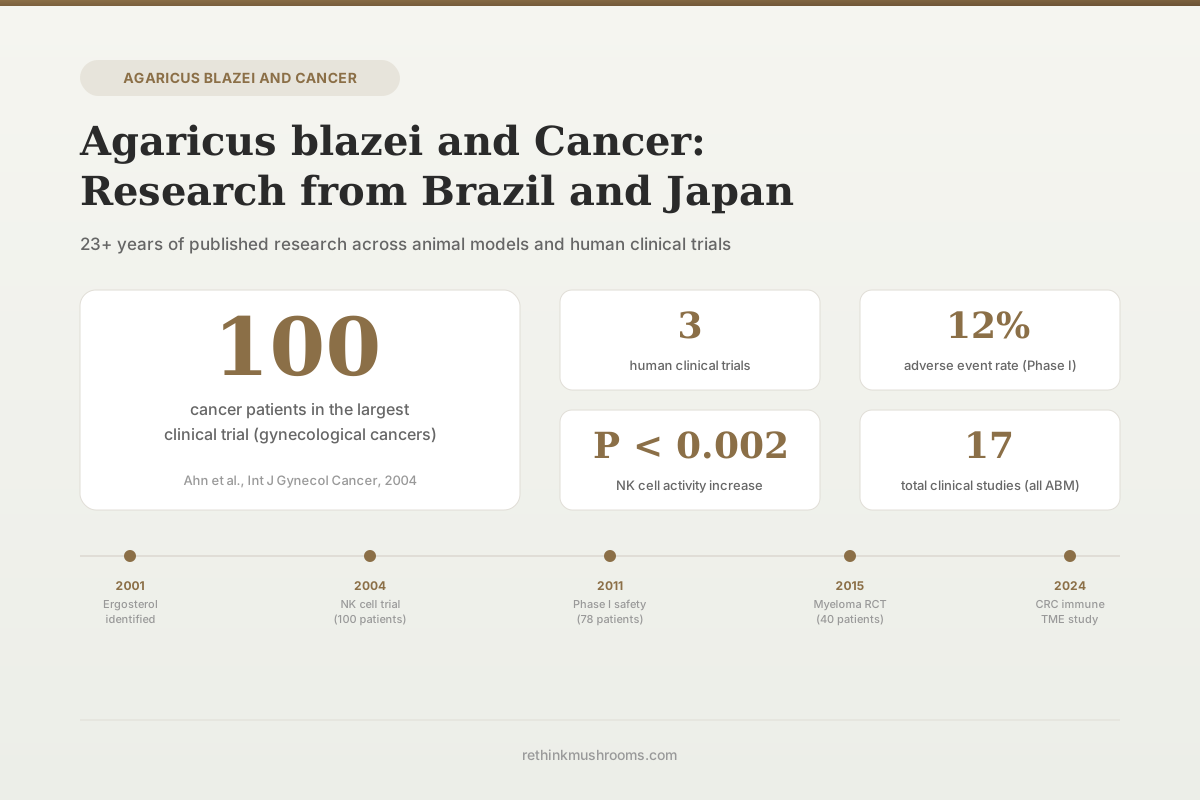
Three clinical trials make up the entire human evidence base for Agaricus blazei in cancer. The largest found improved natural killer cell activity during chemotherapy; the only randomized one found no difference in survival.
Ahn et al. 2004; Ohno et al. 2011; Tangen et al. 2015
23 Years
of published research, from 2001 to 2024
3 Human Trials
gynecological cancer, cancer survivors, myeloma
0 Survival Wins
no trial has shown an ABM survival benefit
Ahn et al. 2004; Ohno et al. 2011; Tangen et al. 2015
 View as image ↗
In the Atlantic Forest region of southeastern Brazil, locals call it "cogumelo do sol" (mushroom of the sun). In Japan, where it is now widely cultivated for medicinal use, it is "himematsutake."[16] Agaricus blazei Murill (ABM) is native to Brazil and became one of the most popular complementary medicines among Japanese cancer patients.[14] That journey — from a Brazilian forest to a Japanese cancer ward — is the story the mushroom is usually sold with.
The research landscape is more scattered than the story suggests. Three human clinical trials, a set of animal studies across several cancer types, and several comprehensive reviews have examined ABM's anticancer potential. The work centers on immune modulation, particularly the mushroom's beta-glucan polysaccharides and their ability to activate natural killer cells, macrophages and dendritic cells. For how those immune activation mechanisms work at the cellular level, that topic gets its own deep dive. This article maps the full research landscape — including who actually produced it.
Key Takeaways
- Ergosterol isolated from ABM inhibited tumor growth in Sarcoma 180 mice by suppressing tumor-induced angiogenesis (new blood vessel formation), not by direct cytotoxicity (Takaku et al., The Journal of Nutrition, 2001)
- In 100 gynecological cancer patients, ABM extract significantly increased NK cell activity during chemotherapy (P < 0.002) and improved side effects including appetite, alopecia and general weakness (Ahn et al., International Journal of Gynecological Cancer, 2004)
- A Phase I study of 78 cancer survivors found ABM tolerable at doses up to 5.4g/day for 6 months, with adverse events in 12% of patients, mostly digestive (Ohno et al., Evidence-Based Complementary and Alternative Medicine, 2011)
- The only randomized, double-blind trial — 40 multiple myeloma patients — found immunomodulatory changes but no significant difference in treatment response, overall survival or time to new treatment (Tangen et al., BioMed Research International, 2015)
- Three cancer patients taking ABM developed severe hepatic damage and two died of fulminant hepatitis, in a case series from Japan's National Cancer Center Hospital East (Mukai et al., Japanese Journal of Clinical Oncology, 2006)
- A 2017 review found only 17 clinical studies and 2 case reports across all ABM research, concluding that clinical evidence remains limited despite abundant, high-quality preclinical data (da Silva de Souza et al., Current Pharmaceutical Design, 2017)
Where This Research Actually Comes From
ABM is native to Brazil and is now widely cultivated in Japan, where it is considered one of the most important culinary-medicinal species.[16] Its reputation grew from traditional use against a long list of conditions — atherosclerosis, hepatitis, hyperlipidemia, diabetes, dermatitis and cancer — rather than from any single discovery.[16]
The consumer uptake in Japan is documented, not merely asserted. A 2006 case series from Japan's National Cancer Center Hospital East described ABM extract as "one of the most popular complementary and alternative medicines among Japanese cancer patients."[14] The scale shows up in a 2007 survey that mailed questionnaires to 2,346 Japanese consumers of a single ABM extract product who identified themselves as cancer patients; 782 responded, and nearly all had begun taking it after their diagnosis.[15] One product, one country, thousands of cancer patients.
What does not survive contact with the reference list is the idea that this is a Brazilian-and-Japanese body of research.
Framing Check
Where ABM Cancer Research Actually Comes From
“Research from Brazil and Japan” is how this literature is almost always described — including in the headline above. Counted by corresponding-author affiliation, those two countries account for 5 of the 16 papers cited in this article. The single largest contributor is Norway.
Norway
Not in the framing4 papersHetland 2011 · Tangen 2015 · Hetland 2016 · Hetland 2020
One group at Oslo University Hospital. Produced the only randomized controlled trial in this evidence base.
Japan
In the framing3 papersTakaku 2001 · Ohno 2011 · Mukai 2006
The ergosterol mechanism paper, the Phase I safety study, and the hepatotoxicity case series.
South Korea
Not in the framing2 papersLee 2003 · Ahn 2004
Includes the largest human study in the entire ABM cancer literature — routinely described as Japanese.
Brazil
In the framing2 papersZiliotto 2009 · da Silva de Souza 2017
The mushroom is Brazilian. The Brazilian contribution here is one null in vivo result and one review.
China
Not in the framing2 papersHuang 2022 · Xu 2024
The most recent primary research in this article is Chinese, not Japanese or Brazilian.
Taiwan
Not in the framing1 paperYu 2009
The prostate cancer in vitro and xenograft work.
Italy
Not in the framing1 paperFirenzuoli 2008
The pharmaco-toxicological review that put agaritine on the agenda.
United States
Not in the framing1 paperTalcott 2007
A Harvard-run survey of Japanese ABM consumers — Japanese subjects, American investigators.
This is not a criticism of the research. It matters because a reader who believes ABM has been independently validated across two continents is reading a different evidence base than the one that exists — where a quarter of the papers, and the only randomized trial, come from one hospital in Oslo.
Country assigned from the corresponding-author affiliation on each PubMed record for the 16 sources cited in this article.
The pattern that matters most here is the Norwegian one. Four of the sixteen sources cited in this article come from Geir Hetland's group at Oslo University Hospital, including the only randomized controlled trial. That group's work is careful and it reports null results when it finds them. It also carries a disclosed commercial interest: Hetland is a cofounder and shareholder of Immunopharma, the Norwegian company that produces AndoSan, the ABM-based extract used in those studies. Both the 2016 mouse study and the 2020 review state this in their competing-interest declarations.[10][3]
Disclosed conflicts are not disqualifying — disclosure is the system working. But it means independent replication from unaffiliated labs is thinner than the raw paper count suggests. For the population-level data that exists, see the epidemiological evidence for ABM and cancer prevention.
The Active Antitumor Compounds
ABM contains several classes of bioactive molecules with anticancer properties in laboratory settings: polysaccharides, lipids including ergosterol, sterols, proteins, vitamins B, C and D, and phenolic compounds.[2]
Beta-glucans are the most studied. ABM is rich in these immunomodulating polysaccharides, which stimulate innate immune cells including monocytes, NK cells and dendritic cells.[1] The mechanism is indirect: beta-glucans do not kill cancer cells themselves. They stimulate the immune system to recognize and attack tumor cells more effectively.
Ergosterol was identified as an antitumor compound by Takaku and colleagues in 2001.[4] Working with Sarcoma 180-bearing mice, they found that oral administration of the lipid fraction from ABM retarded tumor growth, and isolated ergosterol as the active substance. Ergosterol had no cytotoxicity against tumor cells at all. Instead, it inhibited tumor-induced blood vessel formation — a result the authors confirmed in two separate angiogenesis models and described as the first report of ergosterol as an antiangiogenic substance.
Agaritine, a phenylhydrazine derivative found in Agaricus species, is the compound that complicates the safety picture. It is addressed in the safety section below, because the evidence on it does not point the reassuring direction most supplement marketing implies.
Animal Studies: Tumor Suppression Across Cancer Types
The preclinical evidence spans multiple cancer types, with results ranging from strongly positive to flatly null. That spread is the most useful thing about it.
Sarcoma 180
The earliest antitumor studies used the Sarcoma 180 mouse model. Takaku et al. (2001) demonstrated that ergosterol from ABM's lipid fraction suppressed tumor growth via anti-angiogenic mechanisms, at oral doses of 400 and 800 mg/kg over 20 days, without the body weight, thymus, spleen and leukocyte losses that chemotherapy drugs produce.[4] Lee and colleagues (2003) showed that oral administration of ABM hot-water extract (H1 strain) significantly inhibited Sarcoma 180 growth in both ICR and KSN nude mice, with pan T cells significantly increased in all treated groups.[6]
The choice of two mouse strains is worth pausing on. KSN nude mice are athymic and severely T cell deficient; ICR mice are immunocompetent. Running both lets a study separate effects that need a full T cell compartment from effects that do not. The authors reported that splenocyte subset changes differed somewhat between the strains, and framed the model as a screening tool for comparing immunological changes across mouse strains rather than as a test of a specific mechanism.
Prostate Cancer
Yu et al. (2009) examined ABM's effects on human prostate cancer cell lines, both androgen-dependent and androgen-independent.[7] The broth fraction inhibited cell proliferation in both types and induced lactate dehydrogenase leakage in three cancer cell lines. Caspase 3 activity and DNA fragmentation were enhanced most in androgen-independent PC3 cells. In severe combined immunodeficient (SCID) mice with PC3 xenografts, oral supplementation with the broth — the fraction with the higher beta-glucan ratio — significantly suppressed tumor growth without adverse effects, and the tumors showed fewer proliferating cell nuclear antigen-positive cells and reduced microvessel density.
Colon and Colorectal Cancer
Results here are mixed, and the disagreement is informative.
Ziliotto et al. (2009) tested ABM extracts against 9 human cancer cell lines in vitro and in a rat colon carcinogenesis model.[8] Dichloromethane/methanol and hexane extracts showed antitumor activity at 250 µg/mL against all cell lines tested. No antiproliferative or cytotoxic activity was detected for the aqueous, methanol, ethyl acetate or n-butanolic extracts. In the in vivo arm, male Wistar rats given dimethylhydrazine and then fed crude ABM at 5% of diet for 20 weeks showed no suppression of aberrant crypt foci, no change in crypt multiplicity, and no difference in colon tumor incidence. The authors concluded that ABM in the diet does not have a suppressive effect on colon carcinogenesis.
Ziliotto et al. (2009) · Nutrition and Cancer
- Population
- 9 human cancer cell lines in vitro; male Wistar rats given dimethylhydrazine, 20-week colon carcinogenesis model
- Intervention
- Organic and aqueous ABM extracts in vitro; crude ABM at 5% of diet in vivo
- Comparator
- Untreated cell lines; DMH-treated rats without ABM
- Finding
- Dichloromethane/methanol and hexane extracts inhibited all 9 cell lines at 250 µg/mL, but aqueous, methanol, ethyl acetate and n-butanolic extracts did nothing. In rats, dietary ABM did not reduce aberrant crypt foci, crypt multiplicity or colon tumor incidence.
null The extracts that worked in a dish are solvent fractions nobody eats. The preparation closest to actual consumption — crude mushroom in the diet — produced nothing.
Ziliotto et al. (2009), Nutrition and Cancer 61(2):245-50
That in vitro/in vivo split is the single most transferable lesson in ABM research. An organic solvent fraction at 250 µg/mL bathing cells in a dish is not the same exposure as eating the mushroom, and this study ran both comparisons in one paper and got opposite answers.
By contrast, Xu et al. (2024) found that ABM polysaccharide (ABMP) inhibited intraperitoneal but not subcutaneous MC38 colorectal tumor growth in mice.[9] In vitro, ABMP significantly promoted CD8+ T cell activity and their colorectal cancer killing function. In vivo, it reduced lipid-related spectral signals in the peritoneal tumor microenvironment and increased omega-3 polyunsaturated fatty acid content there. The authors suggest the inhibitory effect may be tumor stage-dependent, with fatty acid remodeling as an important determinant.
The two studies are not necessarily in conflict. Ziliotto tested whole mushroom in the diet against chemically induced tumors; Xu tested an isolated polysaccharide against implanted tumors in a specific anatomical compartment. Different preparation, different model, different answer — which is itself the finding.
Intestinal Tumors
Hetland et al. (2016) tested the ABM-based extract AndoSan in the A/J Min/+ mouse, a model of human familial adenomatous polyposis that spontaneously develops adenocarcinomas in the colon and small intestine.[10] Mice given 10% AndoSan as their only drinking water for 15 or 22 weeks had significantly fewer adenocarcinomas and a 60% reduction in intestinal tumor load (tumor number × size) versus control. Legumain expression, a tumor-associated protease, was reduced. AndoSan was also directly cytotoxic to the human Caco-2 colon cancer line in vitro, correlating with apoptosis, and treated mice showed increased anti-tumor Th1-type cytokines.
This is the strongest preclinical result in the set. Two caveats travel with it. AndoSan is not pure ABM — it is 82% ABM plus Hericium erinaceus and Grifola frondosa, so the effect cannot be cleanly attributed to Agaricus. And this is the Immunopharma-affiliated group testing the Immunopharma product, with that interest disclosed in the paper.
Human Clinical Evidence
Only three clinical trials have examined ABM in cancer patients, totalling 218 participants. This is a small evidence base for a mushroom consumed by thousands of cancer patients in Japan alone.
Complete Human Record
Every Trial of Agaricus blazei in Cancer Patients
Three studies, 218 patients total. Not a selection — this is the entire human evidence base for ABM in cancer. The right-hand column is the part that rarely gets quoted.
Ahn et al., 2004
Allocation not describedInternational Journal of Gynecological Cancer
100Cervical, ovarian and endometrial cancer, on carboplatin-based chemotherapy- Design
- Two arms, n=39 ABMK vs n=61 comparison. The abstract describes no randomization or blinding procedure.
- What it measured
- Immune cell activity and chemotherapy side effects — not tumor response
- What it found
- NK cell activity significantly higher in the ABMK arm (P < 0.002). Appetite, alopecia, emotional stability and general weakness all improved.
- What it did not show
- No significant difference in lymphokine-activated killer or monocyte activity. Tumor response, progression and survival were not endpoints.
Ohno et al., 2011
Uncontrolled safety studyEvidence-Based Complementary and Alternative Medicine
78Cancer survivors in remission- Design
- Phase I dose-escalation safety study — 1.8, 3.6 or 5.4 g/day for 6 months. No control arm.
- What it measured
- Safety only — adverse events by NCI-CTCAE v3.0 and laboratory parameters
- What it found
- Adverse events in 9 patients (12%), mostly nausea and diarrhea. One liver dysfunction-related food allergy. None occurred in a dose-dependent manner.
- What it did not show
- This trial was not designed to measure anticancer efficacy, and it did not measure it.
Tangen et al., 2015
Randomized, double-blindBioMed Research International
40Multiple myeloma, undergoing high-dose chemotherapy and autologous stem cell transplant- Design
- Randomized, double-blind, placebo-controlled. AndoSan (82% ABM) n=19 vs placebo n=21, for about seven weeks. 33 evaluable for all endpoints, 40 for survival.
- What it measured
- Immune biomarkers and gene expression, plus treatment response and survival
- What it found
- Increased Treg cells and plasmacytoid dendritic cells in the leukapheresis product; increased serum IL-1ra, IL-5 and IL-7; increased immunoglobulin, KIR and HLA gene expression.
- What it did not show
- No statistically significant difference in treatment response, overall survival, or time to new treatment.
No trial in this set measured whether ABM changes tumor growth, recurrence or survival and found that it does. The one trial powered to look at survival endpoints looked, and found no difference.
Sources: Ahn et al. (2004), International Journal of Gynecological Cancer 14(4):589-94; Ohno et al. (2011), Evidence-Based Complementary and Alternative Medicine 2011:192381; Tangen et al. (2015), BioMed Research International 2015:718539 (NCT00970021)
Gynecological Cancer (Ahn et al., 2004)
The largest study enrolled 100 patients with cervical, ovarian or endometrial cancer, treated with either carboplatin plus etoposide or carboplatin plus taxol every three weeks for at least three cycles, with or without oral ABMK (Agaricus blazei Murill Kyowa).[11] The ABMK group had 39 patients; the comparison group had 61.
NK cell activity was significantly higher in the ABMK group (P < 0.002). Chemotherapy-associated side effects — appetite, alopecia, emotional stability and general weakness — were all improved. No significant difference appeared in lymphokine-activated killer or monocyte activities, nor in the counts of specific immune cell populations. For more on the NK cell enhancement findings, that study gets detailed analysis in its own article.
Two limits deserve to travel with this result. The published abstract does not describe a randomization or blinding procedure, and the unequal arm sizes (39 versus 61) are not what 1:1 randomization typically produces. And the endpoints were immune markers and quality of life — not tumor response, progression or survival. A patient reading "the largest ABM cancer trial was positive" should know it was positive on how people felt and how their NK cells behaved, which is a real benefit and not the same as the cancer doing anything different.
Phase I Safety Study (Ohno et al., 2011)
Seventy-eight cancer survivors took ABM granulated powder at 1.8, 3.6 or 5.4 g/day for 6 months (30, 24 and 24 subjects respectively), with adverse events graded by NCI-CTCAE v3.0.[12] Adverse events occurred in 9 patients (12%), mostly digestive — nausea and diarrhea. One patient developed a liver dysfunction-related food allergy. None of the adverse events occurred in a dose-dependent manner. The authors concluded that ABM does not cause problems in most patients within laboratory parameters at these dosages, while explicitly excluding possible allergic reaction from that reassurance.
This study's value is establishing tolerability in patients in remission. It had no control arm and was not designed to measure anticancer efficacy.
Multiple Myeloma RCT (Tangen et al., 2015)
The strongest design in ABM cancer research: 40 multiple myeloma patients randomized double-blind to AndoSan (82% ABM, 19 patients) or placebo (21 patients) during high-dose chemotherapy and stem cell transplantation, from the day of stem cell mobilizing chemotherapy until the end of aplasia — about seven weeks.[13] Thirty-three patients were evaluable for all study endpoints; all 40 were evaluable for survival.
The immunomodulatory effects were real. In the leukapheresis product harvested after stem cell mobilization, the AndoSan group showed increased percentages of Treg cells and plasmacytoid dendritic cells. Serum IL-1ra, IL-5 and IL-7 rose significantly by end of treatment. Whole-genome microarray showed increased expression of immunoglobulin, Killer Immunoglobulin Receptor (KIR) and HLA genes. AndoSan also showed concentration-dependent antiproliferative activity against mouse myeloma cells in vitro.
And treatment response, overall survival and time to new treatment showed no statistically significant differences.
Tangen et al. (2015) · BioMed Research International
- Population
- 40 multiple myeloma patients undergoing high-dose chemotherapy with autologous stem cell transplant
- Intervention
- AndoSan (82% Agaricus blazei Murrill extract), n=19, for approximately seven weeks
- Comparator
- Placebo, n=21, double-blinded
- Finding
- Increased Treg cells and plasmacytoid dendritic cells in the leukapheresis product; increased serum IL-1ra, IL-5 and IL-7; increased immunoglobulin, KIR and HLA gene expression. No statistically significant difference in treatment response, overall survival or time to new treatment.
mixed With 40 patients, this trial was underpowered to detect a modest survival difference — absence of evidence, not evidence of absence. But it is the only randomized test that exists, and it did not find a clinical benefit.
Tangen et al. (2015), BioMed Research International 2015:718539 (NCT00970021)
This trial is the cleanest illustration of the gap running through all of ABM research: the biomarkers respond, and the patients do not measurably do better. Both halves of that sentence are supported by the same paper.
- Cell studiescompleted
Organic ABM extracts inhibited all 9 human cancer cell lines tested at 250 µg/mL; ABM broth induced apoptosis in PC3 prostate cells; AndoSan was cytotoxic to Caco-2.
- Animal studiescompleted
Positive in Sarcoma 180, prostate xenograft, intraperitoneal colorectal and A/J Min/+ intestinal models. Null for dietary ABM in the rat colon carcinogenesis model.
- Case reportscompleted
Present — but the published case series documents harm, not benefit: three cancer patients with severe hepatic damage, two fatal.
- Small trialscompleted
Ahn 2004 (n=100, immune and quality-of-life endpoints) and Ohno 2011 (n=78, safety only).
- Large RCTsmissing
The only randomized trial enrolled 40 patients and found no difference in treatment response or survival. Nothing larger exists.
- Meta-analysesmissing
There is not enough randomized data to pool. A 2017 review found only 17 clinical studies across all of ABM research, cancer and non-cancer combined.
ABM has climbed most of this ladder. It stalls exactly where it would start to matter to a patient — at adequately powered randomized trials with clinical endpoints.
Ziliotto et al. (2009); Yu et al. (2009); Hetland et al. (2016); Mukai et al. (2006); Ahn et al. (2004); Ohno et al. (2011); Tangen et al. (2015); da Silva de Souza et al. (2017)
What the Reviews Conclude
Da Silva de Souza et al. (2017) searched the literature for basic and clinical studies and found that high-quality ex vivo and in vivo research is "quite abundant," but only 17 clinical studies and two case reports existed across all of ABM research — not just cancer.[5] Their conclusion is worth quoting for its balance: the accumulated evidence "strongly speaks in favor of the health benefits" of ingesting ABM, yet "there are many uncertainties and limitations when attempts are made to extrapolate or to demonstrate their biological effects in the human organism," and more clinical trials with reliable statistics and standardized preparations are needed to establish efficacy.
Hetland et al. (2020) reviewed preclinical and clinical studies of ABM alongside Hericium erinaceus and Grifola frondosa.[3] They describe antitumor mechanisms running along two routes — direct tumor attack via apoptosis and metastatic suppression, and indirect defense via inhibited tumor neovascularization and Th1 immune response — and note that tumor, inflammation and allergy appear linked through a shared Th2-dominant milieu. Their assessment is more optimistic than the other two reviews, and it carries the Immunopharma disclosure noted earlier.
Huang et al. (2022) focused on ABM's chemical composition and health effects, identifying polysaccharides, lipids including ergosterol, sterols, proteins, vitamins B, C and D, and phenolic compounds as the main bioactive constituents.[2] They note that some principles behind the health-promoting effects have not been clarified and that ABM-related clinical trials are limited, concluding that ABM has potential medical usage as a functional food.
The reviews differ in tone but converge on the same structural assessment: substantial preclinical signal, inadequate clinical follow-up.
Safety Concerns That Compete with the Promise
This is the section that most ABM cancer coverage gets wrong, usually by understating it.
Safety
CriticalSevere hepatic dysfunction in cancer patients taking ABM
Concern
Oncologists at Japan's National Cancer Center Hospital East reported three patients with advanced cancer who developed severe hepatic damage while taking Agaricus blazei extract. Two died of fulminant hepatitis. In one patient, liver function recovered after stopping the extract, deteriorated again when she restarted it, and that rechallenge pattern is among the stronger indicators of a causal drug-liver relationship.
What the research says
The authors acknowledged other factors could not be completely ruled out, but concluded a strong causal relationship was suggested. The separate Phase I study in 78 patients also recorded one liver dysfunction event, attributed to food allergy. These appear to be rare, idiosyncratic reactions rather than dose-dependent toxicity — but 'rare' is not 'absent,' and the reported outcome in two of three cases was death.
Particularly relevant for: Cancer patients, particularly those on hepatically metabolized chemotherapy or with existing liver involvement
What to do
Tell your oncology team about any ABM product you are taking or considering, and treat unexplained liver enzyme changes as a reason to stop it. This article summarizes research; it is not medical advice.
Mukai et al. (2006), Japanese Journal of Clinical Oncology 36(12):808-10; Ohno et al. (2011), Evidence-Based Complementary and Alternative Medicine 2011:192381
The Mukai case series makes a second point that has nothing to do with pharmacology. The authors observed that doctors aware their patients were taking the extract often accepted it, probably because they assumed a complementary medicine could do no harm — and that the extract's presence made clinical decision-making substantially more complicated when liver damage appeared. Undisclosed supplement use is its own clinical risk, separate from the supplement.
Fact Check
The agaritine reassurance
The claim
“Agaritine levels in Agaricus blazei supplements are well below the threshold of concern, so the mutagenicity question is settled.”
Agaritine occurs in common button mushrooms too, and that familiarity gets used to argue the question away. Supplement marketing tends to summarize a long-running toxicological debate as though it had been resolved in the mushroom's favor.
What research shows
UnsupportedThe published toxicological reviews do not say this. Firenzuoli and colleagues (2008) describe agaritine as 'a well-known carcinogenic and toxic substance in animals, that must be completely and fully evaluated,' and name its content as a perplexing concern precisely because clinical study of ABM is at an early stage.
This is not evidence that ABM supplements cause cancer in humans — no such evidence exists either. It is an open question that reviewers have repeatedly flagged as unresolved. Claiming it is settled in either direction goes beyond the data.
Firenzuoli et al. (2008), Evidence-Based Complementary and Alternative Medicine 5(1):3-15
Product composition and quality: compositional reviews note that processing and source-region differences materially affect what consumers actually ingest, which is part of why product testing matters for a product category with no premarket approval requirement.[2] A related problem runs through the research itself: "ABM" in one study may be a hot-water extract, in another a broth fraction, in another crude mushroom in feed, and in the clinical trials a proprietary multi-species formulation. Reviewers have specifically called for standardized preparations before efficacy can be established.[5]
Drug interaction potential: ABM's bioactive profile and the general immunomodulatory mechanism raise a theoretical question about co-administration with cancer therapy, and the reviews that catalogue ABM's benefits also catalogue controversies in this area.[5] No clinical pharmacokinetic interaction study in cancer patients has been published, so this remains unquantified rather than ruled out.
These issues do not invalidate the research, but they explain why ABM as a chemotherapy adjunct requires careful weighing of the risk-benefit equation, particularly for patients already on complex drug regimens. The blood sugar effects of ABM add another variable for patients managing diabetes alongside cancer treatment.
Research Gap
What would settle the question
What would it take to know whether Agaricus blazei helps cancer patients?
A randomized trial with a clinical primary endpoint
Tangen 2015 is randomized and double-blind with survival endpoints — but with 40 patients it can only rule out large effects.
Adequate statistical power
Detecting a modest survival difference in an adjunct therapy typically requires several hundred patients. No ABM trial approaches that.
A standardized, characterized preparation
Trials have used ABMK, granulated powder and an 82% multi-species extract. Reviewers have explicitly called standardization a precondition for establishing efficacy.
Replication outside the originating groups
The only RCT comes from a group with a disclosed commercial interest in the product tested. No independent group has replicated it.
Resolution of the agaritine question
Toxicological reviews have called for full evaluation of a compound they describe as carcinogenic in animals. That evaluation has not been completed.
Systematic hepatotoxicity surveillance
A case series and one Phase I signal exist. There is no prospective monitoring that would establish how often severe liver injury actually occurs.
Tangen et al. (2015); da Silva de Souza et al. (2017); Firenzuoli et al. (2008); Mukai et al. (2006)
The Bottom Line
Agaricus blazei cancer research spans over two decades and includes three human clinical trials totalling 218 patients, a set of animal studies, and several comprehensive reviews. Despite the "Brazil and Japan" framing, those two countries account for 5 of the 16 sources cited here; the largest single contributor is one Norwegian group with a disclosed commercial interest in the extract it studies. The preclinical evidence for antitumor effects is largely positive across Sarcoma 180, prostate xenograft, intraperitoneal colorectal and intestinal tumor models, driven by beta-glucan polysaccharides and by ergosterol's anti-angiogenic action — though dietary ABM produced no effect at all in a rat colon carcinogenesis model. Human evidence consists of one gynecological cancer trial with no described randomization or blinding, showing improved NK cell activity and quality of life, one uncontrolled Phase I safety study, and one randomized myeloma trial that found immune biomarker changes but no difference in treatment response or survival. On the safety side, a Japanese case series reported three cancer patients with severe hepatic damage and two deaths from fulminant hepatitis, and toxicological reviewers continue to describe agaritine as an unresolved question rather than a settled one. The gap between mechanism and outcome remains the field's defining limitation. This article is a research summary, not medical advice.
Frequently Asked Questions
Sources & References
- 1RTHM-00215·Hetland, Geir et al. (2011). “The Mushroom Agaricus blazei Murill Elicits Medicinal Effects on Tumor, Infection, Allergy, and Inflammation through Its Modulation of Innate Immunity and Amelioration of Th1/Th2 Imbalance and Inflammation..” Advances in pharmacological sciences.Study breakdown →PubMed →↩
- 2RTHM-00765·Huang, Kaiyuan et al. (2022). “Critical review on chemical compositions and health-promoting effects of mushroom Agaricus blazei Murill..” Current research in food science.Study breakdown →PubMed →↩
- 3RTHM-00620·Hetland, Geir et al. (2020). “Antitumor, Anti-Inflammatory and Antiallergic Effects of Agaricus blazei Mushroom Extract and the Related Medicinal Basidiomycetes Mushrooms, Hericium erinaceus and Grifola frondosa: A Review of Preclinical and Clinical Studies..” Nutrients.Study breakdown →PubMed →↩
- 4RTHM-00039·Takaku, T et al. (2001). “Isolation of an antitumor compound from Agaricus blazei Murill and its mechanism of action..” The Journal of nutrition.Study breakdown →PubMed →↩
- 5RTHM-00468·da Silva de Souza, Aline Cristine et al. (2017). “Agaricus blazei Bioactive Compounds and their Effects on Human Health: Benefits and Controversies..” Current pharmaceutical design.Study breakdown →PubMed →↩
- 6RTHM-00059·Lee, Yun-Lyul et al. (2003). “Oral administration of Agaricus blazei (H1 strain) inhibited tumor growth in a sarcoma 180 inoculation model..” Experimental animals.Study breakdown →PubMed →↩
- 7RTHM-00172·Yu, Ching-Han et al. (2009). “Inhibitory mechanisms of Agaricus blazei Murill on the growth of prostate cancer in vitro and in vivo..” The Journal of nutritional biochemistry.Study breakdown →PubMed →↩
- 8RTHM-00174·Ziliotto, Liane et al. (2009). “Screening for in vitro and in vivo antitumor activities of the mushroom Agaricus blazei..” Nutrition and cancer.Study breakdown →PubMed →↩
- 9RTHM-00916·Xu, Yongzhao et al. (2024). “Preventive intervention with Agaricus blazei murill polysaccharide exerts anti-tumor immune effect on intraperitoneal metastasis colorectal cancer..” International journal of biological macromolecules.Study breakdown →PubMed →↩
- 10RTHM-00427·Hetland, Geir et al. (2016). “The Agaricus blazei-Based Mushroom Extract, Andosan™, Protects against Intestinal Tumorigenesis in the A/J Min/+ Mouse..” PloS one.Study breakdown →PubMed →↩
- 11RTHM-00066·Ahn, W-S et al. (2004). “Natural killer cell activity and quality of life were improved by consumption of a mushroom extract, Agaricus blazei Murill Kyowa, in gynecological cancer patients undergoing chemotherapy..” International journal of gynecological cancer : official journal of the International Gynecological Cancer Society.Study breakdown →PubMed →↩
- 12RTHM-00229·Ohno, Satoshi et al. (2011). “Phase I Clinical Study of the Dietary Supplement, Agaricus blazei Murill, in Cancer Patients in Remission..” Evidence-based complementary and alternative medicine : eCAM.Study breakdown →PubMed →↩
- 13RTHM-00404·Tangen, Jon-Magnus et al. (2015). “Immunomodulatory effects of the Agaricus blazei Murrill-based mushroom extract AndoSan in patients with multiple myeloma undergoing high dose chemotherapy and autologous stem cell transplantation: a randomized, double blinded clinical study..” BioMed research international.Study breakdown →PubMed →↩
- 14RTHM-00105·Mukai, Hirofumi et al. (2006). “An alternative medicine, Agaricus blazei, may have induced severe hepatic dysfunction in cancer patients..” Japanese journal of clinical oncology.Study breakdown →PubMed →↩
- 15RTHM-00121·Talcott, James A et al. (2007). “Measuring perceived effects of drinking an extract of basidiomycetes Agaricus blazei Murill: a survey of Japanese consumers with cancer..” BMC complementary and alternative medicine.Study breakdown →PubMed →↩
- 16RTHM-00131·Firenzuoli, F et al. (2008). “The Medicinal Mushroom Agaricus blazei Murrill: Review of Literature and Pharmaco-Toxicological Problems..” Evidence-based complementary and alternative medicine : eCAM.Study breakdown →PubMed →↩