Turkey Tail & Cancer
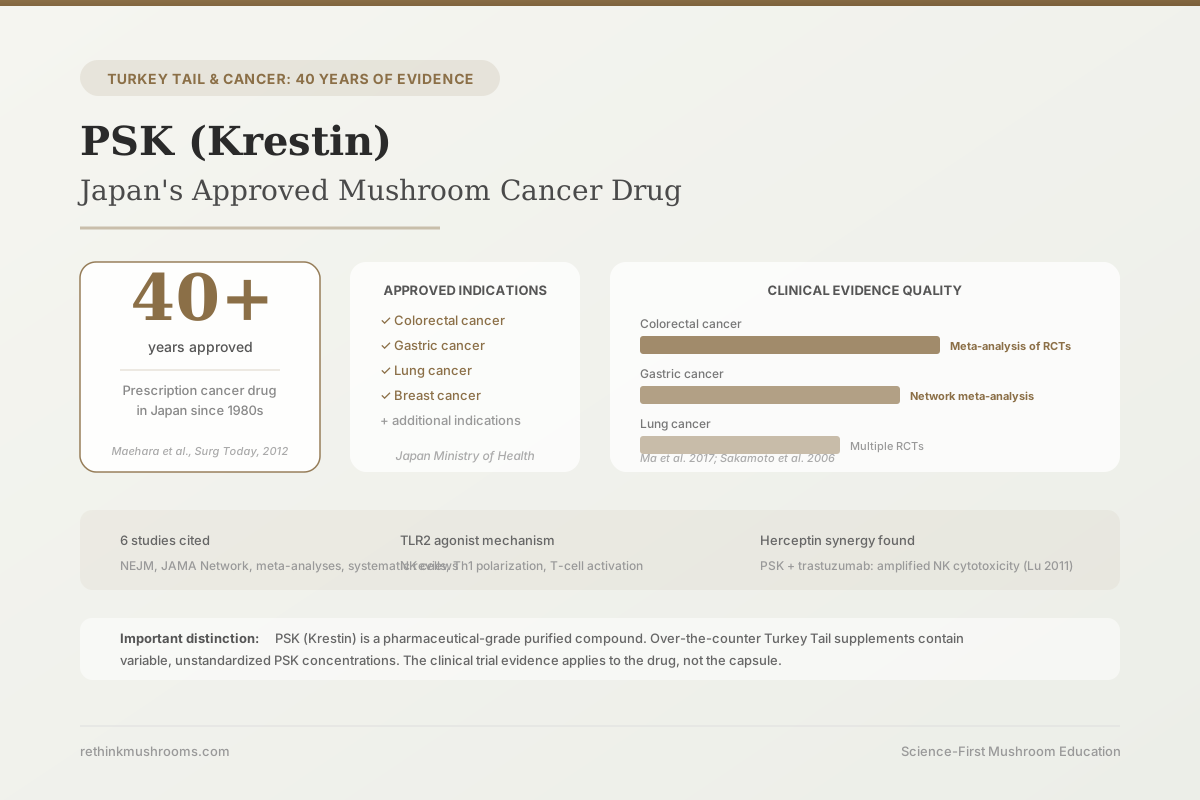
40+ years
PSK (Krestin) has been approved in Japan as a cancer treatment adjunct for over 40 years, backed by meta-analyses of centrally randomized controlled trials — making it the most clinically validated medicinal mushroom compound in the world.
Maehara et al., Surg Today, 2012
6+
cancer types with clinical evidence for PSK in Japan's approval portfolio
1980s
decade PSK received its first Japanese cancer approvals as a prescription adjunct
TLR2
immune receptor PSK activates to trigger NK cells and Th1 immunity
Maehara et al., Surg Today, 2012
 View as image ↗
Most Western writing about Turkey Tail mushrooms treats it as a supplement category: immune support, gut health, general wellness. What almost none of it explains is that Turkey Tail already has an approved cancer drug. PSK, sold under the brand name Krestin and manufactured by Kureha Corporation, has been prescribed as an adjunct to cancer chemotherapy in Japan since the 1980s. It is not a traditional remedy waiting for clinical validation. It is a drug that went through Japanese regulatory review, received approval for multiple cancer indications, and has been in continuous clinical use for four decades.
Understanding the difference between PSK as a pharmaceutical compound and Turkey Tail as a supplement matters for anyone researching this mushroom in a cancer context. The evidence for PSK is not the same evidence as the evidence for the supplements on store shelves. This article covers what PSK is, what the clinical data actually shows for each cancer type, how the mechanism works, and what PSK's status is in the US. For a broader introduction to the mushroom itself, see What Is Turkey Tail Mushroom? A Science-Based Introduction.
Key Takeaways
- PSK (Krestin) is a purified complex sugar-protein compound extracted from Turkey Tail mushroom, manufactured by Kureha Corporation in Japan as a prescription cancer treatment adjunct since the 1980s (Maehara et al., 2012)
- A meta-analysis of centrally randomized RCTs found that PSK adjuvant immunochemotherapy significantly improved survival in patients with curatively resected colorectal cancer compared to chemotherapy alone (Sakamoto et al., 2006)
- A 2017 network meta-analysis confirmed PSK improved both overall survival and disease-free survival in colorectal and gastric cancer patients across multiple chemotherapy regimens (Ma et al., 2017)
- PSK acts as a TLR2 agonist, meaning it activates a specific immune sensor that then triggers the branch of immunity responsible for attacking tumors directly: Th1 polarization, NK cell enhancement, and T-cell stimulation (Wasser et al., 2002)
- A 2011 study found PSK enhanced the anti-tumor effect of trastuzumab (Herceptin) against HER2-positive cancer cells by amplifying NK cell cytotoxicity, opening a potential combination therapy angle not covered by consumer content (Lu et al., 2011)
- Over-the-counter Turkey Tail supplements contain unstandardized amounts of PSK; the pharmaceutical-grade Krestin used in clinical trials is a purified compound that is not interchangeable with general Turkey Tail capsules (Sun et al., 2012)
What PSK Actually Is: A Prescription Drug in Japan, Not a Mushroom Supplement
PSK stands for polysaccharide-K. It is a long-chain sugar molecule linked to a protein component, extracted from the root-like mycelial network of Turkey Tail mushroom. In technical terms, this class of molecule is called a protein-bound polysaccharide; PSK's sugar backbone specifically is a beta-1,4-glucan chain. The ratio is roughly 60% polysaccharide to 40% peptide by mass.[1]
That composition is not incidental. The peptide component is what binds PSK to immune receptors on the surface of white blood cells, activating them against tumor cells. Strip the peptide away, and the cancer-relevant activity diminishes significantly. This is why highly purified PSK as a pharmaceutical compound behaves differently from whole Turkey Tail powder in a capsule: the extract concentrates the protein-bound fraction, and the manufacturing process standardizes it.
Kureha Corporation developed PSK through the 1970s, ran clinical trials through the late 1970s and 1980s, and received approval from Japan's Ministry of Health, Labour and Welfare for use as a cancer treatment adjunct. The drug is registered under the brand name Krestin. It is dispensed by prescription, co-administered with standard chemotherapy regimens rather than used as a standalone treatment, and has been a standard-of-care component for select cancer patients in Japan for decades.[1]
The framing that matters for understanding the evidence: all the clinical trial data on PSK describes a pharmaceutical intervention, not a supplement category. When researchers report survival benefits from PSK in colorectal cancer, they are reporting results from trials using Krestin at specific doses in specific clinical protocols. That evidence does not automatically transfer to Turkey Tail supplements, which may contain variable and unlabeled amounts of the relevant compounds.
PSK (Krestin): Approved Cancer Indications in Japan
| Cancer Type | Evidence Type | Key Finding |
|---|---|---|
| Colorectal | Meta-analysis of centrally randomized RCTs | Improved disease-free and overall survival as chemo adjunct |
| Gastric | Network meta-analysis of multiple RCTs | Improved overall survival combined with chemotherapy |
| Lung | Multiple clinical trials | Immune recovery and survival benefit as adjunct therapy |
| Breast | Phase 1 trial (US) + observational data | NK cell restoration post-radiation; safety confirmed |
The Colorectal and Gastric Cancer Evidence: Meta-Analyses, Not Small Pilot Studies
The strongest clinical evidence for PSK comes from gastrointestinal cancers. This is not because Turkey Tail has unique properties specific to GI tumors. It is because the Japanese clinical research infrastructure, which developed PSK commercially, ran most of its large trials in gastric and colorectal cancer patients during the 1980s and 1990s when those cancers had high mortality and limited treatment options.
The colorectal cancer evidence is the most robust. A 2006 meta-analysis by Sakamoto and colleagues pooled centrally randomized controlled trials of PSK adjuvant immunochemotherapy in patients with curatively resected colorectal cancer.[2] "Curatively resected" means the tumor had been surgically removed and the patient was in a potentially curable state, with PSK used to reduce the chance of recurrence. Pooled across the trials, PSK significantly improved survival outcomes compared to chemotherapy alone. This is the data that underlies PSK's colorectal cancer approval: not a single trial, but a meta-analysis of independently run randomized trials.
A 2017 network meta-analysis by Ma and colleagues extended this analysis to cover both colorectal and gastric cancers across multiple chemotherapy regimens.[3] Network meta-analysis is a method that compares multiple treatments simultaneously even when they haven't all been directly tested head-to-head. Across the studies analyzed, PSK improved overall survival and disease-free survival in patients receiving it as an adjunct to GI cancer chemotherapy. The effect held across different chemotherapy backbones, suggesting PSK's benefit is not dependent on which specific chemotherapy drug it's paired with.
Two honest limitations apply to this evidence. First, most of the underlying trials were conducted in the 1980s and 1990s, before contemporary cancer treatment standards. Second, many of the trials were Japanese and may reflect population-specific factors, treatment practices, or tumor biology patterns that don't fully generalize to Western populations. The network meta-analysis helps address the pooling question but doesn't resolve the generalizability question. These limitations are why PSK has not cleared the evidentiary bar for FDA approval, even though the evidence base is stronger than most people realize. For the full clinical trial landscape across all Turkey Tail cancer evidence, see Turkey Tail Clinical Trials in Cancer: A Comprehensive Review.
How PSK Works Against Cancer: Three Immune Pathways Working in Parallel
PSK does not attack cancer cells directly the way chemotherapy does. It works through the immune system. The cancer cell itself is not PSK's target. The immune cells that detect and destroy cancer cells are.
The central mechanism is TLR2 activation. TLR2 is a pattern-recognition receptor on the surface of immune cells, part of the innate immune system's sensor network for detecting foreign threats. PSK binds TLR2 and triggers it, causing the immune cell carrying that receptor to shift into an activated, tumor-fighting state.[4]
That TLR2 activation sets off a cascade through multiple immune cell types. First, it shifts the immune response toward what immunologists call Th1: the branch that attacks cancer cells directly, rather than the branch that produces antibodies to mark them for later disposal. Tumors benefit from suppressing Th1 activity; PSK partially reverses that suppression. Second, it enhances the activity and cytotoxicity of NK cells, natural killer cells, which are innate immune cells that can destroy cancer cells directly without needing prior sensitization to a specific tumor antigen. Third, it activates T cells of a type called gamma-delta T cells, which have innate-like properties and can attack tumors directly.
The framing the studyNotes for this cluster emphasize is worth stating clearly: PSK is most useful clinically not because it adds immune activity on top of a healthy immune system, but because cancer treatment (chemotherapy, radiation) suppresses the immune system, and PSK partially restores that suppression. It is a corrective treatment as much as an additive one. This mechanistic distinction explains why PSK is used alongside chemotherapy, not instead of it.
The Herceptin Connection: How PSK Could Amplify Modern Targeted Cancer Therapies
The clinical data for PSK comes almost entirely from trials pairing it with conventional chemotherapy in GI cancers. But a 2011 study published in Clinical Cancer Research by Lu and colleagues, working in the Disis laboratory, pointed in a different direction: PSK as a potential partner for modern targeted cancer therapies.[5]
The study focused on trastuzumab, the targeted antibody therapy marketed as Herceptin, which is used in HER2-positive breast cancer and some gastric cancers. Trastuzumab works in part by flagging HER2-expressing tumor cells for destruction by NK cells, a process called antibody-dependent cellular cytotoxicity. Lu and colleagues found that PSK, acting as a TLR2 agonist, activated human NK cells independently and synergistically enhanced trastuzumab's anti-tumor effect against HER2-positive cancer cells (cells that overproduce a growth receptor called HER2) in laboratory experiments.
The mechanism is logical given what we know about TLR2 and NK cells: if PSK activates NK cells to a higher baseline activity level, the NK cells executing trastuzumab's antibody-dependent killing would be more effective at doing so. The Lu 2011 study was in-vitro, meaning it tested cells in a laboratory rather than in patients. That is an important limitation: laboratory synergy does not always translate to clinical benefit. But it identified a biologically plausible combination mechanism and established the conceptual groundwork for testing PSK alongside HER2-targeted therapies.
This finding has received almost no attention in consumer content covering Turkey Tail or PSK, despite being published in one of oncology's most cited journals. It is the clearest evidence connecting PSK's 40-year clinical legacy to the checkpoint inhibitor and targeted therapy era that defines modern cancer treatment. For the broader context on how Turkey Tail's immune mechanisms work, see How Turkey Tail Enhances the Immune System's Anti-Cancer Response.
PSK vs. Turkey Tail Supplements: Why a 40-Year Drug History Doesn't Transfer to Your Capsule
PSK's 40 years of clinical use in Japan is real evidence for a real pharmaceutical compound. Whether that evidence says anything about the Turkey Tail supplement you can buy at a health food store is a separate question, and the honest answer is: not much, directly.
A 2012 review by Sun and colleagues in Current Medicinal Chemistry, titled deliberately "PSK in Cancer: Old Story, New Possibilities?", addressed the translation gap alongside the drug's history.[6] The review noted that PSK's clinical properties depend on its specific molecular structure, its protein-bound form, and the manufacturing standards used to produce pharmaceutical-grade Krestin. Turkey Tail mushroom does contain PSK naturally. But the amount varies considerably between different specimens and growing conditions, and drying and powdering whole mushroom material does not concentrate PSK the way pharmaceutical extraction does.
The core practical issue: most Turkey Tail supplements sold in the US do not list PSK content on the label, and the few that do may not have independent third-party verification of those claims. PSK content in a standard Turkey Tail capsule could be anywhere from negligible to moderate depending on extraction method, mushroom source, and mycelial versus fruiting body material. The clinical trials that showed survival benefits used standardized PSK at specific doses in controlled pharmaceutical settings.
This is not an argument that Turkey Tail supplements are worthless, only that the evidence supporting them is different from the evidence supporting Krestin. Turkey Tail supplements may have their own effects through beta-glucan content and other bioactives. But "Turkey Tail has good cancer evidence" and "Turkey Tail supplements reproduce the drug's cancer effects" are not the same claim. For the full breakdown of what PSK, PSP, and beta-glucans in Turkey Tail are and how they differ, see Turkey Tail Bioactive Compounds: PSK, PSP, and Beta-Glucans.
Availability in the US: Why Japan's Cancer Drug Isn't in American Oncology Clinics
PSK is not FDA-approved. It is not available as a prescription drug in the United States. There are several reasons for this, none of which are that the evidence is fraudulent or that PSK doesn't work.
The primary barrier is regulatory: PSK's clinical trials were conducted primarily in Japan under Japanese regulatory frameworks in the 1980s and 1990s. The FDA requires its own independent review process, which would typically include trials conducted under FDA-aligned protocols. Kureha Corporation, a Japanese pharmaceutical company with its core business in Japan, has not sponsored the US-based trials that would be required for an FDA New Drug Application. Running those trials is extremely expensive, and the commercial incentive to do so is limited when PSK's patent protection has long expired and any generic manufacturer could compete on a successful drug.
What is available in the US is Turkey Tail in supplement form, including some products positioned around PSK content and some that simply sell dried Turkey Tail powder in capsules. These are dietary supplements under FDA jurisdiction, not drugs, meaning they cannot make claims to treat disease, do not require pre-market clinical evidence, and are not subject to the same manufacturing and quality standards as pharmaceuticals.
For the 40-year history of the research arc that brought Turkey Tail from Japanese pharmaceutical labs to mainstream Western awareness, see Turkey Tail and Cancer: 40 Years of Research Reviewed. For a comparison of PSK's evidence against PSP's, see PSP vs. PSK: Comparing Turkey Tail's Two Anti-Cancer Compounds. For context on how PSK fits into the broader category of mushroom-derived approved cancer drugs, see Polysaccharide-Based Anti-Cancer Drugs from Mushrooms.
The Bottom Line
PSK (Krestin) is the most extensively validated medicinal mushroom compound in clinical oncology: a prescription cancer drug in Japan since the 1980s, backed by meta-analyses of randomized trials showing improved survival in colorectal and gastric cancers when used alongside chemotherapy. Its mechanism involves TLR2 activation, NK cell enhancement, and Th1 immune restoration, making it primarily a corrective treatment for the immunosuppression that cancer and chemotherapy impose. The 2011 finding that PSK synergizes with Herceptin-type therapies adds a modern relevance that consumer content has not yet absorbed. None of this evidence transfers automatically to over-the-counter Turkey Tail supplements, whose PSK content is unstandardized and unverified. The drug's 40-year history is real evidence for a pharmaceutical compound, not a marketing claim for a capsule.
Frequently Asked Questions
Sources & References
- 1RTHM-00475·Maehara, Yoshihiko et al. (2012). “Biological mechanism and clinical effect of protein-bound polysaccharide K (KRESTIN(®)): review of development and future perspectives..” Surgery today.Study breakdown →PubMed →↩
- 2RTHM-00200·Sakamoto, Junichi et al. (2006). “Efficacy of adjuvant immunochemotherapy with polysaccharide K for patients with curatively resected colorectal cancer: a meta-analysis of centrally randomized controlled clinical trials..” Cancer immunology.Study breakdown →PubMed →↩
- 3RTHM-00895·Ma, Yan et al. (2017). “Can polysaccharide K improve therapeutic efficacy and safety in gastrointestinal cancer? a systematic review and network meta-analysis..” Oncotarget.Study breakdown →PubMed →↩
- 4. Source details for this reference are not yet available.
- 5RTHM-00420·Lu, Hailing et al. (2011). “TLR2 agonist PSK activates human NK cells and enhances the antitumor effect of HER2-targeted monoclonal antibody therapy..” Clinical cancer research : an official journal of the American Association for Cancer Research.Study breakdown →PubMed →↩
- 6RTHM-00489·Sun, C et al. (2012). “Polysaccharide-K (PSK) in cancer--old story, new possibilities?.” Current medicinal chemistry.Study breakdown →PubMed →↩