Turkey Tail (Trametes versicolor)
50%+ beta-glucan
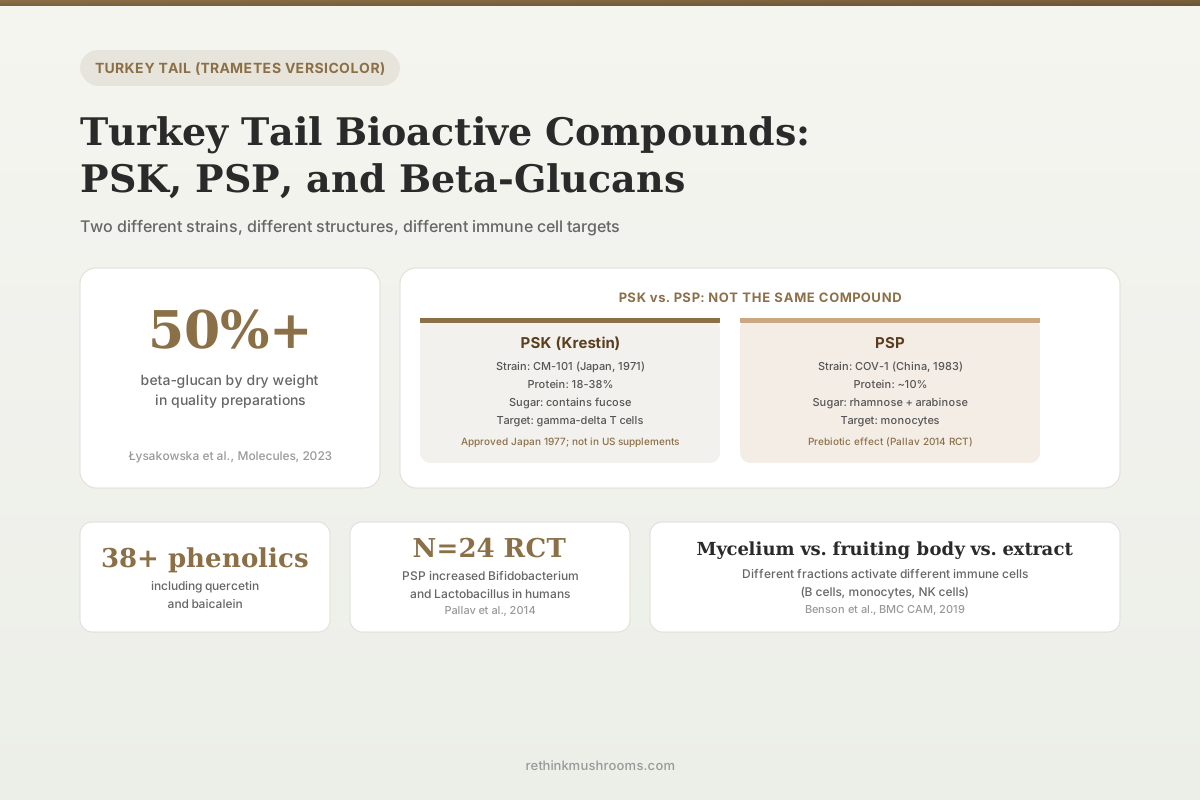
Quality turkey tail preparations contain over 50% beta-glucan by dry weight. Within that fraction, PSK and PSP are the two protein-bound subclasses that have received the most research attention, and they are not the same compound.
Łysakowska et al., Molecules, 2023
38+
phenolic compounds identified in turkey tail (Łysakowska 2023)
CM-101 / COV-1
PSK and PSP come from two different T. versicolor strains
24 volunteers
PSP increased Bifidobacterium and Lactobacillus in the only human gut microbiome RCT (Pallav 2014)
Łysakowska et al., Molecules, 2023
 View as image ↗
Turkey tail content comes with a naming problem. The terms PSK, PSP, beta-glucan, polysaccharide, and polysaccharopeptide appear across supplements, research papers, and competitor sites as if they are interchangeable. They are not. PSK and PSP are both protein-bound beta-glucan polysaccharide complexes isolated from Trametes versicolor, but they come from different fungal strains, have different protein content and sugar compositions, activate different immune cell populations, and were developed in different countries decades apart. Understanding what each compound is and what it does is the prerequisite to reading the turkey tail evidence intelligently. For a broader overview of turkey tail itself, see What Is Turkey Tail Mushroom? A Science-Based Introduction.
Key Takeaways
- Turkey tail contains over 50% beta-glucan by dry weight in quality preparations; PSK and PSP are protein-bound beta-glucan complexes, not free polysaccharides (Łysakowska 2023).
- PSK was isolated from the CM-101 strain by Kureha Corporation in Japan in 1971; it has 18-38% protein content and contains fucose as a side-chain sugar.
- PSP was isolated from the COV-1 strain by Prof. Qing-yao Yang in China in 1983; it has approximately 10% protein content and contains rhamnose and arabinose (not fucose).
- PSK's primary immune target is gamma-delta T cells (an unusual population bridging innate and adaptive immunity); PSP's primary immune target is monocytes: different cell types, different downstream effects (Inatsuka 2013, Sekhon 2013).
- A 2014 RCT (Pallav et al., N=24) showed PSP from turkey tail significantly increased Bifidobacterium and Lactobacillus and decreased Clostridium in healthy volunteers, the first human clinical evidence for turkey tail as a prebiotic.
- Turkey tail whole-mushroom products (mycelium or fruiting body) are not the same as pharmaceutical PSK (Krestin); PSK is a licensed Japanese drug not available in consumer supplements.
Beta-Glucans: Understanding the Parent Compound Class
Before PSK and PSP, there are beta-glucans. The term refers to a class of polysaccharides (long sugar chains) found in cell walls of fungi, yeast, and some plants. In medicinal mushrooms, beta-glucans are the primary immunomodulatory compound class: immune cells have dedicated receptors that recognize and respond to specific beta-glucan structures.
Turkey tail contains high concentrations. Lysakowska and colleagues documented that quality turkey tail preparations contain over 50% beta-glucan by dry weight, placing it among the highest of any medicinal mushroom species.[7] The presence of beta-glucan in a supplement does not tell you whether it contains PSK or PSP specifically, because these are further-refined subclasses of the beta-glucan category, each with a distinct protein component bound to the sugar chain.
PSK and PSP are technically called protein-bound polysaccharides or protein-polysaccharide complexes. They are not free polysaccharides: both have a protein fraction tightly associated with the sugar chain, and the protein fraction affects how immune cells recognize and respond to them.
PSK: The Compound Behind Japan's Approved Cancer Drug
PSK stands for Polysaccharide-K (the K sometimes attributed to Krestin, the trade name, or to the Japanese "Kureha"). It was isolated in 1971 from a specific strain of Trametes versicolor mycelium designated CM-101, by researchers at Kureha Corporation in Japan. The isolation followed observations from the 1960s of immune-related effects in patients who consumed turkey tail preparations, and led to a sustained pharmaceutical development program.
The structure, reviewed comprehensively by Maehara and colleagues:[1]
- A beta-glucan backbone connected via β-1,4 linkages (the main chain), with side branches via β-1,3 and β-1,6 linkages
- Molecular weight approximately 100 kilodaltons
- Protein content ranging from 18 to 38% of the total complex
- Fucose as a characteristic side-chain sugar (used to distinguish PSK from PSP)
Lysakowska et al. confirmed the fucose distinction in their 2023 analysis: it is the structural marker that separates PSK from its Chinese counterpart.[7]
The Japanese Ministry of Health approved PSK (as Krestin) in 1977 as an adjuvant therapy for cancer patients undergoing surgery and chemotherapy. It is used at 3 g/day in clinical practice. This regulatory approval is based on extensive clinical trial data: three separate meta-analyses covering over 20,000 cancer patients in total across colorectal, gastric, and gastrointestinal cancer contexts.
Critically for supplement buyers: PSK (Krestin) is a proprietary pharmaceutical product manufactured by Kureha Corporation, available only as a prescription drug in Japan and some other countries. It is not available in US, European, or other western consumer supplement markets. Supplements sold as "turkey tail" or even as "PSK" in consumer markets do not contain pharmaceutical-grade PSK from the CM-101 strain at 3 g/day dosing. For a detailed comparison of the clinical evidence and what it means for supplement use, see PSK vs. PSP: Comparing Turkey Tail's Two Star Compounds.
How PSK Activates Immune Cells: The Gamma-Delta T Cell Pathway
Most immune cells you read about belong to one of the well-known categories: macrophages, NK cells, CD8+ killer T cells, CD4+ helper T cells. PSK's primary immune target is a less-discussed population: gamma-delta T cells (abbreviated γδ T cells).
These cells sit at an unusual intersection. Unlike most T cells, which require prior exposure to a specific pathogen before they can respond, gamma-delta T cells can respond to stress signals from tumor cells or infected cells without having seen that threat before. They act faster than conventional T cells, releasing IFN-γ (a cytokine that helps kill abnormal cells) when activated.
Inatsuka and colleagues demonstrated that PSK directly activates gamma-delta T cells, inducing IFN-γ production.[2] When they depleted gamma-delta T cells from experimental animals and then tested PSK's anti-tumor effect, the effect disappeared. This established gamma-delta T cells as the primary cellular mediator of PSK's anti-cancer activity, not just a downstream bystander.
Maehara's mechanistic review identified two additional PSK mechanisms beyond gamma-delta T cell activation.[1] First: reversing immunosuppression. Tumors actively suppress immune responses by secreting a protein called TGF-β (a signal that tells the immune system to stand down). PSK appears to counteract this signal, restoring immune activity that the tumor had dampened. Second: direct effects on tumor cells, including induction of programmed cell death (apoptosis) and inhibition of the mechanisms tumors use to spread to new sites.
Guggenheim and colleagues, reviewing turkey tail alongside four other major medicinal mushrooms, positioned it as having the strongest evidence for cancer adjuvant use among all five species studied, attributing this to the combination of NK cell activation, T-cell differentiation promotion, and dendritic cell maturation.[4]
For the full picture of PSK's cancer trial evidence, see Trametes versicolor: The Most-Studied Medicinal Mushroom for Cancer.
PSP: The Chinese-Isolated Sister Compound With a Different Target
PSP stands for Polysaccharide Peptide. It was isolated from a different strain of T. versicolor designated COV-1, by Prof. Qing-yao Yang at the Shanghai Institute of Materia Medica in China in 1983. The development was independent from Kureha's work in Japan.
The structural differences from PSK:
- Similar β-glucan backbone architecture, but not identical
- Protein content approximately 10% (compared to PSK's 18-38%)
- Sugar side chains contain rhamnose and arabinose, not the fucose found in PSK
These structural differences correlate with different biological activity.
Sekhon and colleagues tested PSP on human blood immune cells and found that PSP selectively activates CD14+ monocytes, the large circulating immune cells that can transform into macrophages when they enter tissues.[3] PSP increased the expression of CD69 (a surface marker indicating immune cell activation) on monocytes and stimulated cytokine production. The effect was dose-dependent. Importantly, the monocyte activation by PSP was distinct from PSK's primary γδ T-cell target, suggesting the two compounds engage the immune system through different first points of contact.
PSP is approved in China for cancer-related immune support and is found in some Chinese herbal preparations. It is more likely than PSK to appear in western supplements, though standardization and concentration vary widely across products. The clinical evidence base for PSP is substantially smaller than for PSK.
The Gut Microbiome Finding: Turkey Tail as a Prebiotic
An angle almost entirely absent from competitor coverage: one of the few human randomized controlled trials on PSP does not involve cancer at all. It involves gut bacteria.
Pallav and colleagues enrolled 24 healthy volunteers in a crossover design where participants received either PSP from turkey tail, amoxicillin (a broad-spectrum antibiotic that typically disrupts gut bacteria), or both.[5] The microbiome findings for the PSP group: significantly increased Bifidobacterium species, significantly increased Lactobacillus species, and decreased Clostridium species compared to the amoxicillin-only group.
This is practically significant because Bifidobacterium and Lactobacillus are the bacteria most associated with beneficial gut function. Clostridium species include several strains associated with gut infections and inflammation. PSP produced a shift in the composition of gut bacteria in the beneficial direction, in human volunteers, in a controlled trial.
The mechanism is prebiotic: PSP's polysaccharide chain is fermented preferentially by beneficial bacteria, selectively feeding populations that outcompete less desirable species. This is the same general mechanism as dietary fiber, but PSP's specific structure appears to favor Bifidobacterium and Lactobacillus growth.
For more on how mushroom polysaccharides interact with the gut microbiome, see Mushrooms as Prebiotics: How Fungal Polysaccharides Feed Beneficial Bacteria. For a broader look at mushroom polysaccharide gut effects, see Mushroom Polysaccharides and Microbiome Nourishment.
38 Phenolic Compounds: Turkey Tail's Third Bioactive Layer
PSK and PSP are the headline compounds, but T. versicolor contains a third major bioactive class: phenolic compounds.
Lysakowska and colleagues documented 38 or more distinct phenolic compounds identified in turkey tail, including quercetin and baicalein.[7] Phenolics are antioxidant compounds, and turkey tail's phenolic profile is comparable to several herbs known for their antioxidant activity. These are not the primary compounds behind the cancer adjuvant evidence (that belongs to PSK) or the gut microbiome effects (that belongs to PSP). But they contribute to the full-spectrum biological activity of whole turkey tail preparations in ways that isolated PSK or PSP extracts would not capture.
Quercetin in particular has extensive research in its own right for anti-inflammatory and antioxidant activity. Finding it in meaningful concentration in turkey tail adds another dimension to what "turkey tail bioactivity" means when using whole-mushroom preparations.
Whole Mushroom vs. Purified Extract: The Benson 2019 Finding
A nuanced aspect of turkey tail bioactivity: different parts of the mushroom preparation activate different immune cells.
Benson and colleagues tested the immunological effects of a commercial turkey tail mycelium product (the Host Defense product associated with Paul Stamets) using separate fractions: the mycelium itself and the fermented grain substrate on which it was grown.[6] The mycelium fraction activated B cells and monocytes. The fermented substrate fraction activated NK cells. Neither fraction alone produced the full immune activation profile; the combination did.
This finding has a practical interpretation: whole-product turkey tail supplements that include the full growth medium alongside the mycelium may activate a broader range of immune cell types than isolated PSK or PSP extracts. PSK (pharmaceutical Krestin) activates gamma-delta T cells with high specificity; whole turkey tail preparations appear to activate B cells, monocytes, and NK cells through different compounds in different parts of the preparation.
No head-to-head comparison between pharmaceutical PSK and whole turkey tail supplement has been done in a randomized controlled trial. Whether the immune activation from whole-mushroom supplements translates to the clinical outcomes documented in PSK trials remains an open question.
The Bottom Line
Turkey tail's bioactive compounds divide into three major classes: protein-bound beta-glucan polysaccharides (with PSK and PSP as the two primary subclasses), free beta-glucans, and over 38 identified phenolic compounds. PSK and PSP differ in their strain origin, protein content, sugar composition, and primary immune cell targets: PSK activates gamma-delta T cells via a pathway documented by Inatsuka (2013) and carries the cancer adjuvant evidence from three major meta-analyses; PSP activates monocytes (Sekhon 2013) and demonstrated prebiotic effects in a human RCT (Pallav 2014). PSK is a licensed Japanese pharmaceutical not available in consumer supplements. Whole-mushroom preparations activate a broader range of immune cells than isolated extracts, as demonstrated by Benson (2019), but the clinical relevance of this broader activation compared to pharmaceutical PSK has not been directly tested.
Frequently Asked Questions
Sources & References
- 1. Source details for this reference are not yet available.
- 2. Source details for this reference are not yet available.
- 3. Source details for this reference are not yet available.
- 4. Source details for this reference are not yet available.
- 5. Source details for this reference are not yet available.
- 6. Source details for this reference are not yet available.
- 7. Source details for this reference are not yet available.