Mushrooms & Gut Health
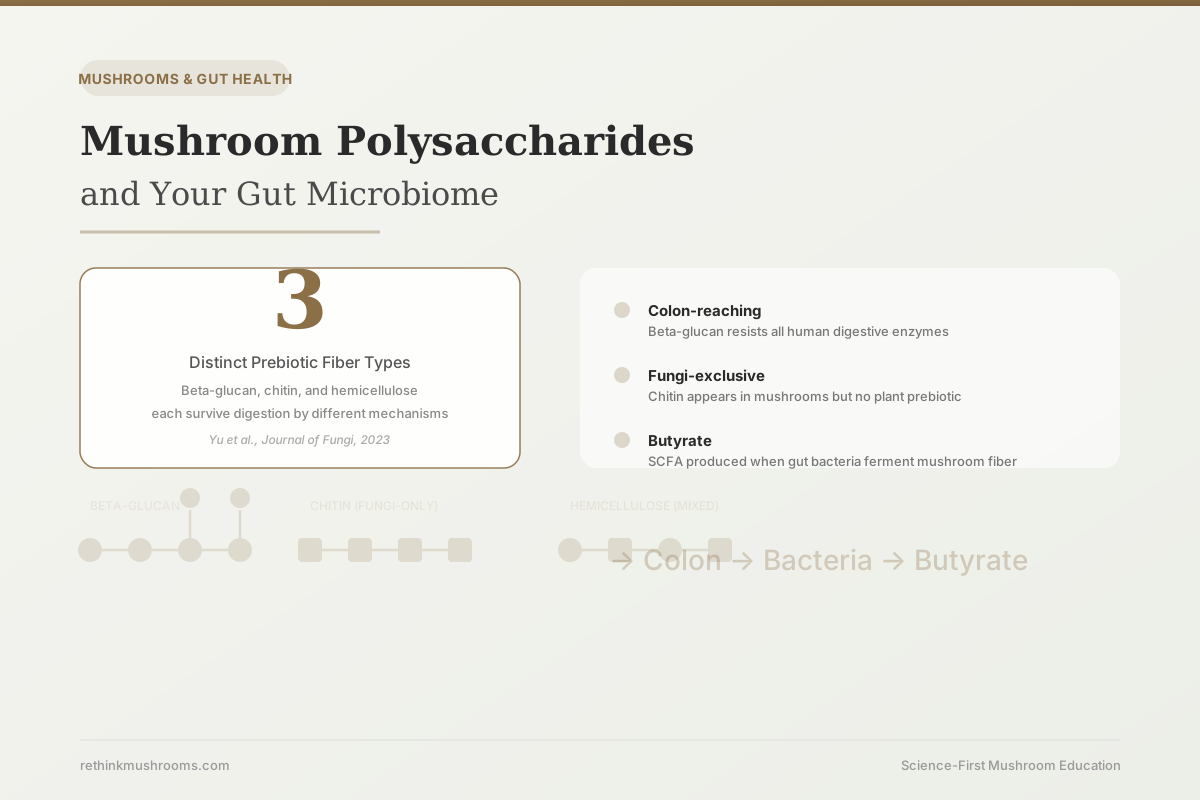
3 distinct prebiotic fiber types
Mushrooms contain three structurally distinct prebiotic fibers: beta-glucan, chitin, and hemicellulose. Each survives digestion by a different mechanism and feeds a different population of gut bacteria.
Yu et al., Journal of Fungi, 2023
Colon-reaching
Beta-glucan resists all human digestive enzymes and arrives intact
Fungi-exclusive
Chitin appears in mushrooms but in no plant prebiotic source
Butyrate
Short-chain fatty acid produced when gut bacteria ferment mushroom fiber
Yu et al., Journal of Fungi, 2023
 View as image ↗
The reason mushrooms feed your gut bacteria has nothing to do with marketing and everything to do with molecular geometry. Human digestive enzymes evolved to break specific chemical bonds. Mushroom polysaccharides happen to use bonds those enzymes cannot cut. That structural accident is the entire mechanism.
Mushroom polysaccharides are complex carbohydrates, primarily beta-glucan, chitin, and hemicellulose, that resist human digestive enzymes and reach the colon intact. There, gut bacteria ferment them into short-chain fatty acids, directly shaping gut microbiome composition: selectively promoting Bifidobacterium, Lactobacillus, and butyrate-producing species while suppressing pathogenic ones. A 2020 review in the Journal of Fungi by Murphy and colleagues confirmed that beta-glucan specifically resists all human digestive enzymes, arrives in the colon unmodified, and selectively feeds bacterial species that produce the enzyme required to break its bonds.[1]
Mushrooms contain not one but three structurally distinct prebiotic fibers, each working by a different chemical logic. The most comprehensive analysis of this fiber diversity, a 2023 review by Yu and colleagues in the Journal of Fungi, documented how beta-glucan, chitin, hemicellulose, and mannan each follow separate fermentation pathways and promote different bacterial populations across multiple species and conditions.[2]
This article covers the chemistry layer: what each fiber type is, why each one makes it to the colon, which bacteria ferment each type, and what the research shows about the downstream effects on the gut microbiome. For the broader introduction to how mushrooms function as prebiotics, see Mushrooms as Prebiotics: How They Feed Your Gut Bacteria.
Key Takeaways
- Beta-glucan's 1,3/1,6-glucosidic linkage cannot be broken by any human digestive enzyme, so it arrives in the colon chemically intact and available for bacterial fermentation (Murphy et al., Journal of Fungi, 2020)
- Chitin is unique to fungi: no plant prebiotic contains it. Mushroom chitin reaches the colon intact, ferments more slowly than beta-glucan, and has additional immune-stimulating effects (Wijesekara and Xu, 2024)
- Different mushroom species produce structurally different polysaccharides: reishi makes ganoderic-acid-associated glucans, shiitake makes lentinan, turkey tail makes PSP and PSK, each feeding different bacterial populations (Zhao et al., Frontiers in Nutrition, 2023)
- Mushroom polysaccharide consumption consistently shifts the Firmicutes-to-Bacteroidetes ratio toward more Bacteroidetes, a microbial pattern associated with healthier metabolic profiles (Liu et al., Food and Function, 2020)
- Reishi polysaccharide increased Lactobacillus, reduced pathogenic bacteria, and suppressed tumor growth in colon tissue in a 2021 animal study, suggesting that microbial changes can have effects far beyond the gut itself (Guo et al., 2021)
- The molecular weight and branching structure of polysaccharides determine which bacteria can ferment them, meaning extraction methods that alter polysaccharide structure may change the prebiotic profile in the colon (Zhao et al., 2023)
Three Fibers, Not One: How Beta-Glucan, Chitin, and Hemicellulose Each Work Differently
When someone says mushrooms are a prebiotic food, they are actually describing three distinct mechanisms happening simultaneously. Each fiber type in a mushroom has a different structure. That structure determines whether it dissolves in water, how quickly bacteria can access it, and which species have the enzymes to break it down.
Beta-glucan is the fiber most studied in the context of mushrooms and gut health. It is a glucose polymer, meaning a long chain of glucose molecules linked together. The key detail is how those glucose units connect: beta-glucan uses what chemists call 1,3 and 1,6 bonds, meaning glucose units connect at their third and sixth carbon positions. Human digestive enzymes work on different bond positions and cannot cut these. Beta-glucan passes through the stomach and small intestine completely unchanged.
Chitin is less widely discussed but arguably more distinctive. It is also a polymer, but instead of glucose, it is built from a modified glucose unit that carries a nitrogen group attached to it. Chemists call this unit N-acetylglucosamine. The nitrogen group is what makes chitin structurally unlike anything found in plant foods. No plant makes chitin. It appears in fungi, crustacean shells, and insect exoskeletons. In mushrooms, chitin forms the structural material of the cell wall itself, so every mushroom you eat contains it.
Hemicellulose is the third type. It is a group of branched carbohydrates built from a mix of sugars including xylose, mannose, and galactose. Its structure varies more across mushroom species than the other two fiber types, which means the bacterial selectivity it produces also varies more.
A 2023 review in the Journal of Fungi by Yu and colleagues traced each of these fiber types through the digestion process, identified the specific bacterial populations each one feeds, and documented the short-chain fatty acid outputs for each.[2] The picture that emerged was not a single prebiotic effect but a collection of parallel prebiotic effects happening in the same colon at the same time.
The 1,3/1,6 Lock: The Chemical Bond That Human Enzymes Cannot Open
The 1,3/1,6 bond is not a technical footnote. It is the entire reason beta-glucan qualifies as a prebiotic fiber.
Human digestive enzymes, produced in the mouth, stomach, and small intestine, work on a specific type of glucose bond called the 1,4-alpha-glucosidic linkage. This is the bond that holds starch together. The human digestive system is extremely efficient at breaking starch into glucose for energy, which is why high-starch foods digest quickly.
Beta-glucan uses a different bond geometry. The 1,3 and 1,6 beta-linkages in mushroom polysaccharides are chemically similar to starch's alpha-linkages but spatially different. Human enzymes cannot fit their active sites around the 1,3 beta-linkage. They pass over beta-glucan the way a lock passes over the wrong key.
A 2020 review by Murphy and colleagues in the Journal of Fungi documented this mechanism in detail.[1] Their analysis confirmed that 1,3/1,6-beta-D-glucan from mushrooms resists all human digestive enzymes, travels through the stomach and small intestine intact, and arrives in the colon in its original form. Once there, it becomes available only to bacterial species that produce beta-glucanase enzymes, the molecular tools required to break these specific bonds.
The bacteria with beta-glucanase enzymes include Bifidobacterium and Bacteroides, two genera consistently associated with positive gut health outcomes in microbiome research. When beta-glucan arrives in the colon, these species have a selective competitive advantage. Species without beta-glucanase cannot participate in the fermentation. This selectivity is the definition of a prebiotic effect: not just feeding gut bacteria in general, but feeding specific populations while others do not benefit.
For deeper coverage of how beta-glucan connects to gut inflammation and inflammatory bowel conditions, see Mushroom Beta-Glucans and Gut Inflammation: IBD Research.
Chitin: The Fiber That Only Fungi Make
Chitin is structurally unique among dietary fibers found in food. Nothing in the plant kingdom produces it. In a dietary context, mushrooms are the most common source for most people.
A 2024 review in the Journal of Agricultural and Food Chemistry by Wijesekara and Xu examined mushroom chitin specifically and distinguished it from crustacean chitin in ways that matter for gut health.[3] Mushroom chitin forms long, linear chains of N-acetylglucosamine units linked by 1,4-beta bonds. These bonds are not broken by any human digestive enzyme. Like beta-glucan, chitin arrives in the colon intact and available for bacterial fermentation.
The fermentation of chitin is slower and involves a different set of bacterial enzymes, called chitinases. Some Bifidobacterium strains produce chitinases. Bacteroides species have some capacity as well. But chitin appears to be fermented more gradually than beta-glucan, which may translate to a more sustained release of short-chain fatty acids along a longer stretch of the colon rather than a concentrated fermentation event.
Wijesekara and Xu also documented that mushroom chitin stimulates immune cells directly through pattern recognition receptors on the surface of immune cells, a mechanism that plant-derived prebiotics like inulin or resistant starch do not share.[3] This means chitin may contribute to gut health through two distinct mechanisms: fermentation-based prebiotic activity and direct immune modulation.
Chitin also forms the physical matrix of the mushroom cell wall. When you eat a whole mushroom rather than a polysaccharide extract, chitin is the scaffold that holds the structure together and controls how quickly other compounds including beta-glucan, nutrients, and bioactive molecules, are released and made available in the gut. This structural role has potential implications for whether whole food or extracted supplement form produces a different prebiotic pattern in the colon.
Which Mushroom Makes Which Polysaccharides? A Species Profile
Not all mushroom polysaccharides are the same, and different mushroom species do not make identical compounds. The specific structure of each polysaccharide, including molecular weight, chain length, degree of branching, and whether protein groups are attached, differs significantly between species. Those structural differences determine which bacterial populations benefit most.
A 2023 review in Frontiers in Nutrition by Zhao and colleagues mapped the polysaccharide profiles of five major medicinal mushroom species in detail: Lentinus edodes (shiitake), Pleurotus ostreatus (oyster), Ganoderma lucidum (reishi), Hericium erinaceus (lion's mane), and Trametes versicolor (turkey tail).[4]
Shiitake's primary polysaccharide is lentinan, a high-molecular-weight beta-glucan with a triple-helix secondary structure. The triple-helix shape makes lentinan particularly resistant to physical degradation and may explain why shiitake maintains biological activity even after cooking.
Reishi produces polysaccharides with ganoderic-acid-associated structures. These tend to have more complex branching than shiitake's lentinan, which means they present a different surface to bacterial enzymes and interact with different gut bacterial species as a result.
Turkey tail stands apart because its two signature polysaccharides, PSP (polysaccharide peptide) and PSK (polysaccharide-K, also known as krestin), are protein-bound. They have amino acid chains attached to the polysaccharide backbone. No plant-derived prebiotic fiber has this structure. The protein component changes how gut bacteria process the compound and may contribute to why turkey tail shows stronger prebiotic evidence in human research than other species. For a detailed look at that human evidence, see Turkey Tail and Gut Bacteria: The Most-Studied Prebiotic Mushroom.
A 2017 systematic review by Jayachandran and colleagues in the International Journal of Molecular Sciences compiled the documented bacterial effects of polysaccharides from these species across preclinical studies, finding consistent increases in Bifidobacterium and Lactobacillus and consistent reductions in pathogenic Clostridium species.[5] For an evidence-ranked species comparison, see Which Mushrooms Are the Best Prebiotics? A Species Comparison.
What Mushroom Polysaccharides Do in Your Gut Microbiome: Fermentation and SCFA Production
The prebiotic mechanism of mushroom polysaccharides begins in the colon. Nothing relevant to that mechanism happens before the colon. Beta-glucan, chitin, and hemicellulose pass through the stomach and small intestine as structural passengers. What happens next, when they arrive in the colon, is fermentation.
In this context, fermentation means bacterial digestion. Specific gut bacteria produce enzymes that break the polysaccharide bonds. When they do, the main products are short-chain fatty acids, usually abbreviated SCFAs. Three SCFAs are produced in meaningful quantities from mushroom fiber: butyrate, propionate, and acetate.
Butyrate is the most studied in relation to gut health. The cells that line the colon wall, called colonocytes, use butyrate as their primary energy source. A colon lining with adequate butyrate supply maintains tighter junctions between cells and lower levels of inflammatory signaling. When colonocyte fuel is scarce, barrier function degrades.
Propionate travels from the colon to the liver through the portal vein, where it participates in glucose metabolism and can influence how the liver manages blood sugar. Acetate reaches the systemic circulation and influences energy balance in peripheral tissues.
A 2020 review by Liu and colleagues in Food and Function traced this full pathway across multiple mushroom species and found that polysaccharide diversity in the diet correlates with greater diversity in the SCFA outputs the colon produces.[6] A diet with only one mushroom species would feed one bacterial population selectively and generate a narrower SCFA profile. A diet with multiple species would promote a broader set of SCFA-producing bacteria.
The Liu 2020 review also noted that mushroom polysaccharides shift the overall composition of the colon microbiome, not just individual species counts. Different polysaccharides created distinct microbial signatures depending on their structure. For a deep dive into SCFA production and its downstream effects, see Mushroom Dietary Fiber and Short-Chain Fatty Acid Production.
The Firmicutes-Bacteroidetes Ratio: Why This Number Matters for Metabolic Health
The ratio of Firmicutes to Bacteroidetes in the gut is one of the most studied numbers in microbiome research. Both are large bacterial categories that each contain hundreds of individual species. A high ratio of Firmicutes relative to Bacteroidetes is associated with obesity, metabolic syndrome, and chronic inflammation in most studies. A lower ratio, meaning more Bacteroidetes relative to Firmicutes, is associated with healthier metabolic profiles.
Mushroom polysaccharides appear to shift this ratio toward Bacteroidetes.
A 2020 review by Liu and colleagues in Food and Function found consistent evidence that mushroom polysaccharide consumption reduces the Firmicutes-to-Bacteroidetes ratio across preclinical models.[6] The proposed mechanism: Bacteroidetes species, particularly Bacteroides and Prevotella, are among the most efficient fermenters of beta-glucan and possess the enzymatic machinery to break down mushroom polysaccharides. Feeding beta-glucan grows this population selectively. Firmicutes species are less efficient at fermenting mushroom-derived polysaccharides and do not grow proportionally.
The ratio shift matters because it represents a change in the competitive balance between two major bacterial populations, not just an absolute increase in beneficial bacteria. When Bacteroidetes grow relative to Firmicutes, the overall metabolic character of the colon shifts. SCFA composition changes. Inflammatory signals from pathogenic bacteria decrease. The downstream effects extend to glucose tolerance, fat storage, and systemic inflammation markers.
The Liu 2020 review also documented variation in how strongly different mushroom species produce this ratio shift, with the magnitude differing by polysaccharide structure. This points to molecular structure as the driver of the effect, not simply the fact of eating a mushroom.
Reishi in the Colon and the Gut-Liver Connection
Most of the mechanistic evidence for mushroom polysaccharides comes from preclinical research: cell culture experiments and animal models. This is the most important caveat to apply to everything in this field. But the animal evidence for reishi polysaccharides is worth examining specifically because it illustrates how far downstream the microbiome effects can travel.
A 2021 study in Carbohydrate Polymers by Guo and colleagues used a mouse model of colitis and colon tumor development to test the effects of reishi polysaccharide.[7] The treatment significantly increased Lactobacillus populations, decreased pathogenic bacteria including Helicobacter, and reduced inflammatory cytokines in colon tissue. In the tumor model, reishi polysaccharide supplementation was associated with reduced tumor burden.
The researchers proposed that the microbial changes were the primary driver of the anti-inflammatory and anti-tumor effects, not a direct pharmacological action of the polysaccharide on colon cells. In other words: reishi polysaccharide changed the bacterial environment in the colon, and the changed environment produced the tissue-level effects. This is a significant mechanistic hypothesis because it places the gut microbiome as the intermediary between dietary fiber and disease outcomes.
The connection between microbiome changes and outcomes in tissues beyond the colon is also supported by the gut-liver axis. This is a well-established physiological connection: bacterial products from the colon travel through the portal vein to the liver, where they influence inflammation, fat metabolism, and enzyme activity. A 2020 review by Nguepi and Song in the International Journal of Medicinal Mushrooms traced how mushroom polysaccharides modulate the gut microbiome and, through the gut-liver axis, reduce the accumulation of bacterial metabolic byproducts that drive liver disease progression.[8] If mushroom polysaccharides reduce pathogenic bacteria in the colon, they also reduce the flow of those bacteria's toxic outputs to the liver.
Human clinical data confirming these pathways remains limited. The animal and mechanistic evidence supports the plausibility of these effects, but extrapolating directly to human outcomes requires caution.
Molecular Weight and Processing: Does Extraction Change the Prebiotic Effect?
When a supplement company extracts beta-glucan from a mushroom, they break down the intact mushroom cell wall and isolate a fraction of the polysaccharides. The question for gut health research is whether that isolated, extracted polysaccharide behaves the same way in the colon as it does in a whole mushroom.
Molecular weight appears to matter.
Polysaccharides with higher molecular weight are fermented more slowly in the colon. This produces a more sustained effect on bacterial growth, spread across a longer section of the colon, rather than a rapid fermentation event concentrated in the first part of the colon. Lower molecular weight polysaccharides, which are common in aggressively processed extracts, ferment more quickly and may not reach the distal colon where certain bacterial populations are concentrated.
A 2024 review by Wijesekara and Xu found that chitin from mushrooms specifically maintains a high molecular weight under typical dietary processing conditions.[3] This may explain why whole mushroom consumption tends to produce a more distributed prebiotic effect across the colon's full length compared to purified beta-glucan extracts.
Branching structure also changes during extraction. A 2023 review by Zhao and colleagues noted that high-temperature water extraction, a common method used for mushroom supplements, can disrupt the branching points on beta-glucan chains.[4] Since branching pattern is part of what determines which bacterial species can access and ferment the polysaccharide, extraction method could plausibly change prebiotic selectivity, not just potency.
These are mechanistically supported hypotheses with limited direct human evidence. No clinical trial has yet compared whole mushroom consumption to mushroom extract on gut microbiome outcomes in the same participants using standardized measurements. That gap in the research remains open.
For a direct comparison of mushroom fiber to inulin, FOS, and other plant-based prebiotics, see How Mushroom Fiber Differs from Other Prebiotic Sources. For the step-by-step fermentation mechanism, see Mushrooms as Prebiotics: How Fungal Polysaccharides Feed Beneficial Bacteria.
The Bottom Line
Mushroom polysaccharides function as prebiotics because of molecular geometry: beta-glucan, chitin, and hemicellulose each use chemical bonds that human digestive enzymes cannot break. These fibers reach the colon intact and are fermented by specific bacterial populations, producing short-chain fatty acids and shifting the microbiome toward Bacteroidetes-associated profiles associated with better metabolic health. Species-specific polysaccharide structures, including shiitake's lentinan, reishi's branched glucans, and turkey tail's protein-bound PSP and PSK, determine which bacterial populations benefit most. The evidence base is primarily preclinical, with mechanistic support from multiple systematic reviews; the clinical data in humans, while growing, remains limited relative to the depth of the laboratory research.
Frequently Asked Questions
Sources & References
- 1RTHM-00639·Murphy, Emma J et al. (2020). “β-Glucan Metabolic and Immunomodulatory Properties and Potential for Clinical Application..” Journal of fungi (Basel.Study breakdown →PubMed →↩
- 2RTHM-01829·Yu, Changxia et al. (2023). “The Effect of Mushroom Dietary Fiber on the Gut Microbiota and Related Health Benefits: A Review..” Journal of fungi (Basel.Study breakdown →PubMed →↩
- 3RTHM-00915·Wijesekara, Tharuka et al. (2024). “New Insights into Sources, Bioavailability, Health-Promoting Effects, and Applications of Chitin and Chitosan..” Journal of agricultural and food chemistry.Study breakdown →PubMed →↩
- 4RTHM-01836·Zhao, Qilong et al. (2023). “The benefits of edible mushroom polysaccharides for health and their influence on gut microbiota: a review..” Frontiers in nutrition.Study breakdown →PubMed →↩
- 5RTHM-00878·Jayachandran, Muthukumaran et al. (2017). “A Critical Review on Health Promoting Benefits of Edible Mushrooms through Gut Microbiota..” International journal of molecular sciences.Study breakdown →PubMed →↩
- 6RTHM-01242·Liu, Xiaoxiao et al. (2020). “A Review on Linking the Medicinal Functions of Mushroom Prebiotics with Gut Microbiota..” International journal of medicinal mushrooms.Study breakdown →PubMed →↩
- 7RTHM-00690·Guo, Cuiling et al. (2021). “Ganoderma lucidum polysaccharide modulates gut microbiota and immune cell function to inhibit inflammation and tumorigenesis in colon..” Carbohydrate polymers.Study breakdown →PubMed →↩
- 8RTHM-00644·Nguepi, Tsopmejio Ivan Steve et al. (2020). “Mushrooms Bioactive as Prebiotics to Modulate Gut Microbiota in Relationships with Causes and Prevention of Liver Diseases (Review)..” International journal of medicinal mushrooms.Study breakdown →PubMed →↩