Mushrooms & Gut Health
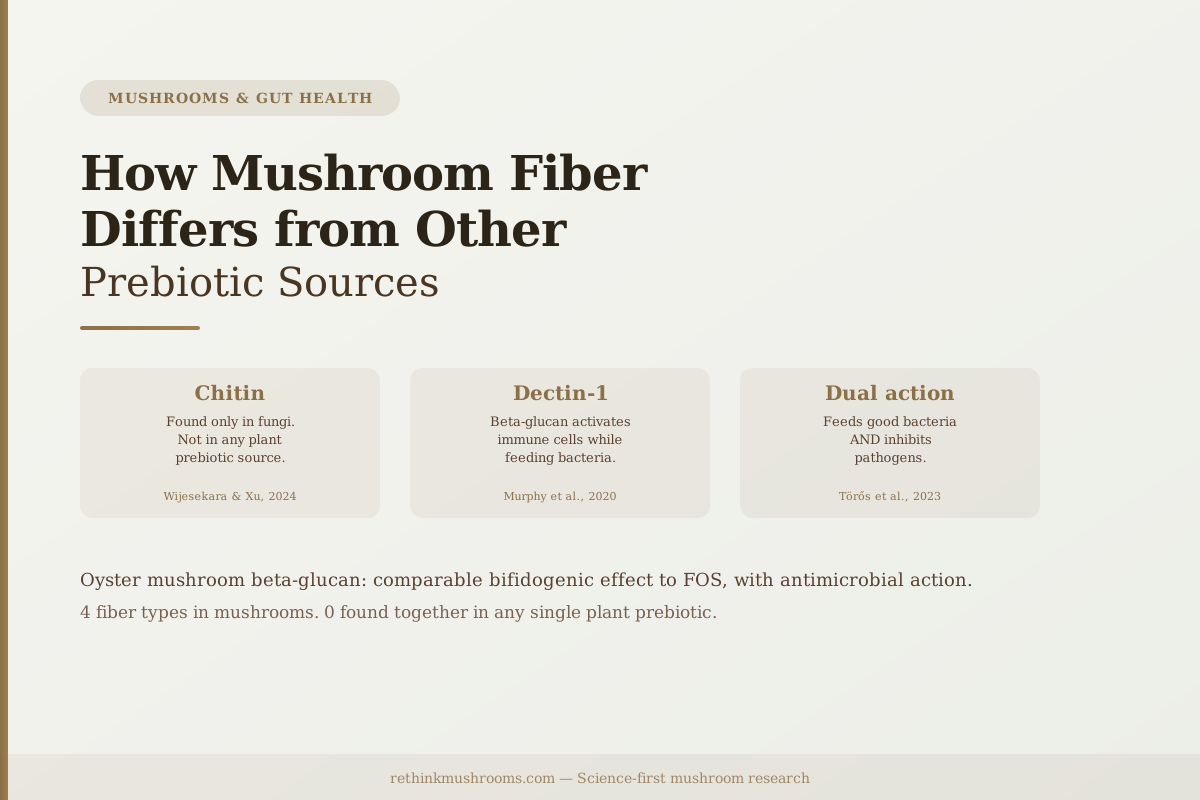
4 fiber types unique to mushrooms that plant prebiotics don't replicate
Mushrooms contain beta-glucan, chitin, hemicellulose, and mannan, a fiber diversity not found in any plant-based prebiotic source, each with distinct mechanisms for feeding gut bacteria.
Yu et al., Journal of Fungi, 2023
Dectin-1
immune receptor activated by beta-glucan, a function no plant prebiotic shares
≈ FOS
oyster mushroom beta-glucan demonstrated comparable bifidogenic effect to FOS in vitro
Less gas
mushroom polysaccharides fermented more slowly than inulin with fewer GI side effects
Yu et al., Journal of Fungi, 2023
 View as image ↗
The most widely used prebiotics in supplements are inulin and FOS (fructooligosaccharides). Both come from plants, primarily chicory root. Both selectively feed beneficial gut bacteria including Bifidobacterium. Both have decades of research support and are legitimately prebiotic by any definition.
Mushroom fiber is different in ways that go beyond source. Mushrooms contain a fiber type found in no plant: chitin, the structural polymer of the fungal cell wall. They contain beta-glucan in a molecular configuration that activates immune receptors while simultaneously feeding bacteria. And in controlled laboratory studies, mushroom beta-glucan has demonstrated bifidogenic effects comparable to FOS at equivalent concentrations, while also inhibiting pathogenic bacteria through mechanisms inulin does not have.
This article examines what the research says mushroom fiber does differently from plant-based prebiotics, where plant prebiotics retain advantages, and what those differences mean in practical terms. For the broader overview of mushrooms' prebiotic effects on the gut, see Mushrooms as Prebiotics: How They Feed Your Gut Bacteria.
Key Takeaways
- Mushrooms contain four distinct prebiotic fiber types (beta-glucan, chitin, hemicellulose, and mannan) not fully replicated by any plant-based prebiotic source (Yu et al., 2023).
- Chitin, the primary structural fiber of fungal cell walls, is unique to fungi and crustaceans and does not exist in plants; every plant prebiotic source lacks it (Wijesekara & Xu, 2024).
- Mushroom beta-glucan activates a specific immune receptor (Dectin-1) on immune cells while feeding beneficial bacteria; inulin and FOS do not have this dual immune-plus-prebiotic mechanism (Murphy et al., 2020).
- Oyster mushroom beta-glucan demonstrated prebiotic properties comparable to FOS and inulin in vitro, while also exerting antimicrobial effects against pathogenic bacteria, a combination no plant prebiotic achieves (Törős et al., 2023).
- Mushroom polysaccharides are fermented more slowly than inulin and produce less colonic gas, making them better tolerated at higher doses in most people (Kulshreshtha et al., 2024).
- Mushroom fiber and plant prebiotics are not competing categories; combining them may offer complementary bacterial selectivity that neither achieves alone.
Mushroom Fiber vs. Plant Prebiotics: The Key Differences
| Property | Mushroom Fiber | Inulin / FOS | Psyllium |
|---|---|---|---|
| Primary fiber types | Beta-glucan, chitin, hemicellulose, mannan | Fructan (fructose chains) | Arabinoxylan |
| Contains chitin | Yes (unique to fungi) | No | No |
| Bifidogenic effect | High | High | Moderate |
| Immune activation | Yes (Dectin-1 receptor) | No | No |
| Antimicrobial activity | Yes (documented in oyster mushroom) | No | No |
| GI gas/bloating | Lower than inulin at equivalent dose | High at doses above 20g/day | Low to moderate |
| Primary research citation | Murphy 2020, Toros 2023, Yu 2023 | Multiple | Multiple |
What Makes Something a Prebiotic: Setting Up the Comparison
A compound qualifies as a prebiotic if it meets three criteria. It must resist digestion in the stomach and small intestine and arrive in the colon intact. It must be selectively fermented by beneficial bacteria rather than just any bacteria. And the fermentation must produce measurable health benefits.
This framework, established by Gibson and Roberfroid and refined in subsequent consensus papers, is the filter through which both plant and fungal fiber compounds should be evaluated. Calling something "prebiotic" without evidence it meets all three criteria is marketing, not science.
Mushroom polysaccharides meet the first criterion because human digestive enzymes cannot break the specific molecular bonds in fungal beta-glucan and chitin. They meet the second because the bacteria that possess the specific enzymes to ferment these compounds are predominantly Bifidobacterium, Bacteroides, and other beneficial species. They meet the third because fermentation of fungal polysaccharides produces short-chain fatty acids (SCFAs, compounds produced when bacteria digest fiber in the colon), including butyrate (the primary fuel for colonocytes, the cells lining the gut) and propionate (which affects liver metabolism and satiety signaling).
Inulin meets the same three criteria through a completely different chemical pathway. The comparison is not about which source is "prebiotic"; both are. It is about what each does that the other cannot.
The Fiber Types: Why Mushrooms Carry Something Plants Cannot
The structural difference between plant and fungal fiber reflects biology: fungi are genetically closer to animals than to plants. The fungal cell wall is built from chitin and beta-glucan, not from cellulose (the structural fiber in plants). This is why mushroom fiber includes compounds that no plant in the human diet contains.
Yu and colleagues conducted the most comprehensive recent review of mushroom dietary fiber in 2023, cataloging four distinct fiber types present in edible mushrooms: beta-glucan, chitin, hemicellulose, and mannan. [3] Each has a different molecular structure, a different bacterial selectivity, and a different metabolic output in the colon.
Plant prebiotics, by contrast, primarily center on one or two fiber types per source. Chicory inulin and FOS are both fructans, chains of fructose molecules. Psyllium is predominantly arabinoxylan. Pectin is galacturonic acid. Each feeds a somewhat different set of bacteria, but none of them includes anything structurally similar to chitin.
Kulshreshtha and colleagues cataloged mushroom prebiotic compounds in a 2024 systematic review and confirmed the full range: chitin, mannans, galactans, xylans, glucans, lentinan, and hemicellulose. [4] This structural diversity means that different species of mushrooms, and different processing methods for the same species, feed somewhat different bacterial communities in the colon.
Beta-Glucan vs. Inulin: The Head-to-Head Data
The most direct experimental comparison between mushroom fiber and plant prebiotics comes from work on oyster mushroom beta-glucan.
Törős and colleagues examined the prebiotic properties of Pleurotus ostreatus (oyster mushroom) beta-glucan and measured its bifidogenic effect compared to FOS and inulin in controlled conditions. The oyster mushroom beta-glucan demonstrated prebiotic properties comparable to FOS and inulin in promoting Bifidobacterium growth. [2]
That finding alone would make mushroom beta-glucan an equivalent prebiotic to the market standard. What separates it from inulin is the second finding from the same study: oyster mushroom beta-glucan also exerted antimicrobial effects against pathogenic bacteria. Inulin does not do this. FOS does not do this. The ability to simultaneously feed beneficial bacteria and inhibit pathogens is, according to the review, a dual mechanism unique to fungal prebiotics compared to the plant-based alternatives.
Murphy and colleagues provided the mechanistic explanation for why mushroom beta-glucan achieves these effects. Beta-glucan from mushrooms has a specific molecular structure: a 1,3/1,6-linked β-D-glucan backbone with branched side chains. This branching pattern is what human enzymes cannot break. [1] When this intact molecule arrives in the colon, bacteria that possess the right glucanase enzymes can ferment it selectively, producing butyrate and other short-chain fatty acids in the process. Bacteria that lack these enzymes cannot ferment it. That is the definition of selectivity.
Inulin's bifidogenic effect operates through a completely different chemistry: Bifidobacterium possesses fructan-cleaving enzymes that most other gut bacteria lack, which creates the selectivity. Both mechanisms achieve high Bifidobacterium selectivity by different routes.
Chitin: The Fiber Found Only in Fungi (and Crustaceans)
Chitin is the structural polymer that gives fungal cell walls their rigidity. It is made from N-acetylglucosamine, a nitrogen-containing sugar, linked into long chains. The result is a fiber that is structurally more resistant to digestion than almost any plant fiber, and that reaches the colon more intact than inulin, pectin, or most other plant-based prebiotic compounds.
Wijesekara and Xu reviewed chitin and its derivatives comprehensively in 2024. The review distinguishes mushroom chitin from crustacean chitin (the source used in most chitosan supplements): mushroom chitin is the primary structural fiber of the fungal cell wall, present in all edible mushroom species, and has unique immunostimulatory properties distinct from crustacean sources. [5]
The prebiotic case for chitin is based on its resistance to human digestive enzymes. Humans lack the enzyme chitinase in sufficient quantities to break down dietary chitin, so it passes through the stomach and small intestine largely intact. Once in the colon, specific bacteria, including species of Bacteroides and certain Firmicutes, do possess chitin-degrading enzymes and can ferment it.
The result of chitin fermentation is a different bacterial population shift than inulin fermentation. Inulin strongly favors Bifidobacterium. Chitin shows selectivity for a somewhat different set of fermenting bacteria, meaning that mushroom fiber, as a combination of beta-glucan and chitin, potentially feeds a more diverse range of beneficial bacteria than inulin or FOS alone.
There is no plant-based chitin prebiotic. Chitin is found in crustacean shells and insect exoskeletons, but not in any plant food. Every plant prebiotic is chitin-free. This is the structural gap that mushroom fiber uniquely fills in the prebiotic landscape.
The Immune Activation That Plant Prebiotics Don't Have
The single most distinctive feature of mushroom beta-glucan compared to plant prebiotics is not its bifidogenic effect. It is what happens before the bacteria even get involved.
Beta-glucan from fungi is recognized by a specific receptor on immune cells called Dectin-1. Dectin-1 is a pattern recognition receptor that evolved specifically to identify the 1,3-β-D-glucan pattern found on the surface of fungal cell walls. When beta-glucan from a mushroom source reaches Dectin-1 receptors in the gut-associated immune tissue, it activates innate immune responses including macrophage activation and dendritic cell maturation.
Murphy and colleagues review this pathway in the 2020 Journal of Fungi analysis, documenting that mushroom beta-glucan has immunomodulatory properties that operate independently of its prebiotic (fermentation-based) effects. [1] The compound feeds beneficial bacteria. And it activates immune cells. These are two separate mechanisms operating simultaneously.
Inulin does not activate Dectin-1. FOS does not activate Dectin-1. Neither does psyllium, pectin, or resistant starch. The Dectin-1 activation mechanism is specific to the molecular pattern in fungal beta-glucan; it is the immune system's way of recognizing fungal exposure and calibrating its response accordingly.
In practical terms, this means that the health effects of eating mushrooms regularly are not solely explained by the prebiotic fermentation pathway. The immune modulation happens at the gut wall itself, before bacteria digest anything. A consumer taking inulin and a consumer eating mushrooms regularly are both getting prebiotic effects in their colons, but only one of them is also getting the Dectin-1-mediated immune response.
Gas and GI Tolerance: Easier on the Stomach Than Inulin
One of the most practical differences between mushroom fiber and inulin is tolerance. Inulin is a well-documented gas producer. At doses above approximately 20 grams per day, inulin reliably causes flatulence, bloating, and abdominal discomfort in most people. This is not a side effect to be concerned about; it is a direct consequence of rapid bacterial fermentation of a highly fermentable substrate. The bacteria are doing exactly what they are supposed to do, but doing it fast produces a lot of gas.
Kulshreshtha and colleagues note in their 2024 review that mushroom polysaccharides, including beta-glucan, are fermented more slowly than fructans like inulin. [4] Slow fermentation produces less gas per unit time, which means less bloating and discomfort at equivalent doses. For people who have tried inulin or FOS supplements and found the GI effects intolerable, mushroom-derived prebiotic fiber is a structurally different substrate that may be better tolerated.
The size and branching complexity of mushroom polysaccharides partly explains this. Beta-glucan is a large, complex molecule with many branching points. Bacteria must do more enzymatic work to access the fermentable subunits compared to the simpler, linear fructose chains in inulin. More work per unit of substrate means slower gas production and a gentler GI experience.
This is not a claim that mushroom fiber causes zero gas. Any highly fermentable prebiotic will produce some gas in susceptible individuals. But the fermentation kinetics of mushroom polysaccharides differ from fructans in a direction that most people's GI tracts find more comfortable.
What Mushroom Fiber Cannot Do That Plant Prebiotics Can
An honest comparison requires acknowledging where plant prebiotics have the advantage.
Inulin and FOS have far more human clinical trial data than mushroom fiber does. The clinical evidence for inulin's prebiotic effects in humans spans decades and includes numerous randomized controlled trials in diverse populations. Mushroom beta-glucan has strong mechanistic evidence and some human trials, but the direct prebiotic (microbiome-modulating) evidence in humans is less extensive.
Inulin is also far more commercially standardized. A chicory inulin supplement contains a known, consistent molecular weight distribution of fructan chains. Mushroom polysaccharide extracts vary in beta-glucan molecular weight, branching pattern, and chitin content depending on species, extraction method, and preparation. This variability makes human-to-human dose comparisons difficult for mushroom products in ways that do not apply to standardized inulin.
Plant prebiotics also include sources with longer dietary histories in Western populations. Garlic, onion, banana, and asparagus are common high-inulin foods that many people eat routinely without thinking about prebiotics. Mushroom consumption patterns in Western countries are more variable and often lower.
The conclusion from the comparison is not that mushroom fiber is superior. It is that mushroom fiber provides a set of mechanisms that plant prebiotics do not: chitin as a unique structural fiber, Dectin-1 immune activation, and the dual prebiotic-plus-antimicrobial action documented for oyster mushroom beta-glucan. These are additions to the prebiotic toolkit, not replacements.
Yu and colleagues conclude their 2023 review by noting that combining mushroom fiber with inulin or other plant prebiotics may offer complementary bacterial selectivity that neither achieves alone. [3] The diversity of fiber types in a diet determines the diversity of bacteria that can be fed. Adding mushrooms to a diet that already includes inulin-rich plant foods expands the range of bacteria receiving preferential nutrition, not narrows it.
The deeper dive into what mushroom polysaccharides do at the molecular level is at Mushroom Polysaccharides and Microbiome Nourishment. For the mechanistic pathway from fungal polysaccharide to bacterial fermentation to short-chain fatty acid production, see Mushrooms as Prebiotics: How Fungal Polysaccharides Feed Beneficial Bacteria. For the question of which mushroom species has the strongest prebiotic evidence, see Which Mushrooms Are the Best Prebiotics?.
And a cross-cluster link worth exploring: Mushroom Dietary Fiber and Short-Chain Fatty Acid Production covers the SCFA output pathway that gives mushroom prebiotics their downstream metabolic and anti-inflammatory effects.
The Bottom Line
Mushroom fiber differs from plant prebiotics in three meaningful ways: chitin (a fiber found only in fungi, absent from all plant sources), Dectin-1 immune activation by beta-glucan (which operates independently of bacterial fermentation), and a dual prebiotic-plus-antimicrobial effect documented for oyster mushroom. On bifidogenic potency, mushroom beta-glucan is comparable to FOS at equivalent doses. On GI tolerance, mushroom polysaccharides are fermented more slowly than inulin with less gas production. Plant prebiotics retain advantages in clinical trial depth and commercial standardization. The evidence supports combining mushroom fiber with plant prebiotics rather than substituting one for the other.
Frequently Asked Questions
Sources & References
- 1RTHM-00639·Murphy, Emma J et al. (2020). “β-Glucan Metabolic and Immunomodulatory Properties and Potential for Clinical Application..” Journal of fungi (Basel.Study breakdown →PubMed →↩
- 2RTHM-00855·Törős, Gréta et al. (2023). “Modulation of the Gut Microbiota with Prebiotics and Antimicrobial Agents from Pleurotus ostreatus Mushroom..” Foods (Basel.Study breakdown →PubMed →↩
- 3RTHM-01829·Yu, Changxia et al. (2023). “The Effect of Mushroom Dietary Fiber on the Gut Microbiota and Related Health Benefits: A Review..” Journal of fungi (Basel.Study breakdown →PubMed →↩
- 4RTHM-01921·Kulshreshtha, Shweta (2024). “Mushroom as Prebiotics: a Sustainable Approach for Healthcare..” Probiotics and antimicrobial proteins.Study breakdown →PubMed →↩
- 5RTHM-00915·Wijesekara, Tharuka et al. (2024). “New Insights into Sources, Bioavailability, Health-Promoting Effects, and Applications of Chitin and Chitosan..” Journal of agricultural and food chemistry.Study breakdown →PubMed →↩