Mushrooms & Gut Health
6g/day
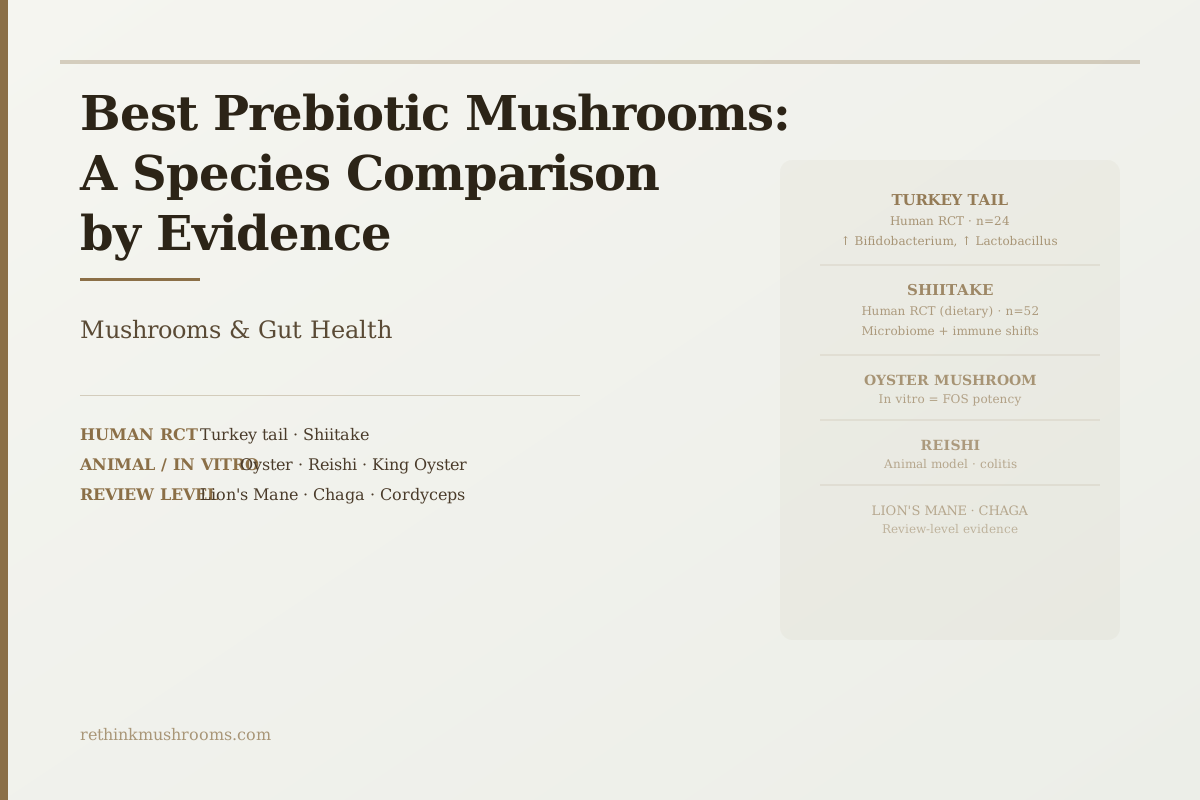
Turkey tail polysaccharopeptide at 6g per day for 8 weeks significantly increased Bifidobacterium and Lactobacillus and reduced Clostridiales in 24 healthy adults, making it the only mushroom species with a human randomized controlled trial demonstrating direct prebiotic effects.
Pallav et al., Gut Microbes, 2014
24 adults
in the only human RCT of a mushroom prebiotic; turkey tail PSP increased beneficial bacteria vs. placebo
52 adults
in the shiitake dietary RCT; 5-10g dried mushroom per day for 4 weeks showed measurable microbiome and immune changes
Matches FOS
oyster mushroom beta-glucan showed bifidogenic potency comparable to fructooligosaccharides in vitro (Toros et al., 2023)
Pallav et al., Gut Microbes, 2014
 View as image ↗
The prebiotic claim appears on supplement labels for nearly every mushroom species. Not all mushroom species have equal evidence for it. Only two have been tested in human clinical trials with gut bacteria measurements, and only one has a randomized controlled trial specifically designed to assess prebiotic effects. This article ranks the most researched mushroom species by evidence quality: human trial data first, then animal studies, then in vitro research. The rankings reflect the evidence, not the marketing. For a broader introduction to how mushrooms function as prebiotics and what the underlying mechanisms are, see mushrooms as prebiotics: how they feed your gut bacteria.
Key Takeaways
- Turkey tail (Trametes versicolor) is the only mushroom with a human RCT specifically measuring prebiotic effects; 6g/day of PSP for 8 weeks significantly increased Bifidobacterium and Lactobacillus and reduced Clostridiales in 24 healthy adults (Pallav et al., Gut Microbes, 2014)
- Shiitake is the only dietary mushroom (consumed as food, not extract) with a human RCT showing microbiome effects; 52 healthy adults eating 5-10g dried shiitake daily for 4 weeks showed immune cell and gut microbial shifts (Dai et al., 2015)
- Oyster mushroom beta-glucan showed bifidogenic potency comparable to FOS (fructooligosaccharides) in a 2023 in vitro study; Pleurotus eryngii polysaccharides also reduced obesity-related gut dysbiosis and increased butyrate-producing bacteria in mice
- Reishi (Ganoderma lucidum) polysaccharides modulated gut microbiota in a colitis animal model, increasing Lactobacillus and reducing inflammatory cytokines (Guo et al., Carbohydrate Polymers, 2021)
- Lion's mane, chaga, and cordyceps are mentioned in broad review articles but have fewer dedicated fermentation or microbiome studies than turkey tail, shiitake, or oyster mushroom
- Whole-food mushroom consumption (not just extract) produces measurable prebiotic effects; whole king oyster mushroom corrected gut dysbiosis in obese mice (Du et al., 2024)
Why Most Mushroom Gut Health Claims Lack Human Trial Data
A prebiotic must meet three criteria: it must be non-digestible, it must selectively feed beneficial bacteria, and it must produce a documented health benefit. Mushroom polysaccharides (primarily beta-glucans and chitin) meet the first criterion reliably. Whether they meet the second and third criteria in humans is a question the research answers differently depending on the species.
Most mushroom gut health claims are extrapolated from laboratory fermentation experiments or animal studies. These are useful data points: they can show which bacteria consume specific polysaccharides and what compounds those bacteria produce. But a laboratory dish or a mouse gut is not a human gut, and the microbiome shift that a high-dose mushroom extract produces in a mouse over two weeks does not straightforwardly predict what a supplement dose produces in a person over months.
Murphy and colleagues' 2020 review in the Journal of Fungi established the pharmacological basis for mushroom beta-glucan as a prebiotic: the 1,3/1,6-linked glucose chains resist human digestive enzymes, reach the colon intact, and selectively feed Bifidobacterium and Bacteroides, which produce short-chain fatty acids (SCFAs) including butyrate and propionate as fermentation byproducts.[9] This pharmacological picture is well-established. The species-specific human data is where the evidence base thins out rapidly.
The Evidence Comparison: Species Ranked by Trial Data
The table below ranks mushroom species by the quality of evidence for prebiotic effects. Evidence level reflects the study design (human RCT highest, in vitro lowest), not the marketing claim.
| Species | Evidence Level | Key Prebiotic Finding | Primary Source |
|---|---|---|---|
| Turkey tail | Human RCT (n=24) | Bifidobacterium and Lactobacillus increased; Clostridiales decreased | Pallav 2014 |
| Shiitake | Human RCT (dietary, n=52) | Immune and microbiome shifts after whole food intake | Dai 2015 |
| Oyster mushroom | In vitro + Animal | Beta-glucan matches FOS; corrects obesity-related dysbiosis | Toros 2023; Nakahara 2020 |
| Reishi | Animal model | Lactobacillus increased; inflammation reduced in colitis model | Guo 2021 |
| King oyster (P. eryngii) | Animal (whole food) | Whole mushroom corrects dysbiosis, reduces fat accumulation | Du 2024 |
| Lion's mane | Review-level | Included in species reviews; limited dedicated studies | Jayachandran 2017; Zhao 2023 |
| Chaga | Review-level | Included in species reviews; limited dedicated studies | Jayachandran 2017; Zhao 2023 |
| Cordyceps | Review-level | Included in species reviews; limited dedicated studies | Jayachandran 2017; Zhao 2023 |
Turkey Tail: The Only Mushroom with a Prebiotic Human RCT
Pallav and colleagues ran the most methodologically rigorous prebiotic mushroom study in the published literature: a randomized clinical trial published in Gut Microbes in 2014, testing polysaccharopeptide (PSP) from Trametes versicolor (turkey tail) against placebo in 24 healthy adults.[1]
Participants received 6 grams of turkey tail PSP daily for 8 weeks. Gut microbiome composition was measured via sequencing before and after the intervention. The PSP group showed significant increases in Bifidobacterium longum and Lactobacillus (both considered beneficial in the gut microbiome) and significant decreases in Clostridiales (associated with inflammation and metabolic disease). The placebo group did not show these shifts.
This study is notable for three reasons. First, it used a clinical dose of a defined mushroom fraction (PSP, not whole mushroom or crude extract) in healthy humans, not patients. Second, it measured bacterial composition changes directly, not just reported symptoms. Third, the bacterial shifts it found (more Bifidobacterium and Lactobacillus, less Clostridiales) match the pattern that established prebiotics like inulin produce, providing a mechanistic comparator.
PSP from turkey tail is distinct from PSK (krestin), the cancer-adjunct compound from the same species. Both are polysaccharide complexes from Trametes versicolor, but PSK has been more extensively studied for immune and cancer applications, while PSP is the compound with the dedicated prebiotic clinical trial.
For a deep dive into the turkey tail prebiotic evidence specifically, see turkey tail and gut bacteria: the most-studied prebiotic mushroom.
Shiitake: Whole-Food Evidence from a 52-Person Trial
Dai and colleagues published a dietary intervention study in the Journal of the American College of Nutrition in 2015 that tested a different question: what happens to gut health when healthy people simply eat shiitake mushrooms daily as food?[2]
Fifty-two healthy young adults were randomized to consume 5 to 10 grams of dried shiitake mushrooms daily for 4 weeks. The researchers measured immune cell function (including gamma-delta T cells and natural killer cells) and microbiome composition at baseline and at 4 weeks.
The shiitake group showed improvements in immune cell proliferation and secretory IgA levels. Gut microbial shifts consistent with a prebiotic effect were also observed. The study was not powered specifically to detect microbiome changes as a primary outcome, and the bacterial taxonomy changes were secondary to the immune outcomes. But the data showed measurable gut microbiome shifts from whole-food shiitake consumption at a quantity that could realistically be consumed in a regular diet.
The practical implication here is different from the turkey tail data: shiitake is a dietary food, widely available, and the evidence comes from eating the mushroom rather than taking a concentrated extract. This makes the shiitake data relevant to a "food first" approach rather than supplementation.
Oyster Mushroom: In Vitro Evidence Comparable to FOS
Toros and colleagues, reviewing Pleurotus ostreatus research in Foods in 2023, documented that oyster mushroom beta-glucan demonstrates prebiotic properties comparable to FOS (fructooligosaccharides) and inulin in fermentation studies.[3] FOS is the reference standard prebiotic, widely used in clinical trials and established as highly bifidogenic. That oyster mushroom beta-glucan matches it in laboratory fermentation is meaningful, though in vitro results do not always translate to equivalent human effects.
The oyster mushroom data has an additional angle that no plant prebiotic offers: simultaneous antimicrobial effects against pathogenic bacteria. Mushroom beta-glucan feeds beneficial bacteria while directly inhibiting certain pathogenic strains, a dual mechanism that inulin and FOS do not replicate. This is a consequence of the immunostimulatory properties of fungal beta-glucan beyond fermentation.
Nakahara and colleagues, testing Pleurotus eryngii (king oyster mushroom) polysaccharides in high-fat diet mice in 2020, found that the mushroom polysaccharides reduced body weight gain, fat accumulation, and gut dysbiosis while significantly increasing Bifidobacterium and butyrate-producing bacteria.[4] The obesity-gut microbiota link in that study is consistent with the SCFA production pathway: butyrate (a short-chain fatty acid produced when bacteria ferment beta-glucan) reduces intestinal inflammation and helps regulate fat metabolism. These are animal data, and extrapolation to humans requires caution, but the specific bacterial shifts documented are pharmacologically plausible.
Reishi and King Oyster: Animal Model Evidence
Guo and colleagues demonstrated that Ganoderma lucidum (reishi) polysaccharides significantly modulated gut microbiota in a mouse colitis model in Carbohydrate Polymers in 2021.[5] Reishi polysaccharide treatment increased Lactobacillus, decreased pathogenic bacteria, and reduced inflammatory cytokines in the colon. This is mechanistically consistent with the prebiotic pathway: more beneficial bacteria producing anti-inflammatory SCFAs, less space for pro-inflammatory species to colonize.
Reishi is frequently marketed for immune support rather than gut health, but its polysaccharides (including beta-glucan and the ganoderic-acid-linked polysaccharide fractions) interact with the gut microbiome first before reaching systemic immune tissue. The colon is where both the prebiotic fermentation and initial immune modulation occur. Zhao and colleagues' 2023 review in Frontiers in Nutrition documented reishi's distinct polysaccharide structures and their species-specific microbiome effects alongside shiitake (lentinan), oyster (beta-glucan), and lion's mane.[8]
Du and colleagues contributed a practical angle in 2024: whole king oyster mushroom, consumed as food rather than as an extract, reduced fat accumulation and corrected gut dysbiosis in obese mice on a high-fat diet.[6] This study is notable because it used whole mushroom material rather than polysaccharide extract, showing that the food matrix preserves prebiotic activity. The practical implication: eating oyster mushrooms as food (rather than taking a concentrated supplement) can deliver meaningful prebiotic fiber.
Lion's Mane, Chaga, and Cordyceps: What the Review Evidence Shows
Lion's mane (Hericium erinaceus), chaga (Inonotus obliquus), and cordyceps species appear in broad gut health review articles and are sometimes marketed for their gut effects. Their prebiotic evidence is real but less directly tested than the species above.
Jayachandran and colleagues' comprehensive 2017 review in the International Journal of Molecular Sciences covered gut microbiota effects across Lentinus, Pleurotus, Ganoderma, and Hericium species, documenting consistent patterns of Bifidobacterium and Lactobacillus increases and Clostridium decreases across species in animal and fermentation studies.[7] Lion's mane is included in that evidence base. Zhao et al.'s 2023 review similarly covered Hericium erinaceus polysaccharide structure and its microbiome-modulating properties.[8]
The honest assessment: lion's mane, chaga, and cordyceps polysaccharides are structurally capable of acting as prebiotics, and they appear to modulate gut bacteria in laboratory and animal studies. The gap in the evidence is dedicated human fermentation or microbiome trials. Most of the gut health claims for these species extrapolate from the general mushroom polysaccharide literature rather than species-specific human data.
The situation is not unusual in nutritional science: clinical trials are expensive and slow, and the foundational science for these species points in the direction of prebiotic activity. But claiming equivalence to turkey tail's human RCT evidence for lion's mane or chaga would not be accurate.
Whole Food or Supplement: What the Evidence Suggests
Both the Dai 2015 shiitake trial and the Du 2024 king oyster study used whole-food mushroom consumption rather than concentrated extract. This matters for the practical question many readers have.
Dried shiitake at 5 to 10 grams daily (the quantity used in Dai 2015) is a realistic dietary amount for someone who cooks regularly with the mushroom. That quantity provided measurable microbiome shifts in a 4-week trial. Shiitake does not require supplementation for its prebiotic effects; it can be consumed as food.
Turkey tail PSP at 6 grams daily (the Pallav 2014 dose) is not a dietary amount from eating the mushroom. Turkey tail (Trametes versicolor) is tough and not commonly eaten as food; supplementation is the realistic delivery vehicle for PSP at clinical doses.
For oyster mushrooms, the Du 2024 data suggests whole-food consumption provides prebiotic benefit. Oyster mushrooms are widely eaten as food and available in most grocery stores. The mushroom polysaccharide cluster article mushroom polysaccharides and microbiome nourishment covers how the polysaccharide content of whole-food mushrooms relates to that of concentrated extracts. For a broader look at how mushroom fiber compares to other established prebiotic sources like inulin and FOS, see how mushroom fiber differs from other prebiotic sources and mushrooms as prebiotics: how fungal polysaccharides feed beneficial bacteria.
The Bottom Line
Only two mushroom species have human trial data for prebiotic effects: turkey tail (Pallav 2014 RCT showing direct gut bacteria shifts in 24 adults) and shiitake (Dai 2015 dietary trial in 52 adults). Oyster mushroom has strong in vitro evidence comparable to FOS and animal data on dysbiosis correction. Reishi and king oyster have animal model support. Lion's mane, chaga, and cordyceps appear in broad reviews but lack dedicated prebiotic human trials. For most readers, this evidence hierarchy means turkey tail extract (for supplement use) and shiitake/oyster (for dietary use) have the strongest research backing at their respective doses.
Frequently Asked Questions
Sources & References
- 1RTHM-00630·Pallav, Kumar et al. (2014). “Effects of polysaccharopeptide from Trametes versicolor and amoxicillin on the gut microbiome of healthy volunteers: a randomized clinical trial..” Gut microbes.Study breakdown →PubMed →↩
- 2RTHM-00368·Dai, Xiaoshuang et al. (2015). “Consuming Lentinula edodes (Shiitake) Mushrooms Daily Improves Human Immunity: A Randomized Dietary Intervention in Healthy Young Adults..” Journal of the American College of Nutrition.Study breakdown →PubMed →↩
- 3RTHM-00855·Törős, Gréta et al. (2023). “Modulation of the Gut Microbiota with Prebiotics and Antimicrobial Agents from Pleurotus ostreatus Mushroom..” Foods (Basel.Study breakdown →PubMed →↩
- 4RTHM-00643·Nakahara, Daiki et al. (2020). “Effect of mushroom polysaccharides from Pleurotus eryngii on obesity and gut microbiota in mice fed a high-fat diet..” European journal of nutrition.Study breakdown →PubMed →↩
- 5RTHM-00690·Guo, Cuiling et al. (2021). “Ganoderma lucidum polysaccharide modulates gut microbiota and immune cell function to inhibit inflammation and tumorigenesis in colon..” Carbohydrate polymers.Study breakdown →PubMed →↩
- 6RTHM-00876·Du, Hengjun et al. (2024). “Dietary intake of whole king oyster mushroom (Pleurotus eryngii) attenuated obesity via ameliorating lipid metabolism and alleviating gut microbiota dysbiosis..” Food research international (Ottawa.Study breakdown →PubMed →↩
- 7RTHM-00878·Jayachandran, Muthukumaran et al. (2017). “A Critical Review on Health Promoting Benefits of Edible Mushrooms through Gut Microbiota..” International journal of molecular sciences.Study breakdown →PubMed →↩
- 8RTHM-01836·Zhao, Qilong et al. (2023). “The benefits of edible mushroom polysaccharides for health and their influence on gut microbiota: a review..” Frontiers in nutrition.Study breakdown →PubMed →↩
- 9RTHM-00639·Murphy, Emma J et al. (2020). “β-Glucan Metabolic and Immunomodulatory Properties and Potential for Clinical Application..” Journal of fungi (Basel.Study breakdown →PubMed →↩