Mushrooms & Gut Health
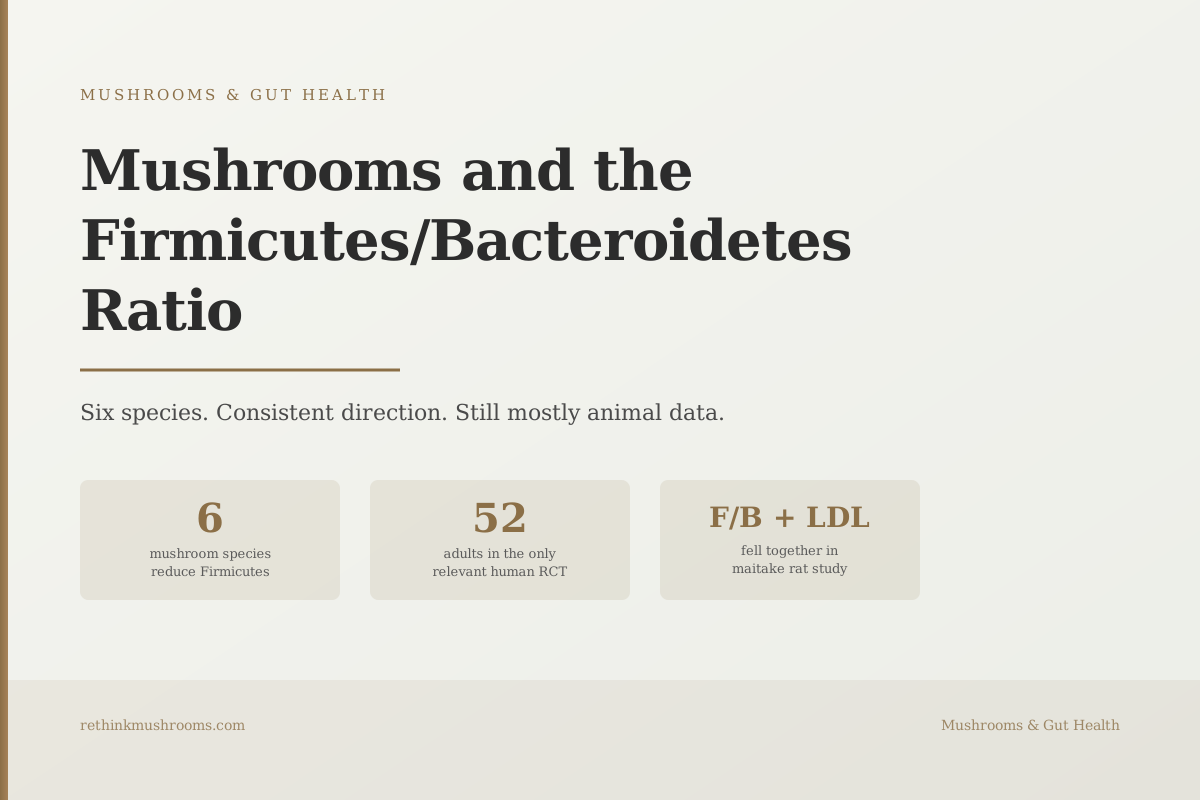
52 adults in the human RCT
The only human trial with directly relevant data: shiitake beta-glucan significantly increased Akkermansia muciniphila, a keystone bacterium associated with reduced obesity risk, in adults with mild high cholesterol.
Morales et al., European Journal of Nutrition, 2021
6 species
reduce Firmicutes in animal metabolic models
F/B + LDL
fell together in the maitake rat study
No human RCT
has directly measured F/B ratio after mushroom supplementation
Morales et al., European Journal of Nutrition, 2021
 View as image ↗
A rat fed a high-fat Western diet develops a gut microbiome that starts to look like a metabolically stressed one. More Firmicutes. Fewer Bacteroidetes. The ratio between these two dominant bacterial groups shifts in a direction that researchers have repeatedly linked to extracting more calories from food, storing more fat, and the kind of microbial imbalance seen in many people with obesity. When Meng and colleagues gave these same obese rats maitake mushroom polysaccharides, the Firmicutes/Bacteroidetes ratio moved back toward normal. So did their triglycerides and LDL cholesterol.[4]
That's a striking finding. It's also a finding from rats, not humans. And the Firmicutes/Bacteroidetes ratio itself has become scientifically contested. It turns out to be more complicated and less reliable as a metabolic biomarker than early research suggested.
This article covers both sides of that story: what the evidence actually shows about mushrooms and the Firmicutes/Bacteroidetes (F/B) ratio, what the current science says about whether that ratio is even a valid target, and where the human evidence stands. For a broader picture of how mushroom polysaccharides reshape gut bacteria composition, see mushrooms as prebiotics: how they feed your gut bacteria.
Key Takeaways
- Six mushroom species reduce the Firmicutes/Bacteroidetes ratio in animal models of metabolic disease: reishi, maitake, Chaga, enoki, lentinan, and turkey tail all show this effect in high-fat diet or inflammatory disease models
- Meng et al. (2019) found that maitake polysaccharides reduced the F/B ratio in high-fat diet rats while simultaneously lowering triglycerides and LDL, suggesting microbiome shifts and metabolic improvements co-occur
- The F/B ratio is contested as a biomarker: it varies widely between healthy people, and the link to metabolic disease is not as direct or consistent as early studies implied
- The only relevant human RCT (Morales et al., 2021, n=52) found shiitake beta-glucan increased Akkermansia muciniphila, a species associated with reduced obesity risk and better metabolic markers, in adults with mild hypercholesterolemia
- No human RCT has measured the Firmicutes/Bacteroidetes ratio as a primary endpoint after mushroom supplementation
- The evidence is most consistent in metabolically stressed models; whether these shifts occur in healthy adults eating mushrooms regularly is not yet known
The Firmicutes/Bacteroidetes Ratio: The Concept That Went Viral (Then Got Complicated)
Firmicutes and Bacteroidetes are the two largest bacterial kingdoms in the human gut. Together they account for roughly 90 percent of all gut bacteria in most people. Their relative balance, known as the Firmicutes/Bacteroidetes ratio, became one of the most discussed metrics in gut health research after a series of early studies connected it to obesity and metabolic disease.
The Firmicutes/Bacteroidetes (F/B) ratio is a gut microbiome metric historically associated with metabolic health. A higher ratio, meaning more Firmicutes relative to Bacteroidetes, is observed in many individuals with obesity. Multiple mushroom polysaccharides reduce the F/B ratio in animal models: reishi (Ganoderma lucidum), maitake (Grifola frondosa), enoki, Chaga, and lentinan all show this effect. Human data is limited.
The foundational finding that launched the concept came from comparisons between obese and lean individuals. People with obesity, on average, had a higher F/B ratio. The hypothesis was mechanistically interesting: Firmicutes-dominant gut communities appeared better at extracting energy from food, harvesting more calories from the same diet and potentially contributing to fat storage. Bacteroidetes-dominant communities seemed to be the reverse.
This became a popular shorthand in health journalism. The F/B ratio became a proxy for "healthy versus unhealthy gut."
But the story got complicated. When researchers looked more carefully across larger and more diverse populations, the correlation weakened significantly. The F/B ratio varies enormously between healthy people from different countries, ethnicities, and dietary traditions. Someone eating a traditional plant-rich diet in one region might have an F/B ratio that looks "obese" by Western standards, while being metabolically healthy. Diet composition strongly influences the ratio regardless of metabolic status; high-fiber, plant-based eating shifts it toward Bacteroidetes independently of weight or disease. Age, geography, antibiotic history, and many other factors confound the relationship.
A comprehensive 2023 review of mushroom polysaccharide-microbiota interactions across multiple disease contexts addressed this directly: the F/B ratio's scientific value lies in tracking community-level shifts in metabolically stressed models, not in making individual health predictions.[2] The current consensus is that the ratio is not a reliable diagnostic biomarker for metabolic disease in individual people.
That framing matters for everything that follows. When a study shows maitake polysaccharides lower the F/B ratio in obese rats, it's a meaningful finding. It does not automatically mean the same thing will happen in a healthy person eating maitake mushrooms.
Why Researchers Keep Measuring It Despite the Controversy
If the F/B ratio is contested, why does it keep appearing in microbiome research?
Because in metabolically stressed conditions (high-fat diet models, obesity, inflammatory bowel disease), the bacterial community shift it represents is real and consistent. A Firmicutes-heavy microbiome in these contexts isn't just a number. It corresponds to reduced production of short-chain fatty acids (acetate, propionate, and butyrate) that the gut lining depends on, reduced populations of protective bacteria like Akkermansia muciniphila, and the kind of microbial imbalance that precedes and accompanies metabolic dysfunction.
When something reliably normalizes the F/B ratio in these disease models, that suggests it's doing something meaningful to the underlying bacterial community. The ratio becomes a proxy for a broader pattern of change, even if it's an imperfect one on its own.
The appropriate frame for reading the mushroom evidence: a consistent shift in the F/B ratio toward Bacteroidetes in metabolically stressed animals is meaningful. It becomes more convincing when that shift co-occurs with improvements in specific metabolic markers. That is exactly what the maitake study found.
The Journey to the Colon: Why Mushroom Fiber Gets There When Most Food Doesn't
Before examining what different mushrooms do to the F/B ratio, it helps to understand why they affect gut bacteria at all.
The main bioactive compounds in mushrooms, specifically beta-glucans, chitin, and heteropolysaccharides, are types of fiber that human digestive enzymes cannot break down. They pass through the stomach and small intestine intact and arrive in the colon available as food for gut bacteria. That's where the selective effect happens.
Different bacterial species have different abilities to ferment these complex polysaccharides. Bacteroidetes, as a phylum, carry more of the enzyme types needed to break down complex polysaccharides than Firmicutes do. When mushroom polysaccharides reach the colon, they preferentially feed Bacteroidetes-associated taxa and related SCFA-producing bacteria. The fermentation produces short-chain fatty acids that lower colonic pH, creating conditions less hospitable to many Firmicutes species.
A 2020 review of mushroom prebiotic activity across disease models documented this pattern consistently across multiple species: Firmicutes relative abundance decreasing as Bacteroidetes-associated taxa expand.[3] The short-chain fatty acid pathway and its downstream effects are covered in depth in mushroom dietary fiber and short-chain fatty acid production.
The Maitake Study: When F/B Ratio and Lipid Markers Fell Together
The most mechanistically compelling study in this area is from Meng and colleagues, published in 2019. They fed high-fat diet rats (a well-established model of metabolic syndrome and dyslipidemia) Grifola frondosa (maitake) polysaccharides and tracked both gut microbiota composition and blood metabolic markers.[4]
The F/B ratio decreased in the maitake group. That alone would be notable. What made the study more compelling was that metabolic markers moved at the same time: triglycerides decreased, and so did LDL cholesterol.
This co-occurrence is the most interesting finding in the study. The microbiome shift wasn't isolated from metabolic outcomes. The two moved together. The correlation between F/B ratio normalization and improved lipid levels is consistent with the broader hypothesis that Firmicutes-dominant microbiomes contribute to caloric extraction and lipid dysregulation. Maitake polysaccharides appeared to shift both simultaneously.
An important note: this was a rat study, using animals already in a state of metabolic disease from a high-fat diet. The model is predictable and well-characterized, but the effects of maitake polysaccharides in metabolically healthy humans eating a varied diet are unknown. The study establishes that the mechanism exists and can be measured in a disease model. Whether it translates to humans is the outstanding question.
The maitake result also suggests that gut microbiome data alone may understate the evidence. When microbiome shifts correlate with changes in clinically relevant metabolic markers like LDL and triglycerides, the case for a real biological effect becomes more plausible.
Reishi, Chaga, Enoki, and Lentinan: A Consistent Pattern Across Six Species
The Firmicutes-reducing effect is not unique to maitake. Li and colleagues reviewed the prebiotic evidence for multiple mushroom species in a 2020 paper covering metabolic and inflammatory disease models across the literature.[3]
Ganoderma lucidum (reishi): Xie and colleagues, in a 2019 study of rats with experimentally induced intestinal inflammation, found that reishi polysaccharides reduced the F/B ratio while also improving gene expression in the cells lining the colon.[5] The inflammation was induced with a chemical compound (dextran sodium sulfate) that creates severe bacterial imbalance in the gut. Reishi polysaccharides shifted both the bacterial community and the gut tissue environment.
Inonotus obliquus (Chaga): Li's review found consistent Firmicutes reduction from Chaga across metabolic disease models. Chaga's polysaccharide composition, which includes beta-glucans and other complex carbohydrates that resist digestion, appears to selectively promote Bacteroidetes-associated taxa in a similar way to other mushrooms.
Flammulina velutipes (enoki): Enoki showed comparable Firmicutes-suppressing effects in metabolic models. Enoki tends to be overlooked in Western gut health literature. It shows up frequently in Japanese and Korean dietary research, where it is a common food, and its prebiotic properties have been studied across multiple disease contexts. For the enoki-specific evidence, see enoki for gut health: prebiotic fiber and microbiome effects.
Lentinan (shiitake extract): Lentinan is a purified beta-1,3/1,6-glucan extracted from shiitake mushrooms and used as a pharmaceutical in Japan for cancer supportive care. It shows F/B ratio reduction in metabolic disease models, connecting the whole-food shiitake evidence to isolated polysaccharide data.
The 2023 review by Zhao and colleagues, the most comprehensive synthesis of mushroom polysaccharide-microbiota interactions available, documented the Firmicutes-reducing pattern as consistent across species and disease contexts, including anti-obesity, anti-diabetes, and anti-IBD studies.[2]
This multi-species consistency is meaningful. When six different mushrooms with different polysaccharide compositions all produce the same directional microbiome shift, the most straightforward explanation is that the shared feature, delivering non-digestible polysaccharides to the colon, is what drives the effect. For a comparison of which species has the strongest prebiotic evidence overall, see which mushrooms are the best prebiotics: a species comparison.
Turkey Tail: The Most-Studied Prebiotic Mushroom Gets Tested in an Obesity Model
Turkey tail (Trametes versicolor) has the most clinical evidence of any prebiotic mushroom, but the primary human RCT used healthy adults, not people with metabolic disease. The 2024 study by Bai and colleagues was specifically designed to test turkey tail's effects in a metabolic disease context.[6]
Using high-fat diet mice, a standard model for obesity and metabolic syndrome, they found that turkey tail polysaccharides improved gut microbiota composition in a direction consistent with the F/B ratio normalization seen in other mushroom species.
This study matters because it extends turkey tail's prebiotic evidence from healthy adults into a context where gut microbiome shifts have more metabolic relevance. The Firmicutes-reducing effect seen in multiple other mushrooms appears in turkey tail's metabolic disease model too. Turkey tail's prebiotic mechanisms in humans, including the striking comparison with antibiotic-induced dysbiosis from the landmark Pallav trial, are covered in turkey tail and gut bacteria: the most-studied prebiotic mushroom.
The Closest Human Data: The Shiitake RCT and Akkermansia
The only randomized controlled trial with human data directly relevant to mushrooms and metabolic gut bacteria comes from Morales and colleagues, published in the European Journal of Nutrition in 2021.[1]
They enrolled 52 adults with mild hypercholesterolemia (elevated blood cholesterol, a common metabolic risk marker) in a randomized, double-blind trial. Half received 3.5 grams per day of shiitake beta-glucan extract; the other half received placebo. The shiitake group showed significant increases in several gut bacterial species, most importantly Akkermansia muciniphila.
Akkermansia muciniphila is a bacterium that lives in the mucus layer of the colon. It plays a protective role in maintaining the integrity of the gut lining, the physical barrier between gut contents and the bloodstream. Its relative abundance is consistently lower in people with obesity, metabolic syndrome, and type 2 diabetes. Higher Akkermansia levels are associated with better insulin sensitivity, lower body fat, and reduced metabolic risk. It functions as a keystone species: its presence supports the health of the broader bacterial community around it.
Akkermansia belongs to the Verrucomicrobia phylum, not Bacteroidetes, but it is consistently associated with Bacteroidetes-favorable microbiome states. The broader pattern of taxa that increased in the Morales trial, including Akkermansia, Ruminococcaceae UCG-014, Subdoligranulum, and Erysipelotrichaceae UCG-003 (all SCFA-producing or metabolically protective species), is consistent with the direction the F/B ratio evidence points from animal studies.
This is not a direct measurement of the F/B ratio in humans. The trial was not designed to measure F/B ratio changes, and was not powered to detect metabolic outcomes like weight loss or insulin sensitivity. It is, however, the strongest human evidence available that mushroom polysaccharides shift gut bacteria in metabolically relevant directions in people, not just animals.
For a full breakdown of the clinical evidence across mushroom species and study designs, see mushroom consumption and bacterial diversity: clinical evidence.
What It Would Take to Confirm This in Humans
The animal evidence for mushrooms reducing the F/B ratio is extensive. Six species, multiple disease models, consistent direction. The human evidence is promising but indirect.
What would a definitive trial need?
- Adults with documented metabolic dysfunction: elevated F/B ratio, metabolic syndrome, pre-diabetes, or obesity
- An intervention of at least 12 weeks (most animal studies see effects at 4-8 weeks; human microbiome trials typically require longer)
- 16S rRNA sequencing with F/B ratio, alpha diversity, and specific keystone taxa as pre-specified endpoints
- Sample sizes large enough to detect moderate effect sizes with confidence, specifically at least 100 participants per group
- Metabolic co-endpoints: fasting glucose, insulin sensitivity markers, lipid panel
No such trial currently exists for any mushroom species. The gap is worth being direct about: six mushroom species show consistent F/B ratio effects in metabolically stressed animal models, one human RCT shows relevant bacterial taxa shifts in people with mild hypercholesterolemia, and the full human metabolic picture remains unstudied.
That gap is not evidence against the mechanism. It is an accurate description of where the research currently stands. A broader look at how different mushroom species change gut bacteria composition across the published evidence is in how mushrooms change your gut microbiome: research review.
The Bottom Line
Multiple mushroom species, including reishi, maitake, Chaga, enoki, lentinan, and turkey tail, consistently reduce the Firmicutes/Bacteroidetes ratio in animal models of metabolic disease and intestinal inflammation, often alongside improvements in lipid markers or gut tissue health. The F/B ratio itself is a contested biomarker in human research, varying widely across healthy populations and strongly influenced by diet. The closest human evidence comes from Morales et al. (2021), where shiitake beta-glucan increased Akkermansia muciniphila in 52 adults with mild high cholesterol. No human RCT has directly measured F/B ratio changes with mushroom supplementation.
Frequently Asked Questions
Sources & References
- 1RTHM-01408·Morales, Diego et al. (2021). “Modulation of human intestinal microbiota in a clinical trial by consumption of a β-D-glucan-enriched extract obtained from Lentinula edodes..” European journal of nutrition.Study breakdown →PubMed →↩
- 2RTHM-01835·Zhao, Jiahui et al. (2023). “The Interaction between Mushroom Polysaccharides and Gut Microbiota and Their Effect on Human Health: A Review..” Biology.Study breakdown →PubMed →↩
- 3. Source details for this reference are not yet available.
- 4. Source details for this reference are not yet available.
- 5. Source details for this reference are not yet available.
- 6RTHM-01857·Bai, Ming et al. (2024). “Polysaccharides from Trametes versicolor as a Potential Prebiotic to Improve the Gut Microbiota in High-Fat Diet Mice..” Microorganisms.Study breakdown →PubMed →↩