Mushrooms & Gut Health
42 days of antibiotic disruption
In the only human trial to run a mushroom prebiotic and an antibiotic in the same protocol (n=24), amoxicillin's microbiome disruption was still measurable 42 days after the course ended. Turkey tail PSP moved the community in a prebiotic-consistent direction with no comparable disruption signature.
Pallav et al., Gut Microbes, 2014
In vitro
the named-genus claims (Bifidobacterium and Lactobacillus up, Clostridium down) come from human fecal culture, not from people (Yu et al., 2013)
SCFA production
colonic fermentation of mushroom polysaccharides produces short-chain fatty acids, lowers pH, and induces beta-glucosidase activity
No clinical benefit yet
the larger of the two human trials (n=52) found no significant change in cholesterol, lipids, or inflammatory markers versus placebo (Morales et al., 2021)
Pallav et al., Gut Microbes, 2014
 View as image ↗
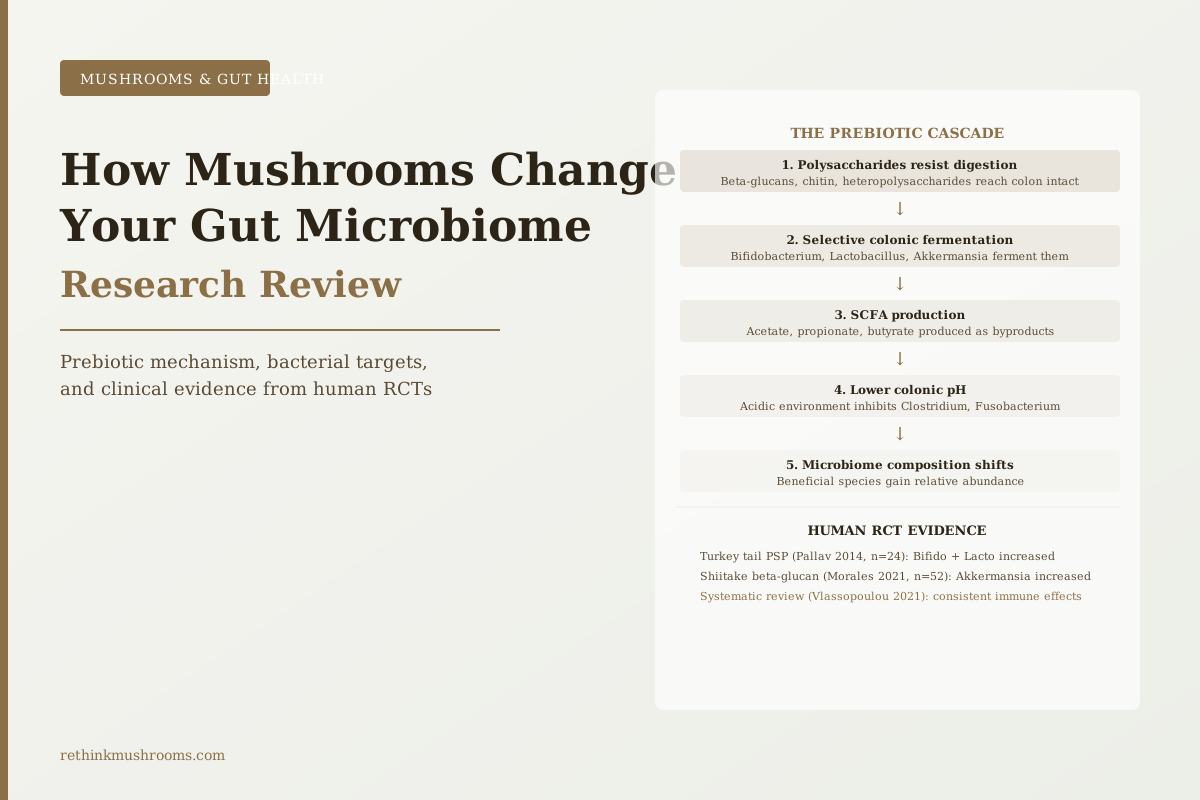
When you eat a mushroom, your digestive system treats most of its polysaccharides the same way it treats a locked box: with limited tools for opening it. The beta-glucans, chitin, and heteropolysaccharides that make up mushroom cell walls resist the enzymes in your stomach and small intestine. They arrive in your colon intact. There, a specific subset of your gut bacteria can ferment these compounds; when they do, they produce metabolites that change the composition of your gut community.
That much is well established. What is far less settled is the part most articles lead with: exactly which bacteria change, by how much, and whether any of it makes you healthier. Those three questions sit at three different evidence tiers, and conflating them is the single most common error in consumer coverage of this topic. This article walks the full cascade from polysaccharide structure to bacterial community effects, and it labels the confidence level at every step. For the broader context on how mushrooms qualify as prebiotics, see mushrooms as prebiotics: how they feed your gut bacteria.
Key Takeaways
- Mushroom polysaccharides (beta-glucans, chitin, heteropolysaccharides) resist human digestive enzymes and reach the colon intact, where they are selectively fermented by saccharolytic bacteria
- Fermentation produces short-chain fatty acids (acetate, propionate, butyrate) that lower colonic pH, inhibit pathogen colonization, and fuel colon epithelial cells
- The widely repeated claim that mushrooms raise Bifidobacterium and Lactobacillus while lowering Clostridium traces to an in vitro human fecal culture study (Yu et al., 2013), not to a human trial
- Turkey tail PSP produced clear, consistent community-level changes "consistent with its activity as a prebiotic" in a 2014 trial (Pallav et al., n=24) — the trial did not report genus-level increases in people
- In that same trial, amoxicillin's disruption persisted 42 days after the antibiotic course ended, while the PSP arm showed no comparable lasting disruption
- Shiitake beta-glucan (Morales et al., 2021, n=52 double-blind RCT) increased microbial diversity versus placebo, but produced no significant change in cholesterol, lipids, or inflammatory markers
- Firmicutes/Bacteroidetes reductions are consistently reported across structurally distinct species — turkey tail, Chaga, Tremella — but only in stressed-model animals, not humans
- No published study has followed humans consuming mushrooms for more than 12 weeks with microbiome composition as a primary endpoint; the mechanism is strong, the human outcome data is thin
Four Claims, Four Different Evidence Tiers
Not Every Statement in This Article Carries the Same Weight
These four claims are routinely quoted side by side as if equally proven. They are not. Bar length reflects how close each claim sits to direct human evidence — the widest bar is the one actually tested in people, and the narrowest is the one most often asserted.
Specific genera move — Bifidobacterium and Lactobacillus up, Clostridium down
In vitro onlyHuman fecal culture, not people
Yu 2013 [11]
The Firmicutes/Bacteroidetes ratio falls
Animal modelsThree species, all stressed-model mice
Bai 2024 [12]; Zhang 2023 [13]; He 2022 [14]
The gut community measurably shifts in humans
Small human RCTsTwo trials, n=24 and n=52
Pallav 2014 [8]; Morales 2021 [9]
Those shifts translate into a measurable clinical benefit
Not establishedNull lipid, cholesterol and cytokine results
Morales 2021 [9]; Vlassopoulou 2021 [10]
How to read it: the most specific claims rest on the least human evidence. Named-genus effects come from a dish, not a person. The ratio claim comes from mice bred or fed into a diseased state. What has genuinely been shown in people is the least quotable version — the community changes — and the step everyone actually cares about, a health outcome, is the one the trials failed to demonstrate.
Sources: Yu 2013 [11]; Bai 2024 [12]; Zhang 2023 [13]; He 2022 [14]; Pallav 2014 [8]; Morales 2021 [9]; Vlassopoulou 2021 [10]. Bar widths are illustrative of proximity to direct human evidence, not quantitative effect sizes.
How Mushroom Polysaccharides Escape Digestion and Reach the Colon
Most carbohydrates you eat are digested in the small intestine: amylase breaks down starch, sucrase handles sucrose, and so on. Mushroom polysaccharides largely escape this process.
Yin and colleagues summarized the mechanism in a 2020 review in Carbohydrate Polymers.[1] Mushroom beta-glucans are linked at specific carbon positions (primarily 1,3 and 1,6) that human digestive enzymes are not designed to cleave. Human small intestine enzymes lack the beta-1,3 and beta-1,6 glucanase activity needed to break these bonds. The polysaccharides pass through the stomach and small intestine essentially unchanged and arrive in the large intestine as intact substrates.
Chitin, the structural polymer that gives mushroom cell walls their rigidity (it also forms insect exoskeletons), is similarly resistant to human digestion. Yu and colleagues published a 2023 review in the Journal of Fungi distinguishing mushroom dietary fiber fractions: the insoluble fraction (primarily chitin) moves through the gut intact and contributes to bulk; the soluble fractions (certain beta-glucans and heteropolysaccharides) dissolve in the aqueous colon environment and become available for fermentation.[2]
To qualify as a prebiotic under the current scientific consensus, a compound must be selectively fermented by beneficial bacteria and produce a measurable health benefit. Kulshreshtha published a 2024 review in Probiotics and Antimicrobial Proteins arguing that mushrooms function as prebiotics on the first criterion: they remain undigested in the upper gut, reach the intestine, support beneficial microbes, inhibit pathogen binding, and drive short-chain fatty acid production.[3] The second criterion — a demonstrated health benefit in humans — is where the evidence thins, as the trial section below shows.
What Happens When Gut Bacteria Ferment These Polysaccharides
The bacteria that can ferment mushroom polysaccharides are predominantly saccharolytic, meaning they specialize in breaking down complex carbohydrates. When these bacteria ferment beta-glucans and other mushroom polysaccharides, they produce short-chain fatty acids as metabolic byproducts: primarily acetate, propionate, and butyrate.
Yin and colleagues (2020) traced the downstream cascade from this fermentation:[1]
- Acetate is absorbed and used as an energy source by colonocytes and peripheral tissues
- Propionate travels to the liver where it influences glucose and lipid metabolism
- Butyrate is the primary energy source for colon epithelial cells; it also promotes tight junction proteins (gut barrier integrity) and has anti-inflammatory effects
The pH consequence has been measured directly. In an in vitro human fecal fermentation, turkey tail PSP increased the concentration of organic acids (lactate and short-chain fatty acids), decreased the pH of the culture, and induced beta-galactosidase and beta-glucosidase activity — the enzymatic machinery of carbohydrate fermentation.[11] A lower pH creates an inhospitable environment for many proteolytic bacteria, which prefer a more neutral environment. The net effect, in that culture system, was a community shift: saccharolytic, acid-producing species gained ground.
Liu and colleagues reviewed this territory in 2020 in the International Journal of Medicinal Mushrooms, summarizing prebiotic effects of mushrooms on gut microbiota across immunological, metabolic, neurological, and cancer-related disease contexts, and proposing that mushrooms both change microbiota composition and promote secretion of beneficial metabolites.[4] Two organisms recur throughout this literature as markers of a healthier community: Faecalibacterium prausnitzii, a major butyrate producer that is consistently depleted in people with inflammatory bowel disease, and Akkermansia muciniphila, a mucin-degrading species associated with intestinal barrier integrity. Both are frequently invoked in mushroom marketing. Neither has been shown to increase in a human mushroom trial.
Zhao and colleagues published a 2023 synthesis in Biology covering how mushroom polysaccharide–microbiota interactions relate to metabolic disease, inflammatory bowel disease, and cancer, and made an important structural point: these activities depend closely on the molecular weight, monosaccharide composition, and glycosidic bond type of the specific polysaccharide.[5] That caveat matters more than it sounds. It means results from one mushroom extract do not automatically transfer to another, or even to a differently processed version of the same species.
Which Bacteria Do Mushrooms Actually Change? Reading the Evidence Tier by Tier
Not all mushrooms promote identical bacterial populations, and — more importantly — the evidence for "which bacteria" is far weaker than the evidence for "the community changes."
The most specific and most quoted findings come from a 2013 in vitro study by Yu and colleagues in Plant Foods for Human Nutrition.[11] Human fecal microbiota was cultured anaerobically with turkey tail PSP. The results were clean and genus-specific:
Significantly increased by PSP:
- Bifidobacterium spp. (also increased by the reference prebiotic FOS, but not by cellulose)
- Lactobacillus spp.
Reduced by PSP:
- Clostridium spp.
- Staphylococcus spp.
- Enterococcus spp.
Unchanged:
- Streptococcus spp., Bacteroides spp., and Escherichia
This is the origin of nearly every "mushrooms increase your good bacteria" claim in circulation. It is real data, carefully done — and it happened in a flask. A fecal culture has no host immune system, no mucosal layer, no bile flow, and no competing diet. It establishes that PSP can selectively feed these genera. It does not establish that eating mushrooms does so in a living person.
Claim Check
Do Mushrooms 'Boost Your Good Gut Bacteria'?
The claim
“Eating mushrooms measurably increases Bifidobacterium and Lactobacillus in your gut and lowers harmful Clostridium.”
A 2013 in vitro fecal-culture study of turkey tail PSP, whose genus-level results are routinely quoted as though they came from a human trial.
What research shows
OverstatedThe genus-level increases were demonstrated in anaerobic human fecal culture, not in people. The two published human trials measured community-level change and diversity — neither reported significant genus-level increases in Bifidobacterium or Lactobacillus as a primary result.
This is a scope error, not a fabrication. The in vitro finding is solid evidence that mushroom polysaccharides selectively feed these genera. The unsupported step is transferring a flask result to a human gut, where baseline microbiome differences between individuals were large enough to overshadow treatment effects in the trial that looked.
Yu et al., Plant Foods for Human Nutrition, 2013 [11]; Pallav et al., Gut Microbes, 2014 [8]; Morales et al., European Journal of Nutrition, 2021 [9]
Jayachandran and colleagues published a critical review in 2017 in the International Journal of Molecular Sciences surveying mushroom prebiotic effects across species.[6] Their treatment of turkey tail is deliberately cautious: PSP "modified Bifidobacterium spp. and Lactobacillus spp. and by that it regulates the human microbiome." Modified, not increased. The review also documents Ganoderma lucidum (reishi) extracts increasing Bifidobacteria in fermentation studies, and Pleurotus species producing a bifidogenic effect on specific B. bifidum, B. breve, B. animalis, and B. longum strains.
One tier up from the flask, the animal literature converges on a different and more consistent marker: the Firmicutes/Bacteroidetes ratio. Turkey tail polysaccharides attenuated the elevated F/B ratio in high-fat-diet mice while reducing bile-salt-hydrolase-producing bacteria.[12] Chaga (Inonotus obliquus) mycelial polysaccharide reduced the F/B ratio at phylum level in mice with DSS-induced ulcerative colitis, alongside improved colon length and reduced inflammatory cytokines.[13] Tremella fuciformis polysaccharide reduced the F/B ratio in high-fat-diet mice, and the anti-obesity effect transferred via fecal microbiota transplantation — strong evidence that the microbiome change was causal in that model.[14]
Three structurally distinct species, three different disease models, same directional result. That convergence is genuinely notable. It is also entirely rodent, and every one of those animals was pushed into a diseased or dysbiotic state first — which is not the baseline of a healthy person eating shiitake at dinner.
For a direct comparison of which species shows the most evidence across human and animal studies, see which mushrooms are the best prebiotics: a species comparison and the dedicated mushrooms and Firmicutes/Bacteroidetes ratio article.
The Two Human RCTs That Anchor the Evidence: Turkey Tail and Shiitake
Most of the mushroom microbiome evidence comes from in vitro fermentation experiments and animal models. Two published human randomized controlled trials provide the clearest anchors — and both are more modest than their reputation.
Pallav 2014 · n=24 randomized, 22 completed
The Only Trial That Ran a Mushroom Prebiotic Against an Antibiotic
Three arms, stool sampled on seven occasions across eight weeks using bTEFAP sequencing. Bar length shows how far each arm’s community moved from its own baseline — and, for the antibiotic arm, how long it stayed moved.
Turkey tail PSP
mushroom prebioticNo disruption signature reported
Clear, consistent community change consistent with prebiotic activity
Amoxicillin
antibiotic comparatorStill altered 42 days after the course ended
Substantial disruption — most notably a rise in Escherichia/Shigella
No treatment
control armReference for normal drift
Baseline microbiome remained largely stable over the sampling window
How to read it: the contrast is directional, not a dose-for-dose comparison — PSP and amoxicillin do different jobs and were never intended as substitutes. What the trial shows is that a mushroom polysaccharide moved the community in a prebiotic-consistent direction without leaving the durable disruption signature the antibiotic arm still carried six weeks later.
Source: Pallav 2014, Gut Microbes 5(4):458–467 [8]. Bar widths are illustrative of the magnitude and persistence of community change described in the trial, not measured effect sizes. The authors also caution that individual baseline microbiomes “tended to remain stable and to overshadow the treatment effects.”
Pallav 2014 (turkey tail PSP, n=24): Pallav and colleagues randomized 24 healthy volunteers to turkey tail polysaccharopeptide, amoxicillin, or no treatment.[8] Twenty-two completed the protocol. Stool was sampled on seven occasions across an eight-week window using bTEFAP microbial ecology methods. PSP "led to clear and consistent microbiome changes consistent with its activity as a prebiotic." Amoxicillin caused substantial disruption, most notably an increase in Escherichia/Shigella, and those changes persisted to the end of the study — 42 days after the antibiotic course ended.
Pallav et al. (2014) · Gut Microbes
- Population
- 24 healthy adult volunteers randomized; 22 completed
- Intervention
- Turkey tail (Trametes versicolor) polysaccharopeptide (PSP)
- Comparator
- Amoxicillin, and an untreated control arm
- Finding
- PSP produced clear, consistent community-level change consistent with prebiotic activity. Amoxicillin caused substantial disruption including an Escherichia/Shigella increase that was still present 42 days after treatment ended.
preliminary Small sample, and the authors note that individual baseline microbiomes tended to remain stable and to overshadow treatment effects. Measured with bTEFAP rather than the deeper 16S or shotgun metagenomic sequencing now standard.
Pallav et al., Gut Microbes 5(4):458-467, 2014 [8]
Two limitations deserve emphasis, because they are usually dropped. First, the authors explicitly report that baseline microbiomes "tended to remain stable and to overshadow the treatment effects" — individual variation was the dominant signal, not the intervention. Second, bTEFAP is a coarser method than the 16S rRNA or shotgun metagenomic sequencing used today. The trial supports a community-level directional claim. It does not support a genus-level one.
The antibiotic comparison remains the most striking result in this literature, and almost no consumer publication has highlighted it. The comparison was not the trial's primary purpose, and PSP and amoxicillin are not substitutes for one another. But the contrast is informative: a fermentable polysaccharide moved the community without leaving the durable disruption signature the antibiotic left behind.
Morales 2021 (shiitake beta-glucan, n=52): Morales and colleagues ran a randomized, controlled, double-blind, parallel trial in 52 adults aged 18–65 with untreated mild hypercholesterolemia.[9] Participants consumed a beta-D-glucan-enriched mixture derived from shiitake (Lentinula edodes) at 10.4 g/day — delivering 3.5 g/day of fungal beta-D-glucans — or placebo, incorporated into commercial creams, for eight weeks.
The result was substantially more mixed than the study's reputation suggests. After eight weeks, there were no significant differences in lipid- or cholesterol-related parameters versus placebo, and none before versus after within the treatment group. There was no inflammatory or immunomodulatory response: no changes in IL-1β, IL-6, TNF-α, or oxidized LDL. What the trial did find was that the beta-glucan mixture modulated the colonic microbiota differently from placebo, increased microbial diversity — an effect the authors attribute most likely indirectly to the increased fiber intake — and produced correlations between several bacterial genera and cholesterol-related biomarkers, with Bifidobacterium and Ruminococcaceae abundance inversely correlated with cholesterol levels.
Morales et al. (2021) · European Journal of Nutrition
- Population
- 52 adults aged 18-65 with untreated mild hypercholesterolemia
- Intervention
- Beta-D-glucan-enriched shiitake extract, 10.4 g/day delivering 3.5 g/day beta-D-glucans, 8 weeks
- Comparator
- Placebo, double-blind, parallel design
- Finding
- Increased microbial diversity and a distinct microbiota modulation versus placebo, with Bifidobacterium and Ruminococcaceae inversely correlated with cholesterol. No significant change in cholesterol, lipids, IL-1B, IL-6, TNF-alpha, or oxidized LDL.
null The primary clinical endpoints were null. The authors state the significance of the microbiota modulation 'was not fully elucidated and requires further studies.' The diversity increase is most likely an indirect effect of increased fibre intake.
Morales et al., European Journal of Nutrition 60(6):3249-3265, 2021 [9]
The authors' own conclusion is appropriately restrained: the results suggest a relation between cholesterol metabolism, microbiota, and beta-glucan administration, but "the precise significance of this differential modulation was not fully elucidated and requires further studies." This is the largest and best-controlled human mushroom microbiome trial available, and its headline finding is a null result on every clinical endpoint it set out to move.
For the full clinical evidence picture, including the null results from button mushroom trials that demonstrate the importance of species and duration, see mushroom consumption and bacterial diversity: clinical evidence.
- In vitro fecal fermentationcompleted
Genus-level shifts, pH drop, and SCFA production demonstrated in anaerobic human fecal culture (Yu 2013)
- Animal modelscompleted
Firmicutes/Bacteroidetes reduction replicated across turkey tail, Chaga, and Tremella in stressed-model mice; causality shown by FMT transfer in one
- Small human RCTscurrent
Two trials: n=24 community-level prebiotic-consistent change; n=52 increased diversity with null clinical endpoints
- Large human RCTmissing
No adequately powered trial with microbiome composition as a primary endpoint beyond 12 weeks
- Meta-analysis of microbiome outcomesmissing
The existing systematic review pools immune outcomes, not microbiome composition — too few comparable trials exist to pool
The mechanism is well characterized and the animal convergence is real, but human evidence stops at two small trials. The rung that matters for any health claim — an adequately powered, long-duration human trial with microbiome composition as a primary endpoint — has not been climbed.
Yu 2013 [11]; Bai 2024 [12]; Zhang 2023 [13]; He 2022 [14]; Pallav 2014 [8]; Morales 2021 [9]; Vlassopoulou 2021 [10]
What the Systematic Review Evidence Shows and Where It Stops
Individual RCTs can be cherry-picked. Systematic reviews aggregate evidence across studies and are harder to distort. For fungal beta-glucan effects on human health, the highest-level synthesis comes from Vlassopoulou and colleagues, who published a systematic review of RCTs in Food & Function in 2021.[10]
Thirty-four RCTs met their eligibility criteria, drawn from 917 records. Beta-glucan sources included Saccharomyces cerevisiae, Aureobasidium pullulans, Pleurotus ostreatus, Lentinula edodes, and Ganoderma lucidum, at doses ranging from 2.5 to 1000 mg daily for up to 6.5 months. The primary physiological outcome across the majority of trials was immunomodulation, which showed up clinically as reduced incidence and symptoms of colds, flu, and other respiratory infections, and as improvement in allergic symptoms. Participants also reported improved mood states and overall wellbeing. Notably, no adverse event was causally related to the glucans.
But the review is explicit about a limit that is routinely misreported: the findings on the induction of immune response alterations were inconsistent at the cellular and molecular levels. In other words, symptom-level benefits appeared with reasonable consistency, while the underlying immune-marker data did not line up behind them. The authors' conclusion is that supplementation is well tolerated and that health-promoting properties manifest primarily through immune potentiation, but that more studies are needed to confirm additional benefits, establish optimal dosing, and reveal the underlying mechanisms.
Note also what this review is not: it pools immune and general health outcomes, not gut microbiome composition. There is no meta-analysis of mushroom effects on the microbiome, because there are not enough comparable trials to pool.
This is the honest summary of where the evidence stands. The mechanism is well characterized in vitro and in animals. Two small human RCTs show community-level effects, with the larger one null on every clinical endpoint. The systematic review confirms consistent symptom-level immune effects and inconsistent cellular ones. What is absent is long-term human data: no published study has followed humans eating mushrooms for 12 weeks or more with gut microbiome composition as a primary endpoint and adequate statistical power.
Nguepi and Song, writing in the International Journal of Medicinal Mushrooms in 2020, frame the most plausible near-term direction for this research — the gut–liver axis.[7] Roughly 75% of the liver's blood supply arrives via the portal vein directly from the intestine, which makes the liver the first organ exposed to bacterial metabolites from the colon. That anatomy is why mushroom polysaccharides — xylans, galactans, alpha- and beta-glucans, and chitin — are being investigated as prebiotics for liver disease specifically. It is also a reminder that this remains a hypothesis under investigation, not an established therapy.
Practical Guidance
ModerateWhat This Evidence Does and Does Not Support
Concern
Mushroom prebiotic research is frequently marketed as support for treating metabolic disease, inflammatory bowel disease, or high cholesterol. The best-controlled human trial to date found no significant effect on cholesterol, lipids, or inflammatory markers, and the systematic review found immune-marker findings inconsistent at the cellular level.
What the research says
Culinary mushrooms are a well-tolerated source of dietary fibre, and no adverse events were causally linked to fungal beta-glucans across 34 RCTs. Treat them as food with a plausible prebiotic mechanism, not as a therapy for a diagnosed condition.
Particularly relevant for: Anyone with inflammatory bowel disease, an immune condition, a liver condition, or on cholesterol-lowering or immunosuppressant medication
What to do
This article is research review, not medical advice. Discuss concentrated mushroom extracts or supplements with your physician before use, particularly if you have an existing gastrointestinal, hepatic, or immune condition, or take prescription medication.
Morales et al., 2021 [9]; Vlassopoulou et al., 2021 [10]
This gap is not a failure of the hypothesis. It reflects the practical difficulty of long-term human microbiome trials and the recency of serious scientific attention to dietary prebiotic effects. The evidence is directional and mechanistically coherent; it is not yet definitive, and no one should present it as such. For readers interested in the specific alpha diversity evidence, see mushroom consumption and microbiome alpha diversity: human feeding trial data.
For how the prebiotic effects on gut bacteria connect to immune cell activation, see how beta-glucans epigenetically reprogram immune cells.
The Bottom Line
Mushrooms change gut microbiome composition through a well-characterized mechanism: non-digestible polysaccharides (beta-glucans, chitin, heteropolysaccharides) escape human digestion, reach the colon intact, and are selectively fermented by saccharolytic bacteria, producing short-chain fatty acids that lower colonic pH and fuel epithelial cells. The confidence attached to specific claims varies sharply by tier. Genus-level effects (Bifidobacterium and Lactobacillus up, Clostridium down) are in vitro findings from human fecal culture. Firmicutes/Bacteroidetes reductions are replicated across turkey tail, Chaga, and Tremella — but only in stressed-model animals. In humans, two trials anchor the field: Pallav 2014 (turkey tail PSP, n=24) showed community-level prebiotic-consistent change, with the striking incidental finding that amoxicillin's disruption persisted 42 days after treatment; Morales 2021 (shiitake beta-glucan, n=52) increased microbial diversity but produced no significant change in cholesterol, lipids, or inflammatory markers. The mechanism is strong; the human outcome evidence is not yet there.
Frequently Asked Questions
Sources & References
- 1RTHM-01308·Yin, Chaomin et al. (2020). “The Impact of Mushroom Polysaccharides on Gut Microbiota and Its Beneficial Effects to Host: A Review..” Carbohydrate polymers.Study breakdown →PubMed →↩
- 2RTHM-01829·Yu, Changxia et al. (2023). “The Effect of Mushroom Dietary Fiber on the Gut Microbiota and Related Health Benefits: A Review..” Journal of fungi (Basel.Study breakdown →PubMed →↩
- 3RTHM-01921·Kulshreshtha, Shweta (2024). “Mushroom as Prebiotics: a Sustainable Approach for Healthcare..” Probiotics and antimicrobial proteins.Study breakdown →PubMed →↩
- 4RTHM-01242·Liu, Xiaoxiao et al. (2020). “A Review on Linking the Medicinal Functions of Mushroom Prebiotics with Gut Microbiota..” International journal of medicinal mushrooms.Study breakdown →PubMed →↩
- 5RTHM-01835·Zhao, Jiahui et al. (2023). “The Interaction between Mushroom Polysaccharides and Gut Microbiota and Their Effect on Human Health: A Review..” Biology.Study breakdown →PubMed →↩
- 6RTHM-00878·Jayachandran, Muthukumaran et al. (2017). “A Critical Review on Health Promoting Benefits of Edible Mushrooms through Gut Microbiota..” International journal of molecular sciences.Study breakdown →PubMed →↩
- 7RTHM-00644·Nguepi, Tsopmejio Ivan Steve et al. (2020). “Mushrooms Bioactive as Prebiotics to Modulate Gut Microbiota in Relationships with Causes and Prevention of Liver Diseases (Review)..” International journal of medicinal mushrooms.Study breakdown →PubMed →↩
- 8RTHM-00630·Pallav, Kumar et al. (2014). “Effects of polysaccharopeptide from Trametes versicolor and amoxicillin on the gut microbiome of healthy volunteers: a randomized clinical trial..” Gut microbes.Study breakdown →PubMed →↩
- 9RTHM-01408·Morales, Diego et al. (2021). “Modulation of human intestinal microbiota in a clinical trial by consumption of a β-D-glucan-enriched extract obtained from Lentinula edodes..” European journal of nutrition.Study breakdown →PubMed →↩
- 10RTHM-01451·Vlassopoulou, Marigoula et al. (2021). “Effects of fungal beta-glucans on health - a systematic review of randomized controlled trials..” Food & function.Study breakdown →PubMed →↩
- 11RTHM-00573·Yu, Zhuo-Teng et al. (2013). “Trametes versicolor extract modifies human fecal microbiota composition in vitro..” Plant foods for human nutrition (Dordrecht.Study breakdown →PubMed →↩
- 12RTHM-01857·Bai, Ming et al. (2024). “Polysaccharides from Trametes versicolor as a Potential Prebiotic to Improve the Gut Microbiota in High-Fat Diet Mice..” Microorganisms.Study breakdown →PubMed →↩
- 13RTHM-00860·Zhang, Jiaqi et al. (2023). “Polysaccharide from fermented mycelium of Inonotus obliquus attenuates the ulcerative colitis and adjusts the gut microbiota in mice..” Microbial pathogenesis.Study breakdown →PubMed →↩
- 14RTHM-01534·He, Gang et al. (2022). “Tremella fuciformis polysaccharide reduces obesity in high-fat diet-fed mice by modulation of gut microbiota..” Frontiers in microbiology.Study breakdown →PubMed →↩