Mushrooms & Gut Health
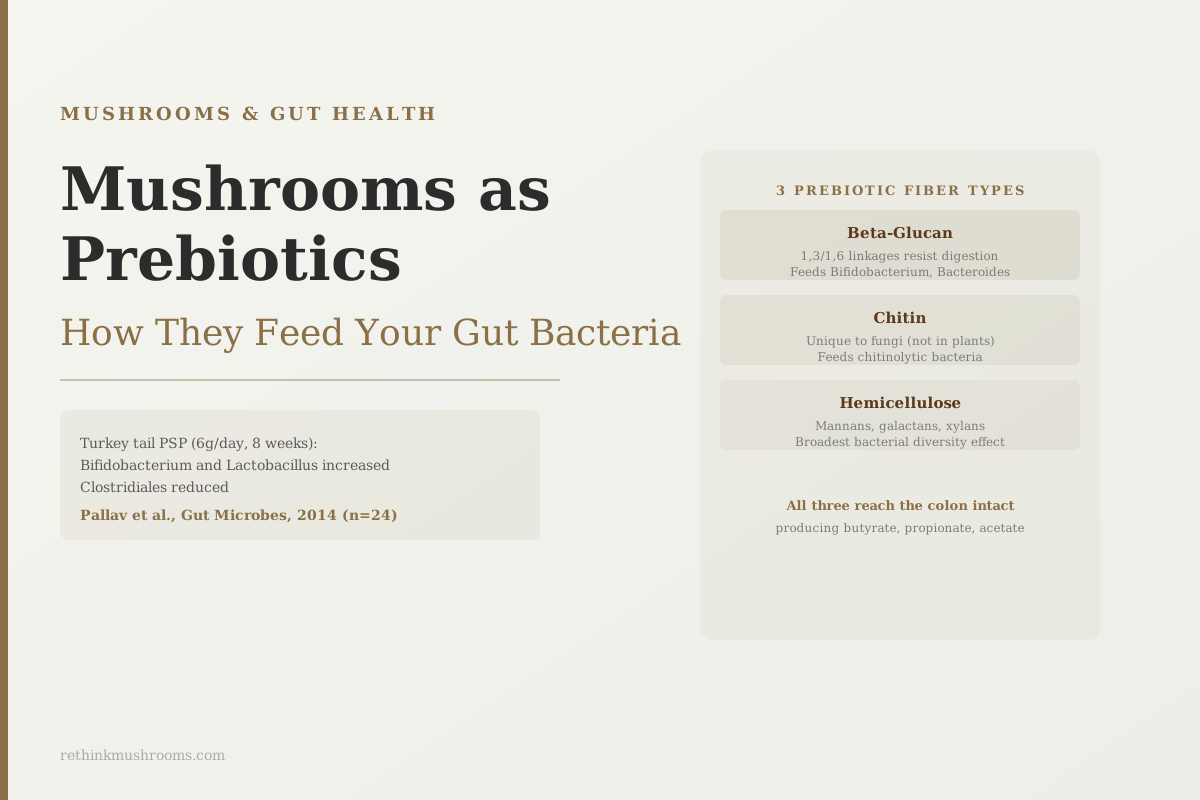
Bifidobacterium and Lactobacillus increased
In the only published clinical trial testing a mushroom extract as a prebiotic, turkey tail polysaccharide at 6g per day significantly increased two beneficial bacterial groups and reduced harmful Clostridiales in 24 healthy adults over 8 weeks.
Pallav et al., Gut Microbes, 2014
3 fiber types
Beta-glucan, chitin, and hemicellulose. All three survive digestion and reach the colon intact
52 adults
Shiitake RCT: 5-10g daily for 4 weeks produced immune and microbiome changes (Dai 2015)
11 studies
Peer-reviewed studies examined in this analysis
Pallav et al., Gut Microbes, 2014
 View as image ↗
Most sources that call mushrooms a prebiotic food never explain what that claim actually rests on. The word "prebiotic" has a specific meaning in nutrition science: a substance that survives digestion, reaches the colon intact, and selectively feeds beneficial bacteria in ways that produce measurable health effects. Mushrooms qualify because they contain fiber types that human digestive enzymes cannot break down, and because clinical trials have confirmed they shift gut microbiome composition.
The strongest human evidence comes from Pallav and colleagues' 2014 randomized clinical trial in Gut Microbes. Twenty-four healthy adults received either turkey tail mushroom polysaccharide at 6 grams per day or a placebo for 8 weeks. The turkey tail group showed significant increases in Bifidobacterium and Lactobacillus, two of the most studied beneficial bacterial groups, alongside reductions in Clostridiales, a group associated with gut dysbiosis.[1] Mushrooms as prebiotics is not a theoretical claim. It has been tested in people.
But the story extends well beyond turkey tail. Mushrooms contain three distinct prebiotic fiber types, each of which reaches the colon and feeds bacteria in a different way. Understanding how each works explains why mushrooms can shift gut bacteria in ways that plant-based prebiotics like inulin cannot.
Key Takeaways
- Turkey tail polysaccharide (6g/day for 8 weeks) significantly increased Bifidobacterium and Lactobacillus and reduced Clostridiales in 24 healthy adults, making this the only published human RCT on mushroom prebiotics (Pallav et al., 2014)
- Mushrooms contain three distinct prebiotic fiber types: beta-glucans (most studied), chitin (unique to fungi, not found in plants), and hemicellulose, each of which selectively feeds different bacterial groups (Yu et al., 2023)
- Beta-glucan's 1,3/1,6 glucose linkage makes it resistant to human digestive enzymes, allowing it to reach the colon intact where it selectively feeds SCFA-producing Bifidobacterium and Bacteroides (Murphy et al., 2020)
- Eating 5-10g of dried shiitake mushrooms daily for 4 weeks produced immune and gut microbiome changes in 52 healthy adults, confirming dietary mushroom consumption (not just extracts) has prebiotic effects (Dai et al., 2015)
- Oyster mushroom beta-glucan demonstrated prebiotic effects comparable to FOS (a well-established plant prebiotic) in vitro while also exerting antimicrobial effects against pathogenic bacteria (Toros et al., 2023)
- Whole king oyster mushroom consumption corrected gut dysbiosis in obese mice, showing the prebiotic benefit extends to whole food consumption, not only concentrated extracts (Du et al., 2024)
What Makes Mushrooms a Prebiotic (and How to Verify a Claim)
The word "prebiotic" has a precise scientific definition. A substance qualifies as a prebiotic when it meets three criteria: it resists digestion in the stomach and small intestine, it is fermented by gut bacteria in the colon, and the fermentation selectively promotes the growth of beneficial bacteria in ways that benefit the host. Yogurt is probiotic (it contains live bacteria). Fiber that feeds those bacteria is prebiotic.
Mushrooms qualify as prebiotics because their main structural fibers survive the conditions of the upper digestive tract. Stomach acid, pancreatic enzymes, and the digestive enzymes lining the small intestine evolved to break down proteins, simple sugars, and many plant fibers. They did not evolve for the specific glucose chain structures found in mushrooms.
The single most important distinction is between alpha-glucan and beta-glucan. Both are chains of glucose molecules. Alpha-glucan (starch) has a 1,4 linkage between glucose units, which human amylase enzymes can break easily. Beta-glucan has a 1,3 or 1,6 linkage, which human enzymes cannot cut. This structural difference is why beta-glucan reaches the colon intact while starch from the same mushroom does not.[5]
Mushrooms are a natural source of prebiotic fiber: non-digestible polysaccharides including beta-glucans, chitin, and hemicellulose that survive digestion and selectively feed beneficial gut bacteria like Bifidobacterium and Lactobacillus. Clinical research, including the Pallav 2014 randomized trial, confirms mushrooms directly shift gut microbiome composition.
For a technical deep-dive into how mushroom polysaccharide structure determines which bacteria can ferment them, see Mushroom Polysaccharides and Microbiome Nourishment.
Three Fiber Types: How Beta-Glucan, Chitin, and Hemicellulose Work Differently
Yu and colleagues' 2023 review in the Journal of Fungi is the most comprehensive recent treatment of mushroom dietary fiber as a prebiotic substrate.[8] The key contribution is distinguishing between three structurally different fiber types, each of which has different effects on which bacteria thrive.
Beta-glucan is the most studied and most concentrated prebiotic fiber in mushrooms. Structurally, it is a branched glucose polymer with 1,3 and 1,6 linkages. Those branches are important: they create a three-dimensional shape that only specific bacterial enzymes can unlock. Bifidobacterium and certain Bacteroides species possess these enzymes. When they ferment beta-glucan, they produce butyrate, propionate, and acetate, the short-chain fatty acids (SCFAs) that fuel colon cells and reduce inflammation throughout the body.[5]
Chitin is the structural fiber that gives mushrooms their chewy texture. It is made from a glucose derivative called N-acetylglucosamine rather than plain glucose, which is why it behaves so differently from beta-glucan. Chitin is unique to fungi and a small number of other organisms; it does not exist in plants. This means plant-based prebiotics like inulin and FOS do not provide it. Chitin reaches the colon even more intact than beta-glucan and feeds a somewhat different bacterial population, including chitinolytic bacteria that produce their own distinct SCFA profile.[11]
Hemicellulose is a heterogeneous group of polysaccharides, meaning they contain more than one type of sugar unit. Mushroom hemicellulose includes mannans, galactans, and xylans. This structural variety means hemicellulose can feed a wider range of bacterial species than beta-glucan or chitin alone, potentially promoting greater microbiome diversity overall.[11]
Having three structurally distinct prebiotic fibers rather than one is what gives mushrooms a broader bacterial feeding range than most plant-based prebiotic foods, which typically contain only one or two fiber classes. For a side-by-side comparison with inulin, FOS, and psyllium, see How Mushroom Fiber Differs from Other Prebiotic Sources.
What Happens in Your Colon When You Eat Mushroom Fiber
After mushroom fibers pass through the stomach and small intestine undigested, they arrive in the colon where roughly 100 trillion bacteria are waiting. The bacteria that benefit most from mushroom fiber are the ones equipped with enzymes to break the specific glucose linkages involved: Bifidobacterium, Lactobacillus, and certain Bacteroides species.
When these bacteria ferment beta-glucan, they produce three main metabolic outputs that matter for human health.
The first is butyrate. Butyrate is the primary fuel source for the cells lining the colon. Without enough butyrate, those cells weaken and gaps can form in the intestinal barrier, the thin layer that keeps bacteria and bacterial products inside the gut and out of the bloodstream. Adequate butyrate production from prebiotic fermentation is associated with reduced intestinal inflammation and a lower risk of colorectal cancer in observational research.[4]
The second is propionate, which travels from the colon to the liver via the portal vein. In the liver, propionate plays a role in regulating blood sugar and cholesterol production. Liu and colleagues' 2020 review in Food and Function links mushroom polysaccharide fermentation to changes in the ratio of Firmicutes to Bacteroidetes bacteria, which is one of the most studied metabolic indicators in gut health research.[4] A higher Bacteroidetes proportion is generally associated with leaner metabolic profiles.
The third is acetate, a short-chain fatty acid used as energy throughout the body and as a precursor for other metabolites.
The bacterial shift that mushroom prebiotic fiber produces is not simply "more good bacteria." It is a specific change: fewer opportunistic and pathogenic bacteria competing for the same space, and more SCFA-producing bacteria generating anti-inflammatory metabolites. For a step-by-step explanation of the fermentation pathway with specific bacterial names, see Mushrooms as Prebiotics: How Fungal Polysaccharides Feed Beneficial Bacteria.
The Only Published Human Trial: Turkey Tail PSP in 24 Healthy Adults
Pallav and colleagues' 2014 study in Gut Microbes tested turkey tail mushroom's polysaccharopeptide (PSP) in a randomized clinical design with 24 healthy adults.[1] Participants received either 6 grams of turkey tail PSP per day or a placebo for 8 weeks. Before and after, the researchers sequenced the participants' gut microbiomes to measure bacterial composition changes.
The PSP group showed significant increases in Bifidobacterium and Lactobacillus. These are not obscure species: Bifidobacterium and Lactobacillus are the two groups most consistently associated with gut health benefits in clinical and observational research, and they are the organisms that most probiotic supplements try to replenish. The turkey tail group also showed reductions in Clostridiales, a broad bacterial group that includes several pathogenic species.
The placebo group did not show these changes.
This study matters because it is the only published randomized clinical trial testing a mushroom extract's prebiotic effect in healthy humans. Every other mushroom prebiotic claim in consumer content rests on animal studies or in vitro (cell culture) research. Pallav 2014 is the one human data point that directly confirms the mechanism works in people.
The limitation worth noting: 24 people is a small sample size, and the study ran for 8 weeks. Longer trials with more participants would provide stronger evidence. The result is real, but calling turkey tail's prebiotic effect "proven" would overstate what one small RCT can establish.
Shiitake Daily for 4 Weeks: The Dietary Mushroom With Clinical Trial Data
Dai and colleagues published the shiitake dietary intervention in the Journal of the American College of Nutrition in 2015.[2] Fifty-two healthy young adults ate either 5 or 10 grams of dried shiitake mushrooms daily for 4 weeks. The researchers measured immune cell proliferation and gut microbial changes before and after.
The shiitake group showed improved immune cell numbers and gut microbial changes consistent with a prebiotic effect. Critically, this was a dietary study, not an extract study. Participants were eating dried mushrooms as food, not taking polysaccharide capsules. The doses (5 to 10 grams of dried mushroom per day) are achievable through regular dietary consumption.
This is practically useful information. It means the prebiotic benefit is not locked behind supplement-level doses. The Jayachandran 2017 review in the International Journal of Molecular Sciences synthesizes the broader shiitake research: lentinan, shiitake's best-studied polysaccharide, promotes Bifidobacterium and Lactobacillus while suppressing pathogenic Clostridium species in multiple study designs.[3]
Species by Evidence Level: Which Mushrooms Have the Most Prebiotic Research?
Not all mushroom species have equal evidence for prebiotic effects. Here is where each stands, organized by the quality of evidence supporting the claim.
| Species | Key Prebiotic Compound | Best Evidence | Key Finding |
|---|---|---|---|
| Turkey tail | PSP (polysaccharide peptide) | Human RCT (Pallav 2014) | Increased Bifidobacterium and Lactobacillus in 24 adults |
| Shiitake | Lentinan, beta-glucan | Human dietary RCT (Dai 2015) | Microbiome and immune changes with 5-10g/day dried |
| Oyster mushroom | Beta-1,3/1,6-glucan | In vitro (Toros 2023) | Comparable bifidogenic effect to FOS plus antimicrobial activity |
| King oyster | Beta-glucan, chitin | Animal study (Du 2024) | Whole food corrected gut dysbiosis in obese mice |
| Reishi, Lion's Mane, others | Varied polysaccharides | Review-level (Jayachandran 2017, Zhao 2023) | Documented in reviews; fewer direct fermentation studies |
Turkey tail and shiitake hold the top positions because they have human clinical trial data. The others have supporting evidence but rely on animal or laboratory research, which is informative about mechanism but cannot yet confirm the same effects occur in people at dietary doses.
Toros and colleagues' 2023 review is notable for the oyster mushroom finding: its beta-glucan showed prebiotic effects comparable to FOS, a well-established plant prebiotic widely used in supplements, while also exerting antimicrobial effects against harmful bacteria in vitro.[7] No plant prebiotic simultaneously feeds beneficial bacteria and kills harmful ones. This dual mechanism is specific to fungal beta-glucan.
Zhao and colleagues' 2023 review in Frontiers in Nutrition adds useful structural context: polysaccharide branching patterns and molecular weight vary across mushroom species, and those structural differences determine which bacteria can ferment them and which cannot.[9] A diverse diet of multiple mushroom species is more likely to feed a diverse range of bacterial populations than any single species.
For a detailed head-to-head species comparison with more data, see Which Mushrooms Are the Best Prebiotics? A Species Comparison.
Whole Mushrooms vs. Extracts: Does the Form Matter?
Most of the mechanistic research on mushroom prebiotics uses concentrated polysaccharide extracts. A reasonable question is whether eating whole mushrooms produces the same effects, or whether a supplement is needed.
Du and colleagues' 2024 study in Food Research International addressed this directly for king oyster mushroom (Pleurotus eryngii).[10] Obese mice fed whole king oyster mushroom showed reduced fat accumulation and correction of gut dysbiosis, with bacterial composition moving toward a healthier profile. The intervention used the whole food, not an extract or isolated polysaccharide.
The Dai 2015 shiitake study makes the same point in humans: 5 to 10 grams of dried mushroom per day, consumed as food, produced measurable microbiome changes.
The honest interpretation: whole mushrooms do appear to carry prebiotic benefit at dietary amounts. Concentrated extracts may produce stronger effects at equivalent dosing because they deliver more polysaccharide per gram of powder. What the research cannot yet establish is the minimum effective dietary dose for each species in each person, because no study has run that dose-finding experiment in humans.
The Kulshreshtha 2024 review in Probiotics and Antimicrobial Proteins notes an additional consideration: the diversity of prebiotic compounds in whole mushrooms (chitin, mannans, galactans, xylans, glucans, lentinan, hemicellulose all present simultaneously) may produce a broader microbiome effect than extracts standardized to a single compound class.[11]
Beyond the Gut: How Mushroom Prebiotics Connect to Liver Health
The prebiotic effect does not stop at the colon wall. Short-chain fatty acids and other metabolites produced during fermentation travel via the gut-liver axis, a bidirectional connection through the portal vein that links gut bacterial metabolism directly to liver function.
Nguepi and Song's 2020 review in the International Journal of Medicinal Mushrooms examines mushroom polysaccharides specifically through this lens, focusing on how gut microbiota changes produced by mushroom prebiotics downstream affect liver disease progression and prevention.[6] The key pathway: gut dysbiosis (an imbalance toward harmful bacteria) increases intestinal permeability, allowing bacterial products like lipopolysaccharide to enter the bloodstream and reach the liver, where they trigger inflammation. Prebiotic fiber that corrects dysbiosis and promotes SCFA production reduces this leakage.
The downstream effects documented in the review include reduced inflammatory signaling in the liver, changes in lipid metabolism, and a more intact intestinal barrier. These are not direct effects of mushroom compounds on the liver. They are indirect effects mediated through what happens to the gut microbiome first.
This gut-liver connection is one reason the prebiotic research is considered relevant to conditions well outside the gut: NAFLD (non-alcoholic fatty liver disease), obesity, and metabolic syndrome all involve gut dysbiosis as a contributing factor, and correcting dysbiosis with prebiotic fiber is one mechanism by which dietary interventions affect these conditions.
For a detailed look at how mushroom prebiotic effects connect to brain function via the gut-brain axis, see How Mushroom Prebiotics Influence Brain Function Through the Gut.
Where the Evidence Is Still Thin
The prebiotic evidence for mushrooms is real but it is young, and being direct about what it cannot yet establish is more useful than overstating the case.
The human clinical trial database is thin. Pallav 2014 is the only RCT testing a mushroom extract as a prebiotic in healthy humans, and its sample size (n=24) is small. Dai 2015 tested shiitake as a dietary food intervention, also small (n=52). Both are single trials without replication. Most of the mechanistic evidence on how mushroom fiber feeds specific bacteria comes from animal studies or laboratory fermentation models, both of which involve conditions that differ from the human gut.
Species-level specificity is also incomplete. Reviews like Jayachandran 2017 and Zhao 2023 cover multiple species, but most individual species data comes from one or two studies, often in different animal models or in vitro conditions, making direct species comparisons difficult.[3][9]
Dose-response data in humans is essentially absent. What dose of what mushroom species, in what form, produces measurable microbiome changes in people who are not already healthy young adults? The research does not yet answer that.
What the evidence does support: mushroom fiber reaches the colon intact, beneficial bacteria can ferment it, and in at least two human trials, measurable microbiome shifts resulted. The mechanism is real. The clinical significance for specific health conditions in specific populations requires more research.
The Bottom Line
Mushrooms qualify as prebiotic foods because they contain three structurally distinct fibers (beta-glucans, chitin, and hemicellulose) that survive digestion and selectively feed beneficial gut bacteria. The strongest human evidence is Pallav 2014: turkey tail polysaccharide at 6g/day for 8 weeks significantly increased Bifidobacterium and Lactobacillus in 24 healthy adults. Shiitake's dietary prebiotic effect was confirmed in a separate 52-person trial. Oyster mushroom beta-glucan demonstrates effects comparable to FOS in vitro. Most other species data comes from animal or in vitro research. The prebiotic mechanism is established; the clinical implications for specific health conditions in people require more study.
Frequently Asked Questions
Sources & References
- 1RTHM-00630·Pallav, Kumar et al. (2014). “Effects of polysaccharopeptide from Trametes versicolor and amoxicillin on the gut microbiome of healthy volunteers: a randomized clinical trial..” Gut microbes.Study breakdown →PubMed →↩
- 2RTHM-00368·Dai, Xiaoshuang et al. (2015). “Consuming Lentinula edodes (Shiitake) Mushrooms Daily Improves Human Immunity: A Randomized Dietary Intervention in Healthy Young Adults..” Journal of the American College of Nutrition.Study breakdown →PubMed →↩
- 3RTHM-00878·Jayachandran, Muthukumaran et al. (2017). “A Critical Review on Health Promoting Benefits of Edible Mushrooms through Gut Microbiota..” International journal of molecular sciences.Study breakdown →PubMed →↩
- 4RTHM-01242·Liu, Xiaoxiao et al. (2020). “A Review on Linking the Medicinal Functions of Mushroom Prebiotics with Gut Microbiota..” International journal of medicinal mushrooms.Study breakdown →PubMed →↩
- 5RTHM-00639·Murphy, Emma J et al. (2020). “β-Glucan Metabolic and Immunomodulatory Properties and Potential for Clinical Application..” Journal of fungi (Basel.Study breakdown →PubMed →↩
- 6RTHM-00644·Nguepi, Tsopmejio Ivan Steve et al. (2020). “Mushrooms Bioactive as Prebiotics to Modulate Gut Microbiota in Relationships with Causes and Prevention of Liver Diseases (Review)..” International journal of medicinal mushrooms.Study breakdown →PubMed →↩
- 7RTHM-00855·Törős, Gréta et al. (2023). “Modulation of the Gut Microbiota with Prebiotics and Antimicrobial Agents from Pleurotus ostreatus Mushroom..” Foods (Basel.Study breakdown →PubMed →↩
- 8RTHM-01829·Yu, Changxia et al. (2023). “The Effect of Mushroom Dietary Fiber on the Gut Microbiota and Related Health Benefits: A Review..” Journal of fungi (Basel.Study breakdown →PubMed →↩
- 9RTHM-01836·Zhao, Qilong et al. (2023). “The benefits of edible mushroom polysaccharides for health and their influence on gut microbiota: a review..” Frontiers in nutrition.Study breakdown →PubMed →↩
- 10RTHM-00876·Du, Hengjun et al. (2024). “Dietary intake of whole king oyster mushroom (Pleurotus eryngii) attenuated obesity via ameliorating lipid metabolism and alleviating gut microbiota dysbiosis..” Food research international (Ottawa.Study breakdown →PubMed →↩
- 11RTHM-01921·Kulshreshtha, Shweta (2024). “Mushroom as Prebiotics: a Sustainable Approach for Healthcare..” Probiotics and antimicrobial proteins.Study breakdown →PubMed →↩