Mushrooms & Gut Health
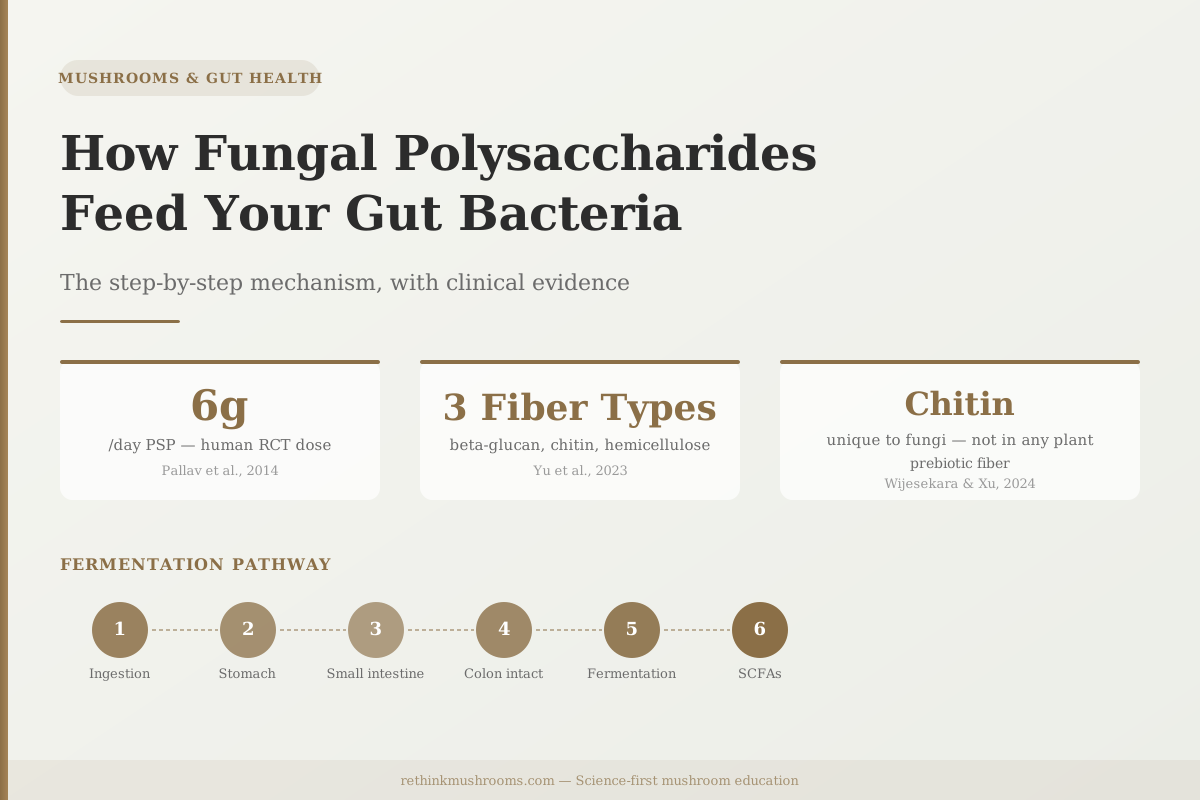
6g/day
In the only randomized clinical trial testing a mushroom extract as a prebiotic, 6 grams of turkey tail PSP daily for 8 weeks increased Bifidobacterium and Lactobacillus and reduced Clostridiales in 24 healthy adults.
Pallav et al., Gut Microbes, 2014.
3 fiber types
beta-glucan, chitin, and hemicellulose in every mushroom
8 weeks
to produce measurable microbiome shifts in the RCT
Chitin
a prebiotic fiber unique to fungi, not found in any plant
Pallav et al., Gut Microbes, 2014.
 View as image ↗
Fungi are genetically closer to animals than to plants. That evolutionary distance matters more than most people realize, because it means the structural molecules in a mushroom are architecturally different from anything in kale, oats, or chicory root. When turkey tail PSP reached the colons of 24 healthy adults in a 2014 randomized trial, it didn't just provide generic prebiotic fiber. Pallav and colleagues found it specifically increased Bifidobacterium and Lactobacillus and reduced Clostridiales, a precise bacterial shift that researchers measure when evaluating whether a substance qualifies as a prebiotic.[1]
This is the mechanisms article. For a broader overview of which mushroom species have prebiotic evidence and how to think about them as a food group, see Mushrooms as Prebiotics: How They Feed Your Gut Bacteria. Here, the focus is narrower: what fungal polysaccharides actually are, why human digestive enzymes cannot process them, which bacteria can, and what those bacteria produce when they do.
Key Takeaways
- Turkey tail PSP at 6g/day for 8 weeks increased Bifidobacterium and Lactobacillus in 24 healthy adults, making it the only randomized trial testing a mushroom extract as a prebiotic in humans (Pallav et al., 2014)
- Every mushroom contains three distinct prebiotic fibers: beta-glucan, chitin, and hemicellulose, each fermented by different bacterial species (Yu et al., 2023)
- Chitin is unique to fungi; no plant prebiotic contains it, and it arrives at the colon more intact than even beta-glucan (Wijesekara and Xu, 2024)
- Beta-glucan's 1,3/1,6-glycosidic bonds resist human digestive enzymes by design; this structural resistance is what makes it a prebiotic (Murphy et al., 2020)
- Oyster mushroom beta-glucan produced bifidogenic effects comparable to FOS, the benchmark plant prebiotic, in laboratory testing (Toros et al., 2023)
- Bacterial fermentation of mushroom polysaccharides produces butyrate, propionate, and acetate: three short-chain fatty acids that affect the colon, liver, and peripheral tissues differently (Liu et al., 2020)
Why Fungal Polysaccharides Behave Differently from Plant Fiber
Plants and fungi both build polysaccharides from simple sugar units. The difference is in how those units are connected.
Plant fiber uses bond configurations that human digestive chemistry has evolved alongside. Cellulose uses a beta-1,4 glucose linkage. Starch uses alpha-1,4 glucose. Inulin uses beta-2,1 fructose bonds. Some of these human enzymes can break. Others pass through largely intact. Plants and humans share a long evolutionary history that shapes which plant molecules get digested and which don't.
Fungi evolved separately from both plants and animals. Their polysaccharides use a 1,3 main chain with 1,6 branch points, a configuration that no human digestive enzyme cleaves efficiently.[4] The result is a molecule that travels through the stomach and small intestine chemically unchanged, arriving in the colon intact where bacteria can use it.
This structural resistance is the first requirement for any compound to qualify as a prebiotic: it must survive digestion. Mushroom polysaccharides pass this test more reliably than most plant fibers because their bond architecture is genuinely foreign to human digestive chemistry.[7]
There is a second reason fungal polysaccharides behave differently. Fungi spent millions of years competing with bacteria in soil environments. Their cell wall chemistry evolved in an ecological context that required interacting with bacterial ecosystems, which produced properties that plant polysaccharides don't have, including selective antimicrobial activity against pathogens alongside the prebiotic feeding of beneficial species.[6]
The Fungal Cell Wall: Three Prebiotic Fibers Working at Different Depths
Most discussions of mushroom fiber treat beta-glucan as though it is the only compound worth knowing. The cell wall is more complex than that, and each layer contributes a different prebiotic compound.
Beta-glucan forms the matrix layer of the cell wall. It is the most studied and most abundant mushroom polysaccharide. The 1,3 backbone with 1,6 branch points is the configuration that resists digestion and reaches the colon intact. The molecular weight of beta-glucan varies significantly across mushroom species, which affects how quickly bacteria ferment it and which bacterial genera respond most strongly.[4]
Chitin forms the primary structural scaffold of the cell wall. It is made from N-acetylglucosamine units (a nitrogen-containing sugar), linked in a way that no human enzyme can efficiently break apart. Chitin is unique to fungi and crustaceans; no plant makes it. Wijesekara and Xu's 2024 review documents that mushroom chitin arrives at the colon even more intact than beta-glucan, and that it has immunostimulatory properties that go beyond simple fermentation. It activates specific immune receptors in the gut lining as it passes through, an activity that plant prebiotic fibers don't produce.[9]
Hemicellulose and mannoproteins form the outer layer. These include mannans, galactans, and xylans. They are less studied individually but are cataloged as prebiotic substrates. Kulshreshtha and colleagues' 2024 review documented five major mushroom prebiotic compound classes: glucans, chitin, mannans, galactans, and xylans. The structural diversity within a single mushroom gives it a prebiotic profile more complex than any single-compound supplement.[8]
Yu and colleagues' 2023 review, which is the most comprehensive treatment of mushroom fiber types available, documented how beta-glucan, chitin, hemicellulose, and mannan each correspond to a distinct fermentation profile in the colon. Different bacteria respond to different layers of the mushroom cell wall. A single whole mushroom, consumed as food, delivers all of these substrates simultaneously.[7]
PSP and PSK: The Two Turkey Tail Polysaccharides That Have Been Most Studied
Turkey tail (Trametes versicolor) is the mushroom with the strongest direct human prebiotic evidence, and that strength comes largely from two specific polysaccharide compounds.
PSK (polysaccharide-K, also called Krestin) is a protein-bound beta-glucan that was the first turkey tail polysaccharide to receive sustained clinical attention. Research on PSK began in Japan in the 1970s, primarily focused on immune function. PSK has been used as an adjunct cancer treatment in Japan for decades, and this clinical focus produced a large research base that indirectly documents its gut microbiome effects.
PSP (polysaccharopeptide) is structurally different from PSK. It binds to different proteins and has a different molecular configuration. PSP was the specific compound used in the Pallav 2014 randomized trial, the only clinical trial designed specifically to test what a mushroom polysaccharide does to the gut bacteria of healthy humans.[1]
In that trial, 24 adults received either 6 grams of turkey tail PSP daily, amoxicillin (the antibiotic control condition), or placebo for 8 weeks. PSP significantly increased Bifidobacterium longum and Lactobacillus and reduced Clostridiales. The amoxicillin group showed a collapse in microbial diversity. The mechanism was direct: PSP provided a substrate that Bifidobacterium and Lactobacillus could ferment, and bacteria that lacked the enzymes to use it were outcompeted for resources.[1]
No other mushroom species currently has a human microbiome randomized trial that matches this level of specificity. Turkey tail PSP is the best-characterized prebiotic compound from any mushroom.
How Mushroom Polysaccharides Become Prebiotics: The Fermentation Pathway
Understanding the pathway from swallowing to bacterial activity clarifies why mushroom polysaccharides produce different effects than fermented foods or probiotic supplements.
Step 1: Stomach transit. The stomach runs at roughly pH 2, making it highly acidic. Beta-glucan and chitin are chemically stable at this pH. They pass through without significant structural change. This stability is what allows them to function as prebiotics at all; a compound that degrades in stomach acid never reaches the colon.[7]
Step 2: Small intestine transit. The small intestine is where most carbohydrate digestion happens. Pancreatic amylase breaks down starch. Brush-border enzymes in the gut lining cleave disaccharides. Beta-glucan's 1,3/1,6 bonds are not substrates for any of these enzymes. Chitin's bonds are similarly resistant. Both polysaccharides exit the small intestine essentially intact, a behavior confirmed in mechanistic reviews by Murphy and colleagues.[4]
Step 3: Arrival in the colon. The colon contains roughly 100 trillion bacteria representing hundreds of species. Some of these bacteria carry enzymes called glycoside hydrolases, specialized cutting tools that can cleave specific polysaccharide bonds. Bifidobacterium species, for example, carry beta-glucanase enzymes that break apart mushroom beta-glucan. Bacteria that lack these enzymes cannot use mushroom polysaccharides as a carbon source and do not grow selectively in their presence.[3]
Step 4: Selective fermentation. Bacteria with the right enzyme library break down the polysaccharides through glycolytic steps, producing gases and the short-chain fatty acids that have downstream health effects throughout the body. Only certain bacteria can ferment these specific bond configurations. This selectivity is what makes mushroom polysaccharides prebiotics rather than just indigestible fiber.[3]
A prebiotic is not simply any fiber that reaches the colon. The technical definition requires that it selectively feeds beneficial species over harmful ones and that this selective feeding produces a health benefit. The structural specificity of mushroom polysaccharides produces exactly this selectivity, as documented in Jayachandran and colleagues' 2017 review of evidence across multiple species.[2]
The Bacteria That Actually Respond: What the Research Names
The bacterial response to mushroom polysaccharides is more specific than most prebiotic discussions suggest. Research names particular genera and families, not just "good bacteria."
Bifidobacterium is the genus most consistently documented to increase with mushroom polysaccharide consumption. Pallav found this in healthy human adults with turkey tail PSP at 6 grams per day.[1] Jayachandran and colleagues' 2017 review documents the same trend across multiple mushroom species and multiple study designs; animal and in vitro work consistently shows Bifidobacterium increases alongside mushroom polysaccharide supplementation.[2] Bifidobacterium produces acetate and lactate, acidifies the colon, and manufactures B vitamins that the host absorbs.
Lactobacillus shows consistent increases across studies, though the species-level response varies by mushroom type. Pallav found Lactobacillus increases from turkey tail PSP in humans. Nakahara and colleagues found the same in a high-fat diet mouse model using Pleurotus eryngii (king oyster mushroom) polysaccharides, where Lactobacillus increased alongside a significant correction of obesity-related gut dysbiosis.[5] Lactobacillus produces lactic acid, contributing to the acidic colonic environment that suppresses pathogenic species.
Butyrate-producing bacteria receive less attention in popular coverage but matter significantly. Nakahara's 2020 study specifically identified that Pleurotus eryngii polysaccharides increased bacteria from the Lachnospiraceae and Ruminococcaceae families, the primary butyrate producers in the human gut.[5] Butyrate is the preferred energy source for the cells that line the gut wall. Low butyrate production is consistently associated with inflammatory bowel conditions.
Clostridiales reduction was documented in the Pallav 2014 RCT alongside the Bifidobacterium increase. This bacterial order includes species associated with gut dysbiosis. The shift away from Clostridiales toward Bifidobacterium represents a change in the balance of two dominant bacterial phyla, Firmicutes and Bacteroidetes. A higher ratio of Bacteroidetes to Firmicutes is the microbial marker that Liu and colleagues connected to metabolic health outcomes in their 2020 review.[3]
For oyster mushroom beta-glucan specifically, Toros and colleagues' 2023 analysis found that it produced bifidogenic effects comparable to FOS, the most widely used plant-derived prebiotic, in laboratory conditions. FOS from chicory root is the benchmark against which other prebiotics are measured, so this comparison puts oyster mushroom beta-glucan in the top tier of evidence for prebiotic potency.[6]
Short-Chain Fatty Acids: What Bacteria Produce From Mushroom Fiber and Why It Matters
Bacteria do not ferment polysaccharides for the benefit of the host. They ferment them for their own energy. Short-chain fatty acids are the metabolic byproducts of that fermentation, and they happen to have significant effects on human physiology.
Butyrate is the short-chain fatty acid with the most documented local gut effects. The cells lining the gut wall use butyrate as their primary fuel; without adequate butyrate, they cannot maintain the tight connections that prevent gut contents from leaking into the bloodstream. Butyrate also reduces inflammatory signaling in the colon by suppressing specific genes involved in the inflammatory response. Liu and colleagues' 2020 review connects mushroom polysaccharide consumption to butyrate-producing bacteria shifts, tracing the path from fiber to bacterial growth to SCFA output.[3]
Propionate travels from the colon to the liver via the portal vein. In the liver, it suppresses the liver's production of new glucose from non-sugar precursors (a process called gluconeogenesis), which is why propionate production is relevant to blood sugar regulation. The bacterial phyla shift associated with mushroom polysaccharides favors Bacteroidetes, which are the primary colonic propionate producers.[3]
Acetate is the most abundant short-chain fatty acid and circulates throughout the body. Bifidobacterium and Lactobacillus, both of which increase with mushroom polysaccharide consumption, are among the primary acetate producers. Acetate serves as an energy substrate for peripheral tissues and contributes to the acidic colonic environment that suppresses pathogens.[2]
The chain from mushroom polysaccharides to short-chain fatty acid production is mechanistically well-documented in laboratory and animal research. Translating this into clinical outcomes in humans is where the evidence is thinner. The Pallav 2014 RCT established that the bacterial shift happens in healthy humans taking turkey tail PSP. Direct measurement of SCFA output from mushroom polysaccharide consumption in human clinical trials has not yet been published, which is an important gap to acknowledge.
Why Polysaccharide Structure Determines Which Bacteria You Feed
Not all beta-glucans produce the same bacterial response. The structural details of each polysaccharide determine which bacteria can ferment it and how quickly.
Molecular weight is the first structural variable. High-molecular-weight beta-glucans are less soluble and ferment more slowly, reaching further into the colon before being broken down. Low-molecular-weight fractions ferment proximally, near the beginning of the colon. The location of fermentation matters because the bacterial population changes significantly along the length of the colon, with different genera dominant in different regions.[7]
Branching degree is the second structural variable. Highly branched beta-glucans expose more terminal sugar units for bacterial enzymes to access. Linear polysaccharides like chitin present a different enzymatic challenge. Some bacteria carry enzymes specialized for branched glucans but cannot break linear chitin bonds; others can handle both. The structural profile of a polysaccharide effectively selects for which bacteria can use it.[8]
Species-specific polysaccharide profiles mean that different mushrooms feed different bacterial populations. Shiitake produces lentinan, a beta-1,3/1,6-glucan with a distinctive branching pattern. Turkey tail's PSP and PSK are protein-bound structures not found in other species. Reishi produces unusually high-molecular-weight beta-glucans. Oyster mushroom beta-glucan has a configuration that Toros and colleagues found comparable to FOS in bifidogenic activity.[6]
This structural diversity has a practical implication that appears in both Jayachandran's 2017 review and Yu's 2023 review: eating multiple mushroom species provides a broader range of polysaccharide structures than any single species or extract.[2] [7] A broader polysaccharide range feeds a more diverse bacterial population. Dietary diversity in mushroom species maps to microbial diversity in the colon through this substrate-diversity mechanism.
For a direct comparison of mushroom species ranked by strength of prebiotic evidence, see Which Mushrooms Are the Best Prebiotics? A Species Comparison. For a side-by-side comparison of mushroom fiber against inulin, psyllium, and other plant-based prebiotics, see How Mushroom Fiber Differs from Other Prebiotic Sources.
The SCFA effects extend further than the gut. Butyrate and propionate influence the enteric nervous system and, through the vagus nerve, can affect brain function. That downstream story is covered in How Mushroom Prebiotics Influence Brain Function Through the Gut. For the gut-barrier angle on how mushroom-fed bacteria help repair leaky gut, see Mushrooms and Leaky Gut: Can They Restore Intestinal Barrier?.
The Bottom Line
Fungal polysaccharides qualify as prebiotics because their structural configuration (specifically the 1,3/1,6-glycosidic bonds in beta-glucan and the beta-1,4 bonds in chitin) resists human digestive enzymes and arrives in the colon intact. There, bacteria with the right enzymatic toolkit selectively ferment these compounds, producing short-chain fatty acids and shifting the bacterial population toward Bifidobacterium, Lactobacillus, and butyrate-producing species. The only human randomized trial (Pallav 2014) confirms this shift happens in healthy adults taking turkey tail PSP at 6 grams per day for 8 weeks. The short-chain fatty acid outcome data and most species-specific claims come from animal and in vitro research; human clinical trials measuring SCFA output from mushroom polysaccharides have not yet been published.
Frequently Asked Questions
Sources & References
- 1RTHM-00630·Pallav, Kumar et al. (2014). “Effects of polysaccharopeptide from Trametes versicolor and amoxicillin on the gut microbiome of healthy volunteers: a randomized clinical trial..” Gut microbes.Study breakdown →PubMed →↩
- 2RTHM-00878·Jayachandran, Muthukumaran et al. (2017). “A Critical Review on Health Promoting Benefits of Edible Mushrooms through Gut Microbiota..” International journal of molecular sciences.Study breakdown →PubMed →↩
- 3RTHM-01242·Liu, Xiaoxiao et al. (2020). “A Review on Linking the Medicinal Functions of Mushroom Prebiotics with Gut Microbiota..” International journal of medicinal mushrooms.Study breakdown →PubMed →↩
- 4RTHM-00639·Murphy, Emma J et al. (2020). “β-Glucan Metabolic and Immunomodulatory Properties and Potential for Clinical Application..” Journal of fungi (Basel.Study breakdown →PubMed →↩
- 5RTHM-00643·Nakahara, Daiki et al. (2020). “Effect of mushroom polysaccharides from Pleurotus eryngii on obesity and gut microbiota in mice fed a high-fat diet..” European journal of nutrition.Study breakdown →PubMed →↩
- 6RTHM-00855·Törős, Gréta et al. (2023). “Modulation of the Gut Microbiota with Prebiotics and Antimicrobial Agents from Pleurotus ostreatus Mushroom..” Foods (Basel.Study breakdown →PubMed →↩
- 7RTHM-01829·Yu, Changxia et al. (2023). “The Effect of Mushroom Dietary Fiber on the Gut Microbiota and Related Health Benefits: A Review..” Journal of fungi (Basel.Study breakdown →PubMed →↩
- 8RTHM-01921·Kulshreshtha, Shweta (2024). “Mushroom as Prebiotics: a Sustainable Approach for Healthcare..” Probiotics and antimicrobial proteins.Study breakdown →PubMed →↩
- 9RTHM-00915·Wijesekara, Tharuka et al. (2024). “New Insights into Sources, Bioavailability, Health-Promoting Effects, and Applications of Chitin and Chitosan..” Journal of agricultural and food chemistry.Study breakdown →PubMed →↩