Mushrooms & Gut Health
46 patients
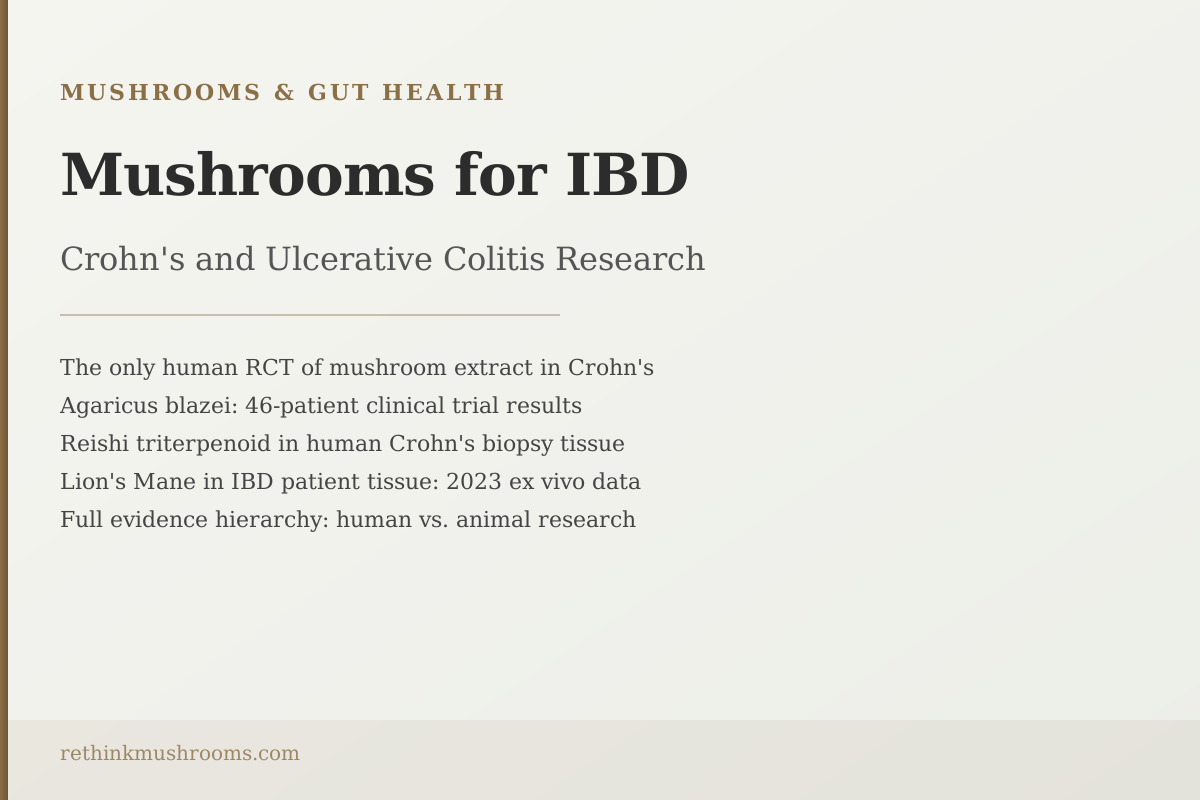
In the only human randomized trial of a mushroom extract specifically in Crohn's disease, Agaricus blazei extract significantly reduced disease activity scores, fatigue, and improved quality of life versus placebo.
Therkelsen et al., PLoS One, 2016
IL-2 −100%
reduction in a key pro-inflammatory cytokine in Crohn's patients given Agaricus blazei extract, in a 21-patient observational study
Human tissue
Reishi triterpenoid downregulated NF-κB signaling in actual Crohn's disease patient biopsy specimens, not just animal models
2023
year of the ex vivo study using IBD patient tissue biopsies to test Lion's Mane plus flavonoid formula on inflammatory markers
Therkelsen et al., PLoS One, 2016
 View as image ↗
Some mushrooms may help reduce inflammation in IBD, but the evidence is mostly from mouse models. That honest summary matters because supplement content on this topic rarely makes it.
Inflammatory bowel disease affects roughly 10 million people worldwide. Crohn's disease and ulcerative colitis are both chronic, immune-mediated conditions that cause significant disability, drug dependence, and elevated cancer risk. Standard treatments (mesalazine, biologics, immunosuppressants) manage symptoms but rarely produce remission in a majority of patients. This is why patients frequently look beyond conventional medicine, and why the question of mushrooms for IBD gets searched thousands of times per month.
The research on this topic ranges from a well-designed randomized human trial to mouse colitis studies of varying quality. Most consumer content treats these as equivalent evidence. They aren't. This article separates the human evidence from the animal studies and tells you what each tier actually shows.
For context on how mushroom polysaccharides interact with the gut microbiome more generally, see mushrooms as prebiotics: how they feed your gut bacteria. For a direct look at microbiome composition changes across mushroom species, see how mushrooms change your gut microbiome: a research review.
Key Takeaways
- The only published human randomized trial of a mushroom extract in Crohn's disease (Therkelsen et al., 2016, n=46) found Agaricus blazei-based extract significantly reduced Crohn's disease activity scores, fatigue, and improved quality of life compared to placebo
- In a 21-patient observational study, Agaricus blazei extract (AndoSan) reduced the pro-inflammatory cytokine IL-2 by 100% and IL-17 by 55% in Crohn's patients, and reduced fecal calprotectin (a direct intestinal inflammation marker) in ulcerative colitis patients
- Reishi (Ganoderma lucidum) triterpenoid reduced NF-κB signaling and inflammatory cytokines in biopsy specimens taken from actual Crohn's disease patients; this is ex vivo evidence in human tissue, not animal models
- A 2023 study using biopsy specimens from IBD patients found a Lion's Mane-containing formulation progressively reduced COX-2 and TNF-α gene expression while increasing anti-inflammatory IL-10 in inflamed intestinal mucosa
- Animal studies show additional species (king oyster and poria cocos, both covered here) reduce colitis severity in DSS-induced mouse models, but none of these preclinical results has been tested in a human IBD trial
- No mushroom has established an effective dose for IBD in humans; mushrooms are not a replacement for standard IBD treatments
IBD vs. IBS: The Distinction That Changes Everything
Before examining the evidence, one clarification that most mushroom content skips: IBD and IBS are different conditions treated differently by different specialists.
IBD (inflammatory bowel disease) is an autoimmune condition causing structural damage to the intestinal wall. Crohn's disease typically affects the small intestine with full-thickness (transmural) inflammation; ulcerative colitis affects the colon's mucosal surface layer. Both are diagnosed via endoscopy and biopsy, managed with anti-inflammatory drugs and immunosuppressants, and carry elevated risk of colorectal cancer over time.
IBS (irritable bowel syndrome) is a functional disorder with no visible structural damage. Bloating, pain, and altered bowel habits occur without detectable inflammation. The causes are incompletely understood, and treatment is symptom-based.
The animal and human studies in this article test colitis models and human Crohn's/UC patients. They are not evidence for IBS. A reader with IBS looking for gut support may still find mushroom prebiotic effects relevant, but the mechanism and disease context are entirely different.
Species · Best Dataset · Evidence Tier
What Each Mushroom Actually Has Behind It
The IBD evidence is not evenly distributed across species. Only one mushroom reaches a human trial; two stop at ex vivo human tissue; the rest are animal-only. This is the per-species view of that hierarchy.
Agaricus blazei
Agaricus blazei Murill (AndoSan)
Evidence type
Randomized trial + clinical observation
The only IBD-specific human RCT: extract reduced Crohn’s Disease Activity Index, fatigue and improved quality of life in 46 Crohn’s patients over 60 days (single-blinded). A separate 21-patient study cut IL-2 by 100%, IL-17 by 55% and reduced fecal calprotectin in UC.
Reishi
Ganoderma lucidum
Evidence type
Ex vivo Crohn’s biopsy tissue
A triterpenoid extract downregulated NF-κB signaling and reduced TNF-α, IL-1β and IL-8 in biopsy specimens taken from active Crohn’s disease patients — the same cytokines that biologic drugs target.
Lion's Mane
Hericium erinaceus
Evidence type
Ex vivo IBD tissue + safety pilot
A combination formula lowered COX-2 and TNF-α and raised anti-inflammatory IL-10 in inflamed IBD patient mucosa (2023). A separate 7-day pilot in 13 healthy adults reported no adverse effects and increased gut-microbiome diversity.
King Oyster & Poria Cocos
Pleurotus eryngii / Wolfiporia cocos
Evidence type
DSS-induced mouse colitis
Both reduced colitis severity in mice by reinforcing the gut barrier and modulating the microbiota; Poria cocos polysaccharide also suppressed NF-κB, and its benefit transferred via fecal microbiota transplant. Neither has been tested in humans.
“Ex vivo human tissue” means the mushroom compound was tested on biopsy samples taken from real IBD patients — several steps closer to clinical relevance than mouse colitis, but still not a trial in living patients.
Source: Therkelsen et al. (2016); Førland et al. (2011); Liu et al. (2015); Gravina et al. (2023); Xie et al. (2021); Hu et al. (2019); Wan et al. (2024)
The Only Human RCT: Agaricus Blazei Extract in 46 Crohn's Patients
In 2016, Therkelsen and colleagues published the only randomized controlled trial of a mushroom extract specifically in Crohn's disease.[1] The study enrolled 46 patients with confirmed Crohn's disease and randomized them to receive AndoSan (an Agaricus blazei Murill-based extract) or placebo for 60 days, on top of their existing standard treatment.
The primary result: patients receiving AndoSan showed significantly reduced Crohn's Disease Activity Index (CDAI) scores compared to placebo. The CDAI is the standard clinical measure for Crohn's disease severity, covering stool frequency, abdominal pain, general wellbeing, and extraintestinal symptoms. Patients also reported significantly less fatigue and improved quality of life in the AndoSan group.
Important limitations: the trial was single-blinded rather than double-blinded, meaning patients knew which treatment they received, introducing potential for placebo response in subjective measures. Sample size was modest (46 patients). The AndoSan extract is a multi-component product containing primarily Agaricus blazei alongside smaller amounts of Hericium erinaceus and Grifola frondosa, so the active species cannot be precisely isolated from this trial alone.
What the trial does establish: in 46 real Crohn's patients, a mushroom extract produced measurable reductions in disease activity that exceeded the placebo response. That is a meaningful finding in a disease where few inexpensive interventions show any signal in controlled trials.
Human Clinical Evidence: Cytokines and Calprotectin in IBD Patients
Five years before the Therkelsen RCT, Førland and colleagues measured what AndoSan does to inflammation markers in IBD patients in a clinical observational study.[2] Twenty-one patients (11 with Crohn's, 10 with ulcerative colitis) took 60 mL/day of AndoSan for 12 days, and blood and stool samples were analyzed before and after.
In Crohn's patients, the cytokine changes were striking. IL-2, which drives T-cell proliferation and inflammatory cascades, dropped by 100%. IL-17, a key driver of intestinal inflammation in Crohn's specifically, fell by 55%. IL-8, which recruits neutrophils to sites of inflammation, fell by 29%. In the ulcerative colitis patients, fecal calprotectin, a protein released by intestinal neutrophils and a direct measure of gut wall inflammation, was reduced.
Fecal calprotectin is clinically significant because it directly reflects mucosal inflammation in the colon, not just systemic immune activation. Reducing it indicates something is actually happening at the site of tissue damage.
This was not a placebo-controlled study, so the changes cannot be definitively attributed to the extract versus spontaneous disease fluctuation. But the magnitude and pattern of cytokine reduction are consistent with the mechanism literature.
Reishi in Human Crohn's Disease Tissue
Liu and colleagues published a 2015 study that is rarely cited outside the academic literature but represents a distinct type of evidence from the clinical studies above.[3] They tested Ganoderma lucidum (reishi) triterpenoid extract on biopsy specimens taken from human Crohn's disease patients.
This is ex vivo research: human tissue removed from actual patients, treated in a controlled laboratory setting. NF-κB, the master inflammatory signaling switch that is constitutively overactive in Crohn's disease mucosa, was downregulated. The pro-inflammatory cytokines TNF-α, IL-1β, and IL-8 were all reduced in the treated tissue. These are the exact cytokines that biologic drugs like infliximab and adalimumab target in Crohn's treatment.
The finding matters because animal colitis models are often poor proxies for human IBD. Ex vivo human tissue from Crohn's patients with active disease is several steps closer to clinical relevance. The Reishi triterpenoid mechanism (NF-κB inhibition) operates in actual human Crohn's disease mucosa, not only in laboratory-induced mouse colitis.
For a complete breakdown of reishi's anti-inflammatory mechanisms and additional evidence, see anti-inflammatory mushrooms for inflammatory bowel disease.
Lion's Mane in IBD Patient Tissue: The 2023 Ex Vivo Study
The most recent human-tissue evidence comes from Gravina and colleagues, published in 2023 in Frontiers in Immunology.[4] The team obtained biopsy specimens from IBD patients with active disease and tested a formulation containing Hericium erinaceus (Lion's Mane) combined with berberine, quercetin, and B vitamins.
The results in inflamed human intestinal mucosa: COX-2 gene and protein expression fell progressively over the treatment period. TNF-α, the central cytokine driving mucosal inflammation in both Crohn's and UC, was reduced. Anti-inflammatory IL-10 increased.
COX-2 is an enzyme that drives prostaglandin production and is the molecular target of NSAID drugs. Reducing its expression in inflamed gut tissue is a clinically coherent anti-inflammatory mechanism.
Two caveats: the formula tested was a combination product, not pure Lion's Mane, so the specific contribution of the mushroom versus the flavonoids and vitamins cannot be isolated from this study. And this is ex vivo data, not an in vivo human trial. What the 2023 Gravina study establishes is that Lion's Mane-containing formulations reduce inflammatory markers in actual IBD patient tissue, not only in mouse models.
For the complete Lion's Mane IBD evidence base, see Lion's Mane for IBD: gastroprotective evidence.
- Cell & Ex Vivo Human Tissuecompleted
Reishi triterpenoid downregulated NF-κB, TNF-α, IL-1β and IL-8 in biopsy specimens from Crohn's patients (Liu 2015); a Lion's Mane combination formula lowered COX-2 and TNF-α and raised IL-10 in IBD patient mucosa (Gravina 2023)
- Animal Studiescompleted
King oyster (Hu 2019) and Poria cocos polysaccharide (Wan 2024) reduced DSS-induced colitis severity in mice via barrier reinforcement and microbiota modulation
- Observational Clinical Seriescompleted
AndoSan (Agaricus blazei) reduced IL-2, IL-17 and IL-8 in Crohn's patients and fecal calprotectin in UC patients in a 21-patient, uncontrolled clinical study (Førland 2011)
- Small Randomized Trialscurrent
One single-blinded RCT: Agaricus blazei extract reduced CDAI, fatigue and improved quality of life in 46 Crohn's patients over 60 days (Therkelsen 2016)
- Large Randomized Trialsmissing
No large, double-blinded, or multi-center trial; no RCT in ulcerative colitis; no dose-finding trial in any IBD population
- Meta-Analyses & Systematic Reviewsmissing
No human meta-analysis of mushroom interventions for IBD outcomes
The mechanism is well-supported in ex vivo human IBD tissue and animal colitis models, and one small single-blinded RCT in Crohn's disease shows a real signal. But the human evidence stops at that single 46-patient trial — there is no double-blinded RCT, no trial in ulcerative colitis, and no established dose. 'Mushrooms help IBD' is promising and biologically coherent, not clinically established.
Aggregate of Therkelsen 2016, Førland 2011, Liu 2015, Gravina 2023, Hu 2019 and Wan 2024
What the Animal Studies Add
Below the human evidence tier, a much larger body of preclinical data covers additional species in mouse colitis models. Two examples worth noting for their recency or dietary angle:
In 2019, Hu and colleagues found that dietary intake (not an isolated extract) of Pleurotus eryngii (king oyster mushroom) ameliorated DSS-induced colitis in mice.[6] The "dietary intake" framing is unusual: mice were fed the whole mushroom rather than a purified extract, which is relevant for food-form supplementation questions. Improved intestinal barrier function and reduced inflammatory infiltrate were the measured outcomes.
In 2024, Wan and colleagues added Poria cocos (Fu Ling) to the preclinical IBD evidence base, showing that its polysaccharides significantly reduced DSS-induced ulcerative colitis severity in mice by reinforcing the gut barrier (increased tight-junction protein abundance), suppressing NF-κB activation, and modulating the microbiota.[7] Notably, faecal microbiota transplantation from treated mice reproduced the benefit, pointing to a microbiota-dependent mechanism rather than a direct drug effect.
The animal study caveat applies universally: DSS-induced mouse colitis does not perfectly replicate human IBD, and most compounds that work in DSS models do not translate to clinical benefit in people. The animal data is informative about mechanism and pharmacology. It is not equivalent to human evidence.
For the full mechanisms picture across all species with animal evidence, see mushrooms and IBD: anti-inflammatory mechanisms in Crohn's and ulcerative colitis. For the beta-glucan-specific mechanisms, see mushroom beta-glucans and gut inflammation: IBD research.
Safety and Drug Interactions: What IBD Patients Should Know
Xie and colleagues published a 2021 pilot study in Nutrients measuring blood and gut-microbiota markers in 13 healthy adults who consumed Hericium erinaceus powder for seven days.[5] No adverse effects were reported. Supplementation increased gut-microbiome diversity and the abundance of short-chain-fatty-acid-producing bacteria (including Faecalibacterium prausnitzii, a species depleted in IBD), with correlated shifts in serum markers such as alkaline phosphatase, LDL, uric acid, and creatinine — changes the authors framed as beneficial physiological adaptation. This is short-term data in healthy people, not IBD patients, and it is a small pilot (n=13), but it provides the most direct human safety signal for Lion's Mane.
The more significant concern for IBD patients is drug interaction. IBD patients often take immunosuppressants (azathioprine, methotrexate) or biologics that dampen immune activity to control disease. Medicinal mushrooms are immunomodulatory, meaning they modify how the immune system behaves. Additive immunosuppression could theoretically reduce treatment efficacy or increase infection risk; competing immune stimulation could theoretically counteract drug effects. Neither scenario has been studied in IBD patients on standard treatment.
The Therkelsen 2016 RCT administered AndoSan on top of existing IBD medication without reported adverse interactions, which is the closest thing to drug-interaction safety data available. But this was a 60-day study, and mechanisms like lentinan (shiitake's beta-glucan) are specifically described as having immune-stimulating properties; the pharmacological interaction with immunosuppressive therapy remains uncharacterized in the published literature.
Safety — mushrooms alongside IBD medication
ModerateImmunomodulatory mushrooms and immunosuppressant drugs are an unstudied combination
Concern
Medicinal mushrooms modify immune activity, and most people with IBD take drugs (azathioprine, methotrexate, or biologics such as infliximab and adalimumab) that deliberately dampen it. In principle, mushroom immunomodulation could either add to that suppression — raising infection risk — or push against it and blunt the drug's effect. This specific interaction has never been directly tested in IBD patients on standard therapy.
What the research says
The one controlled trial (Therkelsen 2016) added the extract on top of existing medication for 60 days without reported adverse interactions, but that is a single small study over a short window. Do not stop or reduce prescribed IBD medication to substitute a mushroom product.
Particularly relevant for: People with IBD taking immunosuppressants or biologics, and those who are immunocompromised
What to do
Clear any mushroom supplement with your gastroenterologist before starting it. This article is educational and is not medical advice.
Framing based on Therkelsen 2016 (on-treatment safety) and the absence of any published mushroom–immunosuppressant interaction study in IBD
The biggest unanswered question is dose. No human study has established an effective dose for any mushroom in IBD specifically. The Therkelsen trial used a fixed commercial preparation at a fixed volume. Whether the active components in that preparation, at that dose, represent the optimal anti-inflammatory strategy is unknown.
The Bottom Line
The human evidence for mushrooms in IBD has four components: the Therkelsen 2016 Crohn's RCT (Agaricus blazei extract reduced CDAI, fatigue, and improved quality of life in 46 patients), the Førland 2011 clinical study (AndoSan reduced IL-2 by 100% and IL-17 by 55% in Crohn's patients), the Liu 2015 ex vivo data (Reishi triterpenoid reduced NF-κB in human Crohn's biopsy specimens), and the Gravina 2023 ex vivo study (Lion's Mane combination formula reduced COX-2 and TNF-α in IBD patient tissue). All remaining species evidence is preclinical. No mushroom has an established dose for IBD, and immunosuppressant interaction data is absent from the literature.
Frequently Asked Questions
Sources & References
- 1RTHM-00451·Therkelsen, Stig Palm et al. (2016). “Effect of the Medicinal Agaricus blazei Murill-Based Mushroom Extract, AndoSanTM, on Symptoms, Fatigue and Quality of Life in Patients with Crohn's Disease in a Randomized Single-Blinded Placebo Controlled Study..” PloS one.Study breakdown →PubMed →↩
- 2RTHM-00213·Førland, D T et al. (2011). “Effect of an extract based on the medicinal mushroom Agaricus blazei Murill on expression of cytokines and calprotectin in patients with ulcerative colitis and Crohn's disease..” Scandinavian journal of immunology.Study breakdown →PubMed →↩
- 3RTHM-00719·Liu, Changda et al. (2015). “Anti-inflammatory Effects of Ganoderma lucidum Triterpenoid in Human Crohn's Disease Associated with Downregulation of NF-κB Signaling..” Inflammatory bowel diseases.Study breakdown →PubMed →↩
- 4RTHM-01701·Gravina, Antonietta Gerarda et al. (2023). “Hericium erinaceus, in combination with natural flavonoid/alkaloid and B3/B8 vitamins, can improve inflammatory burden in Inflammatory bowel diseases tissue: an ex vivo study..” Frontiers in immunology.Study breakdown →PubMed →↩
- 5. Source details for this reference are not yet available.
- 6RTHM-00560·Hu, Qiuhui et al. (2019). “Dietary Intake of Pleurotus eryngii Ameliorated Dextran-Sodium-Sulfate-Induced Colitis in Mice..” Molecular nutrition & food research.Study breakdown →PubMed →↩
- 7RTHM-02011·Wan, Jin et al. (2024). “Poria cocos polysaccharide alleviates dextran sulphate sodium-induced ulcerative colitis in mice by modulating intestinal inflammatory responses and microbial dysbiosis..” International journal of biological macromolecules.Study breakdown →PubMed →↩