Mushrooms & Gut Health
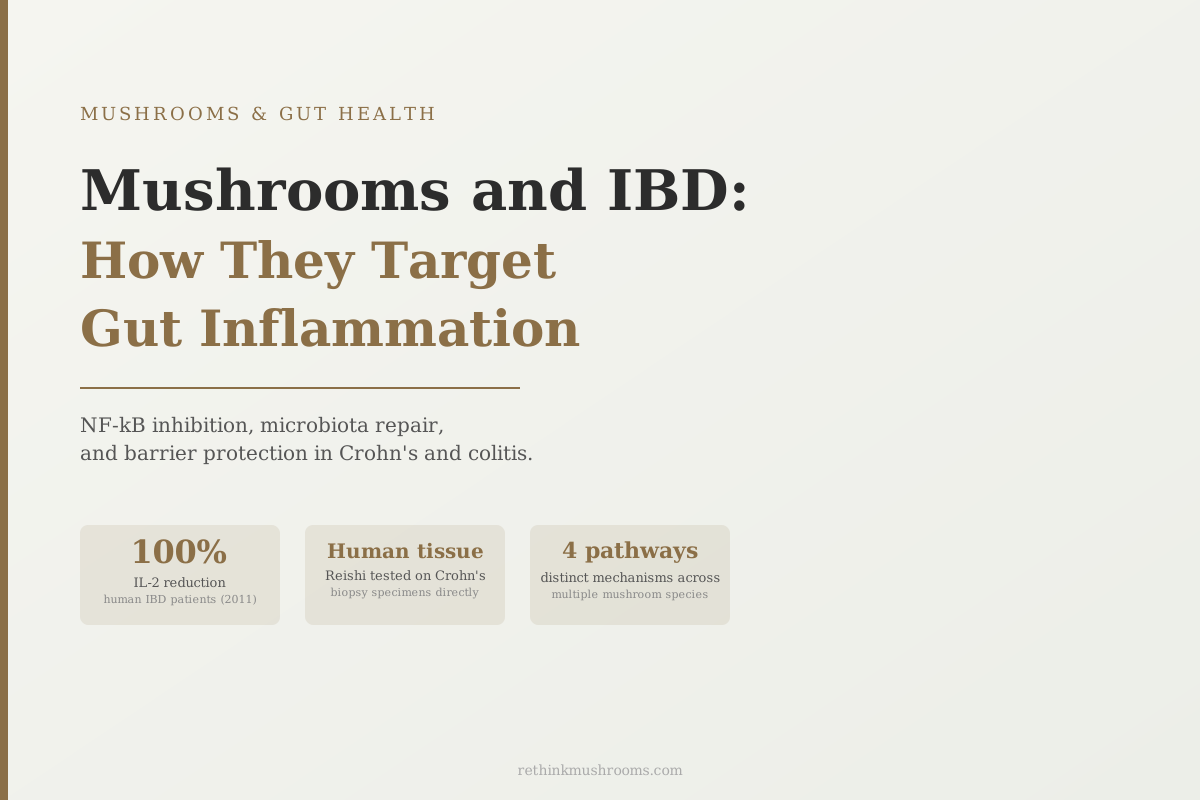
100% IL-2 reduction
In 21 patients with Crohn's or ulcerative colitis given an Agaricus blazei mushroom extract, blood levels of IL-2, a key inflammatory signaling protein, fell by 100% in Crohn's patients over 12 days. IL-17 dropped 55% and IL-8 dropped 29%. This was the first human evidence that a mushroom extract measurably reduces IBD cytokines.
Førland et al., Scand J Immunol, 2011
2015
first human Crohn's tissue evidence (Reishi)
4
distinct anti-inflammatory mechanisms identified
5+
mushroom species studied in IBD animal models
Førland et al., Scand J Immunol, 2011
 View as image ↗
Inflammatory bowel disease involves an immune system that attacks the gut itself. In Crohn's disease, that attack can occur anywhere from mouth to anus; in ulcerative colitis, it's confined to the colon's inner lining. Both conditions involve chronic, relapsing inflammation driven by dysregulated cytokine production, gut microbiota imbalance, and a compromised intestinal barrier. This is a different disease process from irritable bowel syndrome (IBS), which is a functional disorder without immune attack, and the mushroom research for IBD and IBS is entirely separate.
The preclinical research on mushrooms and IBD anti-inflammatory mechanisms is unusually detailed. Multiple species have been studied across multiple animal colitis models, and two human-data studies use actual Crohn's and UC patient tissue rather than mouse models. This article organizes the evidence by mechanism rather than species, which gives a clearer picture of what mushroom compounds actually do in the inflamed gut.
For context on how mushroom polysaccharides function as prebiotics in a healthy gut, see Mushrooms as Prebiotics: How They Feed Your Gut Bacteria.
Key Takeaways
- Ganoderma lucidum (Reishi) triterpenoid extract downregulated NF-kB and reduced TNF-alpha, IL-1beta, and IL-8 in biopsy specimens from actual Crohn's disease patients; this is the most clinically direct anti-IBD evidence for any mushroom species (Liu et al., Inflamm Bowel Dis, 2015)
- Chaga (Inonotus obliquus) polysaccharide in a mouse colitis model rebalanced Th17/Treg immune cell ratios. This is the same immune imbalance seen in human IBD and provides the most mechanistically specific T-cell data for any mushroom species in gut inflammation (Chen et al., Artif Cells Nanomed Biotechnol, 2019)
- Lion's Mane (Hericium erinaceus) reduces colitis in animal models through three simultaneous pathways: NF-kB inhibition, gut microbiota modulation (Bifidobacterium up, Proteobacteria down), and the NF-kB/MAPK/Akt signaling trio (Ren et al., J Nutr Biochem, 2018)
- Wood ear mushroom (Auricularia auricular-judae) polysaccharide protects against colitis through a distinct mechanism, guarding intestinal barrier integrity (reducing plasma D-lactic acid and diamine oxidase, markers of barrier breakdown) and reshaping gut microbiota rather than directly suppressing cytokines (Zhao et al., J Food Sci, 2020)
- Beta-glucan anti-inflammatory effects depend on gut microbiota to ferment the polysaccharide; oat beta-glucan's anti-colitis benefit in mice was mediated by shifts in microbiota metabolism and short-chain fatty acid output, suggesting IBD patients with severe gut dysbiosis may have a reduced response (Bai et al., Food & Function, 2021)
- Mushroom polysaccharides interact with gut immune cells through Dectin-1 and TLR2 receptors, triggering anti-inflammatory IL-10 production; they also feed bacteria that produce short-chain fatty acids (SCFAs), which signal the colon wall through GPR41/43 receptors to reduce inflammation (Zhao et al., Biology, 2023)
Mechanism · Species · Evidence Tier
Four Anti-Inflammatory Pathways, Mapped to Species
The mushroom–IBD research is best read by mechanism, not by species. Each pathway below is served by different mushrooms and different strengths of evidence — only Reishi has been tested in actual human Crohn’s tissue; the rest are animal models.
NF-κB / cytokine inhibition
Dials down the master inflammation switch and the TNF-α, IL-1β and IL-8 it drives.
Gut microbiota modulation
Feeds butyrate-producing bacteria and starves pathobionts; benefit depends on a microbiome to ferment it.
Gut barrier protection
Keeps the intestinal lining intact instead of only quieting inflammatory signals.
T-cell (Th17 / Treg) balance
Shifts the Th17-vs-Treg immune ratio toward regulation — the same target as IBD biologics.
Direct human evidence is limited to two data points: an Agaricus blazei extract that cut blood cytokines in 21 IBD patients [1], and Reishi’s effect in ex vivo Crohn’s biopsy tissue [3]. A separate gut–liver-axis line shows cloud ear and enoki reducing IBD-linked liver injury in mice [12].
NF-kB Inhibition: The Mechanism That Multiple Mushroom Species Share
NF-kB is a transcription factor that acts as a master switch for inflammation inside cells. When NF-kB is activated, it turns on the genes that produce inflammatory proteins, including TNF-alpha, IL-1beta, and IL-8. In IBD, NF-kB is chronically overactivated in the cells lining the gut, keeping the inflammatory response stuck in the "on" position. Most IBD treatments work by reducing the output of this pathway or blocking its downstream products.
Multiple mushroom species inhibit NF-kB. The most clinically relevant evidence for this is from Reishi.
Liu and colleagues (2015) tested Ganoderma lucidum triterpenoid extract directly on biopsy specimens taken from human Crohn's disease patients.[3] The tissue came from actual inflamed intestinal mucosa, not a mouse model. The triterpenoid extract downregulated NF-kB signaling in that human tissue and reduced production of TNF-alpha, IL-1beta, and IL-8. This matters because the gap between "works in mice" and "works in humans" is one of the largest evidence gaps in preclinical research. Reishi's anti-NF-kB activity has been demonstrated in the actual target tissue.
Qin and colleagues (2016) demonstrated Lion's Mane (Hericium erinaceus) ethanol extract inhibited NF-kB in DSS-induced colitis mice at doses of 250 to 500mg per kilogram, reducing TNF-alpha, IL-1beta, and IL-6, while also improving colon length and reducing intestinal bleeding scores.[4] The colitis model used here (DSS, or dextran sulfate sodium, added to drinking water) creates a pattern of intestinal inflammation that closely mimics ulcerative colitis's mucosal damage pattern.
Poria cocos, the traditional Chinese medicinal mushroom also known as Fu Ling, operates through a closely related pathway. Liu and colleagues (2018) found that Poria cocos polysaccharide CMP33 reduced TNF-alpha, IL-6, and IL-1beta in a mouse IBD model by suppressing the Akt/NF-kB axis.[6] Akt is a kinase that activates NF-kB upstream; blocking Akt suppresses NF-kB before it reaches the gene activation stage.
Lentinan, the primary beta-glucan from Shiitake mushroom (Lentinula edodes), suppresses pro-inflammatory cytokine production through TLR4/NF-kB inhibition.[9] Liu and colleagues (2019) demonstrated lentinan's therapeutic activity in mouse models of both IBD and colitis-associated cancer: it reduced colon tissue damage in DSS- and TNBS-induced colitis and, in an azoxymethane/DSS cancer model, decreased tumor number and the expression of colon-cancer markers. That antiproliferative effect is a meaningful consideration given the elevated colon cancer risk in long-term IBD patients. For a deeper look at how beta-glucans from multiple mushroom species drive gut inflammation reduction, see Mushroom Beta-Glucans and Gut Inflammation.
Gut Microbiota Modulation: Repairing the Dysbiosis That Sustains IBD
IBD is closely associated with gut dysbiosis: a reduction in beneficial bacteria (particularly butyrate-producing Ruminococcaceae and Faecalibacterium prausnitzii) and an overgrowth of Proteobacteria and other pathobionts. The dysbiosis is not just a side effect of IBD; it actively perpetuates the inflammatory cycle because gut bacteria train the intestinal immune system.
Zhao and colleagues (2023) published a comprehensive review of how mushroom polysaccharides interact with gut microbiota, describing three distinct routes.[13] First, mushroom beta-glucans are recognized by Dectin-1 receptors on gut immune cells (specifically macrophages and dendritic cells), triggering anti-inflammatory signaling including IL-10 production. Second, undigested polysaccharides serve as a fermentable substrate for Bifidobacterium, Lactobacillus, and Ruminococcaceae, selectively feeding beneficial populations. Third, the fermentation of these polysaccharides produces short-chain fatty acids (SCFAs), primarily butyrate, which bind GPR41 and GPR43 receptors on colon wall cells and signal them to reduce inflammation.
This three-pathway model explains why mushroom polysaccharides can reduce gut inflammation through routes that are entirely independent of their direct NF-kB inhibitory activity.
Lion's Mane has the most characterized microbiota modulation data in the IBD context. Diling and colleagues (2017) found that Hericium erinaceus polysaccharide fractions in DSS colitis mice specifically increased Bifidobacterium populations while decreasing Proteobacteria (the pathobiont group elevated in IBD).[5] Ren and colleagues (2018) extended this finding, showing Lion's Mane polysaccharide increased Ruminococcaceae specifically, the butyrate-producing family that is depleted in IBD, while simultaneously reducing Proteobacteria.[7] For a dedicated review of Lion's Mane's IBD and gastroprotective evidence across all its mechanisms, see Lion's Mane for IBD.
There is an important nuance to the microbiota mechanism. Bai and colleagues (2021) showed that oat beta-glucan's ability to alleviate DSS-induced colitis in mice operated through changes in gut microbiota metabolism, raising short-chain fatty acid output rather than acting on the gut wall directly.[10] This is an oat beta-glucan study, but the finding extends logically to mushroom beta-glucans: the prebiotic and SCFA-producing benefits of mushroom polysaccharides depend on having bacteria present that can ferment them. In severe IBD with profound dysbiosis, the gut may lack enough of the right bacteria to fully activate this pathway.
For a deeper look at how mushrooms specifically reshape gut bacteria composition, see How Mushrooms Change Your Gut Microbiome: Research Review.
Gut Barrier Repair: The Mechanism Focused on Structure, Not Just Signals
Beyond suppressing inflammatory signals and reshaping bacteria, some mushroom species appear to protect the physical integrity of the gut lining itself. This is a distinct mechanism that matters specifically for IBD because intestinal barrier breakdown allows bacterial products to enter the bloodstream and amplify systemic inflammation.
Zhao and colleagues (2020) showed that a polysaccharide from wood ear mushroom (Auricularia auricular-judae) protected against DSS-induced colitis by preserving the gut barrier rather than directly suppressing cytokines.[11] Pre-treatment with the Auricularia polysaccharide reduced plasma D-lactic acid and diamine oxidase, two markers that rise when the intestinal barrier becomes leaky, indicating the barrier stayed more intact; it also shifted gut microbiota composition, and the protective effect was transmissible to healthy mice by fecal transfer. Guarding the physical barrier is a different approach from suppressing TNF-alpha or inhibiting NF-kB; it protects the structure that is being destroyed.
This barrier-repair angle is relevant to IBD because standard anti-inflammatory treatments (mesalazine, biologics) primarily target the inflammatory signals but don't directly promote barrier rebuilding. Compounds that work through barrier repair may be additive rather than redundant with existing IBD treatments. For how mushroom polysaccharides affect tight junction proteins specifically, see Mushrooms and Leaky Gut.
Chaga (Inonotus obliquus) aqueous extract also reduced colon macroscopic damage scores in DSS colitis mice, reducing colon shortening and inflammatory infiltration.[2] Mishra and colleagues (2012) documented the colitis-reducing activity at a tissue level, though the mechanism in that study was not as precisely characterized as the Auricularia barrier findings.
The T-Cell Balance Mechanism: Chaga's Unique Angle
IBD is characterized by a specific immune cell imbalance: an excess of Th17 cells (which drive inflammation) relative to Treg cells (regulatory T cells that suppress inflammation and maintain tolerance). The same imbalance appears in other autoimmune diseases. Correcting the Th17/Treg ratio is one target of advanced IBD biologics.
Chen and colleagues (2019) found that Chaga (Inonotus obliquus) polysaccharide in DSS colitis mice rebalanced the Th17/Treg ratio toward regulation, alongside rebalancing the Th1/Th2 ratio, and reduced loss of the tight-junction proteins occludin and ZO-1 in colon tissue.[8] This is mechanistically the most specific piece of Chaga IBD research, because it targets the same immune cell compartment that IBD biologics do rather than non-specifically suppressing all inflammation. No human data exists for Chaga's effect on T-cell balance in IBD patients.
The Gut-Liver Axis: When IBD Inflammation Extends Beyond the Intestine
IBD is not confined to the gut. Between 25% and 50% of patients develop extraintestinal manifestations, and liver involvement is among the most serious (primary sclerosing cholangitis is a well-known IBD complication). Gut inflammation drives liver injury through bacterial products crossing the damaged intestinal barrier and reaching the liver via the portal vein.
Nguepi Tsopmejio and colleagues (2023) studied both cloud ear mushroom (Auricularia polytricha) and enoki (Flammulina velutipes) in DSS colitis mice and found both reduced liver injury alongside intestinal inflammation, acting through the TLR4/NF-kB pathway to lower inflammation, oxidative stress, and apoptosis in the liver.[12] This gut-liver axis angle distinguishes these two species from the broader IBD research: they are acting on the systemic consequence of IBD rather than just the intestinal inflammation itself. For a focused review of enoki's colitis evidence, see Enoki and Gut Inflammation.
What the Human Evidence Shows
The mechanistic picture from animal models is extensive. The human evidence is narrower but directly relevant.
Førland and colleagues (2011) gave 21 IBD patients (11 with Crohn's, 10 with UC) an Agaricus blazei Murill extract called AndoSan for 12 days and measured changes in blood cytokines and a stool inflammation marker.[1] IL-2 fell by 100% in the Crohn's patients. IL-17 fell by 55%. IL-8 fell by 29%. Fecal calprotectin, a direct marker of intestinal inflammation measured in stool, was reduced in UC patients. These are measurable changes in human patients with real disease, not in mouse models.
Liu and colleagues (2015) add a complementary data point with their ex vivo study: Reishi triterpenoid extract reduced NF-kB and pro-inflammatory cytokines in biopsy specimens from actual Crohn's disease patients.[3] This confirms that the mechanism established in animal models operates in human intestinal tissue.
Both of these studies represent human evidence of a kind that preclinical IBD research rarely reaches. Neither constitutes a clinical trial establishing efficacy. But both confirm that the mechanisms demonstrated in mouse colitis models are biologically active in human IBD tissue.
For the hub article on which mushrooms have evidence for IBD and how evidence tiers compare, see Anti-Inflammatory Mushrooms for Inflammatory Bowel Disease. For a patient-focused assessment of whether any mushroom can practically help Crohn's or UC, including the full clinical evidence tier breakdown, see Mushrooms for IBD. For the Turkey Tail prebiotic angle, see Turkey Tail and Gut Bacteria: The Most-Studied Prebiotic Mushroom.
This article is for education only and is not medical advice. Crohn's disease and ulcerative colitis are serious conditions with proven treatments; the evidence here is almost entirely preclinical, and no mushroom extract is a substitute for medical care. Talk to your gastroenterologist before adding any mushroom supplement, and never stop or delay a prescribed IBD therapy in favor of one.
The Bottom Line
Mushroom compounds reduce IBD inflammation through at least four mechanistically distinct pathways: NF-kB inhibition (Reishi in human Crohn's tissue, Lion's Mane and Poria cocos in animal models), gut microbiota modulation toward beneficial bacteria (Lion's Mane animal data, Zhao 2023 review framework), gut barrier protection (Wood ear/Auricularia animal data), and T-cell immune rebalancing (Chaga Th17/Treg data). The human evidence is limited to two studies using actual IBD patient tissue. Beta-glucan efficacy depends on having adequate microbiota to ferment the polysaccharides, a condition that may not hold for patients with severe IBD-associated dysbiosis.
Frequently Asked Questions
Sources & References
- 1RTHM-00213·Førland, D T et al. (2011). “Effect of an extract based on the medicinal mushroom Agaricus blazei Murill on expression of cytokines and calprotectin in patients with ulcerative colitis and Crohn's disease..” Scandinavian journal of immunology.Study breakdown →PubMed →↩
- 2RTHM-00258·Mishra, Siddhartha Kumar et al. (2012). “Orally administered aqueous extract of Inonotus obliquus ameliorates acute inflammation in dextran sulfate sodium (DSS)-induced colitis in mice..” Journal of ethnopharmacology.Study breakdown →PubMed →↩
- 3RTHM-00719·Liu, Changda et al. (2015). “Anti-inflammatory Effects of Ganoderma lucidum Triterpenoid in Human Crohn's Disease Associated with Downregulation of NF-κB Signaling..” Inflammatory bowel diseases.Study breakdown →PubMed →↩
- 4RTHM-00442·Qin, Mingming et al. (2016). “Anti-Inflammatory Effects of Ethanol Extract of Lion's Mane Medicinal Mushroom, Hericium erinaceus (Agaricomycetes), in Mice with Ulcerative Colitis..” International journal of medicinal mushrooms.Study breakdown →PubMed →↩
- 5RTHM-00470·Diling, Chen et al. (2017). “Extracts from Hericium erinaceus relieve inflammatory bowel disease by regulating immunity and gut microbiota..” Oncotarget.Study breakdown →PubMed →↩
- 6RTHM-00978·Liu, Xiaofei et al. (2018). “The protective effects of Poria cocos-derived polysaccharide CMP33 against IBD in mice and its molecular mechanism..” Food & function.Study breakdown →PubMed →↩
- 7RTHM-00529·Ren, Yilin et al. (2018). “Polysaccharide of Hericium erinaceus attenuates colitis in C57BL/6 mice via regulation of oxidative stress, inflammation-related signaling pathways and modulating the composition of the gut microbiota..” The Journal of nutritional biochemistry.Study breakdown →PubMed →↩
- 8RTHM-00549·Chen, Yi-Fang et al. (2019). “Inonotus obliquus polysaccharide ameliorates dextran sulphate sodium induced colitis involving modulation of Th1/Th2 and Th17/Treg balance..” Artificial cells.Study breakdown →PubMed →↩
- 9RTHM-01100·Liu, Yanrong et al. (2019). “Therapeutic effects of lentinan on inflammatory bowel disease and colitis-associated cancer..” Journal of cellular and molecular medicine.Study breakdown →PubMed →↩
- 10. Source details for this reference are not yet available.
- 11RTHM-00667·Zhao, Di et al. (2020). “Polysaccharide isolated from Auricularia auricular-judae (Bull.) prevents dextran sulfate sodium-induced colitis in mice through modulating the composition of the gut microbiota..” Journal of food science.Study breakdown →PubMed →↩
- 12RTHM-01761·Nguepi Tsopmejio, Ivan Stève et al. (2023). “Auricularia polytricha and Flammulina velutipes reduce liver injury in DSS-induced Inflammatory Bowel Disease by improving inflammation, oxidative stress, and apoptosis through the regulation of TLR4/NF-κB signaling pathways..” The Journal of nutritional biochemistry.Study breakdown →PubMed →↩
- 13RTHM-01835·Zhao, Jiahui et al. (2023). “The Interaction between Mushroom Polysaccharides and Gut Microbiota and Their Effect on Human Health: A Review..” Biology.Study breakdown →PubMed →↩