Enoki Inflammation and Immunomodulation
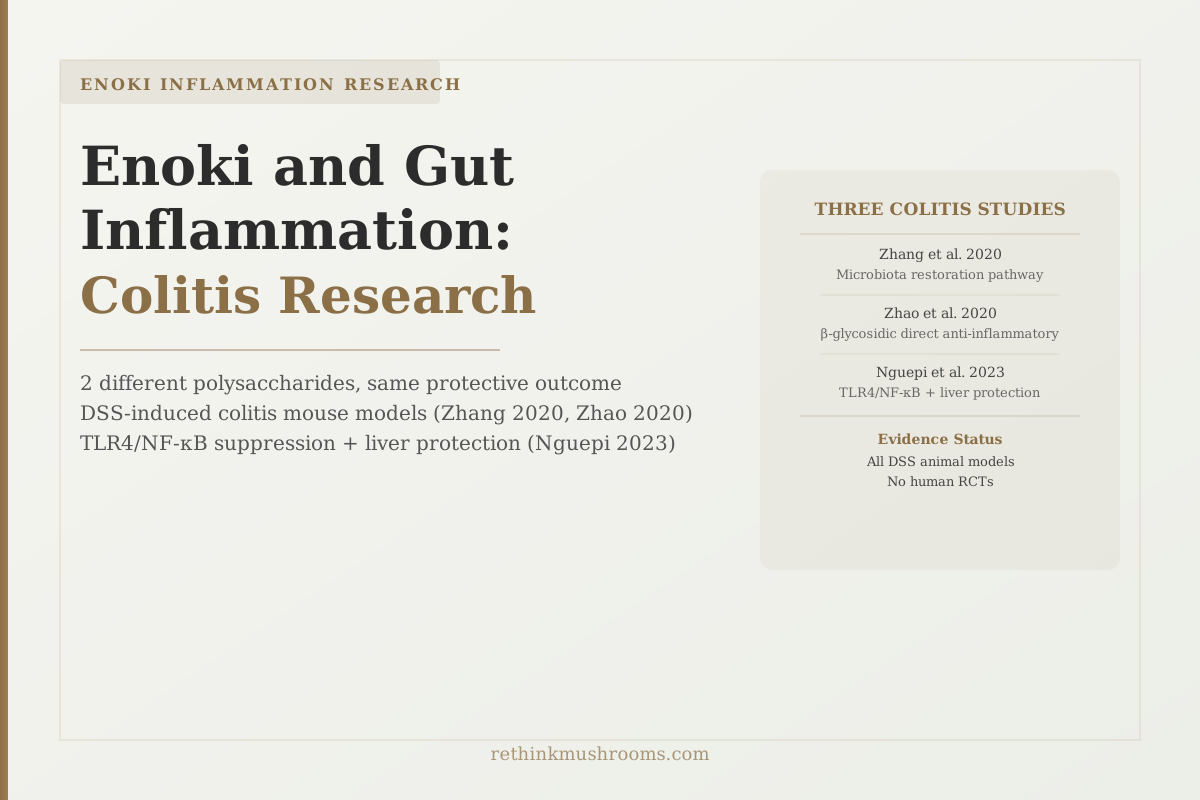
3 independent colitis studies, 2 polysaccharide structures
Two structurally distinct polysaccharides from the same mushroom both reduced DSS-induced colitis in mice via partially different mechanisms. A 2023 study added TLR4/NF-κB suppression and liver injury protection.
Zhang et al., Int J Biol Macromolecules, 2020; Zhao et al., Food & Function, 2020
Microbiota
restoration was the primary mechanism in Zhang 2020; enoki polysaccharide increased Lactobacillus and Bifidobacterium
TLR4/NF-κB
signaling pathway suppressed by enoki in IBD model (Nguepi et al., 2023)
No human trials
all colitis evidence is from DSS-induced mouse models; no clinical data yet
Zhang et al., Int J Biol Macromolecules, 2020; Zhao et al., Food & Function, 2020
 View as image ↗
Enoki mushrooms have more species-specific colitis research behind them than most culinary mushrooms. Two independent studies, both published in 2020, tested different polysaccharide compounds from Flammulina velutipes against DSS-induced colitis in mice, and both found protective effects through partially different mechanisms. A 2023 study added mechanistic depth and extended the finding to liver injury protection. The honest summary: the evidence for enoki in gut inflammation is among the strongest species-specific preclinical data available for any edible mushroom, and it is entirely from animal models. No human clinical trial has tested enoki for colitis or inflammatory bowel disease. This article covers what the three studies actually found, why the convergent evidence from two independent polysaccharide structures matters, and what the evidence genuinely supports versus what it does not. For the broader picture of enoki's research, see What Is Enoki Mushroom? The Tiny Mushroom with Big Research.
Key Takeaways
- Zhang et al. (2020) found that F. velutipes polysaccharide reduced DSS-induced colitis in mice by restoring gut microbiota balance, increasing beneficial bacteria (Lactobacillus and Bifidobacterium), and suppressing the pro-inflammatory cytokines TNF-α and IL-6
- Zhao et al. (2020) found that a structurally different F. velutipes polysaccharide (β-glycosidic linkage type) reduced colitis and modulated gut microbiota in DSS mice via a direct anti-inflammatory mechanism distinct from Zhang's compound
- Two different polysaccharide structures from the same mushroom species both showing colitis protection is convergent evidence that enoki's anti-colitis effects are not an artifact of one compound or one research group
- Nguepi et al. (2023) confirmed TLR4/NF-κB suppression as the mechanistic pathway in a colitis model and added the finding that enoki also protects against secondary liver injury caused by gut-derived inflammation
- All three studies used DSS-induced colitis in mice, a well-validated but imperfect model that does not fully replicate human IBD; no human RCTs exist
- People with IBD should not modify treatment based on animal studies; culinary consumption of enoki is safe for most people and does not require medical discussion
What DSS-Induced Colitis Models Are and Why They Matter
Before the evidence, some context on what these studies actually tested.
DSS stands for dextran sulfate sodium, a chemical compound that damages the cells lining the gut when mice drink water containing it. The damaged gut lining triggers the same type of inflammatory cascade that occurs in human inflammatory bowel disease: immune cells flood the gut, pro-inflammatory signaling proteins flood the bloodstream, the gut microbiome becomes unbalanced, and the intestinal wall develops characteristic lesions. This "DSS model" is the most widely used research model for studying colitis in animals.
The DSS model is well-validated and reproducible, which is why it is used so extensively. Its limitations are also well-understood. DSS colitis is induced by a specific chemical irritant and resolves quickly when DSS is removed. Human ulcerative colitis and Crohn's disease are chronic immune-mediated conditions with more complex origins involving genetic factors, long-term dysbiosis, and immune dysregulation that no mouse model fully replicates. Results from DSS models are biologically relevant but cannot be directly extrapolated to human IBD.
When a study reports that a compound reduces DSS colitis severity, it means the compound reduced chemically induced gut damage in a mouse, a meaningful finding that justifies further investigation, not evidence that the compound treats human IBD.
Zhang 2020: The Prebiotic Route to Anti-Inflammation
Zhang et al. (2020) isolated a polysaccharide fraction from Flammulina velutipes and tested it against DSS-induced colitis in mice.[1] The mice with colitis who received the enoki polysaccharide showed reduced disease severity, lower concentrations of pro-inflammatory cytokines in their blood, and better-preserved gut lining integrity compared to untreated colitic mice.
The most distinctive finding in Zhang's study was the mechanism: the polysaccharide worked primarily by restoring gut microbial balance. Mice with DSS colitis had reduced populations of beneficial bacteria and increased populations of potentially harmful species, a pattern called dysbiosis, meaning the normal community of gut microbes had become unbalanced. The enoki polysaccharide treatment reversed this: Lactobacillus and Bifidobacterium populations increased. Both are genera of bacteria associated with healthy gut function and reduced gut inflammation.
Why does microbiota restoration matter for inflammation? Beneficial gut bacteria produce short-chain fatty acids (SCFAs) like butyrate, acetate, and propionate when they ferment dietary fiber. Butyrate specifically serves as the primary energy source for the cells lining the colon and has well-documented anti-inflammatory properties in gut tissue. Restoring Lactobacillus and Bifidobacterium populations is not just about microbiology. It is about restoring the SCFA production capacity that these bacteria provide, which directly supports the anti-inflammatory environment in the gut.
The cytokine suppression Zhang observed, specifically reduced TNF-α (tumor necrosis factor alpha, a master pro-inflammatory signal) and IL-6 (interleukin-6, another pro-inflammatory signal), was downstream of the microbiota restoration in this model. The polysaccharide's primary action appeared to be prebiotic, feeding beneficial bacteria, rather than directly suppressing inflammatory pathways in immune cells.
For more on how enoki polysaccharides interact with the gut microbiome in non-disease conditions, see Enoki for Gut Health: Prebiotic Fiber and Microbiome Effects.
Zhao 2020: A Different Polysaccharide, A Partially Different Mechanism
Zhao et al. (2020), published in the same year as Zhang's study, took a different polysaccharide fraction from Flammulina velutipes and ran a similar DSS colitis experiment.[2] The key difference: Zhao's compound had a β-type glycosidic linkage structure, distinguishing it structurally from the fraction Zhang used.
Glycosidic linkages are the chemical bonds connecting the sugar units in a polysaccharide chain. The β-type linkage (as opposed to α-type) is the same basic configuration as the beta-glucans more broadly studied in mushroom immunology, the form that activates Dectin-1 receptors on immune cells. The structural distinction matters because different polysaccharide structures engage different receptors and trigger different downstream responses.
Zhao's β-glycosidic polysaccharide also reduced DSS colitis severity and modulated the gut microbiota, producing some of the same practical outcomes as Zhang's compound. But the mechanism had a different emphasis: Zhao's compound showed more direct anti-inflammatory activity in gut tissue, acting at the level of inflammatory signaling rather than primarily through microbiota changes. The microbiota modulation was present but appeared secondary to the direct anti-inflammatory effect.
The significance of two independent studies finding protective effects from two structurally different polysaccharides from the same species is substantial. If only Zhang's study existed, a skeptic could argue it might be an artifact of that specific compound, that extraction method, or that research group. If only Zhao's study existed, the same argument would apply. The two studies together, using different compounds with different structures and finding convergent protective outcomes through partially different mechanisms, constitute stronger evidence than either alone.
Nguepi 2023: TLR4, NF-κB, and the Liver Protection Finding
Nguepi et al. (2023) added both mechanistic depth and a clinically relevant secondary finding to the enoki colitis evidence base.[3]
The study combined Flammulina velutipes with Auricularia polytricha (wood ear mushroom) in a DSS-induced IBD model and examined both gut inflammation markers and liver injury. The mechanistic finding: the combination reduced DSS colitis severity by suppressing TLR4/NF-κB signaling in the gut. TLR4 (Toll-like receptor 4) is a protein on the surface of immune cells that detects bacterial components that have crossed the damaged gut lining. When TLR4 detects these signals, it activates NF-κB, a master switch inside cells that turns on dozens of pro-inflammatory genes. In DSS colitis, this TLR4/NF-κB activation produces the cytokine storm that causes tissue damage.
Suppressing this pathway is the mechanism of action for several approved IBD medications, making it a validated target. The enoki-containing combination suppressed TLR4/NF-κB in the gut tissue and reduced the inflammatory cytokines TNF-α, IL-6, and IL-1β, a third pro-inflammatory signal.
The secondary finding is less commonly discussed but clinically interesting: the treated mice also showed significantly less liver injury than untreated colitic mice. This matters because IBD is not purely a gut disease. Chronic gut inflammation drives systemic inflammation, and the liver is one of the organs most affected by gut-derived inflammatory signals. Primary sclerosing cholangitis and autoimmune hepatitis are well-recognized complications of IBD. A treatment that reduces both gut inflammation and secondary liver injury addresses a real clinical problem in IBD management. No competitor article covering enoki and colitis mentions this secondary liver finding.
What These Three Studies Establish Together
Taken collectively, the three studies support several conclusions.
First, enoki polysaccharides consistently reduce colitis severity in DSS mouse models. This has now been shown by three independent research groups using different compound isolates and partially different experimental designs. The convergence argues against it being an artifact.
Second, the mechanisms are multiple and complementary. Gut microbiota restoration (Zhang), direct anti-inflammatory activity at the β-glucan receptor level (Zhao), and TLR4/NF-κB pathway suppression (Nguepi) are three distinct mechanisms that each have parallels in human IBD biology. This mechanistic diversity suggests enoki polysaccharides are not one-trick compounds.
Third, the evidence is now species-specific. Most "mushrooms reduce inflammation" literature is either reviewed at the genus level, mixed across multiple species, or from species with well-funded research programs (turkey tail, reishi). Enoki now has three colitis-specific studies using F. velutipes material, which is more species-specific colitis evidence than most culinary mushrooms have accumulated.
For how this evidence fits in the broader context of mushroom gut inflammation research, see Mushroom Beta-Glucans and Gut Inflammation: IBD Research. For the mechanistic detail on how the TLR4/NF-κB pathway works in enoki and in mushrooms generally, see How Mushrooms Fight Inflammation: NF-kB, COX-2, and Beyond.
The Clinical Gap: What the Evidence Supports and What It Does Not
The DSS mouse model is biologically relevant, but human IBD is not a DSS model.
Human IBD (both ulcerative colitis and Crohn's disease) is a chronic, relapsing immune-mediated condition involving years of dysregulation, genetic susceptibility, and often significant tissue damage. The DSS model produces acute colitis over days, resolves quickly when DSS is removed, and does not develop the chronic relapsing character of human disease. Treatments that work in DSS models have a mixed track record in human IBD trials.
No randomized controlled trial has tested enoki or enoki polysaccharide supplementation in people with IBD. No clinical data exists on effective dose, duration, or the form of enoki that would be most appropriate. The animal studies used isolated polysaccharide fractions at doses that would require knowing the specific polysaccharide concentration in any given enoki product, information that is not available on commercial supplement labels.
What the evidence supports is further research and biological plausibility. The mechanisms identified in the three studies, microbiota restoration, beta-glucan receptor activation, and NF-κB suppression, are all relevant in human IBD biology, which is why this evidence base warrants more investigation. For people with IBD who eat enoki mushrooms as part of a varied diet, the preclinical data suggests no concern and a plausible prebiotic benefit via microbiota support. For people considering enoki as a treatment for IBD, the preclinical evidence is not a clinical indication. For more on the full range of enoki's anti-inflammatory evidence, see Enoki for Inflammatory Conditions: Research Review and Enoki and Inflammation: Anti-Inflammatory Mechanisms.
The Bottom Line
Three independent studies provide converging evidence that Flammulina velutipes polysaccharides reduce DSS-induced colitis in mice: Zhang et al. (2020) via gut microbiota restoration (increased Lactobacillus/Bifidobacterium), Zhao et al. (2020) via direct β-glycosidic anti-inflammatory activity, and Nguepi et al. (2023) via TLR4/NF-κB suppression with secondary liver protection. Two structurally different polysaccharides showing overlapping protective outcomes argues against artifact. All evidence is from animal models; no human RCTs exist for enoki in IBD.
Frequently Asked Questions
Sources & References
- 1RTHM-01312·Zhang, Rongjun et al. (2020). “Polysaccharide from flammuliana velutipes improves colitis via regulation of colonic microbial dysbiosis and inflammatory responses..” International journal of biological macromolecules.Study breakdown →PubMed →↩
- 2RTHM-01316·Zhao, Ruiqiu et al. (2020). “Effects of a β-type glycosidic polysaccharide from Flammulina velutipes on anti-inflammation and gut microbiota modulation in colitis mice..” Food & function.Study breakdown →PubMed →↩
- 3RTHM-01761·Nguepi Tsopmejio, Ivan Stève et al. (2023). “Auricularia polytricha and Flammulina velutipes reduce liver injury in DSS-induced Inflammatory Bowel Disease by improving inflammation, oxidative stress, and apoptosis through the regulation of TLR4/NF-κB signaling pathways..” The Journal of nutritional biochemistry.Study breakdown →PubMed →↩