Enoki (Flammulina velutipes)
99.7% vs 21.6%
In one experiment, enoki extract scored 99.7% in the DPPH free-radical assay while enoki powder from the same study scored 21.6%. A 4.6-fold gap between two preparations of the same mushroom, measured in a test tube at 1 mg/mL.
Yeh et al., BioMed Research International, 2014 (Table 4)
1972–1986
farmer survey that started the research
4 compound classes
FIP-fve, proflamin, polysaccharides, sterols
1 human RCT
in 40 years — published 2025, not on cancer
Yeh et al., BioMed Research International, 2014 (Table 4)
 View as image ↗
In 2001, the Japanese researcher Tetsuro Ikekawa published an epidemiological survey that has shaped mushroom research ever since. Tracking cancer deaths among farmers who grew Flammulina velutipes across 15 years, from 1972 to 1986, he reported that their cancer-related death rates were roughly 39% lower than those of comparable populations not involved in mushroom farming.[1][15]
Two things about that survey matter as much as the number. Nobody measured how much enoki anyone actually ate: the review literature that relays the finding states plainly that it assumes the farmers "would have eaten some of the mushrooms they farmed."[1] And the primary report was published in a journal that is not indexed in PubMed, so its underlying rate tables cannot be independently inspected. That single observation still triggered a chain of laboratory research that is producing data in 2025.
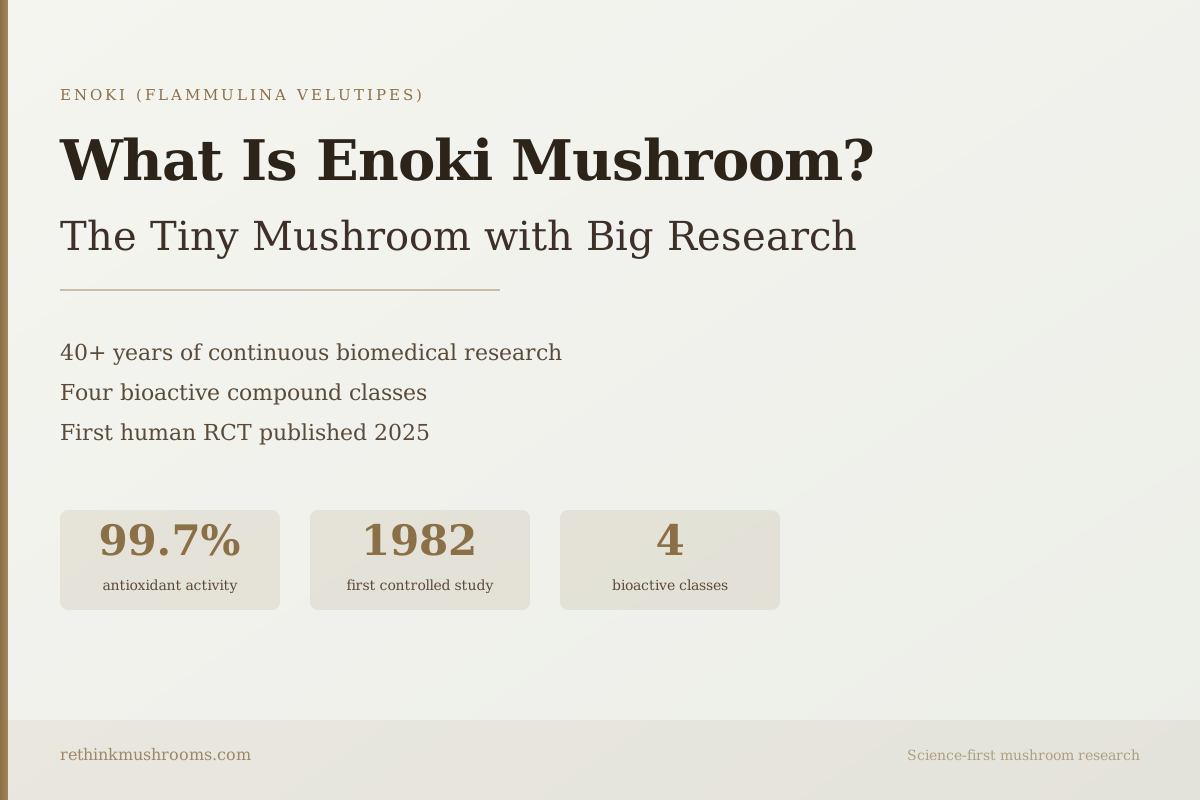
What is enoki mushroom? Enoki mushroom (Flammulina velutipes) is an edible fungus native to East Asia, cultivated for centuries in Japan, China, and Korea. The cultivated form sold worldwide (thin white stems topped with small round caps, bundled together) looks dramatically different from its wild relative. Both forms have been studied since the early 1980s. Researchers have identified four distinct bioactive compound classes in this mushroom: an immune-activating protein (FIP-fve), an antitumour glycoprotein (proflamin), polysaccharide fractions that activate immune cells, and sterols with laboratory-demonstrated cytotoxicity against some cancer cell lines.
A 2016 comprehensive review catalogued these compound classes across decades of preclinical research, covering anticancer, immunomodulatory, antioxidant, antihypertensive, and cholesterol-lowering activities.[1] In 2025, the first human randomised controlled trial on enoki extract was published. What follows is the complete picture of what researchers have found, and what the limitations of that research actually are.
Key Takeaways
- The founding observation is a 39% lower cancer death rate among enoki farmers over 1972–1986 — but nobody measured how much enoki they ate, and the primary report is not PubMed-indexed
- Ikekawa's proflamin, isolated from enoki mycelium in 1985, increased median survival time by 86% and 84% in mice bearing B-16 melanoma and adenocarcinoma 755 at 10 mg/kg orally — with no cytocidal effect in vitro, meaning the effect was host-mediated
- Yeh et al. (2014) recorded 99.7% DPPH scavenging for enoki extract at 1 mg/mL — but only 21.6% for enoki powder in the same table, a distinction usually dropped when this number is quoted
- Wang et al. (2025) mapped the most complete immune mechanism yet: enoki polysaccharide FVP-1 activates macrophages via RSAD2, triggering both NF-κB and MAPK signalling
- Zhao et al. (2024) found enoki polysaccharide FVP-S1 induced mitochondrial apoptosis in lung adenocarcinoma A549 cells, activating Caspase-3 and Caspase-9
- Yamada et al. (2025) published the first human RCT on enoki: a 12-week trial in men selected by symptom score, not by testosterone level, with two authors employed by the laboratory that supplied the analysis
Provenance Check
The enoki farmer statistic you have probably read
The claim
“Enoki farmers in Nagano prefecture died of cancer at 97.1 per 100,000 versus a national average of 160.1 per 100,000, documented in a 1989 survey by the Nagano Prefectural Research Institute of Rural Industry.”
Supplement marketing copy and health blogs, which repeat the figures with decimal-point precision and cite each other rather than a study.
What research shows
UnsupportedNo peer-reviewed source checked for this article contains those rates, that institution, or that date. The two citable sources that describe the survey — Tang et al. (2016) and Monro (2003) — report a 15-year span of 1972–1986 and a gap of about 39%, with no rates per 100,000 and no mention of Nagano.
The underlying observation is real and is reported in the peer-reviewed literature. What is invented is the false precision layered on top of it. The primary report (Ikekawa, International Journal of Medicinal Mushrooms, 2001) is not indexed in PubMed, so nobody quoting those decimals has inspected the tables they supposedly come from.
Tang et al., Frontiers in Pharmacology (2016) [ref 1]; Monro, Archives of Environmental Health (2003) [ref 15]
What Enoki Mushroom Is (And Why It Looks Nothing Like Its Wild Form)
Wild Flammulina velutipes grows at the base of elm, willow, and other broadleaf trees during autumn and winter across East Asia and temperate Europe. It has a tawny brown cap up to 8 centimetres wide, a short velvety stem, and thrives in cold conditions. This form is sometimes called velvet foot or velvet shank in English, referring to the dark, downy texture of its lower stem.
The version sold in grocery stores is the same species produced under completely different conditions. Cultivated enoki is grown in cylindrical containers in near-total darkness with elevated carbon dioxide concentrations. This environment suppresses cap development and drives stem elongation, producing the thin, pale, elongated bundles that look nothing like the wild form.
The difference is environmental, not genetic. Bring cultivated enoki into light and reduce the CO₂, and it will develop a brown cap. This matters for understanding the research: most biomedical studies have been conducted on the cultivated white form, which is also what people consume.
Phillips et al. (2011) measured vitamin D and sterol composition across 10 types of mushrooms purchased from US retail suppliers and found enoki contained measurable ergosterol, the precursor to vitamin D2.[2] Indoor cultivation eliminates UV exposure, which is what drives ergosterol conversion to vitamin D2. This is the most practically significant difference between a mushroom grown in daylight and one grown in a dark room.
On beta-glucans, the structural polysaccharides at the centre of most immune research on this mushroom, the honest answer is that nobody has published the comparison. Kanno et al. (2020) quantified beta-glucan content in fruiting bodies of six edible species including F. velutipes using a novel artificial recognition protein, and enoki's glucans were readily detectable.[3] But that study compared species to each other, not wild enoki to cultivated enoki. Whether the two forms carry comparable beta-glucan content is an open question, not an established finding.
The practical implication: the mushroom in your grocery store is the same species whose compounds have been studied since the early 1980s, and cultivation changes its appearance entirely. What cultivation does to its bioactive content is only partly mapped.
For a detailed comparison of structural differences, bioactive retention, and what wild versus cultivated forms mean for research applicability, see Enoki vs. Wild Velvet Foot: How Cultivation Changes the Mushroom.
How a Kitchen Mushroom Earned 40 Years of Continuous Research
The farmer survey sparked a scientific question, not a conclusion. What was it about enoki that might explain a cancer mortality difference? Researchers began working backward from the population observation toward the chemistry.
The research arc:
- 1982: Ikekawa and colleagues isolated antitumour polysaccharides from F. velutipes and determined the structure of one of them, EA3, as a beta-(1→3)-glucan. Among the fractions isolated, the highest-molecular-weight polysaccharide showed the highest rate of antitumour activity.[16]
- 1985: Ikekawa et al. isolated proflamin, a weakly acidic glycoprotein from enoki culture mycelium, and showed that 10 mg/kg given orally increased median survival time by 86% in mice bearing B-16 melanoma and 84% in mice bearing adenocarcinoma 755.[4]
- 1995: Ko et al. isolated FIP-fve and elucidated its complete amino acid sequence: 114 residues, 12,704 Da, with an acetylated amino end and no methionine, half-cystine, or histidine. It stimulated human peripheral blood lymphocytes and enhanced transcription of interleukin-2 and interferon-gamma.[17]
- 2004: Wang et al. traced FIP-fve's induction of interferon-gamma to the p38 MAPK pathway, showing that the p38 inhibitor SB203580 fully abolished IFN-γ production.[18]
- 2013: Chang et al. showed FIP-fve suppressed proliferation and migration of A549 lung cancer cells in culture, via p53/p21 activation and RacGAP1 suppression.[5]
- 2022: Gu et al. used proteomics to refine the mechanism further, identifying MAP2K3/p38α as the signalling axis behind FIP-fve-driven IL-2 release in Jurkat E6-1 cells.[19]
- 2024: Zhao et al. published the most mechanistically detailed polysaccharide cancer study to date, showing a specific enoki polysaccharide fraction induces mitochondrial apoptosis in lung adenocarcinoma cells.[6]
- 2025: Two research groups published in the same year. Mitra et al. reported neuroprotective effects in hippocampal neurons.[7] Yamada et al. published the first human randomised controlled trial.[8]
This is not the research arc of a trendy superfood. It is 40 years of scientists following a specific biological question deeper into mechanism, compound by compound. It is also 40 years that produced exactly one randomised trial in humans, and that trial was not about cancer.
Four Compound Classes and Why Each Gets Its Own Research Program
Most writing about enoki describes it as "containing antioxidants" or "supporting immunity" without specifying what the actual compounds are or how they work. Flammulina velutipes contains four structurally distinct categories of bioactive compounds, each studied through independent research programs with different mechanisms.
FIP-fve (Fungal Immunomodulatory Protein): The most extensively characterised compound in enoki. It is a 114-amino-acid protein that activates T-cells through a signalling chain mapped over nearly 30 years, from its isolation and sequencing in 1995,[17] through p38 MAPK in 2004,[18] to MAP2K3/p38α in 2022.[19] It also showed activity against lung cancer cell migration and proliferation in Chang et al.'s 2013 study.[5]
Proflamin: A weakly acidic glycoprotein (more than 90% protein, molecular weight ~13,000 Da) isolated from enoki culture mycelium. Ikekawa's 1985 study described it explicitly as a biological response modifier and reported that it produced no cytocidal effect against cultured cell lines in vitro, despite substantially extending survival in tumour-bearing mice.[4] That combination is the signature of a compound working through the host's own biology rather than by directly killing tumour cells.
Polysaccharides: Several distinct polysaccharide fractions have been isolated from F. velutipes, differing in structure and activity profile. FVPA1, structurally characterised by Jia et al. (2017) at approximately 1.8 × 10⁴ Da, significantly enhanced natural killer (NK) cell activity against K562 leukaemia cells in vitro.[9] A separate fraction, FVP-1, was shown by Wang et al. (2025) to act on macrophages through the RSAD2 effector, mediating NF-κB/MAPK signalling.[10] Yet another, FVP-S1, was the subject of the 2024 Zhao apoptosis study. These are not the same compound under different names. They are distinct structures with distinct mechanisms.
Sterols and sesquiterpenes: F. velutipes produces sterols, mainly ergosterol derivatives, that show cytotoxicity against some cancer cell lines. Yi et al. (2013) reported that at 72 hours the sterol fraction outperformed the standard anti-tumour drug 5-fluorouracil against U251 glioma cells to some extent — while HeLa cervical cancer cells were not significantly susceptible.[20] The same study found the sterols so poorly soluble that a mixed micellar nanoformulation was required to raise oral bioavailability in rats, which is itself a statement about how little of this compound class survives ordinary digestion.
Understanding the four classes matters because researchers studying FIP-fve are asking different questions from researchers studying polysaccharides. Progress in one track does not automatically translate to the others.
Four Tracks · One Shared Ceiling
How Far Each Enoki Compound Class Has Been Tested
“Four bioactive compound classes” sounds like one large body of evidence. It is four separate research programmes that started decades apart, ask different questions, and all stop at the same place.
FIP-fve (immunomodulatory protein)
since 1995
Cells: testedCells
Animals: partly testedAnimals
Humans: not testedHumans
Furthest result: Sequenced in full, signalling traced from p38 MAPK (2004) to MAP2K3/p38α (2022). Suppressed A549 lung cancer proliferation and migration via p53/p21 and RacGAP1 — cell cycle arrest, not apoptosis.
Where it stops: The 2022 mechanism work used Jurkat E6-1 cells, a leukaemia T-cell line. Animal work is limited to anaphylaxis and footpad models from the 1995 isolation paper.
Proflamin (antitumour glycoprotein)
since 1985
Cells: not testedCells
Animals: testedAnimals
Humans: not testedHumans
Furthest result: 10 mg/kg orally increased median survival time by 86% in B-16 melanoma mice and 84% in adenocarcinoma 755 mice, with no lethal or apparent adverse effects.
Where it stops: Inverted from the usual pattern: proflamin had NO cytocidal effect on cultured cell lines. It works through the host, not on the tumour directly — and it has not been revisited in four decades.
Polysaccharides (FVPA1, FVP-1, FVP-S1, EA3)
since 1982
Cells: testedCells
Animals: partly testedAnimals
Humans: not testedHumans
Furthest result: The busiest track. FVPA1 raised NK activity against K562 (2017); FVP-1 activated macrophages via RSAD2 and NF-κB/MAPK (2025); FVP-S1 induced mitochondrial apoptosis in A549 via Caspase-3/9 (2024); oral FVE protein slowed BNL hepatoma in mice (2010).
Where it stops: Distinct fractions with distinct mechanisms — findings do not transfer between them. Most in vivo work is rodent gut and lipid models, not tumour endpoints.
Sterols and sesquiterpenes
since 2013
Cells: partly testedCells
Animals: partly testedAnimals
Humans: not testedHumans
Furthest result: Outperformed 5-fluorouracil against U251 glioma cells at 72 h to some extent. Pharmacokinetics and tissue distribution measured in rats.
Where it stops: HeLa cervical cancer cells were NOT significantly susceptible. The sterols are so poorly soluble that a micellar nanoformulation was required to get meaningful oral bioavailability — which is a statement about how little survives normal digestion.
The shared ceiling. The Humans column is empty in every row. The only randomised controlled trial of enoki in people (Yamada et al., 2025) tested a whole-extract powder standardised to adenosine — a nucleoside that belongs to none of these four classes — against symptoms of male ageing. Not one of the four mechanisms above has been tested in a human being.
Sources: Ikekawa et al., 1982 [ref 16] and 1985 [ref 4]; Ko et al., 1995 [ref 17]; Wang et al., 2004 [ref 18]; Chang et al., 2010 [ref 11] and 2013 [ref 5]; Yi et al., 2013 [ref 20]; Jia et al., 2017 [ref 9]; Gu et al., 2022 [ref 19]; Zhao et al., 2024 [ref 6]; Wang et al., 2025 [ref 10]; Yamada et al., 2025 [ref 8]
For mechanistic detail on each compound class, see Enoki Bioactive Compounds: Flammulin, Proflamin, and Polysaccharides.
The Cancer Research: From a Farm Survey to 2024 Apoptosis Data
The farmer mortality observation drove a 40-year mechanistic research program across three parallel compound tracks.
Ikekawa's proflamin work in 1985 was the first major step: 10 mg/kg administered orally increased median survival time by 86% in B-16 melanoma mice and 84% in adenocarcinoma 755 mice, with no lethal or apparent adverse effects observed.[4] His hypothesis was that regular consumption might explain part of the farmers' lower cancer mortality, though this was never directly tested.
The polysaccharide track advanced independently. Jia et al. (2017) structurally characterised FVPA1 and showed it enhanced NK cell activity against K562 leukaemia cells.[9] NK cells operate before the adaptive immune system engages tumours, making NK activation data relevant to cancer immunology even at the preclinical stage.
Zhao et al. (2024) · Scientific Reports
- Population
- A549 human lung adenocarcinoma cells in culture
- Intervention
- FVP-S1 (purified acidic polysaccharide) and FVP-C (crude neutral polysaccharide) from F. velutipes water extract
- Comparator
- Untreated A549 cells
- Finding
- Both fractions inhibited proliferation and migration and altered cell morphology, with FVP-S1 the more potent. Both decreased mitochondrial membrane potential, increased Caspase-3 and Caspase-9 expression, and raised the Bax/Bcl-2 ratio — the signature of apoptosis through the mitochondrial pathway.
preliminary Cell culture only. No animal model, no human data. Apoptosis in a dish is a mechanism finding, not evidence of an anticancer effect in people.
Zhao et al., Scientific Reports (2024) [ref 6]
On the FIP-fve track, Chang et al. (2013) showed that FIP-fve suppressed A549 lung cancer cell proliferation and migration. The mechanism was specific: increased p53 and downstream p21 expression, inhibition of EGF-induced Rac1 activation, and reduced RACGAP1 at both mRNA and protein level. Notably, flow cytometry showed cell cycle arrest but not apoptosis — a different mode of action from the polysaccharide fractions.[5]
Chang et al. (2010) provided an important bridge result: they gave the enoki immunomodulatory protein FVE to mice orally at 10 mg/kg and measured antitumour effects against BNL hepatoma. Oral administration increased lifespan, inhibited tumour size, raised the tumoricidal capacity of peritoneal macrophages and tumour-specific splenocytes, and inhibited tumour angiogenesis — with interferon-gamma playing a key role.[11] This established that at least one enoki protein survives digestion and retains biological activity when swallowed rather than injected.
The honest calibration: all F. velutipes cancer research is preclinical. Laboratory studies on cancer cell lines and animal models. The farmer survey is a population observation that shows correlation, in an occupational group that differs from comparison populations in diet, activity, income, and healthcare access, and in which nobody measured mushroom consumption. No human cancer treatment or prevention trial has been conducted on enoki extract or any of its isolated compounds.
- Cell studiescompleted
Extensive across all four compound classes: FIP-fve in A549 (Chang 2013), FVP-S1 in A549 (Zhao 2024), FVPA1 and NK activity against K562 (Jia 2017), sterols in U251 but not HeLa (Yi 2013).
- Animal studiescompleted
Proflamin extended median survival 86% and 84% in two murine tumour models (Ikekawa 1985); oral FVE increased lifespan and inhibited tumour growth in BNL hepatoma mice (Chang 2010).
- Human case reportsmissing
None. No published case reports of enoki or its compounds used in human cancer care.
- Small human trialsmissing
None with a cancer endpoint. The only enoki RCT (Yamada 2025) measured male menopausal symptoms.
- Large randomised trialsmissing
None.
- Meta-analysismissing
None. The occupational survey from 1972–1986 is an observational study, not a trial, and has never been replicated.
Enoki cancer research has a deep preclinical base and an empty clinical one. The highest rung ever reached is the mouse. Every rung that would be needed to make a claim about people is vacant, and the 1972–1986 occupational observation that started it all cannot substitute for any of them.
Ikekawa et al., 1985 [ref 4]; Chang et al., 2013 [ref 5]; Zhao et al., 2024 [ref 6]; Jia et al., 2017 [ref 9]; Chang et al., 2010 [ref 11]; Yi et al., 2013 [ref 20]
The full evidence trail is covered in Enoki and Cancer: The Japanese Epidemiological Discovery and Flammulina velutipes: From Japanese Kitchen Staple to Cancer Research.
For context on whether consuming mushrooms generally correlates with reduced cancer risk in population data, see Daily Mushroom Consumption and Cancer Risk Reduction.
Immune System Effects: T-Cells, NK Cells, and a Molecular Chain That Took 30 Years to Map
The immune research on Flammulina velutipes is notable not just for breadth but for mechanistic specificity. This is not "stimulates immunity." It is a documented molecular chain, refined over three decades, naming specific proteins and pathways.
Wang et al. (2025) produced the most detailed map of enoki polysaccharide immune activity yet published. In RAW264.7 macrophage cells and mouse spleen cells, FVP-1 increased secretion and mRNA expression of TNF-α, IL-6, and IL-1β, upregulated COX-2 and iNOS, and enhanced reactive oxygen species release and phagocytic activity — the capacity of macrophages to engulf and destroy targets. These effects depended on concentration, and the RSAD2 effector mediated FVP-1's activation of the NF-κB/MAPK pathway.[10]
Jia et al. (2017) showed a different polysaccharide fraction, FVPA1, specifically enhanced NK cell activity against leukaemia cells.[9] Separately, Chang et al. (2010) established oral bioactivity: FVE administered by mouth activated both the innate arm (macrophages) and the adaptive arm (tumour-specific splenocytes) in mice.[11]
On the FIP-fve track, the protein activates T-lymphocytes through the MAP2K3/p38α axis. Gu et al. (2022) found that FIP-fve stimulated cell proliferation and IL-2 release dose-dependently in Jurkat E6-1 cells, upregulated four T-cell activation markers (ZAP-70, CD69, CD82, KIF23), and that inhibitors of both p38 and MAP2K3 blocked the effect.[19] This is a different arm of immunity from the polysaccharide effects, meaning enoki contains compounds that engage multiple parts of the immune response through distinct mechanisms.
What makes this research notable is the precision — and what limits it is the setting. Thirty years of follow-on studies have identified the upstream kinase, its downstream target, and the specific cytokines produced. All of it in cells and mice. No human immune trial on enoki or FIP-fve has been conducted.
For the full mechanistic breakdown, see Enoki and the Immune System: Immunomodulatory Research and Enoki and Flammulin: A Unique Immunomodulatory Protein.
The polysaccharide immune effects described here parallel findings from other mushroom species. How 1,3/1,6 Beta-Glucans Activate Your Immune System covers the shared structural mechanisms.
Antioxidant Activity: What the 99.7% Figure Actually Measured
The DPPH assay is a standardised test measuring how well a substance neutralises a synthetic free radical in a test tube. Results are reported as a percentage scavenged. Values approaching 100% mean the sample eliminated essentially all the radical present under those conditions.
Yeh et al. (2014) ran this assay on two preparations of enoki at 1 mg/mL and reported both in the same table. The extract (FVE) scored 99.7 ± 3.62%. The powder (FVP) scored 21.6 ± 0.19%.[12] The same table shows the extract's total phenol content at 4,598 ppm against the powder's 164.5 ppm — a 28-fold difference that explains the gap.
One Table · Two Preparations
What Yeh et al. Actually Measured at 1 mg/mL
Enoki powder (FVP) and enoki extract (FVE) were tested side by side in the same table of the same paper. The famous 99.7% belongs to one column only.
DPPH radical scavenging
Powder21.6%Extract99.7%The figure quoted everywhere is the 99.7 on the right.
FRAP reducing power
Powder17.1%Extract68.1%Ferrous chelating ability
Powder10.9%Extract46.4%Total phenols
Powder164.5 ppmExtract4,598 ppmA 28-fold difference — the likely reason for the gap above.
Context from the same paper. Yeh’s own discussion cites earlier work in which F. velutipes scavenged just 43–70% of DPPH radicals at 6.4 mg/mL, and in which Pleurotus geesteranus reached 81.8%. A single extract hitting 99.7% in one assay is not the same as enoki ranking near the top of the mushroom antioxidant literature.
All values measured in vitro at 1 mg/mL. A DPPH percentage describes a reaction in a test tube; it does not describe absorption, tissue delivery, or any outcome in a person.
Source: Yeh et al., BioMed Research International (2014), Table 4 and Section 3.2 [ref 12]
Two pieces of context are routinely dropped when the 99.7% figure is quoted. The first is the powder comparison above. The second comes from Yeh's own discussion, which cites earlier work in which Flammulina velutipes scavenged only 43–70% of DPPH radicals, and in which Pleurotus geesteranus reached 81.8%.[12] In other words, the paper reporting enoki's 99.7% also reports that a different enoki preparation performed far worse and that another mushroom outperformed it in that comparison. Describing 99.7% as "one of the highest antioxidant readings in the mushroom literature" is not a claim the source supports; it is a claim about one concentrated extract at one concentration in one assay.
Enoki is also genuinely rich in ergothioneine, an unusual sulphur-containing amino acid found almost exclusively in fungi, which is taken up in human tissue by a dedicated transporter. Yang et al. (2020) cloned and characterised the three biosynthetic genes that F. velutipes uses to produce it.[22] Ergothioneine: The Most Selective Antioxidant in Your Body covers this compound and why fungi are its primary dietary source.
For the full antioxidant research on F. velutipes, see Enoki and Antioxidant Activity: Free Radical Research.
Heart Health and Cholesterol: What One Hamster Study Showed
The Yeh et al. (2014) study was primarily a lipid experiment. Male hamsters were fed diets containing 1%, 2%, or 3% enoki powder (FVP) or enoki extract (FVE) for eight weeks on a high-fat background. At the 3% level — and specifically at that level — both the FVP and FVE groups showed the lowest concentrations of total cholesterol, triacylglycerol, LDL cholesterol, and LDL/HDL ratio in serum and liver, with HDL increased.[12]
A 2024 structural study by Jia et al. characterised a newly isolated F. velutipes polysaccharide and found it demonstrated both lipid-lowering activity and macrophage immune activation, a dual function from a single polysaccharide fraction.[13]
Both studies are animal or cell-based, and the hamster result required a diet that was 3% enoki by weight — a proportion no human diet approaches. Human cardiovascular trials on enoki have not been conducted. The direction of the data is consistent across studies and compound classes; the distance to human clinical evidence remains the entire distance.
For the detailed cardiovascular research, see Enoki and Heart Health: Cardiovascular Research Review and Enoki and Blood Pressure: Anti-Hypertensive Research.
Blood Sugar, Gut Health, and Systemic Effects
Flammulina velutipes polysaccharides resist digestion in the upper gut and reach the colon, where gut bacteria ferment them, giving them the functional profile of a prebiotic fibre. Tang et al.'s 2016 review covers preliminary data on blood sugar regulation and gut effects alongside the broader research catalogue on this species.[1] These areas have received less attention than the immune and antioxidant tracks, and the existing evidence comes largely from rodent models.
For the detailed evidence on glucose regulation and gut microbiome interactions, see Enoki and Blood Sugar: What the Research Shows and Enoki for Gut Health: Prebiotic Fiber and Microbiome Effects.
Brain Health in 2025: Enoki Protected Hippocampal Neurons in the Lab
Neuroprotection is the newest major research track on F. velutipes. Mitra et al. (2025) treated primary hippocampal neurons with methanolic and ethanolic extracts of enoki. The methanolic extract significantly enhanced neurite outgrowth, improved neuronal cytoarchitecture, and promoted neuronal survival under oxidative stress; the ethanolic extract produced only moderate effects.[7]
The mechanism the authors identified was NTRK receptor activation, supported by in vitro assays alongside GC-MS metabolite profiling and molecular docking with MM-GBSA binding-energy analysis. NTRK receptors are the proteins on neurons that respond to nerve growth factor and brain-derived neurotrophic factor, two molecules essential for neuronal survival and the formation of new connections.
Two caveats deserve equal billing with the finding. This is cell culture — hippocampal neurons in a dish, not animals and not people. And part of the mechanistic case rests on molecular docking, a computational prediction of how strongly a molecule binds a target, which is a hypothesis-generating tool rather than a measurement of an effect in tissue.
The 2025 date matters: this is an emerging research direction, not a mature literature. Four decades of immune and cancer research on enoki preceded the first serious neuroprotective investigation.
For this emerging research area, see Enoki and Brain Health: Neuroprotective Research.
The First Human Trial: What the 2025 Yamada RCT Found
Forty years of preclinical research on Flammulina velutipes produced one human randomised controlled trial. It was published in 2025, and it was not about cancer, immunity, or the brain.
Yamada et al. (2025) · Nutrients
- Population
- Healthy middle-aged and elderly Japanese men with Aging Males' Symptoms (AMS) scores of 27–49 — selected by symptom questionnaire, not by measured testosterone
- Intervention
- Powdered enoki mushroom extract containing adenosine, 12 weeks
- Comparator
- Placebo, randomised and double-blind
- Finding
- The primary endpoint was the AMS score; the sexual subscale improved significantly versus placebo, and more subjects reached 'high improvement'. In a stratified secondary analysis, more men in the treatment group showed total testosterone increases of ≥0.5 ng/mL.
preliminary One trial, one population, 12 weeks. Testosterone was a secondary endpoint analysed by post-hoc stratification, not the primary result. Two authors were employed by TechnoSuruga Laboratory Co., Ltd. The active compound, adenosine, is not unique to enoki.
Yamada et al., Nutrients (2025) [ref 8]
Four pieces of context matter for reading this trial correctly.
First, the population was defined by symptoms, not hormones. Participants were enrolled on an AMS score between 27 and 49 — a questionnaire measure of ageing-related complaints. They were not screened into the trial for low or low-normal testosterone, which is how the result is often described.[8]
Second, the testosterone finding is weaker than the headline suggests. Testosterone was a secondary endpoint, and the reported result came from a stratified analysis splitting subjects by whether their testosterone changed by more or less than 0.5 ng/mL. That is a legitimate analysis to report, but it is not the same as a pre-specified primary outcome.
Third, two of the authors were employed by TechnoSuruga Laboratory Co., Ltd., disclosed in the paper's conflict-of-interest statement. This does not invalidate the result. It is standard practice to weigh it.
Fourth, the active compound identified was adenosine, a nucleoside present in many foods and not unique to enoki. Whether enoki's adenosine content specifically drove the effect, or whether adenosine-rich foods generally would, was not tested.
What this trial represents is a milestone: 40 years of preclinical research followed, for the first time, by a controlled experiment in humans with measurable outcomes. That is meaningful regardless of whether this particular finding replicates — and single trials frequently do not.
For the full research context on the cultivated supermarket form of this mushroom, see Flammulina velutipes: The Supermarket Mushroom With Hidden Research Credentials.
An Unexpected Research Area: Antiviral Activity Against H1N1 and Herpes
Krupodorova et al. (2014) screened basidiomycete mycelial extracts for antiviral activity in cell culture. Flammulina velutipes mycelium extract showed activity against both H1N1 influenza and herpes simplex virus type 2.[14]
This is preliminary cell-culture data from a broad screen rather than a targeted mechanistic study, and it tested mycelium — the fungal root network grown in culture — not the fruiting bodies people eat. Antiviral effects in culture are a first step, not evidence of clinical efficacy.
The finding is notable because it adds a fifth research direction to the four compound-based tracks already described. Whether the antiviral activity is mediated by the same polysaccharides driving immune effects, or by a separate compound class, has not been established.
What Enoki Tastes Like and How It Is Used in the Kitchen
Enoki mushrooms have a mild, slightly fruity flavour with a delicate umami quality. They are far more subtle than shiitake, maitake, or oyster mushrooms. The texture is thin and crunchy when raw, becoming tender with brief cooking. The delicate stems do not need more than 30 to 60 seconds in a hot broth.
In Japanese cooking, enokitake appear in shabu-shabu hot pot, miso soup, ramen, and as a filling wrapped in beef and grilled. In Chinese cuisine they are used in stir-fries and simmered dishes. In Korean cooking they are eaten in hot pot and namul (seasoned vegetable) preparations. Their mild flavour makes them compatible with nearly any broth or sauce.
One food-safety point deserves more attention than it usually gets. Enoki has been linked to a multinational outbreak of Listeria monocytogenes infections traced to product imported from the Republic of Korea between 2016 and 2020, investigated jointly by public health agencies across several countries.[21] Because Listeria multiplies at refrigerator temperatures, keeping enoki cold does not make it safe. Cooking does.
Food Safety
ModerateEnoki has a documented Listeria outbreak history — cook it
Concern
Enoki mushrooms have been linked to multinational Listeria monocytogenes outbreaks. Pereira et al. (2023) documented infections across multiple countries traced to enoki imported from the Republic of Korea between 2016 and 2020, an investigation involving US, Canadian, and French public health agencies. Listeria can grow at refrigeration temperatures, so chilling does not control it.
What the research says
Thorough cooking eliminates Listeria. Enoki needs only 30–60 seconds in hot liquid to be both palatable and heated through, so cooking costs nothing in texture. Raw enoki in salads carries the same risk profile as other raw produce with a contamination history.
Particularly relevant for: Pregnant people, adults over 65, newborns, and anyone immunocompromised are at substantially higher risk from listeriosis and should avoid raw enoki entirely.
What to do
Cook enoki before eating it. Check recall notices if you buy imported enoki, and discard any product named in an active recall rather than washing it — rinsing does not remove Listeria reliably.
Pereira et al., Journal of Food Protection (2023) [ref 21]
For preparation methods, flavour pairings, and specific culinary applications, see Enoki in Asian Cuisine: Culinary Uses and Recipes.
Where This Leaves You
Enoki is a nutritious, low-calorie culinary mushroom with an unusually deep laboratory research record for a supermarket vegetable, and an unusually thin human one. Those two facts belong together in any honest summary. The compounds are real, the mechanisms are specific and well mapped, and the gap between "FVP-S1 induces apoptosis in A549 cells" and "eating enoki does something for a person with cancer" has not been crossed by a single trial in 40 years.
Eat it because it is good food. Do not buy it as a treatment.
This article describes published research. It is not medical advice, and nothing here should be used to diagnose, treat, prevent, or cure any condition. Enoki and its extracts have not been shown in human trials to treat any disease. If you have a medical condition, are pregnant, are immunocompromised, or take prescription medication, talk to your doctor or pharmacist before adding concentrated mushroom extracts to your routine.
The Bottom Line
Flammulina velutipes has a research record spanning 40 years, driven by an occupational survey covering 1972–1986 in which farmers who grew the mushroom showed cancer-related death rates about 39% lower than comparable non-farming populations — an observation in which mushroom consumption was never measured and whose primary report is not PubMed-indexed. Researchers identified four bioactive compound classes (FIP-fve protein, proflamin, polysaccharides, and sterols), each with mechanistic evidence through independent research tracks. The cancer and immune research is entirely preclinical: cell and animal data, with no human cancer trial of any kind. The first and only human RCT was published in 2025 and tested male menopausal symptoms over 12 weeks in men selected by questionnaire score. Brain health is the newest direction, with 2025 cell-culture data showing NTRK-mediated neuroprotection under oxidative stress. The widely quoted 99.7% DPPH antioxidant figure describes a concentrated extract at 1 mg/mL; enoki powder in the same table scored 21.6%.
Frequently Asked Questions
Sources & References
- 1RTHM-00831·Tang, Calyn et al. (2016). “Golden Needle Mushroom: A Culinary Medicine with Evidenced-Based Biological Activities and Health Promoting Properties..” Frontiers in pharmacology.Study breakdown →PubMed →↩
- 2RTHM-00230·Phillips, Katherine M et al. (2011). “Vitamin D and sterol composition of 10 types of mushrooms from retail suppliers in the United States..” Journal of agricultural and food chemistry.Study breakdown →PubMed →↩
- 3RTHM-00625·Kanno, Takashi et al. (2020). “Quantification of β-Glucan from Culinary-Medicinal Mushrooms Using Novel Artificial β-Glucan Recognition Protein..” International journal of medicinal mushrooms.Study breakdown →PubMed →↩
- 4RTHM-00016·Ikekawa, T et al. (1985). “Proflamin, a new antitumor agent: preparation, physicochemical properties and antitumor activity..” Japanese journal of cancer research : Gann.Study breakdown →PubMed →↩
- 5RTHM-00513·Chang, Yu-Chi et al. (2013). “Interruption of lung cancer cell migration and proliferation by fungal immunomodulatory protein FIP-fve from Flammulina velutipes..” Journal of agricultural and food chemistry.Study breakdown →PubMed →↩
- 6RTHM-02038·Zhao, Fei et al. (2024). “Effect of Flammulina velutipes polysaccharide on mitochondrial apoptosis in lung adenocarcinoma A549 cells..” Scientific reports.Study breakdown →PubMed →↩
- 7RTHM-02150·Mitra, Sarmistha et al. (2025). “Neuroprotective and Neurotrophic Potential of Flammulina velutipes Extracts in Primary Hippocampal Neuronal Culture..” Nutrients.Study breakdown →PubMed →↩
- 8RTHM-02214·Yamada, Shizuo et al. (2025). “Beneficial Effects of Enoki Mushroom Extract on Male Menopausal Symptoms in Japanese Subjects: A Randomized, Double-Blind, Placebo-Controlled Study..” Nutrients.Study breakdown →PubMed →↩
- 9RTHM-00879·Jia, Wei et al. (2017). “Structural Characteristics of the Novel Polysaccharide FVPA1 from Winter Culinary-Medicinal Mushroom, Flammulina velutipes (Agaricomycetes), Capable of Enhancing Natural Killer Cell Activity against K562 Tumor Cells..” International journal of medicinal mushrooms.Study breakdown →PubMed →↩
- 10RTHM-02206·Wang, Qiuyi et al. (2025). “Flammulina velutipes polysaccharide exerts immunomodulatory function involving RSAD2 to regulate the NF-κB/MAPK signaling pathway in RAW264.7 macrophage cells and in mouse spleen cells..” International journal of biological macromolecules.Study breakdown →PubMed →↩
- 11RTHM-00328·Chang, Hui-Hsin et al. (2010). “Oral administration of an Enoki mushroom protein FVE activates innate and adaptive immunity and induces anti-tumor activity against murine hepatocellular carcinoma..” International immunopharmacology.Study breakdown →PubMed →↩
- 12RTHM-00663·Yeh, Ming-Yei et al. (2014). “Hypolipidemic and antioxidant activity of enoki mushrooms (Flammulina velutipes)..” BioMed research international.Study breakdown →PubMed →↩
- 13RTHM-01910·Jia, Wei et al. (2024). “Structural Elucidation of a Polysaccharide from Flammulina velutipes and Its Lipid-Lowering and Immunomodulation Activities..” Polymers.Study breakdown →PubMed →↩
- 14RTHM-00331·Krupodorova, Tetiana et al. (2014). “Antiviral activity of Basidiomycete mycelia against influenza type A (serotype H1N1) and herpes simplex virus type 2 in cell culture..” Virologica Sinica.Study breakdown →PubMed →↩
- 15RTHM-02348·Monro, J A (2003). “Treatment of cancer with mushroom products..” Archives of environmental health.Study breakdown →PubMed →↩
- 16RTHM-00007·Ikekawa, T et al. (1982). “Studies on antitumor polysaccharides of Flammulina velutipes (Curt. ex Fr.) Sing.II. The structure of EA3 and further purification of EA5..” Journal of pharmacobio-dynamics.Study breakdown →PubMed →↩
- 17RTHM-00041·Ko, J L et al. (1995). “A new fungal immunomodulatory protein, FIP-fve isolated from the edible mushroom, Flammulina velutipes and its complete amino acid sequence..” European journal of biochemistry.Study breakdown →PubMed →↩
- 18RTHM-00146·Wang, Po-Hui et al. (2004). “Fungal immunomodulatory protein from Flammulina velutipes induces interferon-gamma production through p38 mitogen-activated protein kinase signaling pathway..” Journal of agricultural and food chemistry.Study breakdown →PubMed →↩
- 19RTHM-01528·Gu, Kefei et al. (2022). “FIP-fve Stimulates Cell Proliferation and Enhances IL-2 Release by Activating MAP2K3/p38α (MAPK14) Signaling Pathway in Jurkat E6-1 Cells..” Frontiers in nutrition.Study breakdown →PubMed →↩
- 20RTHM-00571·Yi, Chengxue et al. (2013). “Cytotoxic effect of novel Flammulina velutipes sterols and its oral bioavailability via mixed micellar nanoformulation..” International journal of pharmaceutics.Study breakdown →PubMed →↩
- 21RTHM-01763·Pereira, Evelyn et al. (2023). “Multinational Outbreak of Listeria monocytogenes Infections Linked to Enoki Mushrooms Imported from the Republic of Korea 2016-2020..” Journal of food protection.Study breakdown →PubMed →↩
- 22RTHM-01305·Yang, Xueqin et al. (2020). “The Biosynthetic Pathway of Ergothioneine in Culinary-Medicinal Winter Mushroom, Flammulina velutipes (Agaricomycetes)..” International journal of medicinal mushrooms.Study breakdown →PubMed →↩