Enoki & Immunity
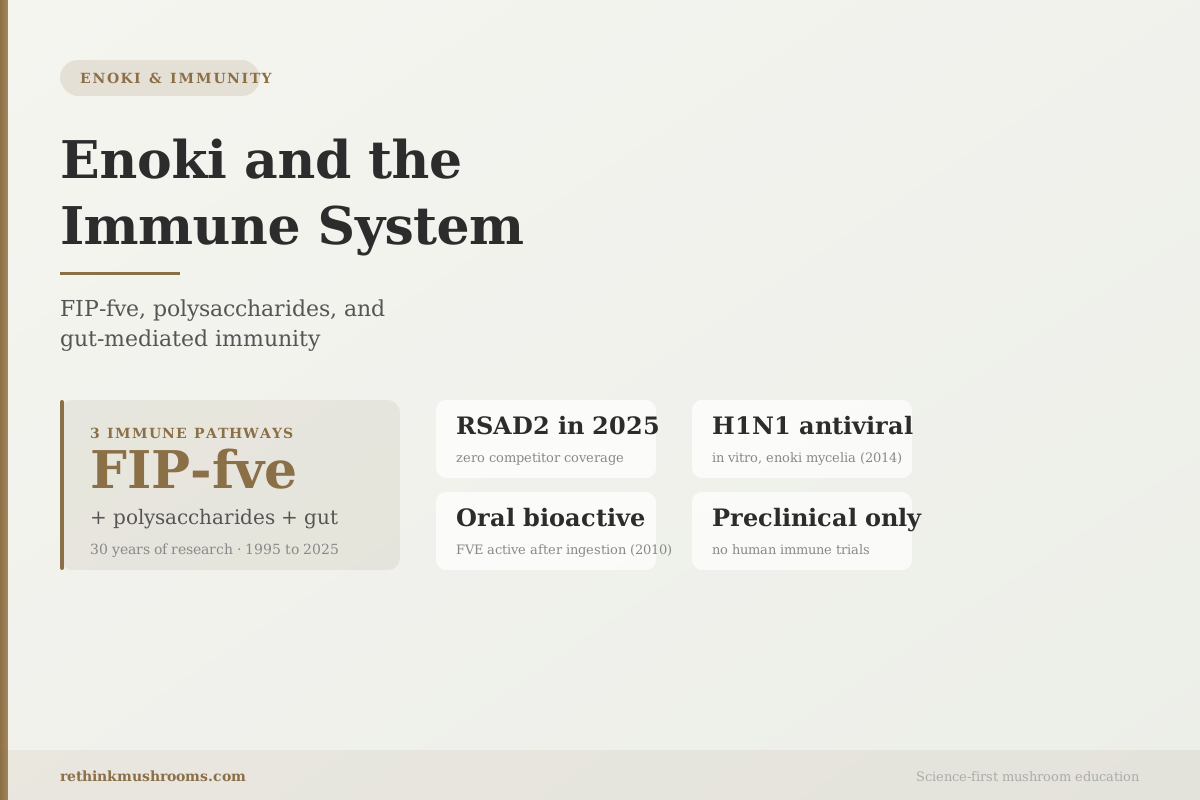
3 mechanisms of immune activation
Enoki mushrooms activate immunity through three separate pathways: FIP-fve protein stimulates T cells and triggers IFN-γ production, polysaccharides activate macrophages via RSAD2 and NF-κB signaling, and prebiotic fiber supports gut-mediated immune enhancement.
Ko et al., Eur J Biochem, 1995; Wang et al., Int J Biol Macromol, 2025
30 years
of immunomodulatory research on F. velutipes, from FIP-fve discovery (1995) to RSAD2 pathway (2025)
RSAD2 pathway
identified in 2025 as the key node for polysaccharide macrophage activation; in zero competitor content
Oral bioactive
FVE (FIP-fve) remained immunologically active after oral administration in mice, increasing macrophage and T-cell activity (Chang et al., 2010)
Ko et al., Eur J Biochem, 1995; Wang et al., Int J Biol Macromol, 2025
 View as image ↗
Enoki mushrooms contain at least three types of compounds that affect the immune system through distinct molecular pathways. A protein called FIP-fve activates T cells and drives a specific type of antiviral immune response. Polysaccharides trigger macrophages through a receptor signaling cascade that, in a 2025 study, was traced to a specific antiviral gene called RSAD2. And the prebiotic fiber in enoki feeds gut bacteria that, in turn, modulate the immune cells lining the intestinal wall.
These three pathways operate independently and produce different downstream effects. Understanding them separately matters because consumer content typically groups all of "enoki's immune benefits" into a single vague claim, missing the mechanistic specificity that three decades of research has actually established.
This article covers each pathway with its specific study evidence, the important distinction between two enoki proteins that are often confused, and the honest acknowledgment that all of this evidence is preclinical. For the broader enoki species context, what is enoki mushroom provides the full profile.
Key Takeaways
- FIP-fve, a protein unique to Flammulina velutipes, activates human T cells to produce IFN-γ (an antiviral and antitumor immune signal) via the p38 MAPK signaling pathway, specifically driving Th1-type immune responses (Ko 1995, Yamin 2004, Yu 2022)
- Oral administration of FVE (FIP-fve) in mice increased macrophage tumoricidal activity, T-cell tumor-specific responses, and IFN-γ production, demonstrating biological activity after ingestion (Chang 2010)
- Enoki polysaccharides activate macrophages through the NF-κB/MAPK pathway; a 2025 study identified RSAD2 (an antiviral interferon-stimulated protein) as the key mediator of this polysaccharide immune response (Wang 2025)
- A 2020 study found a single F. velutipes polysaccharide produced both direct macrophage activation and gut microbiota shifts in rats, documenting dual immune effects from one compound (Liu 2020)
- Enoki mycelia extract showed antiviral activity against influenza H1N1 in vitro by blocking viral-induced cell death (Chen 2014)
- Flammulin (a different enoki protein) is a ribosome-inactivating protein that kills cells by blocking protein synthesis; it is distinct from FIP-fve and operates through a completely different mechanism
Pathway 1: FIP-fve and T-Cell Immune Activation
FIP-fve stands for Fungal Immunomodulatory Protein from Flammulina velutipes. Ko and colleagues discovered and fully characterized it in 1995: a small glycoprotein (12.7 kDa, 114 amino acid residues) with a structure related to lectins (proteins that bind carbohydrates) but with an immunostimulatory function rather than a carbohydrate-binding function.[1]
The 1995 study found FIP-fve stimulated human peripheral blood lymphocytes (immune cells circulating in the blood) and induced the expression of several cytokines: IL-2 (interleukin-2, a growth signal that drives T-cell proliferation), IFN-γ (interferon-gamma, the primary antiviral and antitumor immune activator in cellular immunity), and TNF-α (tumor necrosis factor alpha, which activates macrophages and coordinates inflammation).
Yamin and colleagues (2004) went deeper into the mechanism, specifically identifying the signaling pathway FIP-fve uses to produce IFN-γ.[2] FIP-fve activates T cells through the p38 MAPK pathway (a chain of intracellular signaling proteins that transmit stress and inflammatory signals). When the researchers blocked this pathway with a specific inhibitor, FIP-fve-induced IFN-γ production was completely abolished, confirming p38 MAPK as the essential signaling route.
Importantly, the IFN-γ/low-IL-4 profile that FIP-fve induces indicates a Th1-type immune response, the branch of the immune system focused on fighting viruses and intracellular bacteria, rather than the Th2 response associated with allergic reactions and parasitic infection defense. FIP-fve specifically tips the immune balance toward the cellular immune response needed for viral clearance.
Chang and colleagues (2010) tested whether FIP-fve retained biological activity after oral administration, a more practical delivery route than injection.[3] Mice fed oral FVE (10 mg/kg body weight) showed significantly increased macrophage killing activity, tumor-specific T-cell responses, and IFN-γ levels. In mice with liver cancer, oral FVE increased median survival and reduced tumor size. This study established that FVE (FIP-fve) can cross the gut barrier and produce systemic immunological effects after ingestion.
Yu and colleagues' 2022 study provided the most recent and mechanistically detailed look at FIP-fve signaling.[4] Using a T-cell line, they showed FIP-fve stimulated T-cell proliferation and IL-2 secretion dose-dependently, operating through the MAP2K3/p38α pathway (MAP2K3 is the kinase, a protein that activates p38 by transferring a phosphate group, which is how the signal travels through the cascade). Activation markers on the T cells (ZAP-70, CD69, CD82, KIF23) all increased in response to FIP-fve treatment. These markers confirm genuine T-cell activation rather than passive stimulation.
Pathway 2: Polysaccharides and Macrophage Activation via RSAD2
Enoki mushrooms contain polysaccharides, the long-chain sugar molecules that make up much of the cell wall, in addition to FIP-fve protein. These two compound classes activate immune cells through completely different pathways.
Liu and colleagues (1997) first established that F. velutipes polysaccharide fractions had both immunomodulatory and antitumor activity, separate from and additional to FIP-fve.[5] This founding study established the dual-pathway model: enoki activates immunity through both a protein route (FIP-fve) and a polysaccharide route, and these can be studied independently.
The most mechanistically detailed recent work on the polysaccharide pathway comes from Wang and colleagues, published in 2025.[6] Using RAW264.7 macrophage cells (the standard laboratory model for studying macrophage responses) and mouse spleen cells, they mapped the signaling pathway through which F. velutipes polysaccharide activates macrophages. The cascade goes through NF-κB (a molecular switch that turns on inflammatory gene programs) and MAPK pathways, which is consistent with how other mushroom polysaccharides work. The specific finding that distinguishes this study: RSAD2 was identified as the key mediating node.
RSAD2 (also known as Viperin) is an antiviral protein. It is normally turned on by interferon signals during viral infections, and its activation is part of the innate immune response to many RNA viruses. The finding that a polysaccharide from enoki mushrooms activates macrophages through RSAD2 suggests a possible mechanism for enoki's antiviral properties beyond simply stimulating general immune activity: it may specifically engage the same cellular antiviral programs that interferon signaling activates.
No consumer health article has reported this RSAD2 connection. The Wang 2025 study was published in the International Journal of Biological Macromolecules and has not reached consumer health media as of this writing.
For a deeper treatment of the polysaccharide immune pathway specifically, see enoki polysaccharides and immune cell activation.
Pathway 3: Gut-Mediated Immunity Through Microbiota Changes
The third immune pathway operates through the gut. Rather than acting directly on immune cells in the bloodstream or lymph tissue, enoki polysaccharides reach the colon, feed specific gut bacteria, and the bacteria-produced compounds subsequently modulate the immune cells that line the intestinal wall and interact with the systemic immune system.
Liu and colleagues (2020) documented this dual mechanism in a single study using a novel F. velutipes polysaccharide: the polysaccharide both directly activated macrophages in cell culture (confirming direct immunomodulatory activity) and shifted gut microbiota composition toward beneficial species in rats.[7] This makes Liu 2020 the most direct available evidence that one enoki compound operates through both the direct and gut-mediated immune pathways simultaneously.
The gut-immune connection in enoki research is covered in more depth in Flammulina velutipes and gut-mediated immune enhancement. For the bacteria-specific data (which bacteria change and in what direction), see enoki and gut bacteria composition: research review.
The Antiviral Angle: Enoki Mycelia Against Influenza H1N1
Chen and colleagues (2014) specifically tested whether F. velutipes mycelia extract had activity against influenza H1N1, the flu strain that caused the 2009 pandemic.[8] The extract showed antiviral activity by inhibiting viral-induced apoptosis (the process by which infected cells are killed by the virus, which normally helps viruses spread by releasing viral particles from dying cells).
This in vitro finding provides mechanistic context for the traditional use of enoki as a winter food and for the RSAD2 pathway finding: RSAD2 is an antiviral protein, and the polysaccharide pathway converging on RSAD2 may be part of why enoki extracts show antiviral activity in these cell studies.
The honest caveats: all of this is in vitro evidence from cell culture. In vitro antiviral activity does not predict clinical antiviral efficacy. No clinical trial has tested whether eating enoki mushrooms reduces flu infection rates or severity.
The Protein Distinction: Flammulin vs. FIP-fve
Consumer and competitor content about enoki immunity frequently conflates two enoki proteins that do very different things.
FIP-fve is the protein covered throughout this article: it activates immune cells (T cells, macrophages), drives IFN-γ production, and stimulates antitumor immunity. It is found in the fruiting body and appears to survive oral administration.
Flammulin is a ribosome-inactivating protein (RIP) also found in enoki mushrooms. Ribosomes are the cellular machinery that makes proteins. Ribosome-inactivating proteins disable ribosomes, stopping protein synthesis. In cancer cell research, flammulin's RIP activity is studied because cancers need continuous protein synthesis to proliferate. This is the mechanism behind flammulin's antitumor effects: it kills dividing cells by blocking their protein production machinery, not by activating the immune system.
Tang's 2016 comprehensive review explicitly documents both proteins and distinguishes their mechanisms.[9] Flammulin (antitumor via RIP mechanism) and FIP-fve (immunostimulatory via lymphocyte activation) are two structurally and functionally distinct compounds from the same mushroom. Confusing them produces inaccurate mechanistic claims about how enoki affects immunity.
The Bottom Line
Enoki mushrooms modulate immunity through three parallel pathways. FIP-fve protein activates T cells to produce IFN-γ via p38 MAPK/MAP2K3 signaling, driving Th1 cellular immune responses; oral bioavailability has been confirmed in mice. Polysaccharides activate macrophages through NF-κB/MAPK signaling, with RSAD2 (an antiviral interferon-stimulated protein) identified as the key pathway node in 2025 research. Gut-mediated immunity operates through microbiota shifts producing SCFA-mediated immune modulation. All three pathways are preclinical; no human immune trials for enoki exist. Flammulin (RIP mechanism) and FIP-fve (immune activation mechanism) are distinct proteins that should not be conflated.
Frequently Asked Questions
Sources & References
- 1. Source details for this reference are not yet available.
- 2. Source details for this reference are not yet available.
- 3. Source details for this reference are not yet available.
- 4. Source details for this reference are not yet available.
- 5. Source details for this reference are not yet available.
- 6. Source details for this reference are not yet available.
- 7. Source details for this reference are not yet available.
- 8. Source details for this reference are not yet available.
- 9. Source details for this reference are not yet available.