Enoki & Immunity
114 amino acids
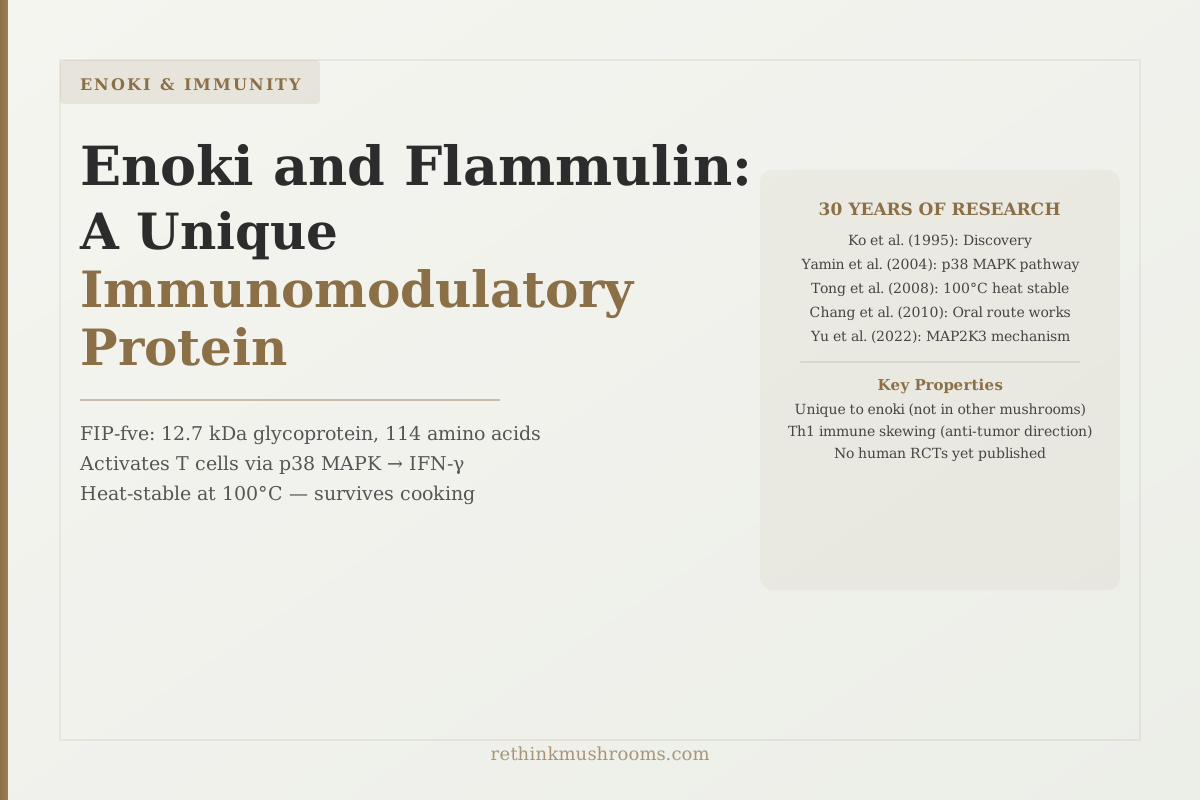
FIP-fve, the immunomodulatory protein unique to enoki, was fully sequenced in 1995. It is a 12.7 kDa glycoprotein that stimulates human T lymphocytes to produce interferon-gamma, the immune signal that drives anti-tumor and anti-viral responses.
Ko et al., European Journal of Biochemistry, 1995
100°C stable
FIP-fve retains activity after boiling for 30 minutes (Tong et al., 2008)
Oral route
FIP-fve activated anti-tumor immunity in mice after oral dosing (Chang et al., 2010)
p38 MAPK
the T-cell signaling relay that FIP-fve triggers to produce interferon-gamma
Ko et al., European Journal of Biochemistry, 1995
 View as image ↗
Enoki mushrooms contain an immune-activating protein called FIP-fve that no other commonly eaten mushroom produces. Researchers first isolated it in 1995, traced its mechanism through specific signaling pathways in T cells, confirmed that the protein survives cooking at boiling temperatures, and showed that oral consumption delivers immune-activating effects in animal models. The research spans 30 years and seven published studies. This article covers what FIP-fve actually is, how it works at the cellular level, and what those findings mean for understanding enoki as a food. For a broader look at enoki's research profile, see What Is Enoki Mushroom? The Tiny Mushroom with Big Research.
Key Takeaways
- FIP-fve (also called FVE) is a 12.7 kDa glycoprotein with 114 amino acids, found only in Flammulina velutipes (enoki), first isolated and fully sequenced by Ko et al. (1995)
- FIP-fve activates human T lymphocytes and induces production of interferon-gamma (IFN-γ), the immune signal associated with anti-tumor and anti-viral responses
- The mechanism runs through the p38 MAPK signaling relay inside T cells; blocking this relay with a specific inhibitor stops FIP-fve's IFN-γ induction entirely, confirming the pathway (Yamin et al., 2004)
- Yu et al. (2022) traced the pathway more precisely to MAP2K3/p38α MAPK14, showing FIP-fve also drives IL-2 release and T-cell multiplication, with ZAP-70 and CD69 identified as early activation markers
- Tong et al. (2008) found FIP-fve retains full immunomodulatory activity after 30 minutes at 100°C and 15 minutes at 121°C. Cooking does not destroy it.
- Chang et al. (2010) showed that oral FVE administration (10 mg/kg) in hepatoma-bearing mice activated innate and adaptive immunity and significantly extended lifespan and reduced tumor size
The Terminology Problem: Flammulin vs. FIP-fve
Before the science, a naming issue that causes most articles about this topic to be imprecise.
"Flammulin" appears in consumer content as the name for enoki's immune protein. But in the strict protein-chemistry literature, flammulin refers to a ribosome-inactivating protein, a type of protein that blocks the cell machinery that builds other proteins and can kill cells by preventing them from making the proteins they need. Flammulin in this sense has antitumor properties through direct cell killing. It is a different protein from FIP-fve.
FIP-fve stands for Fungal Immunomodulatory Protein from Flammulina velutipes. It works not by killing cells but by activating the immune system. It is also called FVE. Tang et al.'s 2016 comprehensive review of Flammulina velutipes biology distinguished both proteins explicitly: flammulin as the ribosome-inactivating protein, FIP-fve as the immunostimulatory protein that activates T cells. When popular articles describe enoki's "immune-activating protein," they almost always mean FIP-fve, not flammulin in the strict sense.
This article uses FIP-fve throughout for clarity. Both proteins are real and both are interesting; they just work through entirely different mechanisms.
The Discovery: Ko 1995 and the Protein That Stimulates Human Lymphocytes
In 1995, Ko and colleagues isolated FIP-fve from Flammulina velutipes fruiting bodies and published its complete amino acid sequence in the European Journal of Biochemistry.[1]
The protein is a glycoprotein, meaning it has small sugar chains attached to its surface in addition to its amino acid backbone. The molecular weight is 12.7 kDa. "kDa" stands for kilodaltons, a unit used to measure protein size; for reference, hemoglobin (the oxygen-carrying protein in red blood cells) is about 64 kDa, making FIP-fve a relatively small protein.
When Ko's team added FIP-fve to human peripheral blood lymphocytes (white blood cells from healthy donors), the lymphocytes showed measurably increased activation. Gene expression analysis revealed that FIP-fve switched on the production of three immune signaling proteins: IL-2 (a signal that causes T cells to multiply), IFN-γ or interferon-gamma (the anti-tumor and anti-viral immune signal), and TNF-α or tumor necrosis factor-alpha (another immune activation signal). The protein was not killing cells or acting as a nutrient. It was changing how immune cells behaved.
Lin et al. (1997) followed up by performing the molecular cloning of FIP-fve.[2] Molecular cloning means producing an exact genetic copy of the instructions to make the protein, which allows it to be manufactured in quantity in the laboratory. Crucially, the cloned, lab-produced version of FIP-fve retained the same immunomodulatory activity as the protein extracted directly from the mushroom. This confirmed that the protein's structure alone, not some contaminant in the mushroom extract, was responsible for the immune activation.
How FIP-fve Activates T Cells: The p38 MAPK Pathway
When a T cell encounters a signal it recognizes, that signal does not travel directly to the cell's nucleus. Instead, it passes through a relay chain of proteins inside the cell. Each protein in the chain activates the next one, ending at the nucleus where specific genes are switched on. These relay chains are called signaling pathways, and different pathways produce different immune outcomes.
Yamin et al. (2004) identified which relay chain FIP-fve uses: the p38 MAPK pathway.[3] The p38 part refers to a specific signaling protein (p38 kinase) and MAPK stands for mitogen-activated protein kinase, the family it belongs to. When activated, this relay chain ends in the production of IFN-γ.
The experiment was straightforward in design. T cells were treated with FIP-fve and showed strong IFN-γ production. Then the researchers added SB203580, a drug that specifically blocks the p38 step in the relay chain. IFN-γ production dropped to baseline. The relay chain was the mechanism: when you block the relay, you stop the outcome. FIP-fve activates the p38 MAPK relay, which produces IFN-γ.
Yamin also found that FIP-fve-stimulated T cells produced high IFN-γ but low IL-4. IL-4 is the signal associated with allergic responses. High IFN-γ plus low IL-4 is the immune pattern immunologists call Th1 skewing: the immune system shifting toward the mode that fights viruses and tumors rather than the mode that responds to parasites and allergens. A Th1-skewed immune response is the direction most associated with anti-tumor activity.
For the broader context on how enoki's immune effects compare to its other health research, see Enoki and the Immune System: Immunomodulatory Research. For the polysaccharide immune pathway that operates in parallel to FIP-fve, see Enoki Polysaccharides and Immune Cell Activation.
The 2022 Precision Update: MAP2K3, IL-2, and T-Cell Activation Markers
Yu et al. (2022) published the most mechanistically detailed FIP-fve study to date, using modern molecular tools to trace the signaling pathway at higher resolution than was possible in 2004.[7]
The researchers used Jurkat E6-1 cells, a well-established human T-cell line used for signaling research. FIP-fve stimulated these cells in a dose-dependent way: more FIP-fve produced more activation. The specific upstream activator within the pathway turned out to be MAP2K3, a signaling protein that activates p38α (also called MAPK14). MAP2K3 is the "on switch" upstream of p38, and FIP-fve was turning it on.
The effects cascaded downstream. T cells treated with FIP-fve showed increased IL-2 secretion, the signal that drives T cells to multiply and maintain an ongoing immune response. They also showed upregulation of ZAP-70 and CD69, two proteins that appear on the surface of T cells early in the activation process. ZAP-70 and CD69 are standard markers that researchers use to confirm T cells have actually activated rather than just receiving a stimulus. The presence of these markers in FIP-fve-treated cells confirmed genuine T-cell activation, not just a stress response.
The 2022 data also identified KIF23, a motor protein involved in cell division, as upregulated. This suggests FIP-fve does not just activate existing T cells but also pushes them to divide, expanding the pool of activated immune cells.
The Practical Question: Does Cooking Destroy It?
For any food compound with health implications, the cooking question is critical. Many proteins denature, or unfold and lose their function, when heated.
Tong et al. (2008) tested FIP-fve's heat stability directly.[4] They subjected FIP-fve protein preparations to three conditions: boiling at 100°C for 30 minutes (standard cooking temperatures), autoclaving at 121°C for 15 minutes (higher than any household cooking method), and freezing at -80°C for an extended period. After each treatment, they measured whether the protein retained its immunomodulatory activity.
The result: FIP-fve retained activity after all three treatments. Boiling, autoclaving, and freezing did not destroy its immune-activating function.
This finding is practically significant in two ways. First, it means that cooked enoki, the form recommended for food safety reasons (raw enoki has been associated with listeria contamination), delivers FIP-fve in active form. There is no trade-off between safety and the immune protein. Second, it means that commercial processing, including the heat treatment used in many packaged food products, is unlikely to inactivate FIP-fve.
The structural reason for this stability is not fully established but is likely related to the lectin-like characteristics of the protein. Many lectins, a class of sugar-binding proteins, are notably heat-resistant.
Does Eating Enoki Actually Deliver FIP-fve? The Oral Bioavailability Evidence
Heat stability establishes that FIP-fve survives cooking. A separate question is whether a protein that survives cooking also survives digestion and reaches the immune system in active form.
Proteins in food are generally broken down by digestive enzymes in the stomach and small intestine. This is the normal process of protein digestion. A functional protein consumed orally must either resist this breakdown or its breakdown products must retain or generate the original activity.
Chang et al. (2010) tested this directly in an animal model.[6] Hepatoma-bearing mice (mice with liver cancer tumors) were given oral FVE at 10 mg per kilogram of body weight. If the protein were completely inactivated by digestion, no immune or anti-tumor effect would be expected. The results showed the opposite: oral FVE significantly extended the lifespan of treated mice compared to controls, reduced tumor size, and activated both innate immunity (the first-responder immune system) and adaptive immunity (the targeted immune response). The researchers measured specific immune effects: increased tumoricidal (tumor-killing) activity in peritoneal macrophages (immune cells in the abdominal cavity) and increased tumor-specific activity in splenocytes (immune cells from the spleen). IFN-γ was confirmed as the key mediating signal.
Oral delivery working in a living animal is different from test-tube evidence of heat stability. It shows that some portion of FIP-fve either survives digestion intact or produces active fragments, and that either way, the immune system receives a meaningful signal.
The Vaccine Adjuvant Application: Where the Research Is Heading
Beyond dietary and supplemental applications, FIP-fve has attracted interest as a vaccine adjuvant, a substance that enhances the immune response to a vaccine.
Tsao et al. (2009) co-administered FIP-fve alongside a tumor-associated antigen in an animal model.[5] The combination produced a significantly enhanced anti-tumor immune response compared to the antigen alone. The mechanism is the same Th1-skewing action identified by Yamin: FIP-fve primes T cells to produce more IFN-γ, which amplifies the immune response to the co-administered cancer antigen.
The vaccine adjuvant angle represents the most advanced translational application of FIP-fve research. Standard adjuvants like aluminum salts (used in many childhood vaccines) work by creating a local inflammatory signal to attract immune cells to the injection site. FIP-fve works through a different pathway, specifically activating T cells toward the Th1 response most relevant for tumor immunity.
No human trials using FIP-fve as a vaccine adjuvant have been published. The animal and cell-based data provides a mechanistic case for continued investigation, not a clinical claim.
The Honest Summary: What Thirty Years of Research Established
The FIP-fve evidence base is unusually mechanistic and internally consistent for a food compound. The protein was characterized structurally, its cloning was confirmed, its signaling pathway was traced to a specific intracellular relay chain, its heat stability was tested, its oral bioavailability was confirmed in animal models, and its application as a vaccine adjuvant was demonstrated in an animal model. This is more complete mechanistic documentation than most food compounds receive.
What it is not is human clinical evidence. No randomized controlled trial in humans has confirmed that eating enoki mushrooms delivers FIP-fve to the immune system in amounts that measurably change immune function, resistance to infection, or cancer outcomes. The animal and cell-study evidence is directionally consistent and mechanistically coherent, but the translation to human benefit at typical dietary doses remains unestablished.
Understanding the difference between those two positions, strong preclinical mechanistic evidence versus confirmed human health benefit, is the key to reading any article about enoki and immunity honestly.
The Bottom Line
FIP-fve is a 12.7 kDa glycoprotein unique to enoki mushrooms, first isolated and sequenced in 1995 (Ko et al.). It activates human T cells via the p38 MAPK/MAP2K3 signaling pathway to produce interferon-gamma and IL-2, with Th1 skewing (anti-tumor/anti-viral direction). It is stable at 100°C cooking temperatures (Tong et al., 2008) and retains anti-tumor immune activity after oral administration in mice (Chang et al., 2010). No human trials have confirmed dietary relevance at typical enoki intake levels.
Frequently Asked Questions
Sources & References
- 1. Source details for this reference are not yet available.
- 2. Source details for this reference are not yet available.
- 3. Source details for this reference are not yet available.
- 4. Source details for this reference are not yet available.
- 5. Source details for this reference are not yet available.
- 6. Source details for this reference are not yet available.
- 7. Source details for this reference are not yet available.