Enoki & Immunity
RSAD2 antiviral gene pathway
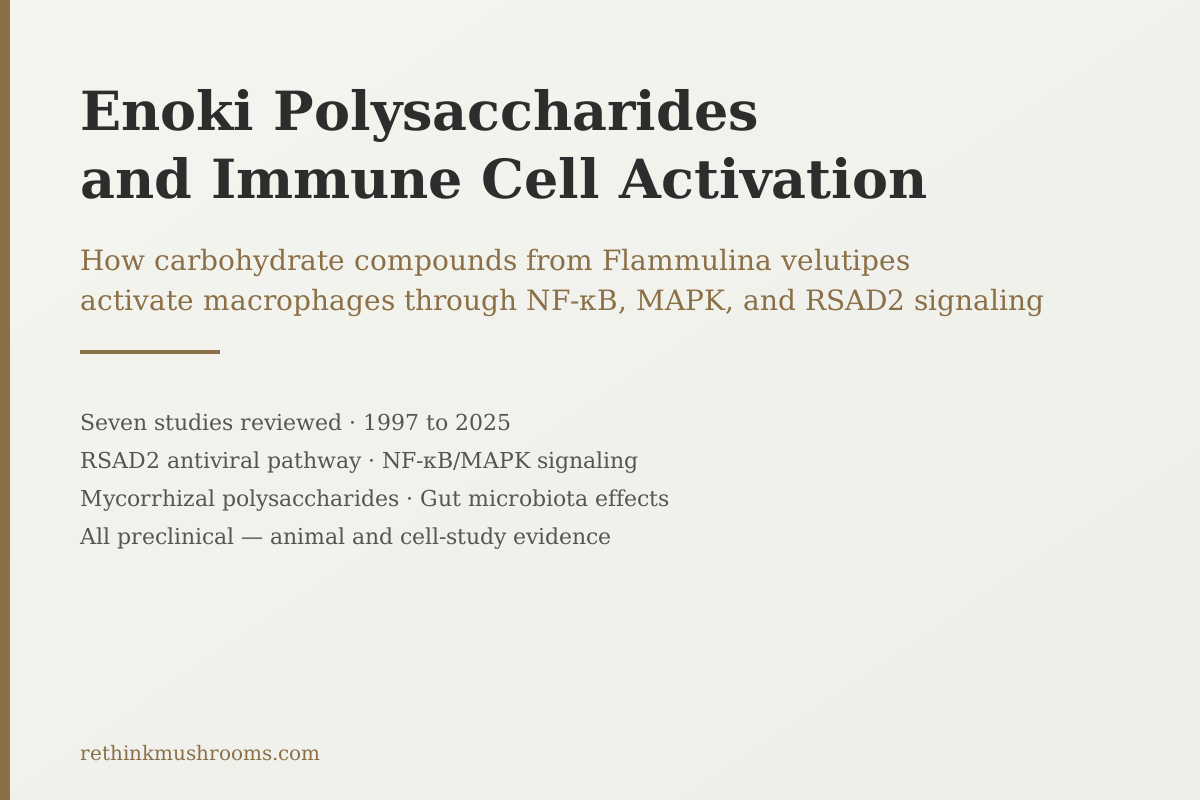
Wang et al. (2025) identified RSAD2, an antiviral interferon-stimulated gene, as a key node through which enoki polysaccharides activate macrophages, a finding absent from all consumer health media.
Wang et al., International Journal of Biological Macromolecules, 2025
1997
year of first polysaccharide isolation from F. velutipes
NF-κB/MAPK
two signaling cascades activated by enoki polysaccharides in macrophages
Preclinical
all evidence to date is animal or cell study; no human trials exist
Wang et al., International Journal of Biological Macromolecules, 2025
 View as image ↗
Enoki mushrooms contain two structurally unrelated classes of immune-active compounds. The first is FIP-fve, a glycoprotein that activates T lymphocytes and is covered separately in the article on enoki's immunomodulatory protein. The second is polysaccharides, long-chain carbohydrate molecules that activate a different set of cells, primarily macrophages and dendritic cells, through different receptors and different intracellular signals. Conflating the two is the most common error in consumer reporting on enoki and immunity.
The polysaccharide research began with a 1997 isolation and has now accumulated seven independent studies tracing the mechanism from receptor binding through to gut microbiota effects. The endpoint of the research, for now, is a 2025 paper identifying RSAD2 as a key gene in the pathway. RSAD2 is an antiviral interferon-stimulated gene, which is notable: enoki polysaccharides appear to activate immune machinery that evolved specifically to fight viruses, without any virus being present. No consumer article has reported this finding. For a broader introduction to the species, see What Is Enoki Mushroom?.
Key Takeaways
- Liu et al. (1997) first isolated an immunomodulatory polysaccharide from F. velutipes, establishing it as distinct from the protein FIP-fve and founding a dual-pathway model for enoki immune activity
- Enoki polysaccharides activate macrophages by binding Dectin-1 and Toll-like receptors, triggering NF-κB/MAPK signaling that increases phagocytic activity and cytokine production including TNF-α, IL-6, and IL-12
- A 2025 study by Wang et al. identified RSAD2, an antiviral interferon-stimulated gene, as an additional activation node, connecting enoki polysaccharide immunostimulation to an antiviral immune pathway
- Polysaccharides extracted from the mycorrhizae (root-like structures) of enoki also activate immune cells, not only fruiting-body extracts (Yang et al., 2014)
- Liu et al. (2020) found a single F. velutipes polysaccharide produced both direct macrophage activation in cell culture and gut microbiota shifts in rats, two distinct immune effects from one compound
- All seven studies are preclinical; no human clinical trial has tested enoki polysaccharides against an immune endpoint
The 1997 Baseline: How Two Different Mechanisms Were Found in One Mushroom
Liu and colleagues published the first isolation and characterization of an immunomodulatory and antitumor polysaccharide from Flammulina velutipes in 1997.[1] The significance of that paper lay in what it was alongside, not just what it found. At the same time, other researchers had already isolated FIP-fve, the immunomodulatory protein from enoki. The existence of two independent papers on two structurally different compound classes from the same mushroom established what became the dual-pathway model: enoki activates immunity through at least two unrelated routes.
The practical difference between the two routes matters. FIP-fve is a glycoprotein with a specific amino acid sequence; it binds to surface receptors on T lymphocytes and drives IFN-γ production through p38 MAPK signaling. Polysaccharides are carbohydrate chains with no amino acids; they bind pattern-recognition receptors on macrophages and trigger a different set of downstream signals. They do not primarily activate T cells; they activate innate immune cells that detect structural patterns common to bacteria and fungi. Both pathways converge on the MAPK signaling family, but upstream they are completely different.
A consumer article that says "enoki boosts your immune system" describes the destination without describing the road. There are at least two roads. This article covers the carbohydrate one.
How Polysaccharides Talk to Macrophages: From Receptor to Cytokine
Wu and colleagues (2014) extracted polysaccharides from F. velutipes fruiting bodies and tested them directly on macrophages in cell culture.[2] The polysaccharides increased phagocytic activity, the ability of macrophages to engulf and destroy foreign material, and induced TNF-α production. The study also documented antioxidant activity in the same polysaccharide fraction, suggesting it has effects on oxidative stress alongside the immune response.
The mechanism that accounts for these results follows a sequence documented across multiple fungal polysaccharides. Macrophages carry pattern-recognition receptors on their surfaces; two that are particularly relevant here are Dectin-1 (which recognizes beta-glucan structures) and Toll-like receptors, or TLRs (which detect structural motifs that mark things as non-self). When a polysaccharide binds these receptors, it initiates an internal signaling cascade. The cascade activates two transcription factors: NF-κB (nuclear factor kappa B, which switches on genes for inflammation and immune defense) and MAPK (mitogen-activated protein kinase, which governs cell proliferation, differentiation, and cytokine release). The end result is a macrophage that releases cytokines (TNF-α, IL-6, IL-12) and increases its capacity to identify and eliminate pathogens.
This is not unique to enoki polysaccharides. The same receptor-to-signaling sequence is documented for beta-glucans from shiitake, reishi, and other medicinal mushrooms. What distinguishes the enoki polysaccharide story is not the receptor pathway but two findings that are specific to this species: the mycorrhizal polysaccharide data and the 2025 RSAD2 discovery.
The 2025 Breakthrough: RSAD2 and the Antiviral Connection
Wang and colleagues (2025) used a more precise approach than prior studies: they ran enoki polysaccharide-treated macrophages through transcriptomic and proteomic analysis to identify exactly which genes were being upregulated.[3] Among the most significantly upregulated genes was RSAD2, also known as viperin.
RSAD2 (radical S-adenosyl methionine domain containing 2) is an interferon-stimulated gene: the category of genes that get switched on when the immune system is responding to a viral threat. In normal physiology, RSAD2 becomes active when interferons are released during viral infection. Its protein product, viperin, disrupts viral replication by interfering with the lipid modifications that viruses use to enter and exit cells. It is a frontline antiviral defense tool.
Finding RSAD2 upregulation in polysaccharide-treated macrophages is unexpected in this way: enoki polysaccharides appear to activate a core antiviral response gene even without any virus present. The pathway runs through NF-κB and MAPK, the same transcription factors documented in the Wu 2014 macrophage activation data, but adds RSAD2 as an additional downstream node. Wang et al. confirmed RSAD2's role directly by knocking down the gene in macrophage cells: when RSAD2 expression was reduced, much of the polysaccharide-induced immune activation was abolished.
This finding provides a mechanistic connection between enoki polysaccharide immunostimulation and the antiviral properties documented in the broader enoki literature. It is also the most mechanistically precise description of how the polysaccharide pathway works that currently exists in the published research. For context on how the bioactive compounds in enoki relate to each other, enoki bioactive compounds: flammulin, proflamin, and polysaccharides covers the compound landscape.
Not Just the Cap: Mycorrhizal Polysaccharides Are Active Too
Yang and colleagues (2014) extracted polysaccharides not from enoki fruiting bodies but from the mycorrhizae, the dense root-like fungal structures that anchor the mushroom to its growth substrate.[4] These mycorrhizal polysaccharides activated immune cells in cell culture assays, the same immunomodulatory effect documented for fruiting-body extracts in the Liu 1997 study.
This matters for practical supplement evaluation. Mycelium-based extracts, produced by growing the fungal mycelium on grain substrate and harvesting before fruiting body formation, are sold as lower-cost alternatives to fruiting-body extracts. The Yang 2014 data supports the claim that non-fruiting-body parts of the fungus contain immunomodulatory polysaccharides. What it does not establish is concentration equivalence, bioavailability parity, or comparative potency between mycelium and fruiting-body preparations. Those comparisons have not been run in direct head-to-head trials. The Yang 2014 study shows that active polysaccharides exist in the root fraction; it does not quantify how much activity per gram relative to the mushroom cap.
The finding extends the biological picture: enoki is not just a cap-and-stem food that happens to have polysaccharides in the edible part. The immunomodulatory carbohydrate activity runs through the entire fungal organism.
One Study, Two Effects: Direct Activation and Gut Microbiota Together
Liu and colleagues (2020) isolated a novel polysaccharide structure from F. velutipes and tested it in two experimental systems simultaneously: macrophage cell culture and live rat oral supplementation.[5] The same compound activated macrophages directly in the cell culture arm, increasing phagocytosis and cytokine release, and shifted gut microbiota composition in the live animal arm.
The dual-arm design produced evidence for two distinct immune mechanisms from one compound. The direct macrophage activation pathway (receptor binding, NF-κB/MAPK signaling, cytokine production) runs in parallel with the gut-mediated pathway, where polysaccharides that reach the colon undigested are fermented by gut bacteria. Those bacteria produce short-chain fatty acids and other metabolites that train mucosal immunity and systemic immune tone. The Liu 2020 study documented the gut microbiota shift, and its presence in the same study as macrophage data made explicit what the polysaccharide field had been noting separately: these are two parallel, not competing, mechanisms.
The gut-mediated immune pathway is covered in depth in the companion article Flammulina velutipes and Gut-Mediated Immune Enhancement, which focuses specifically on the downstream immune consequences of the microbiota shift.
T Cells and the MAP2K3 Connection
The polysaccharide research centers on macrophages, but T cells also form part of the broader immune response to fungal compounds. Yu and colleagues (2022) studied how FIP-fve, the enoki protein rather than polysaccharides, activates T cells via MAP2K3/p38α signaling.[6] The study showed that T-cell activation markers CD69 and CD82 increased, ZAP-70 (a T-cell receptor signaling protein) was upregulated, and IL-2 secretion rose in a dose-dependent manner. MAP2K3 is an upstream kinase in the MAPK family, the same signaling family documented in the macrophage polysaccharide research.
The indirect connection is this: the MAPK cascade is shared between protein-mediated and polysaccharide-mediated immune activation in enoki. Different compounds from the same mushroom, working through different receptors on different cell types, both end up activating branches of the MAPK pathway. Whether enoki polysaccharides alone produce meaningful T-cell effects is not established; the T-cell research has been done with FIP-fve, not polysaccharide fractions. The convergence on MAPK is biologically coherent but does not yet tell us whether polysaccharides independently drive T-cell proliferation.
Wang and colleagues (2022) extended the picture with proteomics analysis on spleen tissue from polysaccharide-supplemented mice.[7] The spleen is a systemic immune organ, not a gut organ. Finding immune-related protein upregulation in splenic tissue means the immune effects of polysaccharide supplementation are not confined to the gut mucosa or peritoneal macrophages. The signal travels. The mechanism connecting gut microbiota change to splenic immune activation is consistent with the known SCFA and gut-immune axis pathways, but Wang 2022 documented it directly through protein expression changes rather than inferring it.
For a comparison of how the beta-glucan polysaccharide mechanism in shiitake activates immune cells through Dectin-1 receptors, Shiitake Beta-Glucans and Immune Cell Function covers the parallel pathway.
What This Evidence Does and Doesn't Settle
The mechanistic picture for enoki polysaccharide immune activation is now reasonably detailed. Polysaccharides bind Dectin-1 and TLR receptors on macrophages. They trigger NF-κB and MAPK signaling cascades. They induce cytokine release and increased phagocytic activity. In a 2025 study, the RSAD2 antiviral gene was identified as an additional activation node. A parallel pathway runs through gut microbiota: polysaccharides that reach the colon shift bacteria composition, which feeds back into mucosal and systemic immune tone. The polysaccharides exist not only in the fruiting body but in the root structures, and mycorrhizal extracts show the same activation profile.
What the evidence does not contain is any human trial. All seven studies cited here are cell culture or animal experiments. The most important clinical question, whether eating enoki mushrooms or taking enoki polysaccharide supplements changes immune markers in healthy or immunocompromised humans, is unanswered. No dose-response relationship has been established for people. No formulation has completed a double-blind, randomized trial. The preclinical mechanistic picture is consistent and increasingly detailed, but the gap between mouse spleen data and human immune outcomes is real and has not been bridged.
The Bottom Line
Seven independent studies spanning 1997 to 2025 have traced how enoki polysaccharides activate immune cells, from the first isolation by Liu et al. through the 2025 RSAD2 discovery by Wang et al. The mechanism involves Dectin-1/TLR receptor binding, NF-κB/MAPK signaling, RSAD2-mediated antiviral gene activation, and a parallel gut-microbiota-mediated immune pathway. Polysaccharide activity extends to the mycorrhizal root structures of the fungus, not only the fruiting body. All evidence is preclinical; no human clinical trial has tested these compounds against an immune endpoint.
Frequently Asked Questions
Sources & References
- 1. Source details for this reference are not yet available.
- 2. Source details for this reference are not yet available.
- 3. Source details for this reference are not yet available.
- 4. Source details for this reference are not yet available.
- 5. Source details for this reference are not yet available.
- 6. Source details for this reference are not yet available.
- 7. Source details for this reference are not yet available.