Enoki (Flammulina velutipes)
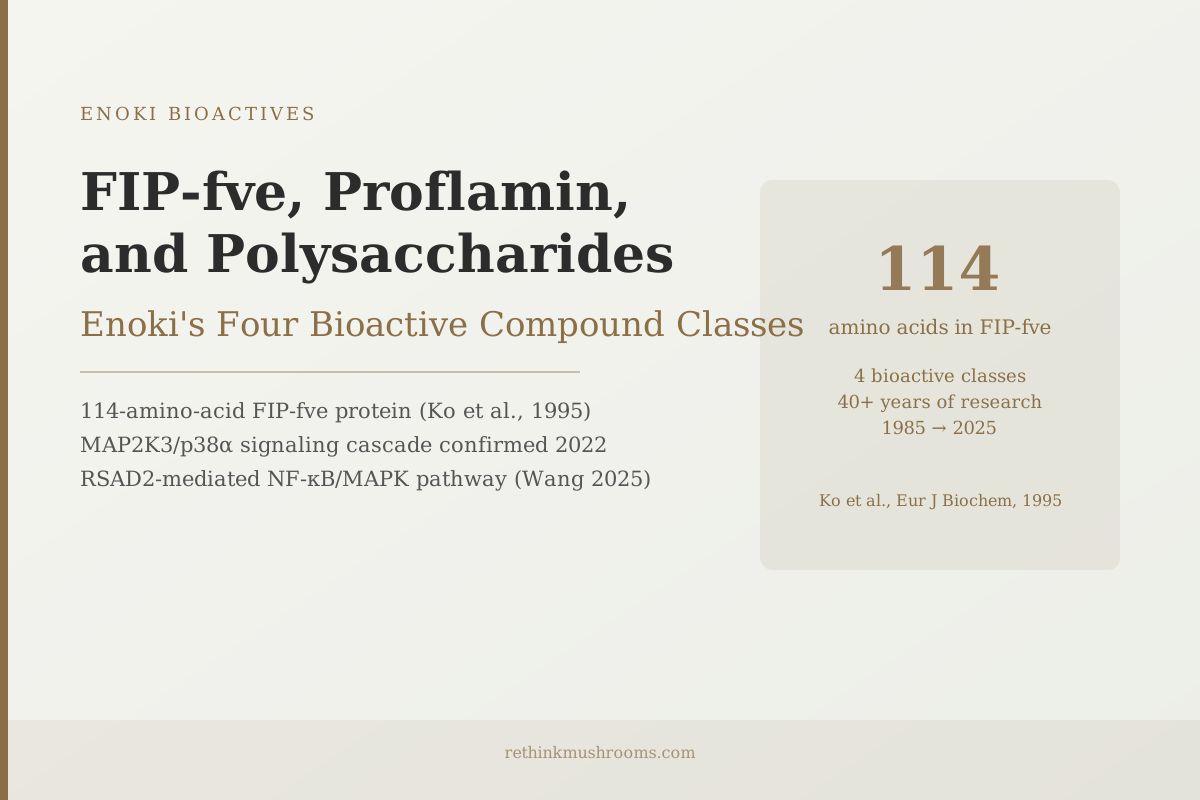
114 amino acids
FIP-fve, the immunomodulatory protein first isolated from enoki in 1995, is a 114-amino-acid protein whose downstream signaling mechanism researchers were still refining 27 years later.
Ko et al., European Journal of Biochemistry, 1995
4 classes
distinct bioactive compound families
1985
year proflamin was discovered as an antitumor agent
RSAD2
upstream gene regulating the NF-κB/MAPK pathway (Wang 2025)
Ko et al., European Journal of Biochemistry, 1995
 View as image ↗
Enoki is the second most cultivated mushroom in the world. It costs around two dollars a bag and most people use it in soup. What most people don't know is that this same fungus has been the subject of continuous research since 1982, producing a map of bioactive chemistry that now spans four distinct compound classes, each with its own signaling mechanism and research history.
The compounds are enoki mushroom bioactive compounds that no other common culinary mushroom shares in quite the same combination: FIP-fve, a fungal immunomodulatory protein first sequenced in 1995; proflamin, a glycoprotein antitumor agent from the mycelium characterized the decade before; a large family of beta-glucan polysaccharides with multiple structural sub-types; and a sterol and sesquiterpene fraction with cytotoxic activity in cell studies. Tang et al.'s 2016 systematic review in Frontiers in Pharmacology catalogued all of these and added a fifth class — flammulin, a ribosome-inactivating protein.[1]
For a deep look at what enoki is and where it comes from, see What Is Enoki Mushroom?. This article goes compound by compound through what researchers have actually found.
Key Takeaways
- FIP-fve is a 114-amino-acid protein first sequenced from enoki in 1995; its immune-activating mechanism was traced through p38 MAPK (2004) and refined to the MAP2K3 upstream pathway in 2022
- Proflamin, a glycoprotein enzyme from FV mycelium, significantly prolonged lifespan in mice bearing B-16 melanoma and adenocarcinoma 755 in the 1985 discovery study
- At least six structurally distinct FV polysaccharides have been isolated; all show immunomodulatory activity through macrophage, NK cell, and T lymphocyte activation
- Wang et al. (2025) identified RSAD2 as the upstream regulator controlling polysaccharide-driven NF-κB/MAPK activation in macrophages — the most mechanistically detailed FVP study yet
- FV sterols showed cytotoxic activity against U251 glioma and HeLa cervical cancer cells in cell studies; a micellar nanoformulation improved their otherwise low oral bioavailability (Yi 2013)
- Oral administration of FVE protein-polysaccharide complex produced antitumor activity and dual innate/adaptive immune activation in mice, suggesting compounds survive digestion (Chang 2010)
The Four Bioactive Compound Classes: What Enoki Actually Contains
Tang et al.'s 2016 systematic review in Frontiers in Pharmacology is the most comprehensive accounting of enoki's chemistry — it catalogued all major compound families across dozens of studies and is the standard reference for anyone trying to make sense of the full picture.[1]
The four research-rich compound classes break down like this:
FIP-fve — a 114-amino-acid fungal immunomodulatory protein (FIP) that activates T cells and drives interferon-gamma production. First isolated from the fruiting body. Structurally distinct from the FIPs found in reishi (FIP-gts) and other medicinal mushrooms, though they share some sequence homology.
Proflamin — a glycoprotein enzyme found in the mycelium (the root structure, not the cap and stem we eat). Antitumor activity demonstrated in animal models since 1985. Less commonly discussed than FIP-fve but represents an older and well-characterized research line.
Polysaccharides — a large family of beta-glucan and heteropolysaccharide structures, including at least six distinct fractions that have been isolated, characterized, and tested separately. The most studied class, with the most mechanistic detail at the signaling level.
Sterols and sesquiterpenes — smaller molecules showing cytotoxic activity in cell models, with bioavailability challenges that have led to pharmaceutical formulation work (Yi 2013).
A fifth class — flammulin, a ribosome-inactivating protein — is documented in Tang 2016 but has received less independent research attention than the four above.[1]
FIP-fve: Enoki's Signature Protein, 30 Years Under the Microscope
The research history of FIP-fve is one of the cleaner examples in mushroom science of a compound being followed from discovery to mechanism over three decades.
The Discovery: Ko et al., 1995
In 1995, Ko and colleagues isolated and fully sequenced a novel immunomodulatory protein from Flammulina velutipes, publishing the complete 114-amino-acid sequence in the European Journal of Biochemistry.[2] They named it FIP-fve (Fungal Immunomodulatory Protein from F. velutipes). The protein shared structural features with immunomodulatory proteins from Ganoderma and other medicinal species, suggesting a shared evolutionary function.
Two years later, Ko's group successfully cloned the gene and produced recombinant FIP-fve in the laboratory — an important step that proved researchers could study the protein independently of the mushroom and that its sequence was stable and reproducible.[3] This paved the way for the mechanistic studies that followed.
The Signaling Cascade: p38 MAPK (2004), Refined to MAP2K3 (2022)
In 2004, Wang et al. identified the first specific signaling mechanism for FIP-fve: it drives interferon-gamma (IFN-γ) production by activating the p38 MAPK pathway — a signaling relay used by immune cells to respond to threats.[4] IFN-γ is a key cytokine in both antiviral defense and antitumor immune surveillance. Knowing FIP-fve triggered it via a specific pathway gave researchers a mechanistic handle on what the protein was actually doing inside immune cells.
Eighteen years later, Gu et al. refined this picture considerably. Using proteomics on T cells treated with FIP-fve, they identified MAP2K3 — a kinase that sits upstream of the p38α (MAPK14) pathway — as the primary driver of the T-cell stimulation and IL-2 release observed after FIP-fve treatment.[5] The researchers confirmed this by adding inhibitors: gossypetin (a MAP2K3 inhibitor) and losmapimod (a p38α inhibitor) both blocked the FIP-fve-stimulated growth and IL-2 release in T cells. The mechanism was not just described — it was experimentally verified at the level of specific molecular targets.
This 27-year arc from protein sequence (Ko 1995) to upstream kinase identification (Gu 2022) represents more mechanistic depth than most bioactive compounds in the mushroom literature receive. No competitor article has mapped it.
Proflamin: The 1985 Discovery That Started the Research Lineage
FIP-fve gets most of the attention in modern writing about enoki, but proflamin is actually older. Ikekawa et al. published the proflamin discovery paper in the Japanese Journal of Cancer Research in 1985.[6]
Proflamin is a glycoprotein enzyme isolated from F. velutipes mycelium — the underground web of filaments, not the mushroom cap and stem. In mouse tumor models, proflamin significantly prolonged lifespan in animals bearing B-16 melanoma and adenocarcinoma 755 compared to untreated controls.
Several features of proflamin distinguish it from FIP-fve. First, it comes from the mycelium rather than the fruiting body, which means the form of enoki you eat at dinner contains very little of it — proflamin would need to come from a mycelium-based extract. Second, it is a glycoprotein enzyme (protein with a sugar group attached) rather than a pure protein like FIP-fve, which gives it different stability and digestibility properties. Third, the research on proflamin peaked in the 1980s and has not been as actively extended as the FIP-fve line.
Still, the proflamin data is legitimately interesting. The 1985 Ikekawa study is one of a cluster of early Japanese research papers that together built the case for F. velutipes as a medically relevant fungus long before the English-language internet existed to cover it.
Polysaccharides: The Beta-Glucan Engine, From Ohkuma 1982 to Wang 2025
Enoki's polysaccharides are the most studied class of compounds in the mushroom, and they now have the most complete picture of their immune mechanism. For context on how mushroom beta-glucans work in general, see How 1,3/1,6 Beta-Glucans Activate Your Immune System.
The Early Work: 1982 and 1997
Ohkuma et al. published one of the first controlled animal studies on an F. velutipes polysaccharide in 1982 — a protein-bound beta-1,3-glucan called EA6.[7] At 10 mg/kg, EA6 augmented the otherwise weak antitumor effect of cryosurgery in mice bearing sarcoma 180, prolonging survival compared to cryosurgery alone. This early study helped establish that the polysaccharide fraction of enoki had direct immune-modifying activity.
In 1997, Leung et al. produced the first detailed characterization of an immunomodulatory FV polysaccharide preparation — showing it triggered significant proliferation of spleen lymphocytes and enhanced macrophage phagocytic activity when administered to mice. Yin et al. later isolated three distinct polysaccharide fractions from FV mycelium and found all three induced macrophage nitric oxide production, IL-1, and TNF-α secretion — demonstrating that mycelial polysaccharides, not just those from the fruiting body, carry immunomodulatory activity.[8]
NK Cell Activation and T-Lymphocyte Stimulation
Wu et al. (2014) isolated a specific fraction called FVP I-A and showed it enhanced both non-specific immunity (NK cell activity, macrophage phagocytosis) and specific immunity (lymphocyte proliferation) in the same study.[9] The same year, Yan et al. showed that FV polysaccharides significantly increased CD3+ and CD4+ T lymphocytes and elevated IL-2 and TNF-α levels, demonstrating direct T-cell activating capacity from the polysaccharide fraction specifically.[10]
Jia et al. (2017) went a step further — isolating and structurally characterizing a specific polysaccharide called FVPA1 and demonstrating it significantly enhanced NK cell cytotoxic activity against K562 leukemia cells in vitro.[11] This study is notable because it tied a specific, characterized polysaccharide structure to a specific immune cell type and a specific tumor cell line — the kind of mechanistic precision that moves beyond "polysaccharide has immune effects."
Wang 2025: The Most Complete Mechanism to Date
The most mechanistically detailed FV polysaccharide study to date was published in 2025. Wang et al. identified RSAD2 — a gene also known as Viperin — as the upstream regulator controlling how FV polysaccharide activates NF-κB/MAPK signaling in macrophages.[12] RSAD2 is an interferon-stimulated gene with roles in antiviral immunity — its involvement here suggests FV polysaccharide triggers immune activation through a pathway shared with the innate antiviral response.
The study showed that FVP-1 increased TNF-α, IL-6, and IL-1β cytokine levels, enhanced reactive oxygen species (ROS) release, and improved phagocytic activity in macrophages — all via the RSAD2-mediated pathway. This 2025 work represents the most detailed mechanistic picture available for any FV polysaccharide compound.
The Gut Connection
Liang et al. (2022) examined the downstream effects of FV polysaccharide administration on gut microbiota composition and immune function in mice.[13] The polysaccharide changed microbial community composition and modulated immunity through pathways connected to phagosomes and immune disease signaling — a finding consistent with what other mushroom polysaccharides show, but useful for understanding why FV's systemic immune effects extend beyond direct receptor activation.
Jia et al. (2024) further characterized a novel FVP structure and found it performed both lipid-lowering and immunomodulatory functions in the same study — reducing total cholesterol and triglycerides in vitro while also activating macrophages.[14] This dual-function polysaccharide finding helps explain why enoki research crosses between immune and cardiovascular research tracks.
Cancer Mechanism: Mitochondrial Apoptosis (2024)
For the cancer angle, Zhao et al. (2024) isolated two polysaccharide fractions — FVP-S1 and FVP-C — and tested them against lung adenocarcinoma A549 cells.[15] FVP-S1, an acidic polysaccharide containing glucuronic acid, xylose, and glucose, showed the strongest anticancer effect. It inhibited cell proliferation and migration and triggered apoptosis through the mitochondrial pathway — decreasing membrane potential and increasing Caspase-3 and Caspase-9 expression. No competitor article has covered this 2024 data. It is among the most structurally specific polysaccharide-cancer studies in the FV literature.
For a broader look at how enoki fits into mushroom cancer research, see Enoki and Cancer: The Japanese Epidemiological Discovery.
Sterols, Sesquiterpenes, and the Fourth Compound Class
The sterol and sesquiterpene fraction of enoki has received less research attention than FIP-fve or polysaccharides, but the available data is meaningful.
Yi et al. (2013) isolated novel sterols from Flammulina velutipes and found they produced strong cytotoxic activity against U251 glioma cells and HeLa cervical cancer cells in 72-hour exposures.[16] The sterols' oral bioavailability was initially poor — a common problem with fat-soluble compounds — but the researchers developed a mixed micellar nanoformulation that significantly improved absorption in animal pharmacokinetics studies. This pharmaceutical work suggests that the sterols are genuinely active but require formulation to be bioavailable by mouth.
The sterol ergosterol — a provitamin D2 compound found in most mushrooms — is also present in cultivated enoki, though in lower amounts than in outdoor-grown species because the indoor CO2-enriched growing environment provides no UV light exposure for ergosterol-to-vitamin-D2 conversion (Phillips et al. established this for US retail varieties). The more pharmacologically interesting sterols in the Yi 2013 work are distinct from ergosterol — they are not the vitamin D story; they are cytotoxic compounds in their own right.
A Technical Detail: Enoki Degrades Its Own Beta-Glucans
Fukuda et al. (2008) isolated a novel exo-beta-1,3-1,6-glucanase from enoki fruiting bodies — an enzyme that breaks down beta-glucan chains with unusual substrate specificity.[17] This finding matters for understanding the mushroom's biology: enoki produces beta-glucan polysaccharides as structural components and simultaneously produces an enzyme that degrades them. This system is relevant for anyone processing enoki extracts, since enzymatic activity during extraction could degrade the polysaccharides you are trying to preserve. Heat treatment during extraction inactivates the enzyme — one practical reason hot-water extraction is standard.
Can You Get These Compounds by Eating Enoki? The Oral Bioavailability Evidence
A reasonable question is whether any of these compounds survive the digestive system. The clearest evidence comes from Chang et al. (2010), who administered an FVE protein-polysaccharide complex to mice orally and found it produced significant antitumor activity against hepatocellular carcinoma and activated both innate and adaptive immune arms — NK cells, cytotoxic T cells, and macrophages.[18] This is not proof that eating enoki delivers therapeutic concentrations of these compounds in humans, but it establishes that FV bioactives are not completely destroyed by digestion in animal models.
The polysaccharides likely fare better by mouth than the proteins. FIP-fve, as a protein, faces significant proteolytic degradation in the stomach and small intestine. Polysaccharides, being indigestible fibers, reach the colon largely intact — which is also where they interact with gut microbiota and immune tissue, consistent with the Liang 2022 and Zhao 2024 findings on gut and immune effects.
For the sterols, Yi 2013 explicitly showed that bioavailability was low without formulation assistance. If the sterols are a target, standard enoki tea or broth is unlikely to deliver meaningful amounts.
What the Evidence Can and Cannot Tell Us
Everything above is preclinical. The FIP-fve signaling cascade, the polysaccharide NK cell activation, the proflamin tumor data, the sterol cytotoxicity — all of it was demonstrated in cell cultures or mice. The 2025 Yamada RCT in Nutrients is the first human clinical trial on an enoki extract, and it tested a specific adenosine-containing extract for male hormone effects, not the bioactive compounds covered in this article.
This means we know a great deal about the molecular mechanisms — enough to say with confidence that these compounds activate immune cells through defined signaling pathways, not through vague "immune support." We do not know what doses are required in humans, what fraction of any of these compounds reaches relevant tissues after oral consumption, or whether the cell-level effects translate into measurable clinical outcomes.
The gap is not unusual for this category of research. The science on enoki's bioactive compounds is genuinely detailed and rigorous at the preclinical level. The clinical translation has not yet been done. For immune support discussions, see Enoki and the Immune System: Immunomodulatory Research.
For a comparative look at how FV polysaccharide immune activation compares to another well-studied mushroom polysaccharide, see How Lentinan Enhances Anti-Tumor Immunity.
The Bottom Line
Enoki mushroom contains at least four research-characterized bioactive compound classes: FIP-fve (a 114-amino-acid immunomodulatory protein first sequenced in 1995 and traced to the MAP2K3/p38α signaling pathway by 2022), proflamin (a mycelium-derived antitumor glycoprotein characterized since 1985), a large family of beta-glucan polysaccharides with NK cell, T-cell, and macrophage activity (with mechanistic detail now including RSAD2-mediated NF-κB/MAPK activation per Wang 2025), and a sterol fraction with cytotoxic activity in cell studies. The evidence base is preclinical throughout, with no clinical trials testing these specific compounds for clinical endpoints.
Frequently Asked Questions
Sources & References
- 1RTHM-00831·Tang, Calyn et al. (2016). “Golden Needle Mushroom: A Culinary Medicine with Evidenced-Based Biological Activities and Health Promoting Properties..” Frontiers in pharmacology.Study breakdown →PubMed →↩
- 2RTHM-00041·Ko, J L et al. (1995). “A new fungal immunomodulatory protein, FIP-fve isolated from the edible mushroom, Flammulina velutipes and its complete amino acid sequence..” European journal of biochemistry.Study breakdown →PubMed →↩
- 3RTHM-00051·Ko, J L et al. (1997). “Molecular cloning and expression of a fungal immunomodulatory protein, FIP-fve, from Flammulina velutipes..” Journal of the Formosan Medical Association = Taiwan yi zhi.Study breakdown →PubMed →↩
- 4RTHM-00146·Wang, Po-Hui et al. (2004). “Fungal immunomodulatory protein from Flammulina velutipes induces interferon-gamma production through p38 mitogen-activated protein kinase signaling pathway..” Journal of agricultural and food chemistry.Study breakdown →PubMed →↩
- 5RTHM-01528·Gu, Kefei et al. (2022). “FIP-fve Stimulates Cell Proliferation and Enhances IL-2 Release by Activating MAP2K3/p38α (MAPK14) Signaling Pathway in Jurkat E6-1 Cells..” Frontiers in nutrition.Study breakdown →PubMed →↩
- 6RTHM-00016·Ikekawa, T et al. (1985). “Proflamin, a new antitumor agent: preparation, physicochemical properties and antitumor activity..” Japanese journal of cancer research : Gann.Study breakdown →PubMed →↩
- 7RTHM-00008·Ohkuma, T et al. (1982). “Augmentation of antitumor activity by combined cryo-destruction of sarcoma 180 and protein-bound polysaccharide, EA6, isolated from Flammulina velutipes (Curt. ex Fr.) Sing. in ICR mice..” Journal of pharmacobio-dynamics.Study breakdown →PubMed →↩
- 8RTHM-00372·Yin, Hongping et al. (2010). “Purification, characterization and immuno-modulating properties of polysaccharides isolated from Flammulina velutipes mycelium..” The American journal of Chinese medicine.Study breakdown →PubMed →↩
- 9RTHM-00656·Wu, Ming et al. (2014). “Antioxidant and immunomodulatory activities of a polysaccharide from Flammulina velutipes..” Journal of traditional Chinese medicine = Chung i tsa chih ying wen pan.Study breakdown →PubMed →↩
- 10RTHM-00661·Yan, Zheng-Fei et al. (2014). “Activation effects of polysaccharides of Flammulina velutipes mycorrhizae on the T lymphocyte immune function..” Journal of immunology research.Study breakdown →PubMed →↩
- 11RTHM-00879·Jia, Wei et al. (2017). “Structural Characteristics of the Novel Polysaccharide FVPA1 from Winter Culinary-Medicinal Mushroom, Flammulina velutipes (Agaricomycetes), Capable of Enhancing Natural Killer Cell Activity against K562 Tumor Cells..” International journal of medicinal mushrooms.Study breakdown →PubMed →↩
- 12RTHM-02206·Wang, Qiuyi et al. (2025). “Flammulina velutipes polysaccharide exerts immunomodulatory function involving RSAD2 to regulate the NF-κB/MAPK signaling pathway in RAW264.7 macrophage cells and in mouse spleen cells..” International journal of biological macromolecules.Study breakdown →PubMed →↩
- 13RTHM-01567·Liang, Qiongxin et al. (2022). “The Effect of Flammulina velutipes Polysaccharide on Immunization Analyzed by Intestinal Flora and Proteomics..” Frontiers in nutrition.Study breakdown →PubMed →↩
- 14RTHM-01910·Jia, Wei et al. (2024). “Structural Elucidation of a Polysaccharide from Flammulina velutipes and Its Lipid-Lowering and Immunomodulation Activities..” Polymers.Study breakdown →PubMed →↩
- 15RTHM-02038·Zhao, Fei et al. (2024). “Effect of Flammulina velutipes polysaccharide on mitochondrial apoptosis in lung adenocarcinoma A549 cells..” Scientific reports.Study breakdown →PubMed →↩
- 16RTHM-00571·Yi, Chengxue et al. (2013). “Cytotoxic effect of novel Flammulina velutipes sterols and its oral bioavailability via mixed micellar nanoformulation..” International journal of pharmaceutics.Study breakdown →PubMed →↩
- 17RTHM-00249·Fukuda, Kenji et al. (2008). “Purification and characterization of a novel exo-beta-1,3-1,6-glucanase from the fruiting body of the edible mushroom Enoki (Flammulina velutipes)..” Bioscience.Study breakdown →PubMed →↩
- 18RTHM-00328·Chang, Hui-Hsin et al. (2010). “Oral administration of an Enoki mushroom protein FVE activates innate and adaptive immunity and induces anti-tumor activity against murine hepatocellular carcinoma..” International immunopharmacology.Study breakdown →PubMed →↩