Lentinan: Shiitake's Anti-Cancer Compound
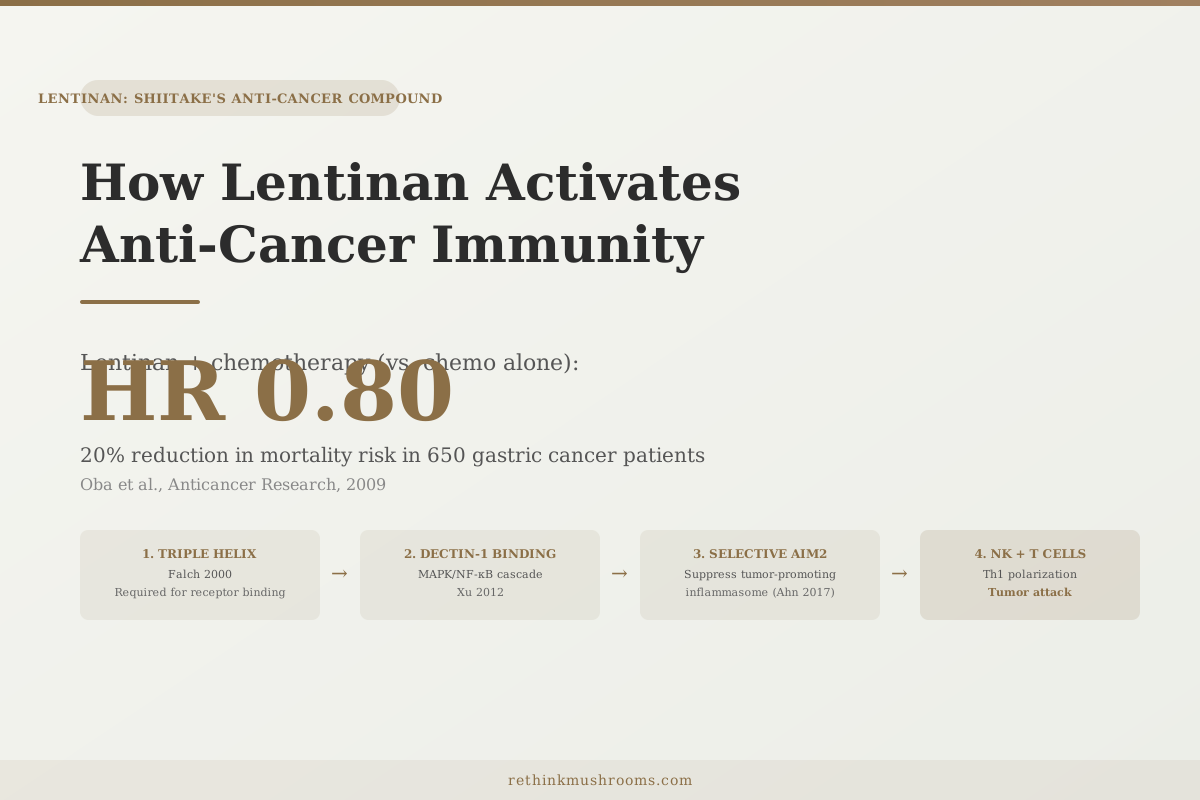
0.80 HR
Hazard ratio for overall survival in 650 patients with unresectable gastric cancer given lentinan plus chemotherapy vs. chemotherapy alone, representing a 20% reduction in mortality risk driven by immune activation rather than direct tumor killing.
Oba et al. Anticancer Research. 2009
4
distinct immune pathways activated by lentinan: Dectin-1, MAPK, AIM2 inflammasome, Peyer's patch
1985
year lentinan received government approval in Japan as a cancer treatment adjunct
650
individual patients in the landmark Oba 2009 survival meta-analysis
Oba et al. Anticancer Research. 2009
 View as image ↗
Lentinan does not kill cancer cells. This is the first and most important thing to understand about its mechanism. It is not a cytotoxic drug that targets tumor tissue directly. It is an immunomodulator: it works by activating the immune system's own capacity to recognize and attack cancer cells.
This distinction explains why lentinan is studied almost exclusively in combination with chemotherapy rather than as a standalone treatment. The chemo kills cancer cells directly; lentinan recruits and activates the immune cells that support, sustain, and extend that response. The two mechanisms work on different parts of the problem simultaneously.
Understanding how lentinan achieves its immune effects requires starting with its molecular structure, because the structure determines everything that follows.
For the background on lentinan's clinical history and its approval in Japan, see Lentinan: The Shiitake Compound Approved for Cancer Treatment in Japan. For the broader immune effects of whole shiitake mushrooms, see Shiitake and the Immune System: Clinical Trial Results. For the broader context of shiitake's bioactive compounds, see What Is Shiitake Mushroom?.
Key Takeaways
- Lentinan does not kill cancer cells directly. It works by activating macrophages, NK cells, dendritic cells, and T cells in the tumor microenvironment
- The triple helix conformation is required for immunostimulatory activity. Denatured or degraded lentinan loses activity, which is why processing matters for supplements (Falch 2000)
- Lentinan binds Dectin-1 and TLR2/4 receptors on immune cells, triggering MAPK and NF-kB signaling cascades that activate macrophages
- Ahn et al. (2017) showed lentinan selectively suppresses the AIM2 and non-canonical NLRP3 inflammasomes (which promote chronic cancer-supporting inflammation) while preserving pro-inflammatory tumor-killing cytokine production
- A 2024 study revealed a previously unknown oral route: lentinan is absorbed through M cells in intestinal Peyer's patches via Dectin-1, activating lymphatic immune cells without requiring systemic blood absorption
- The immune changes translate to clinical outcomes: Oba 2009 meta-analysis of 650 patients found HR 0.80 for overall survival with lentinan plus chemotherapy vs chemotherapy alone
Start With the Shape: Why the Triple Helix Determines Everything
Lentinan is a beta-1,3-glucan polysaccharide extracted from shiitake mushrooms. Its backbone consists of glucose units linked at the 1,3 positions, with branch points at the 1,6 positions. In solution and in biological tissue, this chain folds into a characteristic triple helix structure, where three polysaccharide chains coil around each other like a molecular rope.
This structure is not incidental. It is required for immunostimulatory activity.
Falch and colleagues demonstrated this directly in a 2000 study in Carbohydrate Research.[1] They tested beta-D-glucans in their native triple-helix form against denatured versions where the triple helix had been disrupted. The native triple helix stimulated cytokine production. The denatured form did not.
The triple helix acts as the molecular signature that immune pattern recognition receptors have evolved to identify. For immune cells, it signals "microbial cell wall," which triggers a defensive response. This is the evolutionary origin of lentinan's immunostimulatory effect: the immune system recognizes the triple helix as a conserved microbial pattern and activates its response accordingly.
The practical implication: lentinan preparations that have been processed with high heat, extreme pH, or aggressive solvents may denature the triple helix and lose activity. This is one reason pharmaceutical-grade injectable lentinan, manufactured under controlled conditions, has the strongest clinical evidence. It is also one reason that oral shiitake supplements vary substantially in activity depending on processing.
The First Gate: How Dectin-1 Recognizes Lentinan
Once lentinan encounters an immune cell, the first interaction is with surface receptors. The primary receptor for beta-1,3-glucans on immune cells is Dectin-1 (dendritic cell-associated C-type lectin-1), a pattern recognition receptor expressed on macrophages, dendritic cells, neutrophils, and other innate immune cells.
Dectin-1 recognizes the beta-1,3-glucan backbone of lentinan's triple helix through a carbohydrate recognition domain. When lentinan binds Dectin-1, it triggers a downstream signaling cascade inside the cell. The primary pathway involves a protein called Syk kinase, which activates PKC-delta, which in turn activates the NF-kB transcription factor. NF-kB then turns on genes for inflammatory cytokines, co-stimulatory molecules, and phagocytic activity.
Lentinan also binds TLR2 and TLR4 (toll-like receptors 2 and 4), which are a different class of pattern recognition receptor. TLR activation synergizes with the Dectin-1/Syk pathway, amplifying the overall immune response. The combination of Dectin-1 + TLR signaling produces a more robust activation than either pathway alone.
The result is macrophage polarization toward an M1 phenotype. M1 macrophages are the "activated" form: they produce pro-inflammatory cytokines, present antigens to T cells, and engage in direct phagocytic killing of tumor cells. Untreated tumors often suppress macrophages into an M2 "anti-inflammatory" phenotype, which supports tumor growth rather than opposing it. Lentinan's Dectin-1/TLR activation counters this tumor-induced immune suppression.
Inside the Macrophage: What Happens After Binding
After Dectin-1 and TLR binding, the downstream effects inside macrophages are not simply "more inflammation." Xu and colleagues characterized the specific MAPK pathway response in a 2012 Journal of Biological Chemistry study using lentinan on macrophages stimulated with bacterial lipopolysaccharide (LPS).[2]
They found that lentinan inhibited both nitric oxide (NO) production and TNF-alpha release in activated macrophages, mediated through suppression of the MAPK (mitogen-activated protein kinase) signaling pathway. The MAPK family includes ERK, JNK, and p38, which are central regulators of macrophage inflammatory gene expression.
At first glance, this appears contradictory: if lentinan suppresses TNF-alpha and NO in macrophages, is it actually activating them or inhibiting them? The resolution is that lentinan's MAPK pathway effects are context-dependent. In the LPS-stimulated model used by Xu, lentinan reduces the excessive inflammatory response that can cause tissue damage. In untreated macrophages in a tumor microenvironment, lentinan activates them toward anti-tumor activity.
This context-dependence is actually what makes lentinan therapeutically useful. One of the problems with administering chemotherapy is that the cellular death and tissue damage it causes triggers MAPK-mediated inflammation in macrophages, contributing to treatment side effects. Lentinan's MAPK modulation may reduce this collateral inflammatory damage while still activating tumor-targeting immune functions through other pathways.[2]
The Selective Trick: Suppressing Cancer-Promoting Inflammation
The most mechanistically sophisticated aspect of lentinan's immune effects was described by Ahn and colleagues in Scientific Reports in 2017, and it has received almost no attention in accessible web content.[3]
The researchers examined lentinan's effects on two specific types of inflammasomes. An inflammasome is a multiprotein complex inside immune cells that assembles in response to cellular stress signals, then activates caspase-1, which processes pro-inflammatory proteins (IL-1-beta, IL-18) and triggers pyroptosis (the explosive form of cell death covered in the antcin article).
Two inflammasome types are particularly relevant to cancer: the AIM2 inflammasome and the non-canonical NLRP3 inflammasome. Both are associated with chronic low-grade inflammation of the type that promotes tumor survival and progression. Tumors often create a microenvironment that keeps these inflammasomes persistently activated, producing a background of chronic inflammation that supports angiogenesis (the growth of blood vessels feeding the tumor), immune evasion, and metastasis.
Ahn found that lentinan selectively suppresses both AIM2 and non-canonical NLRP3 inflammasome activation. It reduces the chronic inflammation that tumors exploit. Simultaneously, and this is the key, it induces production of IL-6 and TNF-alpha, the pro-inflammatory cytokines involved in direct anti-tumor immune killing.
In plain terms: lentinan turns down the chronic smoldering inflammation that helps tumors grow while turning up the acute activated inflammation that helps immune cells attack them. This is selectivity that crude immune stimulators do not have.[3]
This mechanism provides a partial explanation for why lentinan seems to reduce chemotherapy side effects in clinical studies: it is suppressing some of the damage-response inflammation that chemotherapy triggers (AIM2/non-canonical NLRP3) while preserving the tumor-killing immune activation.
The End Result: Which Immune Cells Get Activated
The downstream consequences of Dectin-1 binding, MAPK modulation, and inflammasome selectivity translate into specific immune cell changes.
NK cells (natural killer cells) are innate immune cells that can directly kill tumor cells without requiring prior sensitization, making them important in early anti-tumor responses. Lentinan activates NK cells through cytokine signaling from lentinan-stimulated macrophages and dendritic cells: IL-12 and IL-18 produced by activated macrophages stimulate NK cell activity.
T cell populations shift. Lentinan tends to drive the immune system toward a Th1 (T helper 1) dominant phenotype, which favors cell-mediated immunity and direct cytotoxic T lymphocyte (CTL) activity against tumor cells. Many tumors suppress the immune system toward a Th2-dominant phenotype, which is less effective at killing cancer cells and more associated with regulatory immune responses that protect tumors. The Th1 shift moves the microenvironment toward a more tumor-hostile configuration.
CD4+ to CD8+ ratio changes: CD4+ cells are T helper cells that coordinate immune responses; CD8+ cells are cytotoxic T cells that directly kill tumor cells. Lentinan treatment in clinical studies has been associated with increases in the CD4+:CD8+ ratio, consistent with improved immune coordination for anti-tumor activity.
These immune changes are the cellular mechanism behind the survival statistics. The Oba 2009 meta-analysis of 650 patients with unresectable or recurrent gastric cancer found that lentinan added to fluoropyrimidine chemotherapy produced a hazard ratio of 0.80 for overall survival (95% CI 0.68-0.95) compared to chemotherapy alone.[5] A 20% reduction in the risk of death is the measurable clinical consequence of the macrophage activation, NK cell induction, and Th1 shift.
The Oral Route: A Mechanism That Explains What "Poor Bioavailability" Misses
The conventional statement about oral lentinan is that it has poor bioavailability. Lentinan is a large polysaccharide that is not efficiently absorbed through the gut into systemic circulation. This is true. Most clinical evidence uses injectable lentinan precisely because the systemic delivery is direct.
But a 2024 study in Carbohydrate Polymers by Wang and colleagues revealed a mechanism for oral lentinan immunomodulation that the "poor bioavailability" framing entirely misses.[4]
Wang's team found that oral lentinan is absorbed through M cells in Peyer's patches, which are specialized immune tissue structures embedded in the lining of the small intestine. M cells are designed to sample luminal contents and shuttle them into the underlying immune tissue without requiring passage through normal epithelial absorption. In Peyer's patches, Dectin-1 is expressed on CD11c+ mononuclear phagocytes (including dendritic cells and macrophages). These cells take up lentinan delivered by M cells and activate in response.
The downstream effect documented in Wang 2024: lentinan in Peyer's patches modulates the Dectin-1/ILC3 (innate lymphoid cell 3) axis, leading to IL-22 secretion. IL-22 strengthens the intestinal barrier. This is a different mechanism from systemic injection, but it is still an immune activation effect mediated by the same Dectin-1 receptor.
This finding has two implications. First, oral lentinan is not inactive simply because it does not reach high systemic blood concentrations. It activates a distinct branch of the mucosal immune system. Second, the framing should shift from "oral bioavailability is poor" to "oral and injectable lentinan work through different mechanisms": intestinal innate immune activation versus systemic adaptive immune activation.[4]
For a full comparison of injectable and oral forms including clinical evidence for each, see Lentinan for Cancer: Injectable vs. Oral Forms.
What We Know and What the Data Doesn't Yet Cover
The mechanistic picture for lentinan is more detailed than for almost any other medicinal mushroom compound. The triple helix requirement, Dectin-1 binding, MAPK modulation, selective inflammasome suppression, and the oral Peyer's patch route are all documented in peer-reviewed research.
The clinical translation is less complete. Most of the mechanism work is preclinical. The survival benefit in the Oba 2009 meta-analysis confirms the mechanism leads to real outcomes, but the specific contribution of each pathway (which immune changes matter most for survival) has not been isolated in humans.
The PD-1/PD-L1 axis, which is the target of modern checkpoint inhibitor immunotherapy drugs, represents an unexplored angle. Lentinan's Th1-driving and NK cell-activating effects are theoretically synergistic with checkpoint inhibitors, which work by removing the "don't attack me" signal that tumors use to switch off T cells. Combining lentinan with checkpoint inhibitor therapy would engage complementary mechanisms. As of 2024, this has not been tested in clinical trials.
For the full clinical outcomes data, including the 2024 meta-analysis of 31 RCTs and 2,729 patients, see Lentinan Clinical Trials in Gastric Cancer: Results and Outcomes. For how lentinan synergizes with specific chemotherapy regimens and reduces adverse events, see Lentinan and Chemotherapy: Synergistic Effects on Survival.
For comparison with PSK (krestin), the other Japanese government-approved mushroom cancer compound from turkey tail, see PSK vs. PSP: Comparing Turkey Tail's Two Star Compounds.
The Bottom Line
Lentinan works through four documented immune mechanisms: Dectin-1 and TLR binding triggers macrophage activation (MAPK pathway); selective AIM2 and non-canonical NLRP3 inflammasome suppression reduces cancer-promoting chronic inflammation while preserving tumor-killing cytokine production (Ahn 2017); downstream NK cell activation and Th1 polarization create a more tumor-hostile immune microenvironment; and oral lentinan reaches immune cells through Peyer's patch M cells and Dectin-1 signaling, a distinct mucosal route documented in 2024. These mechanisms translate to a measured HR of 0.80 for overall survival in the Oba 2009 meta-analysis of 650 gastric cancer patients. The triple helix conformation of lentinan is required for all receptor-mediated activity.
Frequently Asked Questions
Sources & References
- 1. Source details for this reference are not yet available.
- 2. Source details for this reference are not yet available.
- 3. Source details for this reference are not yet available.
- 4. Source details for this reference are not yet available.
- 5. Source details for this reference are not yet available.