Shiitake Mushrooms
31 randomized trials confirm lentinan improves gastric cancer treatment response
A 2024 systematic review and meta-analysis covering 31 randomized controlled trials and 2,729 patients found injectable lentinan combined with chemotherapy improved treatment response with a relative risk of 1.48 compared to chemotherapy alone.
Wang et al., 2024
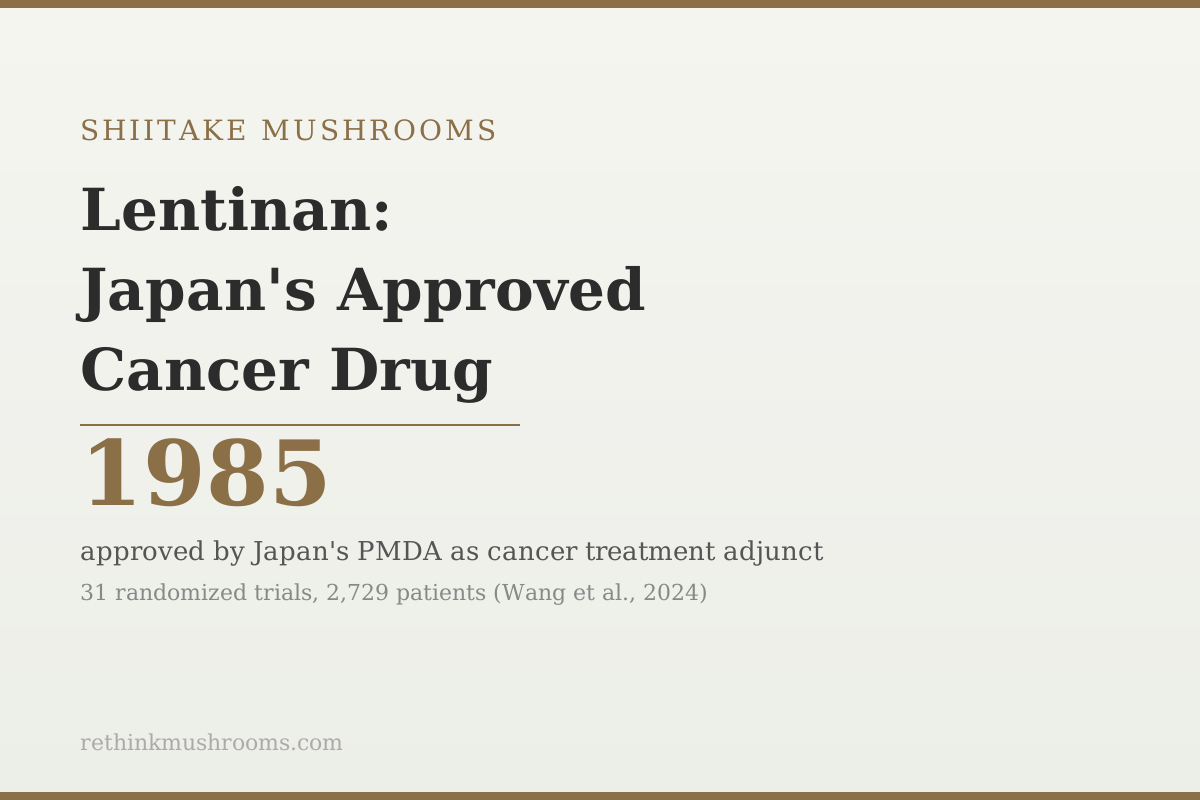
1985
the year Japan's PMDA approved injectable lentinan (produced by Ajinomoto) as an adjunct for gastric cancer, making it one of the earliest approved biological response modifiers in oncology (Ina, 2013)
12 years
of Chinese lung cancer clinical data reviewed by Zhang et al. (2018), establishing benefit beyond the original gastric cancer indication
Triple helix
the three-dimensional conformation that beta-1,3-glucan must maintain to stimulate cytokine production; denaturation by heat or processing destroys this activity (Falch et al., 2000)
Wang et al., 2024
 View as image ↗
In 1985, Japan's pharmaceutical regulatory authority approved a compound derived from shiitake mushrooms as an injectable cancer treatment adjunct. The compound was lentinan, a beta-1,3-glucan polysaccharide manufactured by Ajinomoto. It has been used in Japanese oncology ever since, combined with standard chemotherapy for gastric cancer. Most clinicians outside Japan have never heard of it.
Four decades later, a 2024 systematic review and meta-analysis of 31 randomized controlled trials covering 2,729 patients confirmed what Japanese oncologists had been observing since the 1980s: lentinan combined with chemotherapy consistently improves treatment outcomes compared to chemotherapy alone. The evidence base is now among the largest for any mushroom-derived pharmaceutical compound. For the broader shiitake context, see what is shiitake mushroom: the culinary mushroom with medicinal power.
Key Takeaways
- Lentinan is a beta-1,3-glucan polysaccharide from shiitake (Lentinula edodes) approved in Japan in 1985 as an injectable cancer treatment adjunct; it is the only shiitake-derived compound to receive pharmaceutical drug approval (Ina, 2013)
- A 2024 meta-analysis of 31 randomized trials with 2,729 gastric cancer patients found lentinan plus chemotherapy improved treatment response (RR 1.48) and 1-year survival compared to chemotherapy alone (Wang et al., 2024)
- A 2017 meta-analysis covering 1,423 patients found 1-year survival improvement (RR 1.46) and a 27% reduction in severe adverse events (RR 0.73) with the lentinan-chemotherapy combination (Wang et al., 2017)
- Oba and colleagues (2009) conducted an individual patient data meta-analysis of lentinan for unresectable and recurrent gastric cancer, providing patient-level evidence rather than trial-aggregate statistics
- Zhang et al.'s 2018 review of 12 years of Chinese lung cancer trials established that lentinan's benefit extends to non-gastric cancer, reflecting its mechanism-based rather than tumor-type-specific immune activation
- Lentinan's cytokine-stimulating activity requires maintaining its triple-helix conformation; processing or heat that denatures this structure destroys biological activity (Falch et al., 2000), with direct implications for oral supplement quality
What Lentinan Is: The Beta-Glucan That Requires a Triple-Helix Structure
Lentinan is a beta-1,3-glucan polysaccharide extracted from the fruiting body of shiitake mushrooms (Lentinula edodes). In basic chemistry it belongs to the same broad category as beta-glucans found in oats, yeast, and other medicinal mushrooms. What distinguishes lentinan is a specific structural feature that determines whether it actually does anything biologically useful.
The critical property is the triple helix. Beta-1,3-glucan chains can coil into a triple-helix conformation in which three polysaccharide strands wind around each other, similar in concept to the triple helix of collagen. Falch and colleagues demonstrated in 2000 that this triple-helix conformation is required for cytokine-stimulating activity.[6] When the triple helix is disrupted by heat processing, chemical extraction, or denaturation, the compound loses immune-stimulating activity even though its chemical composition remains unchanged. The molecule is still present. The shape that makes it functional is gone.
This structural requirement has a direct practical implication that most supplement coverage ignores. Injectable pharmaceutical lentinan maintains the triple-helix conformation by design; the manufacturing process specifically preserves it. Oral supplements containing shiitake beta-glucan may or may not preserve this structure depending on extraction and processing methods. The clinical evidence for lentinan's cancer benefits comes almost entirely from the injectable pharmaceutical form. Assuming oral supplement activity matches the injected pharmaceutical form tested in trials is an assumption without direct evidence to support it.
Japan 1985: The Approval That Western Medicine Mostly Missed
The story of lentinan's approval is the story of a different research tradition running parallel to Western oncology.
Japanese cancer research in the 1970s and 1980s pursued biological response modifiers with institutional support that had no equivalent in the United States at the time. While Western oncology concentrated on cytotoxic chemotherapy, the Japanese clinical research system was investigating whether compounds from natural sources could modulate immune function in ways that complemented direct cancer-cell killing. This was not fringe science; it was a funded government-supported research program conducted within academic medical centers.
Ina and colleagues, in a 2013 review covering three decades of lentinan use in gastric cancer treatment, documented the historical arc: PMDA approval in 1985, manufacture by Ajinomoto, intravenous and intramuscular administration alongside chemotherapy for gastric cancer.[1] Gastric cancer was the primary approved indication because that is where the Japanese trial program was most concentrated, not because lentinan's mechanism is specific to gastric tumors.
The 1985 approval predated modern systematic review methods. The supporting evidence consisted of individual randomized trials and prospective cohort data rather than the pooled meta-analyses that characterize current evidence standards. What the Japanese clinical community observed was consistent enough across multiple independent trials to satisfy PMDA: patients receiving lentinan alongside chemotherapy did better than patients receiving chemotherapy alone, with an acceptable safety profile. Lentinan joined PSK (polysaccharide-K, extracted from turkey tail) as one of two mushroom-derived compounds to receive formal oncological drug approval in Japan. For the PSK story, see PSK vs. PSP: comparing turkey tail's two star compounds.
The 2024 Meta-Analysis: The Most Current and Comprehensive Evidence
The 2024 systematic review by Wang and colleagues represents the current top of the evidence pyramid for lentinan in cancer treatment.[5]
The meta-analysis covered 31 randomized controlled trials with 2,729 gastric cancer patients. Pooling data from 31 independent trials produces statistical confidence that no individual study can achieve. The primary finding: lentinan combined with chemotherapy improved treatment response rate with a relative risk of 1.48 compared to chemotherapy alone. Patients receiving the combination were 48% more likely to show measurable treatment response than those receiving chemotherapy without lentinan. The meta-analysis also found improvement in 1-year survival rates for the combination group.
An earlier 2017 Wang meta-analysis, covering 1,423 patients, found a 1-year survival relative risk of 1.46 and a relative risk of 0.73 for severe adverse events.[3] The adverse event reduction is clinically meaningful independent of any survival benefit: patients in lentinan groups experienced 27% fewer severe treatment-related adverse events. Severe adverse events limit tolerable chemotherapy doses and interrupt treatment schedules. An adjuvant that reduces this rate improves not only quality of life but also the practical ability to complete chemotherapy courses.
For a full breakdown of how the chemotherapy synergy works mechanistically, and what specific survival numbers look like from individual trials, see lentinan and chemotherapy: synergistic effects on survival.
Individual Patient Data: Oba 2009
Trial-level meta-analyses pool published summary statistics from multiple studies. Individual patient data meta-analyses go further: they re-analyze the raw data from each individual patient in each contributing trial. This produces more precise estimates and allows analysis of subgroups that aggregate statistics cannot distinguish.
Oba and colleagues (2009) conducted an individual patient data meta-analysis of lentinan for unresectable and recurrent gastric cancer, the highest-risk patient population within the gastric cancer indication.[2] Unresectable gastric cancer means the tumor cannot be surgically removed. Recurrent gastric cancer has returned after initial treatment. Both categories represent situations where standard treatment options are limited.
This patient-level analysis confirmed the benefit signal seen in trial-aggregate meta-analyses, providing evidence that held up under the more rigorous scrutiny that individual patient data enables. The consistency of the finding across this higher-acuity population strengthens the overall evidence picture for the gastric cancer indication.
Beyond Gastric Cancer: 12 Years of Chinese Lung Cancer Data
The Japanese lentinan trial program concentrated on gastric cancer because that is where approval was granted and where clinical infrastructure was established. The underlying mechanism (immune activation through beta-glucan receptor pathways on immune cells) is not intrinsically gastric-specific.
Zhang and colleagues (2018) reviewed 12 years of clinical studies using lentinan for lung cancer in China, covering both non-small cell and small cell lung cancer trials.[4] This review established that lentinan produces consistent benefit in lung cancer patients when added to chemotherapy, with improved treatment response rates and quality-of-life measures across the 12-year dataset.
The significance of the Chinese lung cancer data is partially about cancer type and partially about independence. The Japanese gastric cancer program and the Chinese lung cancer program developed in different countries, in different clinical systems, testing the same compound in a different tumor type, and arrived at the same conclusion. Independent confirmation of benefit across cancer types and across national research programs represents stronger evidence than a single-country, single-indication dataset could provide.
How Lentinan Activates the Immune System Against Tumors
Lentinan does not kill cancer cells directly. Its mechanism is immunological: it activates immune cells that attack tumors through recognition rather than chemical toxicity.
The primary entry point is pattern recognition. Immune cells carry surface receptors, specifically Dectin-1 and Toll-like receptors, that evolved to detect pathogens. The triple-helix beta-1,3-glucan structure of lentinan activates these receptors, triggering a cascade: receptor binding leads to dendritic cell maturation, matured dendritic cells prime CD8-positive cytotoxic T cells, and natural killer cells are activated to target tumor cells through immune recognition. This is additive to chemotherapy's direct cytotoxicity; the two mechanisms attack the tumor through different pathways simultaneously.
The immunological picture includes a selective anti-inflammatory dimension. Ahn and colleagues (2017) showed that lentinan specifically attenuates AIM2 and non-canonical inflammasomes, the sensor complexes associated with the chronic sterile inflammation that promotes tumor progression, while simultaneously inducing the pro-inflammatory cytokines that help immune cells recognize tumors.[7] This means lentinan is not a simple immune stimulant; it specifically blocks the inflammatory circuits that help tumors establish themselves while preserving the immune surveillance that fights them. For the complete selective modulation story, see lentinan and inflammatory cytokine modulation.
Why the US Classifies Lentinan as a Supplement, Not a Drug
Lentinan is classified as a dietary supplement in the United States under the Dietary Supplement Health and Education Act (DSHEA). It is not an FDA-approved drug. This regulatory gap confuses people who know the Japanese evidence, but the explanation is straightforward.
FDA drug approval requires a sponsor, typically a pharmaceutical company, to submit clinical trial data specifically meeting FDA standards and formally apply for approval. The data requirements include at least two adequate and well-controlled studies, typically from large randomized trials in populations that meet FDA enrollment standards. The sponsor bears the cost of generating this data and navigating the approval process.
The Japanese lentinan evidence, substantial as it is, was generated within Japan's PMDA regulatory framework. It meets PMDA's standards for approval, but it does not automatically satisfy FDA standards, which require data submitted specifically for FDA review. No US pharmaceutical company has sought FDA approval for injectable lentinan. Without a sponsor willing to fund the FDA application process, the approval pathway has never been formally initiated.
In Japan, lentinan is a prescription drug administered by injection in oncology settings. In the United States, lentinan-containing products are sold as oral dietary supplements with no therapeutic claims permitted. The clinical evidence base concerns the injectable pharmaceutical form. Oral supplement formulations have not been tested in the randomized trials that established efficacy, and the triple-helix structural requirement identified by Falch et al. (2000) raises legitimate questions about whether the oral form preserves the bioactive conformation.
This gap between evidence and regulatory status reflects the economics of drug approval, not the strength of the evidence for lentinan itself.
The Bottom Line
Lentinan is a beta-1,3-glucan from shiitake approved in Japan in 1985 as an injectable cancer treatment adjunct, supported by four decades of clinical evidence. The 2024 Wang meta-analysis of 31 randomized trials with 2,729 patients found treatment response improvement (RR 1.48); the 2017 Wang meta-analysis of 1,423 patients found survival improvement (RR 1.46) and 27% adverse event reduction (RR 0.73). Oba (2009) confirmed benefit using individual patient-level data in unresectable gastric cancer. Zhang (2018) established benefit across 12 years of Chinese lung cancer trials. FDA approval has not been pursued by any US sponsor; the regulatory gap reflects trial sponsorship economics, not evidence quality. The triple-helix structural requirement (Falch 2000) means oral supplement bioactivity cannot be assumed equivalent to the injectable form studied in trials.
Frequently Asked Questions
Sources & References
- 1. Source details for this reference are not yet available.
- 2. Source details for this reference are not yet available.
- 3. Source details for this reference are not yet available.
- 4. Source details for this reference are not yet available.
- 5. Source details for this reference are not yet available.
- 6. Source details for this reference are not yet available.
- 7. Source details for this reference are not yet available.