Turkey Tail Mushroom
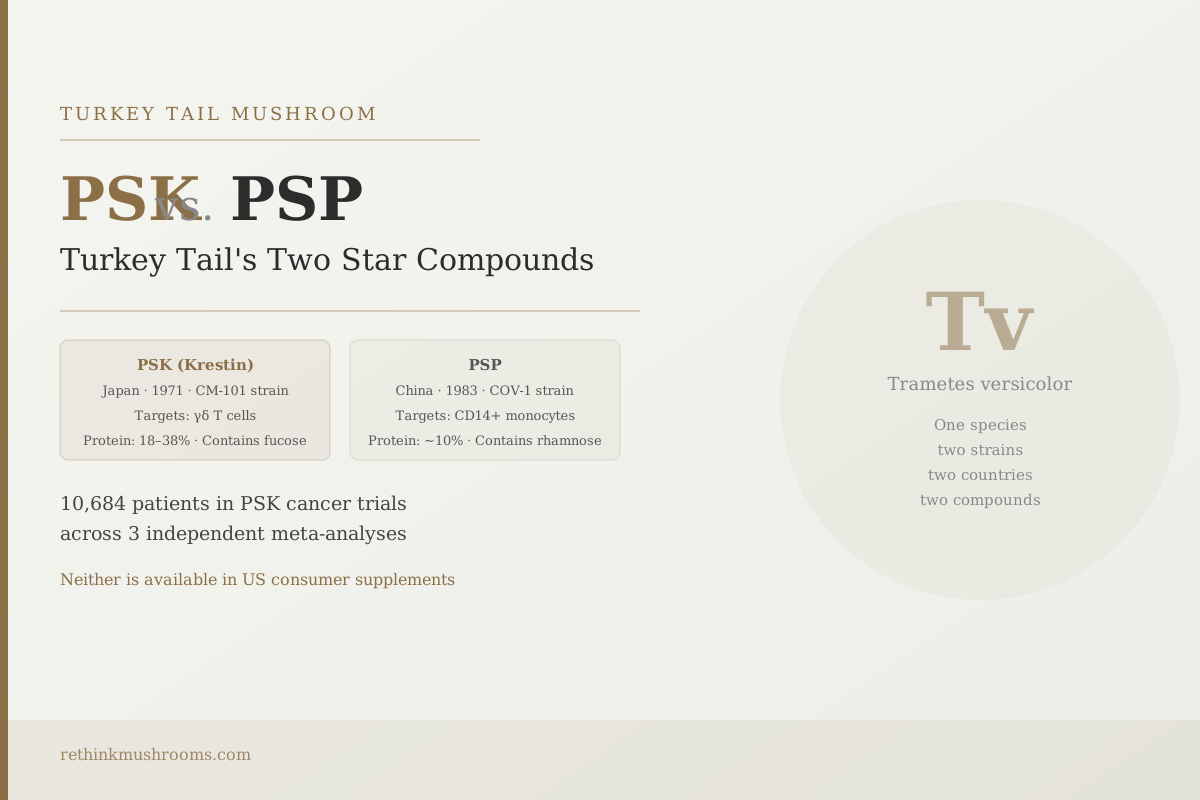
10,684 patients in the largest PSK meta-analysis
PSK has been tested in more cancer patients than any other mushroom compound. PSP, isolated a decade later in China from a different strain, targets entirely different immune cells. They are not interchangeable — and neither is what's in your supplement.
Ma et al., Oncotarget, 2017
1971 vs 1983
PSK isolated in Japan; PSP isolated in China — from different T. versicolor strains, developed independently a decade apart
γδ T cells vs monocytes
PSK's primary immune cell target vs PSP's — a fundamentally different entry point into the immune system
Not in supplements
PSK (Krestin) is a proprietary pharmaceutical from Kureha Corporation — it cannot be found in consumer turkey tail supplements
Ma et al., Oncotarget, 2017
 View as image ↗
Turkey tail mushroom is often described as containing "PSK and PSP" as if these are two versions of the same thing. They aren't. PSK and PSP are distinct molecular compounds, isolated from different strains of the same mushroom in different countries, with different protein contents, different sugar compositions, different primary immune cell targets, and evidence bases so unequal that comparing them requires separate sections.
If you've read anything about turkey tail mushroom's clinical evidence, you were almost certainly reading about PSK. If you've purchased a turkey tail supplement, you almost certainly don't have either compound in its pharmaceutical-grade form. Understanding the difference matters — both for interpreting the research and for knowing what's actually in a bottle.
For the broader picture of turkey tail's biology and research history, see the overview of turkey tail mushroom.
Key Takeaways
- PSK (polysaccharide K) and PSP (polysaccharide peptide) come from different Trametes versicolor strains: CM-101, isolated in Japan (1971, Kureha Corporation), produced PSK; COV-1, selected in China in the early 1980s, produced PSP — they were developed independently a decade apart
- The compounds differ structurally: PSK contains fucose as a sugar side chain with 18–38% protein content; PSP contains rhamnose and arabinose with approximately 10% protein — both share a beta-1,4 glucan molecular backbone, and both sit at roughly 100 kDa, so molecular size is not what separates them (Łysakowska 2023)
- PSK's best-characterised immune mechanism runs through gamma-delta T cells — a specialized class of immune cell that patrols body tissues; depleting these cells during treatment attenuated PSK's anti-tumor effect in mouse models, identifying them as a contributing rather than sole mediator (Inatsuka 2013)
- PSP selectively increased CD14+ monocyte numbers in resting human blood cell cultures, while T cell, NK cell and B cell populations were unchanged — a different immune entry point from PSK's, though demonstrated only in vitro (Sekhon 2013)
- The clinical evidence asymmetry is substantial, but the three PSK meta-analyses overlap heavily rather than stacking: they re-pool the same Japanese adjuvant trial programme, so the defensible headline is the largest single pool of 10,684 patients — not the ~20,000 sum often quoted
- An independent Cochrane review of the same colorectal trials graded the five-year survival benefit as small and low-certainty (RR 1.08, 95% CI 1.01–1.15), and rated the adverse-event evidence very low certainty (Pilkington 2022)
- PSK (marketed as Krestin) is a proprietary pharmaceutical made exclusively by Kureha Corporation in Japan; it is not commercially available in consumer supplement markets and cannot be replicated in a whole-mushroom supplement
One Mushroom, Two Countries, Two Strains: The Origin Story Nobody Covers
PSK and PSP are not variations of the same discovery. They are the products of entirely separate research programs, started a decade apart, on different continents, from different strains of the same mushroom species.
The Japanese work grew out of a broader late-1960s research effort, running across several Japanese institutions, to screen mushroom extracts for antitumor activity in animal models. Kureha Corporation, a Japanese chemical company, pursued Trametes versicolor specifically. Kureha isolated a strain they designated CM-101, and from it extracted and purified the compound that became PSK — polysaccharide K — in 1971. The name reflects its origin: the K is for Kureha. By 1977, Japan's Ministry of Health had approved PSK as an adjuvant cancer treatment under the brand name Krestin.[4]
In China, entirely separately, researchers were working with a different selected strain of Trametes versicolor: COV-1. A protein-bound polysaccharide was isolated from COV-1 in the early 1980s — commonly dated to 1983 — and named PSP, polysaccharide peptide. China approved PSP for clinical use in 1987 following a series of clinical trials.
The parallel development is important context for interpreting the compounds' properties. PSK and PSP were not variants of each other — they were independent discoveries from different starting material. The fact that they share a similar broad structure is a consequence of coming from the same mushroom species, not from shared research.
For the full history of turkey tail in traditional medicine before either compound was isolated, see turkey tail in traditional medicine.
How They're Built Differently: The Structural Comparison
Both PSK and PSP are protein-bound polysaccharides. A polysaccharide is a long chain of sugar molecules; when a protein is bound to this chain, the compound becomes a glycoprotein with a structure that immune cells can recognize and respond to.
The shared molecular backbone is a beta-1,4 glucan chain — a specific way glucose molecules link together that forms the primary structural spine of both compounds. Both also have branching side chains at the beta-1,3 and beta-1,6 positions along this spine.
Where they differ:
Protein content: PSK contains 18–38% protein by weight; PSP contains approximately 10% protein. This is a meaningful difference because the protein component contributes to the compound's interaction with immune receptors.
Sugar side chains: This is the most structurally specific difference. PSK's side chains contain fucose — a six-carbon sugar that appears in a range of important immune recognition molecules in the human body. PSP's side chains contain rhamnose and arabinose instead. These are different sugars with different shapes, meaning PSK and PSP present differently to the immune cell receptors that recognize carbohydrate structures.
Molecular weight — not actually a difference: PSK is reported at roughly 94–100 kilodaltons (a measure of molecular size), and PSP at approximately 100 kilodaltons. Despite frequent claims that one is the larger or more concentrated molecule, the two are of comparable size. Molecular weight is not what separates them; composition is.
These structural differences, documented in detail by Łysakowska and colleagues in their 2023 review of medicinal mushroom bioactive compounds, are likely responsible for the compounds' different primary immune cell targets.[7]
Shared Backbone, Divergent Chemistry
Where PSK and PSP Actually Split
Both compounds are protein-bound polysaccharides built on the same glucan spine. Everything below the spine is where they diverge — except molecular weight, which is the property most often cited as a difference and is not one.
Common to both
Beta-1,4 glucan main chain, with beta-1,3 and beta-1,6 side branching. Protein bound to the polysaccharide in both cases.
Japan · pharmaceutical (Krestin)
PSK — Polysaccharide K
Source strain
CM-101
Isolated
Japan, 1971 (Kureha Corporation)
Protein content
18–38% by weight
Distinctive sugar
Fucose
Molecular weight
~94–100 kDa
Primary cell target
Gamma-delta T cells
Evidence for that target
Mouse splenocytes + in vivo tumour models
China · pharmaceutical (approved 1987)
PSP — Polysaccharide Peptide
Source strain
COV-1
Isolated
China, early 1980s
Protein content
~10% by weight
Distinctive sugar
Rhamnose and arabinose
Molecular weight
~100 kDa
Primary cell target
CD14+ monocytes
Evidence for that target
Resting human PBMC, in vitro
The greyed row is the correction. PSK is frequently described as the larger or “more concentrated” molecule and PSP as a lighter fragment of it; both sit at roughly 100 kDa. What separates them is composition — the fucose side chain and the much higher protein fraction in PSK — and, downstream of that, which immune cell each one engages first. Note also that the two mechanistic findings are not measured on the same footing: PSK’s target was tested in live tumour-bearing animals, PSP’s in a dish.
Sources: Łysakowska et al., Molecules, 2023 [ref 7]; Inatsuka et al., Cancer Immunol Immunother, 2013 [ref 5]; Sekhon et al., Food Chemistry, 2013 [ref 6].
The structural differences and beta-glucan signaling mechanisms are explored in depth in the companion article on turkey tail bioactive compounds: PSK, PSP, and beta-glucans. For the broader context of how beta-glucan structures signal the immune system, see how 1,3/1,6 beta-glucans activate your immune system.
Side-by-Side Comparison
| Feature | PSK (Polysaccharide K) | PSP (Polysaccharide Peptide) |
|---|---|---|
| Source strain | CM-101 (Trametes versicolor) | COV-1 (Trametes versicolor) |
| Country of origin | Japan (Kureha Corporation) | China |
| Year isolated | 1971 | Early 1980s (commonly 1983) |
| Protein content | 18–38% | ~10% |
| Distinctive sugar | Fucose | Rhamnose, arabinose |
| Molecular weight | ~94–100 kDa | ~100 kDa (comparable) |
| Primary immune target | Gamma-delta T cells | CD14+ monocytes |
| Level of that evidence | In vivo tumor models | In vitro human blood cells |
| Regulatory status | Approved pharmaceutical (Japan, 1977) | Approved for clinical use (China, 1987) |
| Available in US supplements? | No — proprietary pharmaceutical | No — pharmaceutical-grade not available |
| Cancer clinical data | 3 overlapping meta-analyses; largest pool 10,684 | Limited clinical trial data |
| Brand name | Krestin | — |
PSK's Immune Mechanism: Gamma-Delta T Cells and the Anti-Tumor Effect
Maehara and colleagues published a comprehensive review of PSK's biological mechanism in Surgery Today in 2012, covering four decades of research by the time of publication.[4] Three overlapping mechanisms emerged from the research program:
First, PSK reverses immunosuppression. Many cancers secrete transforming growth factor-beta (a signaling molecule that instructs immune cells to stand down), which suppresses the body's ability to attack tumor cells. PSK counteracts this suppression, allowing the immune system to resume anti-tumor activity that the cancer has effectively put on pause.
Second, PSK actively stimulates anti-tumor immunity. It promotes the maturation of dendritic cells — the immune system's surveillance coordinators that teach T cells what to attack. It also shifts the balance between different types of immune response (the Th1/Th2 balance) toward the type better suited for fighting tumors, and promotes interleukin-15 production by monocytes.
Third, and most mechanistically specific: Inatsuka and colleagues demonstrated in 2013 that PSK activates gamma-delta T cells.[5]
In the Inatsuka study, PSK stimulated gamma-delta T cells to produce interferon-gamma (a cytokine that signals cancer-fighting activity) and to upregulate the activation markers CD25, CD69 and CD107a. Optimal activation required direct cell-to-cell contact with dendritic cells, and the activated gamma-delta T cells in turn stimulated those dendritic cells to produce more IL-12 — a reciprocal loop. Critically, when researchers depleted gamma-delta T cells during PSK treatment in tumor-bearing mice, PSK's anti-tumor effect was attenuated.
That word matters. The effect was reduced, not abolished. The authors' own conclusion is that gamma-delta T cells "contribute to" PSK's anti-tumor effect — they are one meaningful mediator among several, which is consistent with the multiple parallel mechanisms Maehara's review describes. Sources that describe PSK's benefit as depending on gamma-delta T cells, or as disappearing entirely without them, overstate what this experiment showed.
Inatsuka et al. (2013) · Cancer Immunology, Immunotherapy
- Population
- Mouse splenocytes in vitro; tumor-bearing mice in vivo
- Intervention
- Polysaccharide K (PSK), with and without gamma-delta T cell depletion
- Comparator
- Untreated controls; co-culture vs trans-well systems to test contact dependence
- Finding
- Gamma-delta T cells produced IFN-gamma and upregulated CD25, CD69 and CD107a after PSK treatment. Optimal activation required direct contact with dendritic cells. In vivo, PSK activated gamma-delta T cells among tumor-infiltrating lymphocytes, and depleting those cells during treatment attenuated PSK's anti-tumor effect.
positive A clean mechanistic result, but entirely in mice. Depletion attenuated rather than abolished the effect, so gamma-delta T cells are a contributing mediator, not the sole one. Nothing here was measured in humans.
Inatsuka et al., Cancer Immunology, Immunotherapy, 2013 [ref 5]
PSP's Immune Mechanism: Monocytes and a Different Entry Point
Sekhon and colleagues investigated PSP's primary immune cell target in 2013, using peripheral blood mononuclear cells from healthy human volunteers.[6]
Their finding was specific and narrow. Working with resting immune cells — deliberately skipping the phytohaemagglutinin pre-stimulation step common in this kind of experiment — they found that PSP significantly increased the number of CD14+/CD16− monocytes compared with controls. The result held up when confirmed with a second antibody panel. Monocytes are innate immune cells that circulate in the blood and differentiate into macrophages and dendritic cells when they move into tissues; the CD14 surface marker identifies the mature monocyte population.
What makes the result interesting is what did not change: proliferation of T cells, NK cells and B cells was not significantly affected by PSP. The effect was selective for the monocyte compartment, which is a different immune entry point from the T-cell and NK-cell activity documented in the PSK literature.
Two limits are worth stating plainly, because they are routinely dropped when this study is cited. First, this was an in vitro study on cells in a dish — not a clinical trial, and not an animal tumor model. Second, the measured outcome was monocyte number, not a downstream functional result: the study did not report cytokine output or a dose-response curve, and claims that it did are not supported by the paper.
Sekhon et al. (2013) · Food Chemistry
- Population
- Peripheral blood mononuclear cells from healthy human volunteers, tested at rest (no phytohaemagglutinin pre-stimulation)
- Intervention
- Polysaccharopeptide (PSP) from Coriolus versicolor, characterised by capillary electrophoresis fingerprinting
- Comparator
- Untreated controls, and parallel cultures with prior PHA stimulation
- Finding
- PSP significantly increased the number of CD14+/CD16− monocytes versus controls, confirmed with a second antibody panel (CD14 and MHCII). Proliferation of T cells, NK cells and B cells was not significantly changed — the effect was selective for the monocyte compartment.
narrow-scope A clean, selective in vitro result — and that is its ceiling. Cells in a dish, not an animal model or a patient. The measured outcome was monocyte number; the study did not report cytokine output or a dose-response curve, though it is frequently cited as if it did.
Sekhon et al., Food Chemistry, 2013 [ref 6]
The different primary targets — gamma-delta T cells for PSK versus monocytes for PSP — suggest these compounds engage the immune system at different points in the activation cascade. PSP may prime innate immunity (the rapid, non-specific first response) while PSK operates across both innate and adaptive arms. Whether this difference translates into complementary clinical applications is not established, and the two findings are not on equal evidentiary footing: PSK's was demonstrated in living tumor-bearing animals, PSP's in cultured human cells.
The Evidence Gap: Three Meta-Analyses vs Much Less
The clinical evidence for PSK is among the largest bodies of trial data for any mushroom compound. It is assembled across three meta-analyses published over a decade — but those three are not independent samples of different patients, and reading them as such inflates the apparent evidence base considerably.
Sakamoto and colleagues published the first major PSK meta-analysis in Cancer Immunology and Immunotherapy in 2006, pooling data from three centrally randomized controlled trials covering 1,094 patients with curatively resected colorectal cancer.[1] PSK added to chemotherapy improved 5-year disease-free survival (risk ratio 0.72, 95% CI 0.58–0.90) and overall survival (risk ratio 0.71, 95% CI 0.55–0.90) compared to chemotherapy alone.
Oba and colleagues expanded to gastric cancer in 2007, pooling eight randomized controlled trials with 8,009 patients.[2] PSK immunochemotherapy improved overall survival with a hazard ratio of 0.88 (95% CI 0.79–0.98) — a 12% reduction in the risk of death at any point during follow-up.
Ma and colleagues published a network meta-analysis in Oncotarget in 2017 covering 23 randomized controlled trials and 10,684 patients with gastrointestinal cancers.[3] PSK combined with chemotherapy significantly increased 1- to 5-year overall survival, with positive trends at 6 and 7 years, and no increase in side effects was observed. The network format allowed comparison across different treatment combinations, and PSK plus chemotherapy ranked among the best-performing adjuvant approaches.
Evidence Accounting
Three Meta-Analyses, Not Three Separate Patient Groups
These pools overlap heavily — they re-analyse the same Japanese adjuvant PSK trial programme. Stacking them produces a patient count that does not exist.
Sakamoto 2006 · Colorectal
1,094 · 3 RCTs
OS 0.71 (0.55–0.90); DFS 0.72 (0.58–0.90)
Oba 2007 · Gastric
8,009 · 8 RCTs
HR 0.88 (0.79–0.98)
Ma 2017 · GI (colorectal, gastric, oesophageal)
10,684 · 23 RCTs
PSK + chemo superior for 1–5 yr OS
The number often quoted
~19,787
1,094 + 8,009 + 10,684, as if each meta-analysis recruited its own cohort.
The defensible number
10,684
The largest single pool (Ma 2017), which already spans colorectal, gastric and oesophageal trials.
Same patients, independent grading
What Cochrane concluded from Sakamoto’s 3 colorectal trials
Five-year survival
RR 1.08 (95% CI 1.01–1.15); 1,094 participants, 3 studies; NNTB 16 (95% CI 9 to 70). Graded low certainty.
Adverse events
Neutropenia, nausea, diarrhoea, fatigue, oral cavity disorders — all graded very low certainty. Cochrane could not tell whether adverse events came from the chemotherapy or the extract.
Applicability caveat
The chemotherapy regimens in these trials “do not reflect current preferred practice.”
Both readings are of the same underlying trials. The meta-analyses report a statistically significant survival benefit; Cochrane, applying GRADE, reports that benefit as small and low-certainty and flags that the trials were run against chemotherapy backbones no longer in standard use. The honest summary of PSK is not “proven in 20,000 patients” — it is a consistent, modest signal in a large but ageing and mostly single-country trial programme.
Sources: Sakamoto et al., Cancer Immunol Immunother, 2006 [ref 1]; Oba et al., Cancer Immunol Immunother, 2007 [ref 2]; Ma et al., Oncotarget, 2017 [ref 3]; Pilkington et al., Cochrane Database of Systematic Reviews, 2022 [ref 8].
What an independent review made of the same trials
The meta-analyses above were led by researchers working within the Japanese PSK research programme. In 2022, a Cochrane review led by Pilkington and colleagues assessed the same question using GRADE, the standard framework for rating certainty of evidence.[8]
Looking at the same 1,094 colorectal patients from the same three trials that Sakamoto pooled, Cochrane found low-certainty evidence of a small survival benefit at five years: risk ratio 1.08 (95% CI 1.01–1.15), with a number needed to benefit of 16 (95% CI 9 to 70). In other words, roughly one additional person out of every 16 treated would be alive at five years — a real effect, but a modest one, and one the reviewers were not confident in. The effect at earlier time points was unclear.
On adverse effects — the reason many patients are interested in Coriolus in the first place — Cochrane rated every outcome as very low certainty, including neutropenia, nausea, diarrhoea, fatigue and oral cavity disorders. The reviewers noted they could not determine whether adverse events were caused by the chemotherapy or by the extract itself. They also flagged that the chemotherapy regimens used in these trials "do not reflect current preferred practice," which limits how far the findings transfer to patients treated today.
Both readings are legitimate, and they are not contradictory: a consistent, statistically significant, modest survival signal in a large but ageing and largely single-country trial programme. What is not accurate is presenting PSK as a compound proven across 20,000 patients with settled certainty.
- Cell studiescompleted
Both compounds. PSP's primary human evidence is here — monocyte selectivity in resting PBMC (Sekhon 2013).
- Animal studiescompleted
PSK extensively, including gamma-delta T cell depletion experiments in tumor-bearing mice (Inatsuka 2013). PSP far less.
- Human case reportscompleted
Not the limiting rung for either compound; both moved to controlled trials in their country of origin.
- Small human trialscompleted
PSK: numerous. PSP: several small Chinese trials, less comprehensively integrated into international literature.
- Large randomised trialscompleted
PSK only — 23 trials pooled by Ma 2017. Mostly conducted in Japan, against chemotherapy regimens no longer in standard use. No comparable PSP programme.
- Meta-analysiscurrent
PSK: three overlapping meta-analyses plus an independent Cochrane review grading the survival benefit low-certainty (Pilkington 2022). PSP: none at this scale.
PSK has climbed the entire ladder — the rare mushroom compound that has. The caveat is not the height reached but the breadth: the trials are concentrated in one country, one era, and chemotherapy backbones that have since changed, and independent GRADE assessment rates the survival benefit as small and low-certainty. PSP has not climbed past the lower rungs, and its most-cited human finding is an in vitro result.
Sakamoto et al., 2006 [ref 1]; Oba et al., 2007 [ref 2]; Ma et al., 2017 [ref 3]; Inatsuka et al., 2013 [ref 5]; Sekhon et al., 2013 [ref 6]; Pilkington et al., 2022 [ref 8]
The PSP clinical evidence base is smaller by a wide margin. Sekhon 2013 provides in vitro mechanistic data, and various smaller trials have shown immune-modulating effects. But PSP has not been the subject of meta-analyses at the scale of the PSK literature. This is partly because PSP's development was separate from Japan's extensive PSK research program, and partly because Chinese clinical trial data from this era is less comprehensively integrated into international literature — an absence of visible evidence, which is not the same thing as evidence of absence.
One area where PSP does have direct human data is the gut. Pallav and colleagues ran a randomized clinical trial in 2014 comparing PSP against amoxicillin and no treatment in 24 healthy volunteers, analyzing stool samples across eight weeks.[10] PSP produced consistent microbiome changes consistent with prebiotic activity, while amoxicillin caused substantial disruption including an increase in Escherichia/Shigella. It is a small trial, and the authors noted that baseline microbiome differences between individuals tended to overshadow treatment effects — but it is a randomized human trial, which is more than most PSP claims can point to.
For the complete cancer evidence review including all three meta-analyses in context, see Trametes versicolor: the most-studied medicinal mushroom for cancer. For the dedicated review of PSK's pharmaceutical development and approval history, see PSK (Krestin): Japan's approved mushroom cancer drug.
What Your Turkey Tail Supplement Actually Contains
This is the section that should accompany any reading of the PSK/PSP research — because most people reading this are trying to figure out what to buy, not just understand the biochemistry.
PSK (Krestin) is a proprietary pharmaceutical product. It is manufactured exclusively by Kureha Corporation from the CM-101 strain of Trametes versicolor using a specific extraction and purification process. The pharmaceutical-grade product contains PSK at defined purity and concentration standards set by Japan's Ministry of Health. It is not sold as a dietary supplement — it is sold as a prescription medicine in Japan. When you see "turkey tail" or "coriolus" supplements in the United States, you are not getting pharmaceutical-grade PSK.
PSP faces a similar situation. While the compound originated in Chinese pharmaceutical research and is approved for clinical use in China, pharmaceutical-grade PSP is not commercially distributed in US supplement markets.
Fact Check
The supplement label that cites the cancer trials
The claim
“This turkey tail supplement delivers PSK and PSP — the compounds shown to improve cancer survival in clinical trials.”
Standard framing across turkey tail supplement marketing, usually citing the Sakamoto, Oba or Ma meta-analyses directly on the product page.
What research shows
MisleadingThe trials used pharmaceutical-grade PSK made by Kureha Corporation from a specific proprietary strain under Japanese Ministry of Health purity standards. That product has never been sold as a dietary supplement in any market. What is in the bottle is dried whole-mushroom powder, mycelium powder, or a hot-water extract.
This does not mean supplement turkey tail is inert — whole mycelium preparations do show immune activity in vitro. It means the specific evidence being cited was generated on a different substance. Strain, protein binding, purity and dose all differ, and none of them are characterised on a supplement label.
Maehara et al., Surgery Today, 2012 [ref 4]; Benson et al., BMC Complementary and Alternative Medicine, 2019 [ref 9]
What turkey tail supplements actually contain is typically dried whole-mushroom powder, mycelium powder, or hot-water extract of the fruiting body or mycelium. These preparations contain a range of beta-glucans and other bioactive compounds from Trametes versicolor — some of which are precursors or related structures to PSK and PSP — but they are not equivalent to the pharmaceutical compounds studied in the clinical trials. The protein-binding, strain specificity, molecular weight, and concentration all differ.
This is not to say whole-mushroom turkey tail is without benefit. Benson and colleagues' 2019 study of Trametes versicolor mycelium found that both aqueous and solid fractions of the mycelium triggered robust induction of the CD69 activation marker on lymphocytes and monocytes, while the fermented growth substrate produced only minor activation and the unfermented starting substrate had no effect at all.[9] That is a genuine and useful finding about the material people actually buy. But it is an in vitro result on a different preparation, measuring an activation marker rather than a clinical outcome — and the cancer meta-analyses were built on pharmaceutical PSK, not on whole-mushroom powder.
The honest consumer guidance that no competitor provides: if you see a turkey tail supplement marketed with claims based on the Sakamoto, Oba, or Ma meta-analyses, the compound in those trials is not the compound in the bottle. The evidence for PSK's cancer adjuvant effect is real — modest, low-certainty by Cochrane's grading, but real — and it applies to a pharmaceutical-grade compound that requires a specific strain, extraction method, and dosing protocol that consumer supplements do not replicate.
Important Context
ModerateThis is a research explainer, not medical advice
Concern
The clinical evidence discussed here comes from cancer patients receiving PSK as an adjuvant alongside chemotherapy after curative surgery — under medical supervision, in a hospital setting, with a prescription pharmaceutical. Turkey tail preparations modulate immune signalling, which is precisely why they are studied and precisely why they are not neutral for everyone. Immune-modulating supplements can interact with immunosuppressant drugs, and no supplement should be substituted for, or added to, an oncology treatment plan without the treating team's knowledge.
What the research says
Nothing in this article is a recommendation to treat, prevent, or cure any condition, and none of it should be read as a reason to start, stop, or modify any treatment. It is here to explain what the research on two specific compounds does and does not show.
Particularly relevant for: People undergoing cancer treatment, taking immunosuppressants or anticoagulants, who are pregnant or breastfeeding, or who are immunocompromised
What to do
Talk to your oncologist or a qualified healthcare provider before taking any mushroom supplement, particularly during active cancer treatment. Tell them what you are taking — interactions with treatment are the specific risk here.
Pilkington et al., Cochrane Database of Systematic Reviews, 2022 [ref 8]; Maehara et al., Surgery Today, 2012 [ref 4]
For the context on mushroom beta-glucan quality and how to assess what a product actually contains, see mushroom beta-glucans and immunity: the complete research guide.
The Bottom Line
PSK and PSP are structurally distinct protein-bound polysaccharides from different Trametes versicolor strains, isolated in Japan and China respectively a decade apart. They share a beta-1,4 glucan backbone and a comparable molecular weight of roughly 100 kDa; what separates them is protein content and sugar composition, and downstream of that, which immune cell each engages. PSK's best-characterised pathway runs through gamma-delta T cells, shown in mouse tumor models where depleting those cells attenuated its effect. PSP selectively raised monocyte numbers in resting human blood cells in vitro. PSK's clinical evidence is far larger, but its three meta-analyses overlap rather than stack — the defensible figure is 10,684 patients, not the ~20,000 often quoted — and an independent Cochrane review graded the five-year survival benefit as small and low-certainty. Neither compound in its pharmaceutical-grade form is available in US consumer supplements; turkey tail products contain whole-mushroom or mycelium preparations with related but non-identical chemistry.
Frequently Asked Questions
Sources & References
- 1RTHM-00200·Sakamoto, Junichi et al. (2006). “Efficacy of adjuvant immunochemotherapy with polysaccharide K for patients with curatively resected colorectal cancer: a meta-analysis of centrally randomized controlled clinical trials..” Cancer immunology.Study breakdown →PubMed →↩
- 2RTHM-00226·Oba, Koji et al. (2007). “Efficacy of adjuvant immunochemotherapy with polysaccharide K for patients with curative resections of gastric cancer..” Cancer immunology.Study breakdown →PubMed →↩
- 3RTHM-00895·Ma, Yan et al. (2017). “Can polysaccharide K improve therapeutic efficacy and safety in gastrointestinal cancer? a systematic review and network meta-analysis..” Oncotarget.Study breakdown →PubMed →↩
- 4RTHM-00475·Maehara, Yoshihiko et al. (2012). “Biological mechanism and clinical effect of protein-bound polysaccharide K (KRESTIN(®)): review of development and future perspectives..” Surgery today.Study breakdown →PubMed →↩
- 5RTHM-00291·Inatsuka, Carol et al. (2013). “Gamma delta T cells are activated by polysaccharide K (PSK) and contribute to the anti-tumor effect of PSK..” Cancer immunology.Study breakdown →PubMed →↩
- 6RTHM-00552·Sekhon, Bhagwant Kaur et al. (2013). “PSP activates monocytes in resting human peripheral blood mononuclear cells: immunomodulatory implications for cancer treatment..” Food chemistry.Study breakdown →PubMed →↩
- 7RTHM-00843·Łysakowska, Paulina et al. (2023). “Medicinal Mushrooms: Their Bioactive Components, Nutritional Value and Application in Functional Food Production-A Review..” Molecules (Basel.Study breakdown →PubMed →↩
- 8RTHM-01600·Pilkington, Karen et al. (2022). “Coriolus (Trametes) versicolor mushroom to reduce adverse effects from chemotherapy or radiotherapy in people with colorectal cancer..” The Cochrane database of systematic reviews.Study breakdown →PubMed →↩
- 9RTHM-01034·Benson, Kathleen F et al. (2019). “The mycelium of the Trametes versicolor (Turkey tail) mushroom and its fermented substrate each show potent and complementary immune activating properties in vitro..” BMC complementary and alternative medicine.Study breakdown →PubMed →↩
- 10RTHM-00630·Pallav, Kumar et al. (2014). “Effects of polysaccharopeptide from Trametes versicolor and amoxicillin on the gut microbiome of healthy volunteers: a randomized clinical trial..” Gut microbes.Study breakdown →PubMed →↩