Turkey Tail (Trametes versicolor)
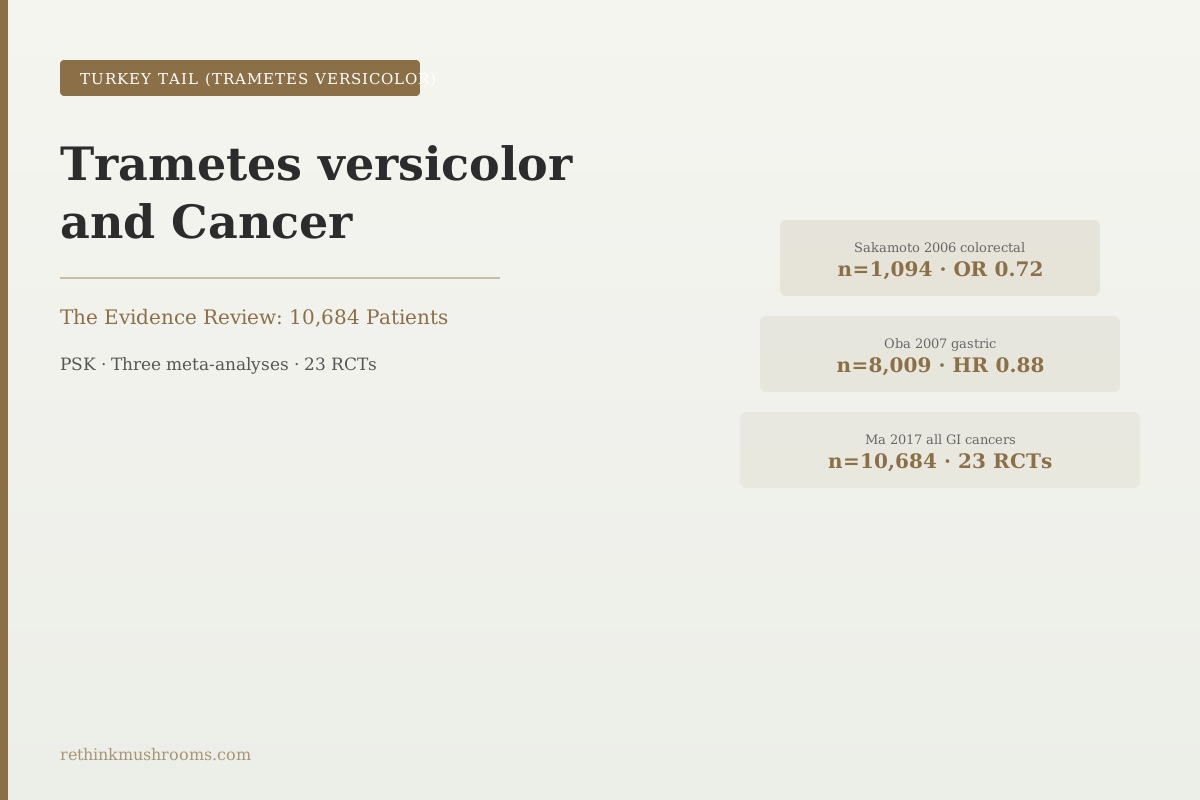
10,684 patients across three PSK meta-analyses
No other medicinal mushroom has been studied in meta-analyses covering this many cancer patients. The PSK extract from Trametes versicolor has three independent meta-analyses covering colorectal, gastric, and combined gastrointestinal cancers, supporting its status as an adjuvant cancer treatment in Japan since 1977.
Ma et al., Oncotarget, 2017; Oba et al., Cancer Immunol Immunother, 2007
1977
Japanese Ministry of Health approves PSK (Krestin) as a cancer adjuvant treatment
OR 0.72
Sakamoto 2006 colorectal: improved 5-year disease-free survival odds ratio (P=0.003)
23 RCTs
Ma 2017 network meta-analysis pooling gastrointestinal cancer trials across 10,684 patients
Ma et al., Oncotarget, 2017; Oba et al., Cancer Immunol Immunother, 2007
 View as image ↗
Trametes versicolor, the turkey tail mushroom, has more controlled clinical trial data in cancer than any other medicinal mushroom. That is not a marketing claim. It reflects the outcome of a sustained pharmaceutical development program in Japan that began after a worker at a chemical company observed what appeared to be remission of his colon cancer after prolonged consumption of the mushroom's extract, and ran through to regulatory approval in 1977 and three independent meta-analyses published between 2006 and 2017 covering more than 10,000 patients. This article reviews the Trametes versicolor cancer evidence: what the trials actually measured, what they found, and where the evidence base has genuine limits. For the full overview of turkey tail mushroom including its biology and traditional uses, see What Is Turkey Tail Mushroom? A Science-Based Introduction.
Key Takeaways
- Three independent meta-analyses cover Trametes versicolor's PSK extract in cancer: colorectal (n=1,094, OR 0.72, P=0.003), gastric (n=8,009, HR 0.88, P=0.018), and combined gastrointestinal cancers (23 RCTs, n=10,684)
- All three meta-analyses show PSK as an adjuvant to chemotherapy improves survival outcomes; the effect is consistent, with confidence intervals not crossing 1.0 in the primary analyses
- PSK was approved by the Japanese Ministry of Health in 1977 as a biological response modifier for cancer adjuvant use; it remains a regulated pharmaceutical (brand name Krestin) not available in consumer supplements
- The US Phase 1 trial (Torkelson 2012, n=9) established safety at up to 9 g/day in breast cancer patients and found dose-related increases in CD8+ T cells, CD19+ B cells, and natural killer cell activity
- Most clinical trials used pharmaceutical-grade PSK at 3 g/day; consumer supplements contain whole dried mushroom or mycelium extract at doses and compound concentrations that are different from the clinical preparations
- The 2023 scoping review by Dan et al. confirmed Turkey tail as the best-evidenced medicinal mushroom across gastric, breast, and colorectal cancer, while noting most high-quality trials were conducted in Japan with limited external validation
Trametes versicolor Cancer Evidence: Why This Mushroom Stands Alone
Among the dozens of medicinal mushrooms studied for cancer applications, Trametes versicolor occupies a distinct position: it has pharmaceutical-grade extracts approved by national health ministries, not just preclinical or pilot data.
The starting point was a polysaccharide-protein compound called PSK (polysaccharide K), isolated from a specific Trametes versicolor strain designated CM-101 by Kureha Pharmaceutical Corporation in Japan in 1971. PSK consists of a beta-glucan backbone with protein components representing 18 to 38% of the molecule by mass. Kureha developed PSK as a cancer adjuvant and ran a series of randomized controlled trials beginning in the 1970s. In 1977, the Japanese Ministry of Health approved PSK (sold under the brand name Krestin) as a biological response modifier for use alongside conventional cancer treatment.
Guggenheim et al.'s 2014 review in Integrative Medicine identifies Trametes versicolor as the mushroom with the strongest evidence base for cancer adjuvant use among the five major medicinal mushrooms studied.[4] The mechanisms it attributes to turkey tail include natural killer cell activation, T-cell differentiation, and dendritic cell maturation, which are the upstream immune functions that coordinate cancer immunosurveillance.
The Colorectal Cancer Evidence: Sakamoto 2006, n=1,094
Sakamoto et al. (2006) published the first major PSK meta-analysis in Cancer Immunology Immunotherapy, pooling data from three centrally randomized controlled clinical trials.[1] The combined sample was 1,094 patients with curatively resected colorectal cancer, meaning patients whose primary tumors had been surgically removed with curative intent.
The primary comparison was PSK plus chemotherapy versus chemotherapy alone. The findings:
- 5-year disease-free survival: odds ratio 0.72 (95% CI 0.58–0.90, P=0.003)
- 5-year overall survival: odds ratio 0.71 (95% CI 0.55–0.90, P=0.006)
Both results reached statistical significance with confidence intervals that did not cross 1.0. An odds ratio of 0.72 means the PSK group had approximately 28% lower odds of disease recurrence or death at 5 years compared to the chemotherapy-only group.
The effect was most pronounced in Stage III patients (lymph node-positive disease). This is a clinically meaningful subgroup: Stage III colorectal cancer carries a substantially higher recurrence risk than Stage I or II disease, so adjuvant interventions that reduce that risk have real impact on patient outcomes.
The Gastric Cancer Evidence: Oba 2007, n=8,009
The second major meta-analysis came the following year. Oba et al. (2007) pooled eight randomized controlled trials of PSK immunochemotherapy in patients with curatively resected gastric cancer.[2] The combined sample was 8,009 patients, more than seven times the colorectal meta-analysis.
The primary outcome was overall survival. The findings:
- Hazard ratio 0.88 (95% CI 0.79–0.98, P=0.018)
A hazard ratio of 0.88 indicates approximately 12% lower risk of death at any time point in the PSK group compared to chemotherapy alone. In a disease like gastric cancer, where 5-year survival rates at stages III and IV are often below 30%, a 12% improvement in the hazard of death is clinically significant.
The gastric cancer meta-analysis involved 8,009 patients across eight RCTs. This sample size and trial count is substantial by the standards of cancer adjuvant research for any compound, let alone a natural product.
The Combined GI Cancer Evidence: Ma 2017, 23 RCTs, n=10,684
The third and most comprehensive synthesis came a decade later. Ma et al. (2017) conducted a network meta-analysis published in Oncotarget, pooling data from 23 randomized controlled trials with 10,684 patients across gastrointestinal cancers including colorectal, gastric, esophageal, and biliary cancers.[3]
Network meta-analysis allows indirect comparisons between treatments that were not directly compared in the same trial. In the Ma 2017 analysis, PSK combined with chemotherapy was significantly superior to chemotherapy alone in both 3-year and 5-year overall survival. PSK ranked among the best-performing adjuvant interventions in the network.
The combined weight of these three meta-analyses, spanning colorectal, gastric, and all GI cancers, covering 10,684 patients across 23 RCTs and published over an 11-year period, constitutes the most rigorous clinical evidence base for any medicinal mushroom-derived compound in cancer treatment. No other mushroom compound approaches this scale of clinical validation.
How PSK Works Against Cancer: The Immune Mechanisms
PSK's anti-cancer effect operates through immune-mediated mechanisms rather than direct cytotoxicity against cancer cells.
Maehara et al.'s 2012 review in Surgery Today identifies three pathways: recovery from immunosuppression (cancer and chemotherapy both suppress immune function; PSK partially reverses this), activation of antitumor immunity (dendritic cell maturation, Th1/Th2 immune balance restoration, IL-15 induction), and direct antitumor effects (apoptosis induction, inhibition of cancer cell migration).[4]
The immunosuppression recovery mechanism explains why PSK is specifically useful as an adjuvant to chemotherapy rather than as a standalone treatment. Chemotherapy kills rapidly dividing cells (including cancer cells) but also suppresses bone marrow function and immune cell populations. PSK may partially counteract this immunosuppression, allowing patients to mount stronger immune responses against residual cancer cells during and after treatment.
Guggenheim et al. (2014) places Turkey tail's specific immune profile within the context of five medicinal mushrooms: of the group (also including reishi, shiitake, maitake, and Agaricus blazei), turkey tail showed the strongest combined evidence for NK cell activation and T-cell differentiation in a cancer adjuvant context.[4]
For a deeper look at how PSK and PSP differ in their compound profiles and immune targets, see PSK vs. PSP: Comparing Turkey Tail's Two Star Compounds.
The US Evidence: Torkelson 2012 and the Phase 1 Trial
Outside Japan, the most significant clinical data comes from a Phase 1 trial published by Torkelson et al. in 2012.[5] This was not a PSK trial: it used whole Trametes versicolor fruiting body preparation, not the isolated pharmaceutical extract. The nine participants were breast cancer survivors.
The trial established safety: up to 9 g per day was well-tolerated with no serious adverse events. On immune outcomes, the Torkelson trial found dose-related increases in CD8+ T cells (cytotoxic T cells that kill cancer cells) and CD19+ B cells (which produce antibodies). Natural killer cell functional activity increased at 6 g per day. Total lymphocyte counts showed upward trends at 6 to 9 g per day.
These are Phase 1 findings in nine people. They establish safety and preliminary immune activity, not clinical efficacy. But they are the only US clinical trial data for Trametes versicolor preparations in cancer patients, and they extend the immune mechanism findings from the Japanese PSK literature to the whole-mushroom preparation that consumers can actually access.
The Critical Caveat: PSK Is Not a Consumer Supplement
The most important context for the entire cancer evidence base is that PSK (Krestin) is a proprietary pharmaceutical product manufactured by Kureha Corporation in Japan. It is approved and dispensed as a drug under the supervision of oncologists in Japan. It is not available as a dietary supplement in the United States, Europe, or most other markets.
The PSK used in the Japanese clinical trials was produced through a controlled fermentation process from the CM-101 strain of Trametes versicolor, standardized to specific compound concentrations, and administered at 3 g per day. Consumer supplements labeled "turkey tail" or "Trametes versicolor" contain dried fruiting body, mycelium, or hot-water extracts of whole mushroom. These preparations contain Trametes versicolor polysaccharides, including PSP (a related but structurally different compound) and beta-glucans, but they are not equivalent to pharmaceutical PSK in compound composition, concentration, or clinical validation.
The Dan et al. 2023 scoping review confirms Turkey tail as the best-evidenced medicinal mushroom for gastric, breast, and colorectal cancer, while explicitly noting that most high-quality trials were conducted in Japan and that external validity to other clinical contexts is limited.[6] The evidence for PSK's efficacy is strong and consistently positive. The evidence that non-PSK Trametes versicolor preparations produce the same outcomes at consumer supplement doses does not exist.
For the broader comparison of medicinal mushrooms as cancer adjuvants, see Medicinal Mushrooms as Cancer Adjuncts: A Cross-Species Evidence Overview.
What the Evidence Actually Supports
The honest summary of the Trametes versicolor cancer evidence is: PSK, a pharmaceutical-grade extract available only in Japan as a drug, has strong clinical evidence for modestly improved survival outcomes when used as an adjuvant to chemotherapy in gastrointestinal cancers. The effect sizes are real but modest (OR ~0.72 for colorectal DFS; HR ~0.88 for gastric OS), the patient populations were predominantly Japanese, and the clinical preparation is not the same as what consumers purchase as "turkey tail supplements."
The Torkelson Phase 1 trial establishes that whole Trametes versicolor preparations are safe at high doses and produce dose-related immune activation. No Phase 2 or Phase 3 efficacy trial of a consumer-accessible turkey tail preparation in cancer patients has been completed in the United States or Europe.
Turkey tail is a legitimate subject of oncology research with more rigorous clinical data behind its primary extract than any other medicinal mushroom. That is both the accurate claim and the full extent of what the evidence supports.
The Bottom Line
Three meta-analyses cover PSK (the pharmaceutical Trametes versicolor extract) in cancer: Sakamoto 2006 (colorectal, n=1,094, OR 0.72), Oba 2007 (gastric, n=8,009, HR 0.88), and Ma 2017 (GI combined, 23 RCTs, n=10,684). All three show statistically significant survival improvements from PSK plus chemotherapy versus chemotherapy alone. PSK was approved in Japan as a cancer adjuvant drug in 1977 and remains a regulated pharmaceutical (Krestin) not available in consumer supplements. The Torkelson 2012 Phase 1 trial in 9 US breast cancer patients established safety of whole Trametes versicolor preparations at 9 g/day with immune activation signals. Consumer supplements are not equivalent to pharmaceutical PSK and have no Phase 2+ efficacy data.
Frequently Asked Questions
Sources & References
- 1. Source details for this reference are not yet available.
- 2. Source details for this reference are not yet available.
- 3. Source details for this reference are not yet available.
- 4. Source details for this reference are not yet available.
- 5. Source details for this reference are not yet available.
- 6. Source details for this reference are not yet available.