Turkey Tail (Trametes versicolor)
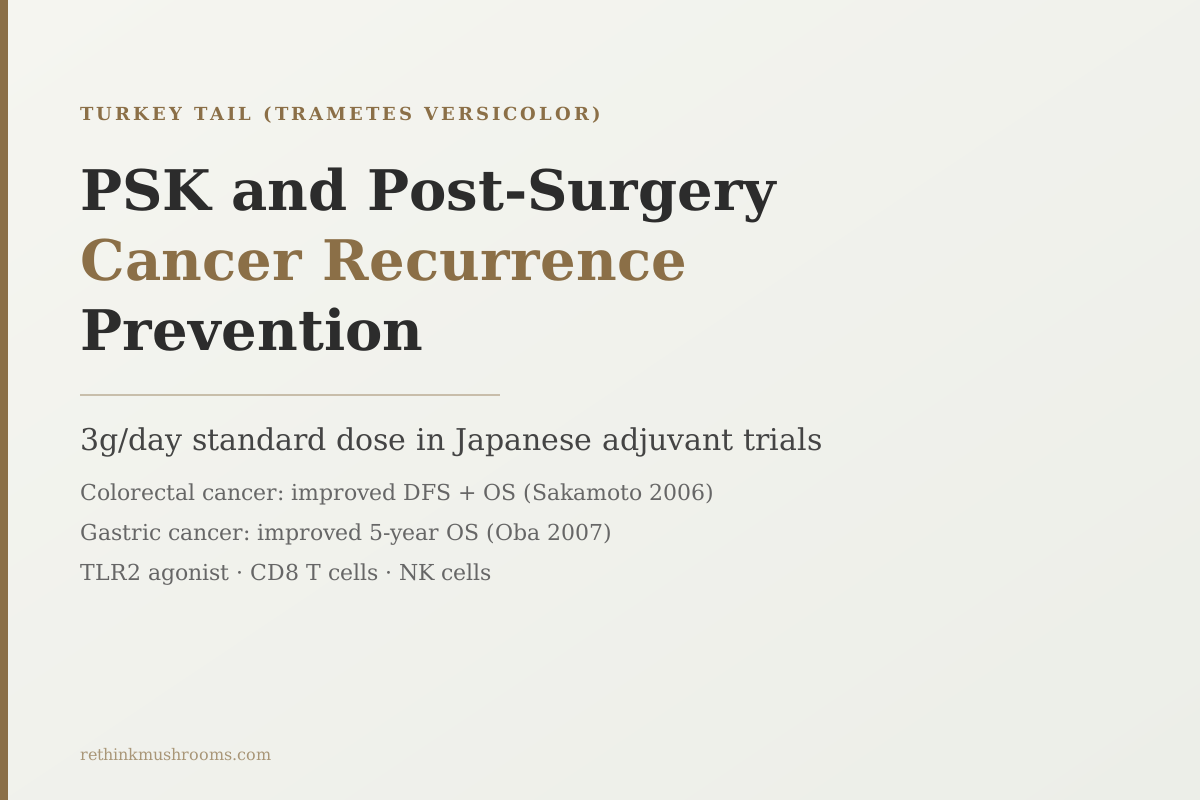
3g/day standard PSK dose in Japanese adjuvant trials
Japanese clinical trials established 3 grams of PSK per day as the post-surgery protocol, taken orally concurrent with chemotherapy, in trials that significantly improved 5-year survival.
Maehara et al., Surgery Today, 2012
Colorectal cancer
PSK improved DFS and OS in meta-analysis of centrally randomized RCTs (Sakamoto 2006)
Gastric cancer
PSK improved 5-year overall survival after curative resection (Oba 2007)
TLR2 agonist
PSK's mechanism: activates immune pattern-recognition, stimulating CD8 T cells and NK cells
Maehara et al., Surgery Today, 2012
 View as image ↗
Curative cancer surgery removes the primary tumor. What it cannot remove are the cancer cells that migrated before or during the operation, settling into nearby tissue, lymph nodes, or blood vessels in numbers too small to detect. Those cells are the source of recurrence, and recurrence is what kills most patients who survive their initial surgery.
PSK cancer recurrence prevention was built around this specific problem. PSK is a protein-bound polysaccharide extracted from Trametes versicolor, the fungus commonly known as Turkey Tail. Japanese oncologists developed it in the 1970s specifically as an adjuvant, a treatment added alongside standard care after surgery, to activate immune surveillance against the microscopic cells that surgery and chemotherapy cannot reach. Meta-analyses of centrally randomized Japanese RCTs have confirmed significant survival benefits in both colorectal and gastric cancer. This article covers those results, the biological mechanism, and what the trials used in practice. Turkey Tail's broader history and regulatory status in Japan are covered in What Is Turkey Tail Mushroom?.
Key Takeaways
- PSK is used in Japan as a post-surgery adjuvant for colorectal and gastric cancer: added to standard chemotherapy to target microscopic residual cancer cells that surgery cannot remove.
- A meta-analysis of centrally randomized RCTs found PSK plus chemotherapy significantly improved both disease-free survival and overall survival after curative colorectal cancer surgery (Sakamoto et al., Cancer Immunology, Immunotherapy, 2006).
- A separate meta-analysis found PSK significantly improved 5-year overall survival after curative gastric cancer surgery (Oba et al., Cancer Immunology, Immunotherapy, 2007).
- A 2017 network meta-analysis confirmed these survival benefits and found PSK did not increase adverse events compared to chemotherapy alone (Ma et al., Oncotarget, 2017).
- PSK works as a TLR2 agonist: it activates an immune pattern-recognition receptor that triggers production of CD8 T cells and natural killer (NK) cells, the immune system's primary cancer-killing cells (Lu et al., Clinical Cancer Research, 2011).
- The standard dosing protocol in Japanese trials was 3 grams per day, taken orally, concurrent with post-surgery chemotherapy and continued as maintenance (Maehara et al., Surgery Today, 2012).
The Problem PSK Was Built to Solve: Cancer Recurrence After Successful Surgery
Curative surgery for colorectal or gastric cancer means all visible tumor tissue was removed with clear margins. Post-operatively, imaging shows no detectable cancer. In conventional clinical terms, the surgery succeeded.
The problem is that cancer cells spread before surgery happens. As a tumor grows, cells enter the lymphatic system and bloodstream. Some settle in lymph nodes or surrounding tissue. Some circulate. A small number survive the immune response and lodge in locations where, over the following months or years, they can generate new tumors. These cells, called micro-metastases because they exist in numbers too small to image, are the primary driver of recurrence after apparently successful surgery.[5]
Standard post-surgery chemotherapy attacks rapidly dividing cells throughout the body, which eliminates some micro-metastatic cells. But chemotherapy does not specifically train immune cells to recognize residual cancer. That is the gap PSK was designed to address.
Maehara and colleagues documented the clinical rationale: PSK is not a replacement for surgery or chemotherapy but an immune activator that works alongside standard post-surgical treatment. All of the clinical trials in the PSK evidence base enrolled patients who had already undergone curative surgery, then tested whether adding PSK to post-surgical chemotherapy improved outcomes compared to chemotherapy alone.[5]
Colorectal Cancer: The Sakamoto 2006 Meta-Analysis
Sakamoto and colleagues published a meta-analysis pooling the Japanese RCT data on PSK for colorectal cancer. The trials they included were centrally randomized, meaning that patient assignment to treatment or control groups was handled by a central coordinating facility, independent of the treating hospital. Central randomization is a methodological safeguard against selection bias that is more stringent than standard on-site randomization. It gives these trials higher credibility than most research in complementary medicine, where poorly controlled study designs are common.[1]
All participants had undergone curative resection for colorectal cancer. The treatment arm received PSK added to standard post-surgical chemotherapy. The control arm received chemotherapy alone. The primary outcomes were disease-free survival, meaning no cancer recurrence at five years, and overall survival, meaning alive at five years.
The meta-analysis found that PSK adjuvant immunochemotherapy significantly improved both disease-free survival and overall survival compared to chemotherapy alone. The benefit was consistent across the pooled data from the multiple trials conducted over the Japanese PSK research program's run.[1]
The significance is in the study design. A meta-analysis of centrally randomized RCTs is the strongest category of clinical evidence. No other medicinal mushroom compound has this quality of evidence for a survival endpoint in cancer patients.
Gastric Cancer: The Oba 2007 Meta-Analysis
A parallel body of Japanese RCT evidence tested PSK in gastric cancer. Oba and colleagues published a meta-analysis applying the same structure as the Sakamoto colorectal analysis: patients who had undergone curative resection for gastric cancer, receiving either chemotherapy alone or chemotherapy plus PSK.[2]
The Oba meta-analysis found that PSK significantly improved 5-year overall survival after curative gastric cancer surgery. Gastric cancer and colorectal cancer were the two most common gastrointestinal cancers in Japan during the period when these trials were conducted. With both Sakamoto 2006 and Oba 2007 published, PSK had meta-analytic RCT evidence supporting its adjuvant use in both conditions.[2]
The gastric cancer evidence is why PSK (marketed as KRESTIN) is a prescription medication approved by Japan's Ministry of Health for gastric cancer, alongside colorectal cancer. The approval was not based on a single trial but on the cumulative Japanese RCT program that the Oba meta-analysis synthesized.
The 2017 Network Meta-Analysis: Confirming Benefit and Ruling Out Harm
The Sakamoto and Oba meta-analyses were published in the mid-2000s. Ma and colleagues published a more current network meta-analysis in 2017 covering PSK evidence across gastrointestinal cancers, analyzing both efficacy and safety together in a single quantitative synthesis.[3]
The efficacy findings confirmed the earlier analyses: PSK significantly improved 5-year overall survival and disease-free survival in gastrointestinal cancer patients compared to chemotherapy alone.
The more notable addition was the safety analysis. PSK combination therapy did not significantly increase adverse events compared to chemotherapy alone. This is a clinically important finding for any adjuvant treatment. Cancer patients undergoing post-surgery chemotherapy already carry a substantial side-effect burden. A treatment added to that regimen must not meaningfully worsen it. The Ma 2017 data established that PSK, at the doses used in the trials, does not add to that burden.[3]
The 2017 network meta-analysis is currently the most comprehensive quantitative synthesis of PSK for gastrointestinal cancers. It confirms the benefit-without-added-toxicity profile that made PSK an approved prescription drug in Japan in the first place.
How PSK Targets Residual Cancer Cells: The TLR2 Mechanism
Understanding why PSK helps post-surgery requires understanding how it activates the immune system. Lu and colleagues at Oregon Health and Science University published a key finding in Clinical Cancer Research: PSK acts on a specific receptor on immune cells called TLR2, triggering the immune system to produce specialized cancer-killing cells. In molecular biology terms, PSK is a TLR2 agonist, meaning it binds to and activates that receptor.[4]
TLR2 stands for Toll-Like Receptor 2. TLR receptors work as molecular sensors on immune cells: they detect patterns on the surface of foreign or abnormal cells and trigger a defense response. TLR2 specifically recognizes surface patterns common to bacteria and to many types of cancer cells. When a molecule binds to and activates TLR2, it tells the immune system that something abnormal is present and needs to be dealt with.
PSK activating TLR2 triggers the production and activity of two types of immune cells. CD8 T cells are the immune system's direct cancer killers: they scan for cells displaying abnormal surface proteins, the kind that cancer cells often express, and destroy those cells on contact. NK cells, or natural killer cells, destroy abnormal cells without needing to first identify a specific surface marker. Both cell types increase their activity when TLR2 is activated.[4]
In Lu's animal models, this TLR2-mediated mechanism inhibited tumor growth. The direct path from PSK to TLR2 activation to immune surveillance gives a plausible biological explanation for why adding PSK to post-surgery chemotherapy reduces recurrence. Chemotherapy attacks dividing cells broadly. PSK adds targeted immune pressure specifically against cells that look abnormal, which is the population that micro-metastases belong to.
Clinical Protocol: Dose, Duration, and the KRESTIN Distinction
Maehara and colleagues, part of the team that developed PSK at Kureha Corporation, documented the clinical protocol used across the Japanese RCT program. The standard was 3 grams of PSK per day, taken orally, administered concurrent with post-surgery chemotherapy and continued as maintenance afterward.[5]
In Japan, PSK is the active pharmaceutical ingredient in KRESTIN, a registered prescription medication. KRESTIN is not classified as a dietary supplement in Japan: it is a biologic drug with a defined manufacturing process, pharmaceutical-grade purity, and dosing standards established by clinical trials. The 3g/day dose across the Japanese trials represents a standardized pharmaceutical intervention, not a general dietary recommendation for Turkey Tail mushroom products.
Turkey Tail mushroom products sold in supplement markets outside Japan vary in composition, concentration, and standardization. Whole mushroom powder, hot water extracts, and other preparations contain beta-glucans and other Turkey Tail bioactives, but the PSK content and concentration may differ substantially from the pharmaceutical preparation used in the clinical trials. The survival data reviewed here is specific to PSK at 3g/day from a pharmaceutical-grade preparation, and the degree to which commercial supplements approximate that exposure has not been systematically studied.[5]
For detail on KRESTIN's regulatory approval history and why it is approved in Japan but not elsewhere, see PSK (Krestin): Japan's Approved Mushroom Cancer Drug.
What the Evidence Shows and Where It Stops
The PSK post-surgery evidence is unusually strong for a complementary cancer intervention. Meta-analyses of centrally randomized RCTs. Two independent analyses for two cancer types. A 2017 network meta-analysis confirming the survival benefit and ruling out added toxicity. This evidence base is more rigorous than what most pharmaceutical adjuvants had when they first entered clinical practice.
Several limits apply, and they should be stated clearly.
All clinical evidence for PSK is adjuvant, meaning post-surgery combined with chemotherapy in patients who have already undergone curative resection. There are no completed RCTs of PSK for primary treatment, for prevention in healthy people, or for metastatic disease. The claims reviewable from this evidence base are specifically about adding PSK to post-surgical chemotherapy in curatively resected colorectal and gastric cancer patients.
The Japanese trials were conducted primarily in the 1980s and 1990s, when standard chemotherapy protocols were less effective than current regimens. Whether PSK's survival benefit holds when combined with modern chemotherapy has not been established. An adjuvant benefit can shrink or disappear when the underlying treatment it is added to becomes more effective.
The trial populations were Japanese patients. Genetic background, dietary patterns, gut microbiome composition, and overall health-system differences may affect how these results generalize to other populations. That extrapolation has not been tested in controlled trials outside Japan.
For the full picture of Turkey Tail's evidence across 40 years of cancer research, see Turkey Tail and Cancer: 40 Years of Research Reviewed. The immune mechanisms underlying these outcomes are explored in depth in How Turkey Tail Enhances the Immune System's Anti-Cancer Response.
The cluster articles covering PSK's colorectal cancer data and gastric cancer research legacy go deeper on each indication: Turkey Tail and Colorectal Cancer: PSK Clinical Trial Results and Turkey Tail for Gastric Cancer: The Japanese Research Legacy.
The Bottom Line
PSK, the protein-bound polysaccharide from Turkey Tail mushrooms and Japan's approved prescription cancer drug KRESTIN, was designed specifically for the post-surgery window when residual micro-metastatic cancer cells are the primary recurrence threat. Meta-analyses of centrally randomized Japanese RCTs confirmed significant improvements in disease-free and overall survival for both colorectal and gastric cancer when PSK was added to post-surgical chemotherapy. A 2017 network meta-analysis confirmed the benefit without added toxicity. The mechanism involves TLR2 activation stimulating CD8 T cells and NK cells to target abnormal cells. The standard dose in trials was 3 grams per day of pharmaceutical-grade PSK.
Frequently Asked Questions
Sources & References
- 1RTHM-00200·Sakamoto, Junichi et al. (2006). “Efficacy of adjuvant immunochemotherapy with polysaccharide K for patients with curatively resected colorectal cancer: a meta-analysis of centrally randomized controlled clinical trials..” Cancer immunology.Study breakdown →PubMed →↩
- 2RTHM-00226·Oba, Koji et al. (2007). “Efficacy of adjuvant immunochemotherapy with polysaccharide K for patients with curative resections of gastric cancer..” Cancer immunology.Study breakdown →PubMed →↩
- 3RTHM-00895·Ma, Yan et al. (2017). “Can polysaccharide K improve therapeutic efficacy and safety in gastrointestinal cancer? a systematic review and network meta-analysis..” Oncotarget.Study breakdown →PubMed →↩
- 4RTHM-00419·Lu, Hailing et al. (2011). “Polysaccharide krestin is a novel TLR2 agonist that mediates inhibition of tumor growth via stimulation of CD8 T cells and NK cells..” Clinical cancer research : an official journal of the American Association for Cancer Research.Study breakdown →PubMed →↩
- 5RTHM-00475·Maehara, Yoshihiko et al. (2012). “Biological mechanism and clinical effect of protein-bound polysaccharide K (KRESTIN(®)): review of development and future perspectives..” Surgery today.Study breakdown →PubMed →↩