Turkey Tail & Cancer
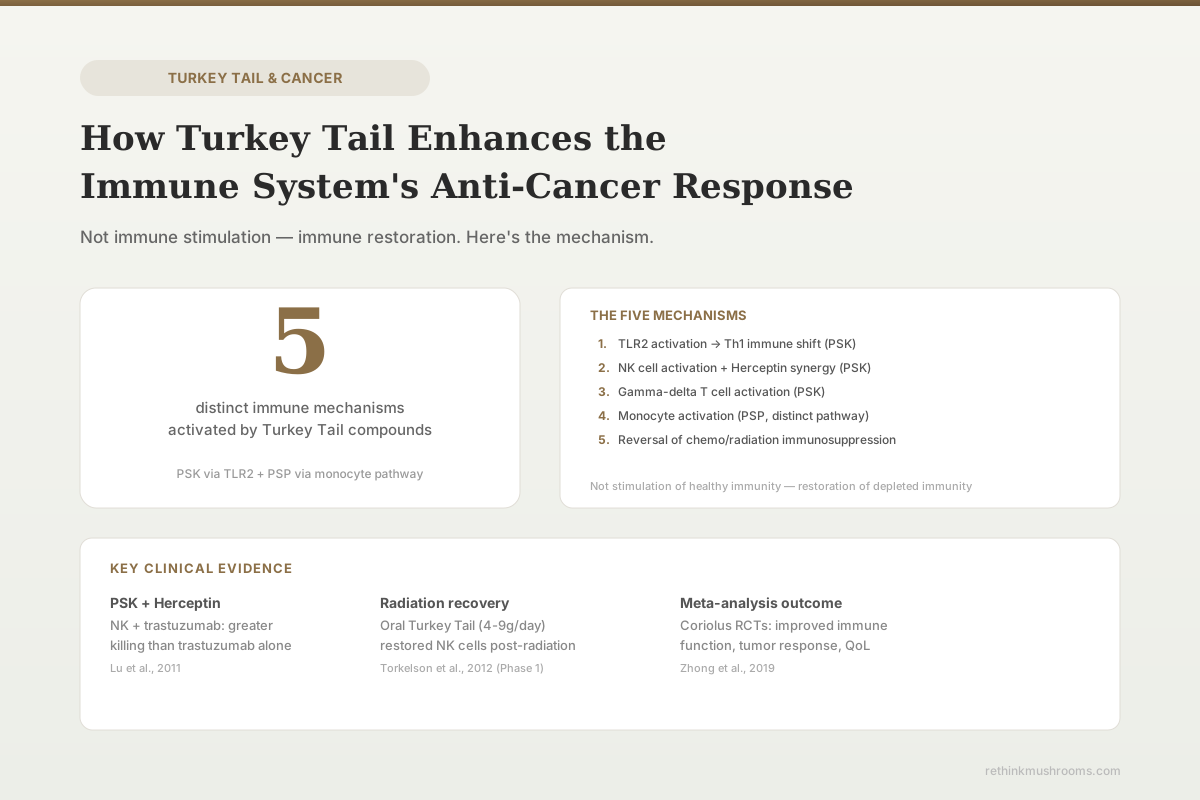
5 distinct immune mechanisms activated by Turkey Tail
PSK activates NK cells via TLR2 binding and synergistically enhanced the anti-tumor effect of trastuzumab (Herceptin) in laboratory studies. In the first FDA-approved Turkey Tail clinical trial, oral Turkey Tail corrected radiation-induced immunosuppression and restored NK cell numbers in breast cancer patients.
Lu et al., Clinical Cancer Research, 2011; Torkelson et al., ISRN Oncology, 2012
TLR2 agonism
PSK binds Toll-like receptor 2 on immune cells, triggering the same pattern-recognition cascade activated by bacterial invaders and initiating a broad anti-tumor immune response (Wasser et al., 2002)
NK + Herceptin
PSK-activated NK cells combined with trastuzumab produced significantly greater cancer cell killing than trastuzumab alone in laboratory studies (the modern immunotherapy combination angle) (Lu et al., 2011)
Radiation recovery
oral Turkey Tail at 4–9g/day for 6 weeks corrected radiation-induced immunosuppression and restored NK cell numbers and function in breast cancer patients post-radiation (Torkelson et al., 2012)
Lu et al., Clinical Cancer Research, 2011; Torkelson et al., ISRN Oncology, 2012
 View as image ↗
The phrase "immune-boosting mushroom" misrepresents what Turkey Tail actually does in a cancer context. Cancer and the therapies used to treat it (chemotherapy, radiation) systematically suppress the immune function that would otherwise surveil and kill tumor cells. Turkey Tail's compounds, principally PSK, work primarily by restoring what cancer and treatment have depleted, not by adding stimulation on top of an already healthy immune system.
This distinction matters because it explains why Turkey Tail has been used as a conventional cancer therapy adjunct in Japan for forty years, not as a standalone treatment or a supplement for healthy people. The immune effects are relevant precisely when the immune system is most compromised.
This article covers the five documented mechanisms by which Turkey Tail restores and enhances anti-cancer immunity, with the human clinical evidence for each. For context on how Turkey Tail came to be studied for cancer in the first place, see what is turkey tail mushroom: a science-based introduction.
Key Takeaways
- Turkey Tail's primary anti-cancer immune role is restoration, not stimulation: cancer and chemotherapy suppress NK cells, shift immune balance away from tumor-killing activity, and deplete T cell populations; PSK counteracts each of these suppressions
- PSK acts as a TLR2 (Toll-like receptor 2) agonist, triggering the innate immune cascade that activates dendritic cells, produces IL-12, and primes both NK cells and cytotoxic T cells for anti-tumor activity (Wasser et al., Isr Med Assoc J, 2002)
- PSK activates human NK cells and synergistically enhanced the anti-tumor effect of trastuzumab (Herceptin) in laboratory studies, suggesting PSK may act as an immunological amplifier for HER2-targeted therapies (Lu et al., Clin Cancer Res, 2011)
- PSK activates gamma-delta T cells, an innate-like T-cell population that can kill tumor cells without prior sensitization; this provides anti-tumor activity in patients whose conventional T-cell populations are depleted by chemotherapy (Inatsuka et al., Cancer Immunol Immunother, 2013)
- PSP (Turkey Tail's second major compound) activates monocytes in human peripheral blood through a mechanism distinct from PSK, providing complementary immune stimulation via a different pathway (Sekhon et al., Food Chem, 2013)
- In the first FDA-approved clinical trial of Turkey Tail in cancer patients, oral Turkey Tail (4–9g/day for 6 weeks post-radiation) corrected radiation-induced immunosuppression and restored NK cell numbers and function in breast cancer patients (Torkelson et al., ISRN Oncol, 2012)
The Framing That Changes Everything: Restoration, Not Stimulation
The dominant marketing narrative around medicinal mushrooms positions them as immune "boosters." For Turkey Tail in a cancer context, this framing is both misleading and undersells the actual clinical mechanism.
Tumors are not passive objects sitting in the body while the immune system attacks them. They actively suppress immune function. Tumors secrete TGF-beta (transforming growth factor-beta), which suppresses the immune cells that would normally recognize and kill them. They shed antigens that trigger immune exhaustion in T-cells. They create local immune environments that convert pro-inflammatory cells (which fight cancer) into anti-inflammatory cells (which tolerate it).
Chemotherapy and radiation compound this problem. Both treatments are effective at killing rapidly dividing cells, including tumor cells. Both also kill rapidly dividing immune cells, particularly NK cells and T-cells. The immune system most patients bring into a chemotherapy course is not the immune system they have partway through it.
Turkey Tail's clinical value comes in because PSK addresses these specific suppressions. It does not add immune activity to an already-robust immune system. It restores the Th1 immune bias, the NK cell populations, and the T-cell activation pathways that cancer and its treatment have suppressed. The Wasser 2002 systematic review of PSK mechanisms documented this dual-pathway profile: T-cell activation, NK cell enhancement, macrophage activation, and direct anti-proliferative effects on tumor cells.[1]
Mechanism 1: TLR2 Activation and the Th1 Immune Shift
The entry point for PSK's immune activity is a receptor called TLR2 (Toll-like receptor 2). TLR2 is part of the innate immune system's pattern-recognition machinery; it detects structural patterns associated with pathogens and damaged tissue. When TLR2 is activated, it triggers a signaling cascade that initiates an immune response.
PSK binds TLR2 on immune cell surfaces, triggering this cascade. The downstream effects are relevant to anti-cancer immunity at multiple levels: dendritic cells become activated, producing IL-12 (a cytokine that primes T-cells and NK cells); the overall immune balance shifts toward Th1 (the anti-tumor direction) rather than Th2 (which cancer actively promotes); and the immune system enters a state more capable of recognizing and attacking tumor cells.
The Th1/Th2 balance is a key axis in cancer immunology. Tumors create a Th2-biased environment that promotes tolerance and limits the cytotoxic responses that would destroy them. PSK's TLR2-mediated shift toward Th1 directly counteracts this tumor-induced immune evasion. Habtemariam's 2020 comprehensive review documented the full molecular landscape of Turkey Tail's cancer-relevant pathways, including NF-κB, MAPK, and PI3K/Akt signaling, confirming the breadth of the immune rebalancing mechanism.[2]
For the full breakdown of Turkey Tail's bioactive compounds and how PSK is structurally distinct from standard beta-glucans, see turkey tail bioactive compounds: PSK, PSP, and beta-glucans.
Mechanism 2: NK Cell Activation and the Herceptin Connection
Natural killer (NK) cells are lymphocytes that can kill tumor cells without prior sensitization. They patrol the body looking for cells that display abnormal surface markers, and they kill on contact using perforin and granzyme. In cancer patients, particularly those receiving chemotherapy or radiation, NK cell populations drop dramatically, removing a critical anti-tumor defense.
PSK activates NK cells via the TLR2 cascade. The clinical evidence from Lu and colleagues in 2011 demonstrated this in both animal models and human immune cell studies.[3]
The same Lu 2011 study extended this finding to a clinically significant combination question: trastuzumab (Herceptin), the HER2-targeted monoclonal antibody widely used in HER2-positive breast cancer, works partly through antibody-dependent cellular cytotoxicity (ADCC). In ADCC, NK cells recognize tumor cells coated with antibody and kill them. If NK cells are depleted by chemotherapy, ADCC is less effective.
Lu's finding: PSK-activated NK cells in combination with trastuzumab produced significantly greater cancer cell killing than trastuzumab alone. PSK was not just restoring NK cell numbers but potentially enhancing the functional effectiveness of an already-approved targeted therapy. This is an in vitro result, not a clinical trial outcome, but it establishes a mechanistically grounded hypothesis for PSK as a combination partner for modern immunotherapy, not just a relic of 1980s chemotherapy protocols.
Mechanism 3: Gamma-Delta T Cell Activation
CD8+ cytotoxic T cells get most of the attention in cancer immunotherapy, but PSK also activates a less-discussed T-cell population with direct tumor-killing capability: gamma-delta T cells.
Gamma-delta T cells are innate-like lymphocytes, meaning they can kill tumor cells without the specific prior sensitization that conventional CD8+ T cells require. They recognize stress signals and abnormal phosphoantigens that tumor cells display, and they can kill directly through perforin/granzyme pathways and through cytokine secretion (TNF-alpha, IFN-gamma).
Inatsuka and colleagues demonstrated in 2013 that PSK activates gamma-delta T cells and that these cells contribute to PSK's anti-tumor effect.[4] This mechanism is clinically relevant in chemotherapy patients for a specific reason: chemotherapy often depletes conventional CD4+ and CD8+ T cells more severely than gamma-delta T cells, which have somewhat different proliferation kinetics. PSK's ability to activate gamma-delta T cells provides anti-tumor immune activity through a pathway that may be partially preserved when conventional T-cell populations are most depleted.
Mechanism 4: PSP's Separate Monocyte Pathway
Turkey Tail contains two major immune-active compounds: PSK (polysaccharide-K) and PSP (polysaccharide-peptide). They are structurally distinct, manufactured from different strains, and activate different immune cell populations.
While PSK's primary immune activity runs through TLR2, NK cells, and T-cells, PSP activates monocytes. Monocytes are precursor cells to macrophages and dendritic cells; they are among the first responders in innate immunity and key players in inflammatory and anti-tumor activity.
Sekhon and colleagues demonstrated in 2013 that PSP activates monocytes in resting human peripheral blood mononuclear cells, providing immunological evidence for PSP's independent immune-stimulating activity through a distinct cellular pathway from PSK.[5]
The clinical evidence base for PSP is considerably weaker than for PSK; PSK has been tested in large randomized trials while PSP has primarily been studied in smaller experiments. But the mechanistic distinctness matters: most Turkey Tail supplements contain both compounds. The immune profile produced by Turkey Tail as a whole-mushroom product likely reflects contributions from both pathways.
For a detailed comparison of PSK and PSP's evidence in cancer specifically, see PSP vs. PSK: comparing Turkey Tail's two anti-cancer compounds.
Mechanism 5: Reversal of Chemo- and Radiation-Induced Immunosuppression
The fifth and most clinically grounded mechanism is the one with the most direct human evidence: Turkey Tail corrects the immunosuppression caused by conventional cancer treatment.
Torkelson and colleagues at Bastyr University conducted the first FDA-approved clinical trial of Turkey Tail in cancer patients, published in 2012.[6] The trial enrolled nine women with breast cancer who had completed standard treatment including radiation. Participants received oral Turkey Tail mushroom (4–9g/day for 6 weeks).
The finding: oral Turkey Tail corrected radiation-induced immunosuppression. NK cell numbers and function, both of which are reduced by radiation therapy, were significantly restored in participants. The lymphocyte populations most depressed by radiation showed recovery over the 6-week treatment period.
This was a Phase 1 trial designed primarily to assess safety, and the sample size of nine participants limits how much can be concluded about efficacy. But the immune restoration finding was specific and measurable. The FDA's approval of this trial as a Phase 1 is itself clinically significant: it established Turkey Tail as a compound worth investigating in the US regulatory context, which culminated in subsequent larger trials.
The Zhong 2019 meta-analysis pooled all randomized controlled trials of Coriolus versicolor (Turkey Tail) as a cancer adjunct and found significant improvements in immune function outcomes alongside tumor response improvements and quality of life.[7] This aggregate evidence is consistent with each of the individual mechanisms described above: when multiple immune cell populations are simultaneously restored through complementary pathways, the net clinical effect on immune function is measurable.
For the broader clinical trial record, see turkey tail clinical trials in cancer: a comprehensive review. For the full history of Turkey Tail in cancer research, see turkey tail and cancer: 40 years of research reviewed.
For how Turkey Tail compares mechanistically to other mushroom compounds used as cancer adjuncts, see mushroom polysaccharides and cancer: how they fight tumors and trametes versicolor: the most-studied medicinal mushroom for cancer.
The Bottom Line
Turkey Tail's anti-cancer immune role is restoration of compromised function, not general stimulation. Cancer and conventional therapy suppress the immune pathways that kill tumor cells; PSK and PSP counteract these suppressions through five distinct mechanisms. PSK acts via TLR2 activation to restore Th1 bias, NK cells, and T-cell function (Wasser et al., 2002; Habtemariam, 2020). PSK-activated NK cells synergize with trastuzumab to enhance cancer cell killing (Lu et al., 2011). PSK activates gamma-delta T cells that retain function when conventional T cells are depleted (Inatsuka et al., 2013). PSP activates monocytes through a separate pathway (Sekhon et al., 2013). The only US clinical trial to date confirmed that oral Turkey Tail corrected radiation-induced immunosuppression and restored NK cell function in breast cancer patients (Torkelson et al., 2012). A 2019 meta-analysis of Turkey Tail RCTs found significant improvement in immune function, tumor response, and quality of life (Zhong et al., 2019).
Frequently Asked Questions
Sources & References
- 1. Source details for this reference are not yet available.
- 2RTHM-01194·Habtemariam, Solomon (2020). “Trametes versicolor (Synn. Coriolus versicolor) Polysaccharides in Cancer Therapy: Targets and Efficacy..” Biomedicines.Study breakdown →PubMed →↩
- 3RTHM-00420·Lu, Hailing et al. (2011). “TLR2 agonist PSK activates human NK cells and enhances the antitumor effect of HER2-targeted monoclonal antibody therapy..” Clinical cancer research : an official journal of the American Association for Cancer Research.Study breakdown →PubMed →↩
- 4RTHM-00291·Inatsuka, Carol et al. (2013). “Gamma delta T cells are activated by polysaccharide K (PSK) and contribute to the anti-tumor effect of PSK..” Cancer immunology.Study breakdown →PubMed →↩
- 5RTHM-00552·Sekhon, Bhagwant Kaur et al. (2013). “PSP activates monocytes in resting human peripheral blood mononuclear cells: immunomodulatory implications for cancer treatment..” Food chemistry.Study breakdown →PubMed →↩
- 6RTHM-00267·Torkelson, Carolyn J et al. (2012). “Phase 1 Clinical Trial of Trametes versicolor in Women with Breast Cancer..” ISRN oncology.Study breakdown →PubMed →↩
- 7RTHM-01155·Zhong, Linda et al. (2019). “Coriolus Versicolor and Ganoderma Lucidum Related Natural Products as an Adjunct Therapy for Cancers: A Systematic Review and Meta-Analysis of Randomized Controlled Trials..” Frontiers in pharmacology.Study breakdown →PubMed →↩