Turkey Tail & Cancer
6 cancer types
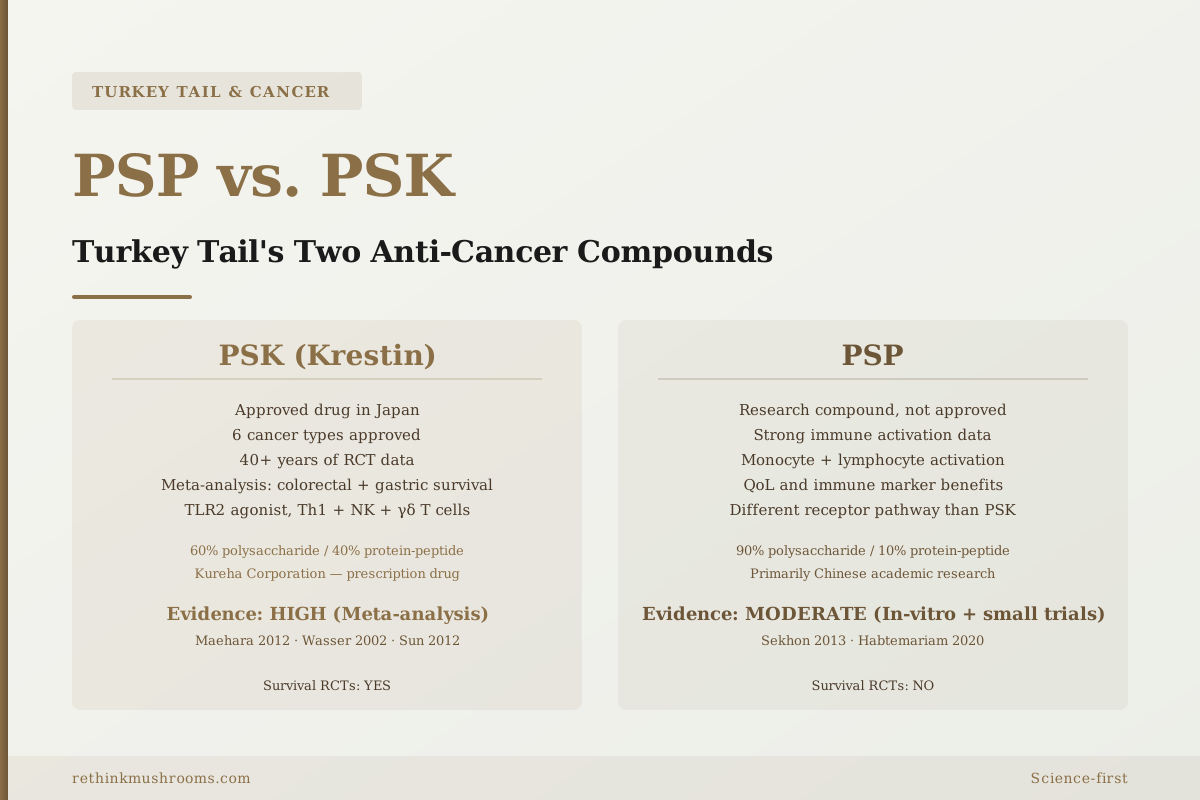
PSK (Krestin), one of two key polysaccharide compounds in Turkey Tail, is approved as a prescription cancer drug in Japan for six cancer types, backed by meta-analyses of randomized controlled trials.
Maehara et al., Surg Today, 2012
PSK
TLR2 agonist with RCT-level survival data across colorectal, gastric, lung, and breast cancers
PSP
activates monocytes and lymphocytes with strong immune data but fewer cancer survival RCTs
40+ yrs
of PSK clinical use in Japan as an approved prescription cancer adjunct
Maehara et al., Surg Today, 2012
 View as image ↗
Turkey Tail mushroom contains two polysaccharide compounds that cancer researchers have studied for decades: PSK (polysaccharide-K, also called Krestin) and PSP (polysaccharide-peptide). Both come from the same fungus. Both activate immune cells. Both appear in the same Turkey Tail supplements sold in health stores.
But their cancer evidence profiles could not be more different.
PSK is a prescription drug in Japan, approved for six cancer types after decades of randomized controlled trials. PSP is a research compound with promising immune activation data but a much thinner clinical trial record. No head-to-head survival comparison has been published. PSP has never received regulatory approval anywhere.
This article focuses specifically on the cancer evidence for each compound: what the clinical trials show, where the survival data exists, and how the two mechanisms differ in the context of fighting cancer. For compound chemistry and general properties, see PSK vs. PSP: Turkey Tail's two star compounds.
For broader context on Turkey Tail cancer research, the Turkey Tail introduction and Turkey Tail bioactive compounds guide cover the foundational material.
Key Takeaways
- PSK (Krestin) is a prescription drug approved in Japan for use alongside chemotherapy in colorectal, gastric, esophageal, lung, breast, and cervical cancers, based on decades of randomized controlled trials
- PSP activates monocytes and lymphocytes in human blood cells and shows strong immune activation properties, but has fewer and smaller cancer survival RCTs than PSK
- PSK's primary cancer mechanism is TLR2 receptor agonism, which activates Th1 immune polarization, NK cell activity, and gamma-delta T cell responses in a multi-pathway immune restoration
- PSP activates monocytes through a different receptor pathway than PSK, per Sekhon et al. 2013; the two compounds complement rather than duplicate each other's immune effects
- The evidence gap between PSK and PSP exists because PSK was developed as a commercial pharmaceutical with Kureha Corporation funding for large RCTs; PSP remained a research compound
- Most Turkey Tail supplements contain both PSK and PSP in unspecified proportions; cancer-specific evidence supports PSK content, not PSP, for survival outcomes
PSP vs. PSK: The Cancer Evidence Compared at a Glance
| Feature | PSK (Krestin) | PSP |
|---|---|---|
| Full name | Polysaccharide-K | Polysaccharide-peptide |
| Regulatory status | Approved drug in Japan (6 cancer types) | Research compound, not approved anywhere |
| Cancer survival RCTs | Yes: multiple meta-analyses covering colorectal, gastric, lung | No robust survival RCTs published |
| Strongest evidence | Colorectal and gastric cancer survival | Immune activation, quality of life |
| Primary cancer mechanism | TLR2 agonism, Th1 polarization, NK + γδ T cell activation | Monocyte activation, lymphocyte stimulation |
| Evidence quality | Meta-analysis (high) | In-vitro and small clinical studies (moderate) |
| Commercial development | Prescription drug (Krestin, Kureha Corp.) | Research compound in supplements |
| Available in US | As supplement (variable PSK content) | As supplement (alongside PSK) |
This table captures the fundamental difference: PSK has the survival evidence that oncologists rely on; PSP has mechanistic and immune data without equivalent clinical outcome data.
PSK's Cancer Evidence: Six Approvals, Meta-Analyses, and 40 Years of RCTs
PSK is not a supplement. In Japan, it is a prescription pharmaceutical sold under the brand name Krestin, manufactured by Kureha Corporation, and approved for use alongside chemotherapy in six cancer types.
A 2012 comprehensive review by Maehara and colleagues traced PSK's development from preclinical research through Japanese clinical approval.[2] The review covers the mechanistic work establishing PSK's immune profile, the successive clinical trials across cancer types in Japan, and four decades of clinical use in Japanese oncology.
The approved indications include colorectal cancer, gastric cancer, esophageal cancer, lung cancer, breast cancer, and cervical cancer. Each approval was supported by clinical trial evidence. The colorectal and gastric cancer evidence is the strongest.
A 2012 review by Sun and colleagues summarized the 40-year research arc directly: PSK went from preclinical immunology to approved cancer drug through a sustained program of randomized clinical trials, regulatory review, and post-approval surveillance.[3] The review noted that PSK's long clinical track record also means its safety profile is well-characterized across large patient populations.
For the specific clinical trial data by cancer type, see Turkey Tail clinical trials in cancer: a comprehensive review and PSK (Krestin): Japan's approved mushroom cancer drug.
PSK's Anti-Cancer Mechanisms: TLR2 Agonism and Four Immune Pathways
PSK fights cancer through at least four measurable immune mechanisms, documented across multiple studies.
The primary mechanism is TLR2 receptor agonism. PSK binds to Toll-like receptor 2 on immune cells and activates it, which initiates a signaling cascade that promotes Th1 immune polarization. A 2002 review in the Israel Medical Association Journal by Wasser and colleagues described PSK as exerting anti-cancer effects through T-cell activation, NK cell enhancement, and macrophage activation, establishing the multi-pathway profile that makes PSK's mechanism coherent across cancer types.[1]
Th1 polarization is important in the cancer context because tumors actively suppress Th1 immunity and promote Th2 responses, which are less effective at killing tumor cells. PSK's ability to shift this balance back toward Th1 is one reason it improves outcomes when combined with chemotherapy.
A 2013 study by Inatsuka and colleagues identified a specific additional mechanism: PSK activates gamma-delta T cells, a category of immune cells that have direct tumor-killing capability and are distinct from conventional NK cells and conventional T cells.[4] This mechanism is particularly relevant in patients who are T-cell depleted from chemotherapy, because gamma-delta T cells can respond to tumor signals even when the adaptive immune system is suppressed.
A 2020 review by Habtemariam in Biomedicines confirmed that Trametes versicolor polysaccharides, led by PSK, act on NF-kB, MAPK, and PI3K/Akt cell signaling pathways in tumor cells directly, not only through immune activation.[6] PSK has both immunostimulatory and direct anti-proliferative effects on cancer cells.
For deeper coverage of these immune pathways, see how Turkey Tail enhances the immune system's anti-cancer response and the broader mushroom polysaccharides and cancer overview.
PSP's Cancer Evidence: Strong Immune Activation, Without the Survival Data
PSP shares Turkey Tail's source and general polysaccharide structure with PSK, but its cancer evidence profile is substantially different.
PSP's strongest evidence is in immune activation. A 2013 study by Sekhon and colleagues tested PSP against resting human peripheral blood mononuclear cells (PBMCs, the population of immune cells in blood) and found that PSP activated monocytes, a category of innate immune cell that plays a key role in early tumor recognition and immune cascade initiation.[5] The Sekhon study characterized PSP's immunomodulatory activity as potentially relevant for cancer treatment, with the authors describing it as demonstrating that PSP has independent immunological properties.
What PSP does not have, as of the published literature, is the robust cancer survival outcome data that PSK has accumulated across 40 years of Japanese RCTs. There are no meta-analyses of randomized controlled trials showing that PSP extends survival in colorectal or gastric cancer patients, because those trials were never conducted for PSP in the way they were for PSK.
Several smaller clinical studies from Chinese research groups have investigated PSP for quality of life, immune function, and symptom management in cancer patients. These studies generally show benefits in immune markers and reported quality of life, which is meaningful. But they are smaller, often not randomized, and have not been pooled in the kind of meta-analyses that give PSK's evidence its current strength.
PSP has also shown anti-tumor activity in preclinical models: cell culture and animal studies demonstrating effects on tumor growth, apoptosis induction, and immune response. These findings are biologically relevant but preclinical, meaning they have not yet been validated in powered randomized clinical trials.
The 2020 Habtemariam review confirms that Trametes versicolor polysaccharides as a class, including PSP, act on cancer through multiple pathways. But the clinical outcome evidence is substantially more developed for PSK than for PSP.[6]
PSP's Mechanism: Monocyte Activation via a Different Pathway Than PSK
The Sekhon 2013 study is worth examining in more detail because it reveals why PSK and PSP are not simply duplicate compounds.[5]
PSK activates the immune cascade primarily through TLR2. This is the pathway through which PSK promotes Th1 polarization and NK cell enhancement. PSP activates monocytes, but through different receptors and signaling pathways than TLR2.
This mechanistic non-overlap means the two compounds likely target different entry points in the immune response to cancer. PSK leans toward the Th1/NK axis. PSP leans toward the monocyte/early innate immune axis. In principle, the two could be complementary in a combination protocol, though no clinical trial has tested this combination specifically.
The structural difference between PSK and PSP provides a clue: PSK has approximately equal proportions of polysaccharide and protein (roughly 60% polysaccharide, 40% protein-peptide moiety). PSP has a much higher polysaccharide proportion (approximately 90%) and a thinner peptide moiety (approximately 10%). The different protein-to-polysaccharide ratios are likely responsible for their different receptor binding profiles.
Neither compound activates the immune system in a nonspecific "boosting" sense. Both have specific molecular targets. The Wasser 2002 review described PSK's effects as targeted activation of specific immune populations, not general immune stimulation.[1]
Why the Evidence Gap Exists Between PSK and PSP
The difference in cancer evidence between PSK and PSP is not primarily a difference in biological activity. It is a difference in who funded the research and how.
PSK was developed by Kureha Corporation in Japan beginning in the late 1960s. Kureha invested in the preclinical research, then in the clinical trial program that produced the Japanese regulatory approvals, then in the 40 years of post-approval surveillance and combination trial data. That investment produced the meta-analyses that give PSK its current evidence grade.
PSP was identified and researched primarily by Chinese academics, particularly groups at the Chinese University of Hong Kong. This research program produced important mechanistic findings and smaller clinical studies, but it did not have the commercial infrastructure behind it to fund the kind of large, multi-center, randomized survival trials that PSK accumulated in Japan.
A 2012 Sun et al. review summarizing PSK's research history explicitly noted that the compound's commercial development path was integral to the strength of its evidence base: the drug company's need to demonstrate efficacy for regulatory approval drove the clinical trial program that ultimately proved cancer survival benefits.[3]
PSP has not had equivalent commercial development. That is why it lacks equivalent survival data. The biology may well support it. The immune mechanisms are real and documented. The clinical trials to test those mechanisms for survival outcomes have simply not been done at PSK's scale.
What PSK vs. PSP Means for People Buying Turkey Tail Products
Most Turkey Tail supplements available in the United States and elsewhere contain both PSK and PSP as part of the polysaccharide fraction, because they are extracted together from the mushroom. Most supplement labels do not specify the proportion of PSK versus PSP in the product.
This matters for cancer patients trying to use the evidence to inform their choices. The cancer survival evidence, from the Japanese RCTs and the meta-analyses built from them, is specifically evidence for PSK at studied doses. The clinical trial doses of PSK in Japan ran in the range of 3g per day of Krestin, which is a standardized, purified extract. That is not the same as an unspecified amount of whole-mushroom Turkey Tail extract.
The 2012 Maehara review emphasized that PSK's efficacy evidence comes from studies using the standardized pharmaceutical preparation, and that extrapolating these results to supplement products with variable PSK content requires caution.[2]
PSP's evidence, being primarily in immune activation and quality of life, may still be relevant to cancer patients and survivors for those outcomes. The Sekhon 2013 monocyte activation data and PSP's broader immune properties are real. But the evidence does not currently support claims that PSP extends cancer survival in the way PSK's RCT data does.
The clearest practical conclusion from the evidence: if the reason for choosing a Turkey Tail product is the cancer survival data, that evidence is specifically for PSK, and the PSK content of the product matters. Labels that quantify PSK content, or products standardized to a PSK percentage, are more directly tied to the clinical trial evidence than whole-mushroom extracts of unknown composition.
The Bottom Line
PSK (Krestin) has 40+ years of Japanese randomized controlled trial data, meta-analyses, and regulatory approval for six cancer types. PSP has documented immune activation properties, particularly monocyte activation, but lacks the survival RCT data that PSK has accumulated. The evidence gap reflects commercial development differences, not necessarily biological differences. For cancer patients, the survival outcome evidence specifically references PSK at studied doses, not unspecified Turkey Tail supplement content.
Frequently Asked Questions
Sources & References
- 1. Source details for this reference are not yet available.
- 2RTHM-00475·Maehara, Yoshihiko et al. (2012). “Biological mechanism and clinical effect of protein-bound polysaccharide K (KRESTIN(®)): review of development and future perspectives..” Surgery today.Study breakdown →PubMed →↩
- 3RTHM-00489·Sun, C et al. (2012). “Polysaccharide-K (PSK) in cancer--old story, new possibilities?.” Current medicinal chemistry.Study breakdown →PubMed →↩
- 4RTHM-00291·Inatsuka, Carol et al. (2013). “Gamma delta T cells are activated by polysaccharide K (PSK) and contribute to the anti-tumor effect of PSK..” Cancer immunology.Study breakdown →PubMed →↩
- 5RTHM-00552·Sekhon, Bhagwant Kaur et al. (2013). “PSP activates monocytes in resting human peripheral blood mononuclear cells: immunomodulatory implications for cancer treatment..” Food chemistry.Study breakdown →PubMed →↩
- 6RTHM-01194·Habtemariam, Solomon (2020). “Trametes versicolor (Synn. Coriolus versicolor) Polysaccharides in Cancer Therapy: Targets and Efficacy..” Biomedicines.Study breakdown →PubMed →↩