Turkey Tail (Trametes versicolor)
2,000+ years of documented medicinal use
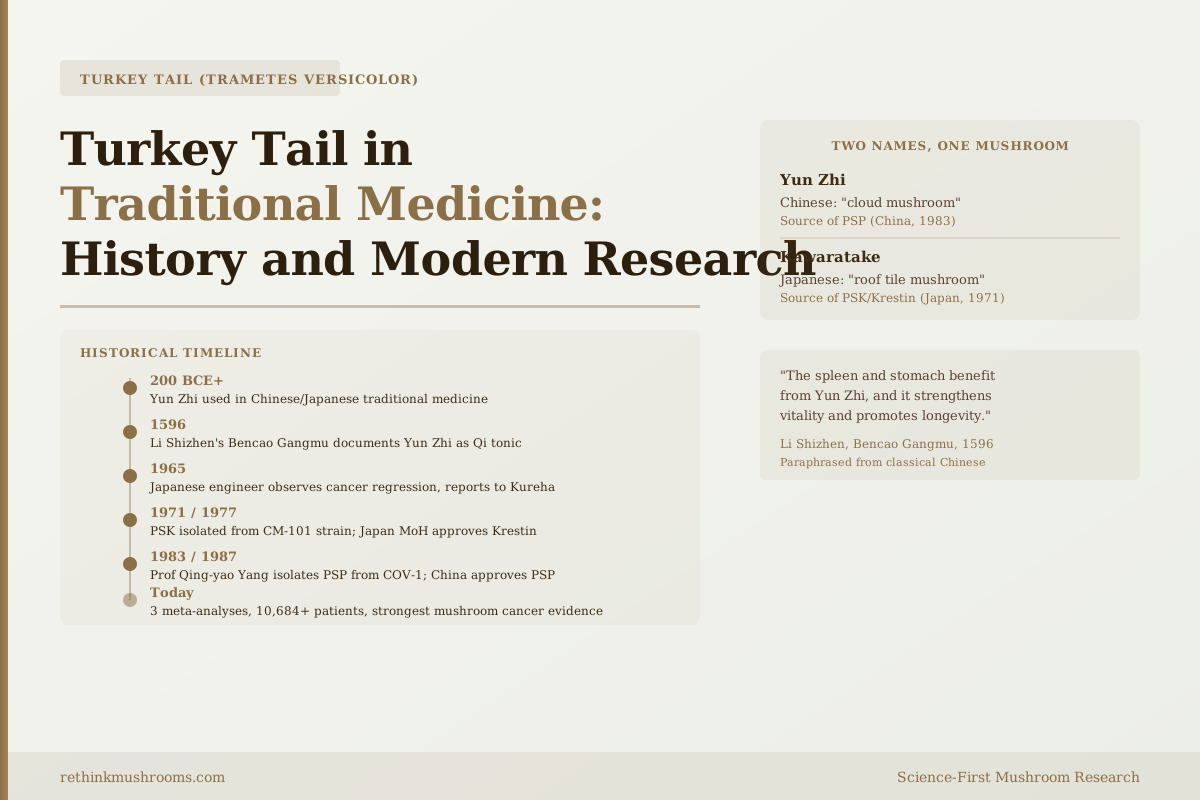
Turkey tail (Yun Zhi in Chinese medicine) appears in East Asian herbal records stretching back over two millennia. In 1965, a single clinical observation of cancer regression launched a research program that produced the first government-approved mushroom cancer drug.
Maehara et al., Surgery Today, 2012; Łysakowska et al., Molecules, 2023
1596
Li Shizhen's Compendium of Materia Medica documents Yun Zhi as a Qi tonic for spleen and stomach
1977
Japan Ministry of Health approves PSK (Krestin) as adjuvant cancer treatment, the first mushroom cancer drug
1987
China approves PSP, isolated independently by Prof Qing-yao Yang from the COV-1 strain
Maehara et al., Surgery Today, 2012; Łysakowska et al., Molecules, 2023
 View as image ↗
In 1965, a Japanese chemical engineer noticed something that would take decades to understand. After prolonged consumption of a mushroom tea brewed from Yun Zhi (a fan-shaped polypore that grew on rotting wood), an individual with cancer experienced regression that contemporary medicine could not readily explain. The engineer reported what he had observed to Kureha Corporation, a Japanese chemicals and pharmaceutical company. What followed was one of the most thorough medicinal mushroom research programs ever conducted, producing the first government-approved mushroom-derived cancer drug.
The mushroom at the center of that story was Trametes versicolor, known in the West as turkey tail and in traditional East Asian medicine by two older names that have coexisted for centuries. For a comprehensive overview of what modern research has found, see What Is Turkey Tail Mushroom? A Science-Based Introduction.
Key Takeaways
- Turkey tail (Trametes versicolor) is known as Yun Zhi (cloud mushroom) in Chinese medicine and Kawaratake (roof tile mushroom) in Japanese traditional medicine, with documented use spanning at least 2,000 years
- Li Shizhen's 1596 Compendium of Materia Medica (Bencao Gangmu) records Yun Zhi as a tonic for Qi (vital energy), spleen, and stomach, and as a longevity agent
- In 1965, a Japanese engineer's observation of cancer regression after Yun Zhi tea consumption prompted Kureha Corporation to begin systematic research
- By 1971, Kureha had isolated polysaccharide K (PSK) from the CM-101 strain of T. versicolor; in 1977, Japan's Ministry of Health approved PSK (Krestin) as the first government-approved mushroom cancer drug
- Chinese researchers independently selected the COV-1 strain in 1983; Prof Qing-yao Yang isolated polysaccharide peptide (PSP), a structurally distinct compound from PSK; China approved PSP in 1987
- Modern clinical research across multiple meta-analyses has confirmed the anti-cancer benefits observed in traditional use, with PSK representing one of the most rigorously tested natural cancer adjuvants in medical history
One Mushroom, Two Names, Two Thousand Years of Use
Trametes versicolor is one of the most visually distinctive fungi in temperate forests worldwide. Its fan-shaped brackets spread in overlapping tiers on dead and dying wood, displaying concentric rings of brown, tan, cream, and rust that shift subtly from sample to sample. In North America and Europe it is called turkey tail, after its resemblance to the fanned display of a wild turkey's tail feathers.
In East Asia, the names came from different observations. In Chinese traditional medicine (TCM), the mushroom has been called Yun Zhi, meaning cloud mushroom, for the way its layered fans suggest clouds stacked against a hillside. In Japanese traditional medicine (Kampo), it became Kawaratake, which translates as roof tile mushroom, named for the overlapping pattern resembling traditional Japanese curved roof tiles.
Both cultures observed it growing on the same dead logs, used it for overlapping therapeutic purposes, and gave it names that captured something true about its appearance from different visual perspectives. The dual naming tradition reflects independent recognition of the same thing across cultures that, for most of the history of this mushroom's use, had no detailed knowledge of what the other was doing.
Turkey tail contains a chemically rich profile. A 2023 review by Łysakowska and colleagues identified more than 38 phenolic compounds in T. versicolor, including quercetin and baicalein, alongside its dominant bioactive polysaccharides.[1] Beta-glucan content can exceed 50% by dry weight in quality preparations. The polysaccharides are what eventually attracted the most scientific attention, but the traditional practitioners who used this mushroom had none of this biochemical vocabulary. They were working from observation and accumulated experience.
What Li Shizhen Wrote About Turkey Tail in 1596
The most significant historical documentation of Yun Zhi in Chinese traditional medicine appears in the Bencao Gangmu, the Compendium of Materia Medica compiled by the physician Li Shizhen and completed in 1578, though not published until 1596. This encyclopedic work, comprising 52 volumes and documenting nearly 1,900 medicinal substances, is the foundational text of Chinese pharmacology and remains a scholarly resource today.
Li Shizhen's entry on Yun Zhi describes it as a tonic for Qi (the vital energy central to TCM theory), beneficial for the spleen and stomach, and associated with longevity. The specific clinical language of 16th-century Chinese medicine translates imperfectly into modern biomedical terminology, but the spleen-stomach framing is consistent with the immune and digestive function categories that modern research has focused on. In TCM, the spleen system governs digestion and nutrient transformation; a tonic for the spleen would, in modern terms, support the body's capacity to absorb and process resources effectively.
References to Yun Zhi in Chinese texts predate Li Shizhen's compilation significantly. Accounts from the Song Dynasty (960-1279 CE) and Tang Dynasty (618-907 CE) periods exist, and some scholars trace references to fungal preparations on rotting wood with Qi-tonifying properties back over 2,000 years. The documentation becomes more consistent and detailed as Chinese pharmacopoeia traditions became more systematized from the Han Dynasty onward.
Japanese Kampo medicine developed its therapeutic framework from Chinese medical traditions beginning roughly in the 5th and 6th centuries CE, when Chinese texts were imported along with Buddhism and other cultural systems. Kawaratake appeared in Japanese herbal compilations under this Chinese-derived influence, used for similar purposes but sometimes attributed additional properties relating to the lungs and respiratory system.
The 1965 Observation That Set Off Six Decades of Research
For the two millennia of its documented use, Yun Zhi and Kawaratake remained within traditional medical frameworks. What happened in 1965 changed the trajectory of research in ways no traditional healer could have anticipated.
A Japanese chemical engineer had been regularly consuming a tea brewed from Kawaratake mushrooms collected from forests near his home. He was dealing with a diagnosis of stomach cancer. In the period during which he consumed the mushroom tea, his cancer showed signs of regression. He documented what he had experienced and brought it to the attention of Kureha Corporation, at the time primarily a petrochemicals company that was diversifying into pharmaceuticals.
This kind of observation, a single anecdotal case, would under normal circumstances carry no scientific weight. Single cases can result from spontaneous remission, misdiagnosis, concurrent medical treatment, or any number of other factors. What made this observation productive was not that it proved anything, but that it motivated systematic investigation by researchers with the resources to follow it seriously.
Kureha began a structured research program to characterize what was biologically active in Kawaratake (T. versicolor) and whether any identified compounds could produce measurable anti-cancer effects in controlled experimental conditions. This decision, taken in response to one person's account, set in motion decades of research.
PSK: From Lab Discovery to Japan's First Approved Mushroom Drug
By 1971, Kureha's research had isolated a specific compound from the CM-101 strain of Trametes versicolor. The compound was a protein-bound polysaccharide (a molecule in which protein chains are bonded to a carbohydrate backbone). Kureha named it Polysaccharide K, abbreviated PSK, where K stood for Krestin, the brand name under which the eventual drug would be marketed.
A 2012 review by Maehara and colleagues, covering the biological mechanisms and clinical development of Krestin, documents the structural characteristics of PSK: a molecular weight of approximately 100 kilodaltons, protein content between 18 and 38%, and a carbohydrate backbone consisting of a beta-1,4 glucan chain (glucose units linked in a specific configuration) with beta-1,3 and beta-1,6 side chains.[2] The protein component includes fucose as a distinctive sugar, a structural feature that would later prove useful for distinguishing PSK from PSP.
With the compound isolated, Kureha ran systematic studies in animal cancer models, then moved to clinical trials in Japanese cancer centers. The trials used PSK as an adjuvant, added to standard surgery and chemotherapy regimens, in patients with gastric cancer and colorectal cancer. The results showed consistent survival improvements when PSK was added to standard treatment.
In 1977, the Japanese Ministry of Health approved PSK under the brand name Krestin as an adjuvant immunotherapy for cancer. This made PSK the first government-approved mushroom-derived pharmaceutical agent for cancer treatment in the world. Kureha holds the proprietary process for manufacturing pharmaceutical-grade PSK from the CM-101 strain. This pharmaceutical-grade compound, used at 3 grams daily in the clinical trials, cannot be replicated by consumers purchasing turkey tail supplements. Krestin is a pharmaceutical product, not a dietary supplement.
For a detailed comparison of PSK and PSP including their structural differences and clinical evidence asymmetry, see PSK vs. PSP: Comparing Turkey Tail's Two Star Compounds.
China's Parallel Story: How PSP Was Isolated Independently
While Kureha was running clinical trials with PSK in Japan through the 1970s, Chinese researchers were working with Trametes versicolor independently and developed a separate compound through a parallel but distinct process.
In 1983, researchers at a Chinese institution selected a different strain of T. versicolor, designated COV-1, from which Prof Qing-yao Yang isolated a compound with similar general properties to PSK but with measurable structural differences. They named it Polysaccharide Peptide (PSP) to distinguish it from PSK.
The structural differences between PSK and PSP are meaningful. Łysakowska 2023 summarizes the key distinctions:[1] PSP has a lower protein content (approximately 10%, compared to 18-38% in PSK) and its carbohydrate portion contains rhamnose and arabinose as distinctive sugars, rather than the fucose found in PSK. Both share the beta-1,4 glucan backbone with side branches, but the specific branching patterns and protein composition differ.
These structural differences correspond to different interactions with the immune system. While PSK's primary immune activity involves activation of gamma-delta T cells and natural killer cells (documented in later mechanistic research), PSP's early studies showed selective activation of CD14+ monocytes (the innate immune cells that serve as first responders). The two compounds are not interchangeable despite coming from the same mushroom species.
In 1987, the Chinese government approved PSP as a pharmaceutical agent for immune support in cancer patients. This gave PSP regulatory recognition in China comparable to PSK's status in Japan, but the two approvals were based on independent research programs, separate compounds, and different clinical evidence bases.
Two Thousand Years, One Mushroom
Turkey Tail: From Yun Zhi to Two Approved Drugs
The path from a 16th-century Chinese tonic to two independent, government-approved cancer adjuvants — PSK in Japan and PSP in China — isolated decades apart from different strains of the same species, Trametes versicolor.
- c. 1st C. BCE–Traditional Record
Earliest Chinese references
Fungal preparations on rotting wood with Qi-tonifying properties appear in early Chinese pharmacopoeia traditions; use becomes more systematized from the Han Dynasty onward (206 BCE–220 CE).
- 1596Traditional Record
Li Shizhen's Bencao Gangmu
The Compendium of Materia Medica (compiled 1578, published 1596) records Yun Zhi as a tonic for Qi, spleen, and stomach, and as a longevity agent — the foundational historical documentation.
- 1965Japan · PSK
The observation
A Japanese chemical engineer with stomach cancer reports regression after prolonged consumption of Kawaratake (Yun Zhi) tea, and brings the account to Kureha Corporation.
- 1971Japan · PSK
PSK isolated
Kureha isolates polysaccharide K (PSK) from the CM-101 strain — a protein-bound polysaccharide of ~100 kDa, 18–38% protein, on a beta-1,4 glucan backbone.
- 1977Japan · PSK
Krestin approved (Japan)
Japan's Ministry of Health approves PSK under the brand name Krestin as an adjuvant cancer immunotherapy — the first government-approved mushroom-derived cancer drug in the world.
- 1983China · PSP
PSP isolated (China)
Chinese researchers select the COV-1 strain; Prof Qing-yao Yang isolates polysaccharide peptide (PSP) — structurally distinct from PSK, with ~10% protein and rhamnose/arabinose sugars.
- 1987China · PSP
PSP approved (China)
The Chinese government approves PSP as a pharmaceutical agent for immune support in cancer patients — regulatory recognition parallel to, but independent from, PSK in Japan.
Historical dates from Li Shizhen’s Bencao Gangmu (1596) and the documented regulatory record. PSK structure and mechanism per Maehara et al., Surgery Today, 2012; PSK/PSP structural distinctions per Łysakowska et al., Molecules, 2023. Krestin is a pharmaceutical product, not a dietary supplement — the clinical evidence applies to standardized PSK/PSP, not to traditional teas or consumer turkey tail supplements.
When Modern Research Validated the Traditional Evidence
The decades following PSK's 1977 approval saw an accumulation of clinical trial data that transformed a traditional remedy into one of the most rigorously tested natural adjuvants in cancer pharmacology.
A 2014 review by Guggenheim and colleagues, examining immune modulation across five major medicinal mushrooms for application in integrative oncology, placed Trametes versicolor at the top of the evidence hierarchy among the species reviewed.[3] Turkey tail, through its PSK extract, was found to activate natural killer cells, promote T-cell differentiation toward anti-tumor activity, and stimulate dendritic cell maturation, the immune cells that train T cells to recognize specific threats. The Guggenheim review positioned turkey tail as the medicinal mushroom with the strongest clinical evidence base for cancer adjuvant use among the five species examined (which also included reishi, maitake, Cordyceps, and Agaricus blazei).
The full clinical evidence base for PSK, as assembled from randomized controlled trials and meta-analyses covering thousands of patients across gastric cancer, colorectal cancer, and other gastrointestinal cancers, represents one of the largest bodies of controlled evidence for any natural cancer adjuvant. The clinical research has consistently shown that PSK added to standard chemotherapy regimens improves survival outcomes compared to chemotherapy alone.
What this means for the traditional record: Li Shizhen documented Yun Zhi as a tonic for the spleen and stomach in 1596. The compounds he was observing, without knowing it, were beta-glucan-rich polysaccharides that decades of modern research would show to support immune surveillance, reduce pro-tumor immune suppression, and enhance the body's capacity to respond to abnormal cells. The traditional observation was empirically grounded in real biological effects, even if the mechanistic explanation came 400 years later.
For how these compounds activate the immune system at the receptor level, see How 1,3/1,6 Beta-Glucans Activate Your Immune System.
The translation from traditional use to pharmaceutical reality was not straightforward. Traditional preparations of Yun Zhi and Kawaratake varied enormously in concentration, preparation method, and biological content. The pharmaceutical-grade PSK used in clinical trials is an isolated, characterized, standardized compound manufactured under controlled conditions. The tea that the Japanese engineer drank in 1965 was a non-standardized whole-mushroom preparation with unknown concentration. That both the traditional preparation and the pharmaceutical extract appear to produce related effects likely reflects the robustness of turkey tail's bioactive compounds across different preparation methods, but the clinical evidence strictly applies to the pharmaceutical preparations, not to traditional teas or modern supplements.
For the full cancer evidence breakdown and what the clinical data from those trials shows, see How Mushrooms Support Cancer Patients: Mechanisms and Evidence.
The Bottom Line
Turkey tail (Trametes versicolor) has a documented medicinal history spanning over 2,000 years across Chinese and Japanese traditional medicine, known as Yun Zhi and Kawaratake respectively. Li Shizhen's 1596 Compendium documented its use as a Qi tonic for spleen and stomach. The modern research era began with a 1965 clinical observation of cancer regression after Yun Zhi tea use, which prompted Kureha Corporation to isolate PSK from the CM-101 strain by 1971; Japan's Ministry of Health approved PSK (Krestin) in 1977. Chinese researchers independently isolated PSP from the COV-1 strain in 1983, receiving Chinese government approval in 1987. Modern meta-analyses covering thousands of cancer patients have provided scientific confirmation of what traditional practitioners observed over two millennia: that this fungus, in appropriate forms, supports the body's defenses.
Frequently Asked Questions
Sources & References
- 1RTHM-00843·Łysakowska, Paulina et al. (2023). “Medicinal Mushrooms: Their Bioactive Components, Nutritional Value and Application in Functional Food Production-A Review..” Molecules (Basel.Study breakdown →PubMed →↩
- 2RTHM-00475·Maehara, Yoshihiko et al. (2012). “Biological mechanism and clinical effect of protein-bound polysaccharide K (KRESTIN(®)): review of development and future perspectives..” Surgery today.Study breakdown →PubMed →↩
- 3RTHM-00323·Guggenheim, Alena G et al. (2014). “Immune Modulation From Five Major Mushrooms: Application to Integrative Oncology..” Integrative medicine (Encinitas.Study breakdown →PubMed →↩