Mushrooms & Cancer
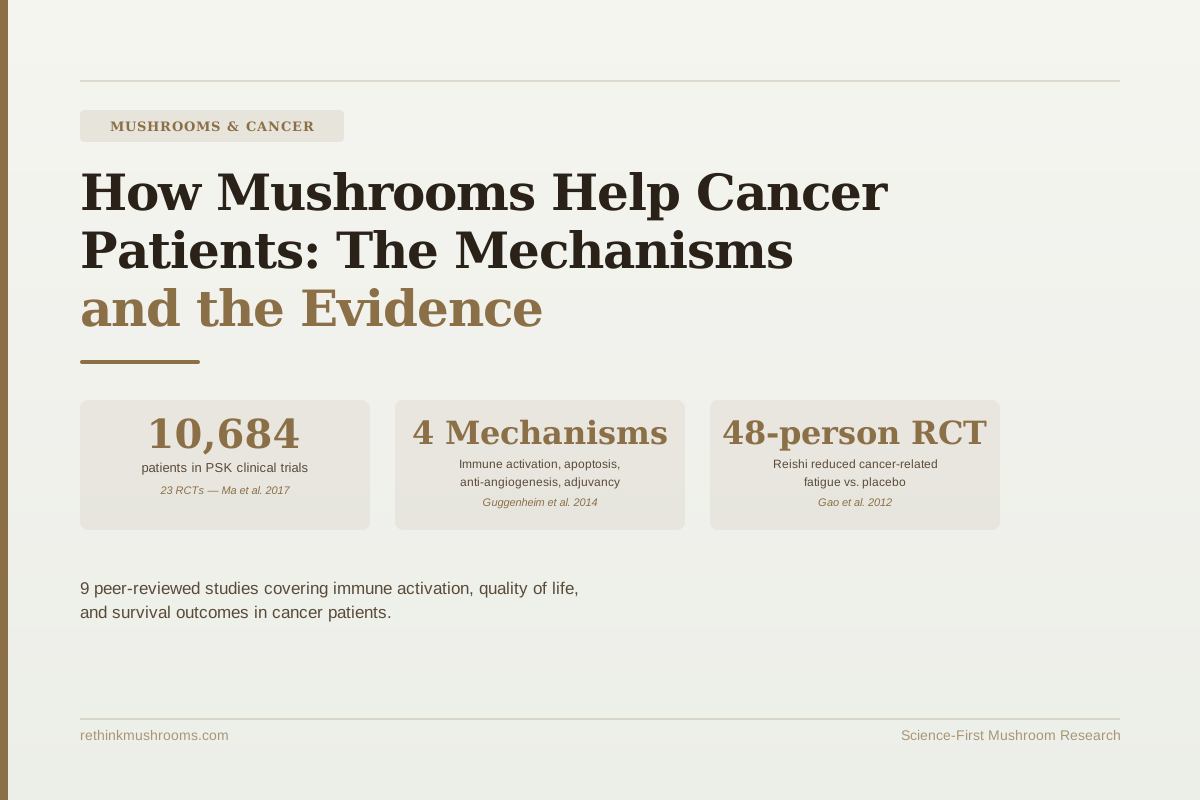
10,684 patients across 23 RCTs of PSK
A 2017 network meta-analysis found that adding PSK (turkey tail) to chemotherapy significantly improved 5-year overall survival and 7-year disease-free survival, without increasing side effects.
Ma et al., Oncotarget, 2017
4 mechanisms
immune activation, apoptosis, anti-angiogenesis, and chemotherapy adjuvancy
RCT evidence
for immune reconstitution in breast cancer patients (Sekhon-Loodu 2012)
48-person RCT
found reishi reduced cancer-related fatigue vs. placebo (Gao 2012)
Ma et al., Oncotarget, 2017
 View as image ↗
In 2017, a network meta-analysis pooled 23 randomized controlled trials and 10,684 cancer patients who had been treated with PSK, a polysaccharide compound extracted from turkey tail mushroom, alongside standard chemotherapy.[4] PSK combined with chemotherapy produced significantly better overall survival at five years and better disease-free survival at seven years compared to chemotherapy alone. This was without increased adverse effects.
That clinical result sits at the end of a research path that starts with cell biology. The reason PSK interacts productively with chemotherapy is not accidental; mushroom-derived compounds engage cancer biology through at least four distinct mechanisms that researchers have been studying for decades. Understanding how each mechanism works also clarifies what the evidence supports and where the gaps remain.
Medicinal mushrooms, in any cancer context, are adjunct approaches. They are studied as add-ons to conventional treatment, not replacements for chemotherapy, radiation, or surgery. This is the framing the evidence supports, and it is the framing used throughout this article. For the broader clinical landscape, see Medicinal Mushrooms in Cancer Treatment: A Complete Guide. For specific drug interaction and safety considerations, see Mushroom Supplements During Cancer Treatment: What Oncologists Say.
Key Takeaways
- A network meta-analysis of 23 RCTs (10,684 patients) found PSK from turkey tail mushroom combined with chemotherapy significantly improved 5-year overall survival and 7-year disease-free survival without increasing side effects (Ma et al. 2017)
- Beta-glucans from medicinal mushrooms bind Dectin-1 receptors on immune cells, triggering NK cell activation, CD8+ T cell responses, and pro-inflammatory cytokine cascades that target cancer cells (Guggenheim et al. 2014)
- Turkey tail mushroom produced dose-dependent immune reconstitution in breast cancer patients after radiation therapy, with measurable improvements in NK cells and CD8+ T cells in the first Phase 1 US clinical trial (Sekhon-Loodu et al. 2012)
- A double-blind RCT of 48 breast cancer patients found reishi spore powder significantly reduced cancer-related fatigue and depression compared to placebo during endocrine therapy (Gao et al. 2012)
- Reishi compounds suppress VEGF, the protein tumors secrete to grow new blood vessels, in cell culture models across multiple cancer types, though no human trials have confirmed this mechanism clinically (Tung et al. 2020)
- Cancer patients in remission taking turkey tail extract showed significant improvements in fatigue, sleep quality, pain scores, and emotional well-being compared to baseline (Johnson et al. 2013)
The Four Mechanisms: How Medicinal Mushrooms Interact With Cancer Biology
Medicinal mushrooms support cancer patients through four distinct biological pathways:
- Immune activation via beta-glucan receptor binding, triggering NK cells and T cells that target cancer cells
- Apoptosis induction via species-specific compounds that signal cancer cells to self-destruct
- Anti-angiogenesis via suppression of VEGF, the protein tumors use to grow new blood vessels
- Chemotherapy adjuvancy via immune reconstitution and reduced side effects that allow treatment to continue more effectively
These mechanisms are not all equally supported by human clinical evidence. Mechanisms 1 and 4 have human trial data, including the PSK RCTs. Mechanisms 2 and 3 are primarily established in cell culture and animal models. The distinction matters for how to interpret what mushrooms might and might not do for a cancer patient.
Beta-Glucans Train Your Immune System to Find and Attack Cancer Cells
The most thoroughly characterized mechanism begins with a receptor on the surface of immune cells called Dectin-1. When beta-glucans from mushroom cell walls bind to this receptor, they trigger a cascade of immune activity. Macrophages and dendritic cells that bind beta-glucan via Dectin-1 become activated and start signaling other immune cells to join the response.[1]
The result is a coordinated immune activation involving multiple cell types. Natural killer (NK) cells, which seek out and destroy cells displaying cancer markers, increase their activity. CD8+ cytotoxic T cells, which recognize and kill cancer cells that the immune system has learned to identify, are also recruited. Cytokines, the chemical messengers that coordinate the immune response, are released in patterns consistent with an anti-tumor response.
Guggenheim and colleagues reviewed the immunomodulatory mechanisms of five major medicinal mushrooms specifically for integrative oncology and found this Dectin-1-mediated beta-glucan mechanism was present across reishi, turkey tail, shiitake, maitake, and chaga.[1] The mechanism is not unique to one species; it is a property of the beta-1,3/1,6-glucan structure found in mushroom cell walls generally.
What makes this mechanism clinically relevant is that cancer patients receiving chemotherapy or radiation therapy often experience immune suppression as a side effect of treatment. The cancer is being targeted, but so is the immune system that would otherwise help. Beta-glucan activation could, in theory, help counteract that immunosuppression and restore immune function during or after treatment.
Park and colleagues tested this directly in cancer patients, measuring natural killer cell activity before and after mushroom extract consumption.[9] They found improved NK cell activity alongside improved quality of life measures, providing early clinical evidence that the laboratory-established mechanism translates to actual patients.
Reishi and Maitake Compounds Signal Cancer Cells to Self-Destruct
The second mechanism operates differently: rather than working through the immune system, certain mushroom compounds act directly on cancer cell biology.
Apoptosis is the biological process by which cells self-destruct in an organized way. It is a normal part of healthy tissue maintenance, and most cells are programmed to undergo it when damaged or when they receive the right signals. Cancer cells are characterized in part by their ability to evade apoptosis; they have developed resistance to the signals that would normally trigger self-destruction.
Reishi has been studied most extensively in this context. Ganoderic acids, the triterpenoid compounds concentrated in reishi fruiting bodies, have shown apoptotic activity against cancer cells in multiple cell line studies. Rop and colleagues reviewed the evidence for mushroom extracts in breast cancer and found that reishi compounds showed anti-proliferative effects in breast cancer cell lines, inhibiting cancer cell growth and triggering apoptosis markers across several study models.[5]
Tung and colleagues reviewed the broader integrative oncology evidence base and identified apoptosis induction across reishi, turkey tail, and maitake in cancer cell culture models, spanning breast, colon, and lung cancer cell lines.[2]
The critical qualifier: this evidence is from cell lines and animal models, not from human trials. Cell cultures allow researchers to test mechanisms in controlled conditions, but cancer cells in a dish behave differently from tumors in a living patient. The apoptosis data establishes a plausible mechanism but cannot be extrapolated to predict clinical outcomes in patients. No human trials have yet confirmed that mushroom compounds induce measurable tumor apoptosis in cancer patients.
Blocking the Blood Supply Tumors Need to Grow
Tumors cannot grow beyond a small size without developing their own blood vessel network. The process of building this network is called angiogenesis, and it depends on a protein called VEGF (vascular endothelial growth factor) that tumors secrete to trigger blood vessel growth. Many cancer drugs work by blocking VEGF or the receptors it binds to.
Reishi compounds have been shown to suppress VEGF secretion in cancer cell culture models across multiple studies, as reviewed by Tung and colleagues.[2] The proposed mechanism is that reishi polysaccharides and triterpenes reduce the tumor's ability to signal for new blood vessel formation.
Like the apoptosis evidence, this mechanism is established in cell culture and has not yet been confirmed in human clinical trials. Anti-angiogenesis is an active area of cancer drug development precisely because the mechanism is validated at the tumor biology level. Whether reishi compounds reach concentrations in human tumors sufficient to produce the VEGF suppression seen in cell culture is not yet known.
The anti-angiogenesis mechanism is worth including in any complete account of mushroom cancer biology, but it should not be presented as established clinical evidence. It represents a promising preclinical pathway with significant investigation still required.
The Mechanism With the Strongest Human Evidence: 23 Trials and 10,684 Patients
The fourth mechanism, chemotherapy adjuvancy, is where the human clinical evidence is the strongest, and where PSK from turkey tail has become the most-studied mushroom compound in oncology.
Adjuvancy means supporting or enhancing the effects of the primary treatment rather than acting as a treatment itself. PSK appears to work as an immune-reconstituting adjuvant: it helps maintain immune function during chemotherapy, which in turn may allow chemotherapy to work more effectively and allow patients to continue treatment without the interruptions caused by immune-related side effects.
Ma and colleagues conducted a network meta-analysis that synthesized 23 randomized controlled trials testing PSK combined with chemotherapy versus chemotherapy alone across gastric and colorectal cancers.[4] The combined evidence showed PSK groups had significantly improved overall survival (up to five years) and disease-free survival (up to seven years) without a significant increase in adverse effects. This is the largest body of clinical evidence for any mushroom compound in cancer treatment.
Chen and colleagues conducted a systematic review of beta-glucan adjuvant studies across multiple cancer types and found evidence supporting improved immune function, reduced chemotherapy side effects, and improved quality of life in cancer patients using mushroom-derived beta-glucans, with PSK and PSP from turkey tail identified as having the strongest human evidence base.[3]
PSK has been an approved prescription anticancer drug in Japan since 1977. It is used alongside chemotherapy for stomach, colorectal, and lung cancer as an established component of the treatment protocol, not as a fringe supplement. This context is largely absent from English-language patient guides but is central to understanding why the evidence base for PSK is as strong as it is: thirty-plus years of clinical use in Japan generated the trial data that now supports the meta-analysis findings.
For more on how mushroom polysaccharides engage multiple cancer-fighting pathways simultaneously, see How Mushroom Polysaccharides Kill Cancer Cells: Four Distinct Mechanisms.
In Cancer Patients: What the Clinical Trials Actually Show
Beyond the PSK survival data, three clinical studies provide specific evidence for how mushrooms affect cancer patients at the level of immune function and quality of life.
Sekhon-Loodu and colleagues conducted the first Phase 1 clinical trial of turkey tail mycelium in the United States, enrolling nine women with breast cancer who had completed radiation therapy.[6] The study used escalating doses of turkey tail to test safety and biological activity. At higher doses, they observed dose-dependent immune reconstitution, specifically improved NK cell activity and CD8+ T cell counts that had been suppressed by radiation. This was the first US clinical data demonstrating both safety and measurable immunological activity for turkey tail in cancer patients.
Gao and colleagues ran a double-blind, placebo-controlled randomized trial of reishi spore powder in 48 breast cancer patients undergoing endocrine therapy (hormone-blocking treatment taken after initial treatment for hormone-positive cancers).[7] The reishi group showed significantly reduced scores on validated fatigue and depression measures compared to the placebo group. This is the most rigorous human RCT for reishi in cancer patients and provides direct evidence for the quality of life benefit that makes reishi interesting in the oncology context: not tumor shrinkage, but fatigue reduction during a demanding and often lengthy phase of treatment.
Johnson and colleagues evaluated cancer patients in remission who were taking turkey tail extract and found significant improvements in fatigue, sleep quality, pain scores, and emotional well-being compared to baseline.[8] Quality of life outcomes matter for cancer patients independently of survival data. A therapy that makes treatment more tolerable, reduces fatigue, and improves sleep during a difficult period has genuine value even if it does not directly affect tumor biology.
For an evidence-based overview of what mushrooms can do for quality of life specifically, see Mushrooms and Quality of Life During Cancer Treatment.
The Honest Limits: What the Evidence Doesn't Show
A complete account of the evidence requires naming what is not established.
The apoptosis and anti-angiogenesis mechanisms described above have no human clinical confirmation. They are real biological phenomena observed in cell culture and animal models, but the path from a cell line result to a clinical outcome in a human patient is long and uncertain. Many compounds that kill cancer cells in a dish fail to produce results in clinical trials.
The PSK survival evidence comes predominantly from Japanese trials. The patient populations, cancer treatment protocols, and dietary contexts may differ from Western patients in ways that affect how the results apply. No large Phase 3 US trials have replicated the PSK survival findings, though the evidence base is larger than for most supplements and supports a meaningful evidence-based conversation with an oncologist.
Species other than turkey tail, shiitake (lentinan), and reishi have no significant clinical cancer evidence. Lion's mane, chaga, and cordyceps have in-vitro cancer research and animal models, but no clinical trials in cancer patients. Using them as cancer adjuncts would be an extrapolation from preclinical data only.
The mechanisms article should inform that conversation, not replace it. Disclosing any mushroom supplement use to your oncology care team before starting is necessary because of real drug interaction risks. Reishi in particular inhibits CYP450 liver enzymes that metabolize many cancer medications.
For the full evidence-graded review of mushroom cancer research by species and study type, see The Evidence for Mushroom-Based Cancer Adjuncts: A Research Review.
The Bottom Line
Medicinal mushrooms interact with cancer biology through four mechanisms: immune activation, apoptosis induction, anti-angiogenesis, and chemotherapy adjuvancy. The strongest human evidence is for the last mechanism, anchored by a 23-RCT meta-analysis showing PSK improved survival alongside chemotherapy in 10,684 patients. The immune reconstitution mechanism is also confirmed in human trials. Apoptosis and anti-angiogenesis evidence remains preclinical. Clinical trial data also supports quality of life benefits from reishi and turkey tail in cancer patients.
Frequently Asked Questions
Sources & References
- 1RTHM-00323·Guggenheim, Alena G et al. (2014). “Immune Modulation From Five Major Mushrooms: Application to Integrative Oncology..” Integrative medicine (Encinitas.Study breakdown →PubMed →↩
- 2. Source details for this reference are not yet available.
- 3. Source details for this reference are not yet available.
- 4RTHM-00895·Ma, Yan et al. (2017). “Can polysaccharide K improve therapeutic efficacy and safety in gastrointestinal cancer? a systematic review and network meta-analysis..” Oncotarget.Study breakdown →PubMed →↩
- 5. Source details for this reference are not yet available.
- 6. Source details for this reference are not yet available.
- 7. Source details for this reference are not yet available.
- 8. Source details for this reference are not yet available.
- 9. Source details for this reference are not yet available.