Mushrooms & Cancer
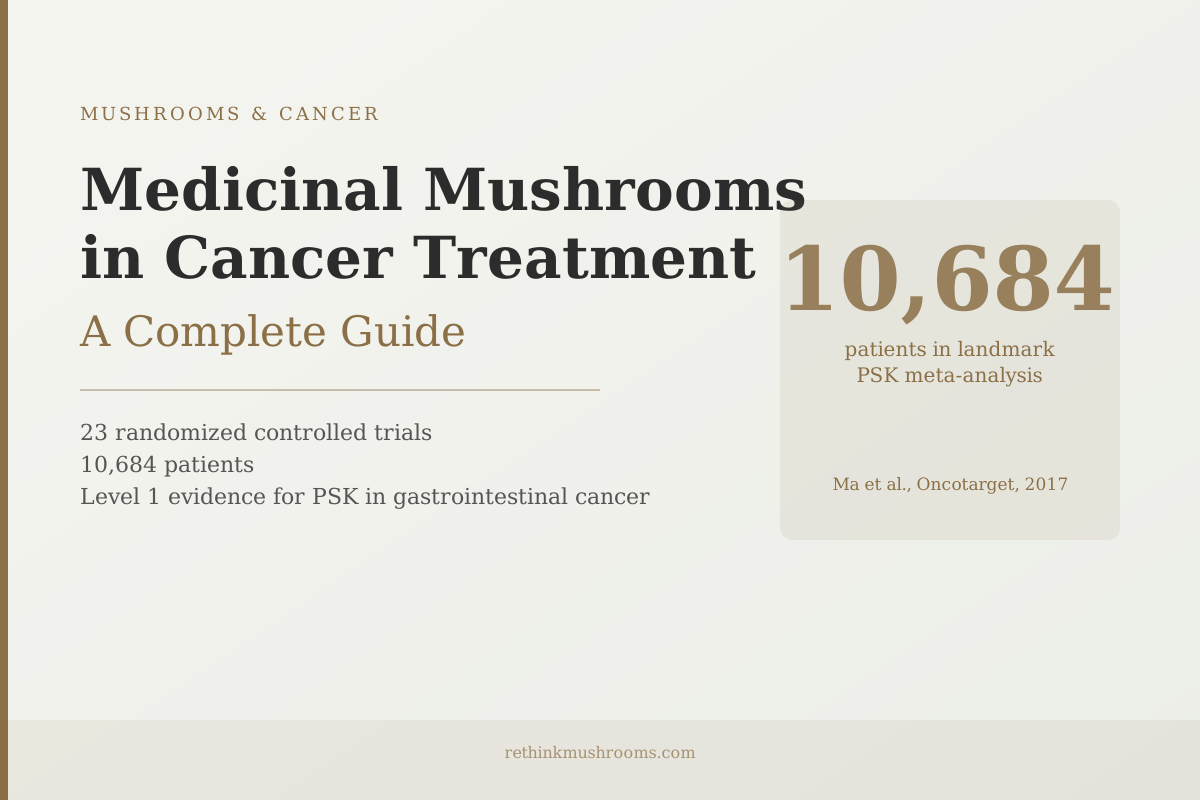
10,684 patients
A 2017 network meta-analysis of 23 randomized controlled trials found that PSK — derived from turkey tail mushroom — combined with chemotherapy significantly improved 5-year survival in gastrointestinal cancer patients.
Ma et al., Oncotarget, 2017
3 compounds
approved as prescription anticancer drugs in Japan
23 RCTs
included in the landmark PSK survival meta-analysis
Level 1
evidence grade for PSK in gastric and colorectal cancer (Narayanan, 2023)
Ma et al., Oncotarget, 2017
 View as image ↗
In Japan, three mushroom compounds are government-approved prescription drugs used alongside conventional cancer treatment. PSK, a compound derived from turkey tail mushroom, has been a standard oncology adjunct in Japan since 1977. Lentinan, derived from shiitake, has been prescribed for lung and gastric cancer since 1985. These are not fringe supplements sold in health food stores. They are reimbursed medications prescribed by oncologists.
Outside Japan, most English-language guides treat medicinal mushrooms as an unproven alternative. That framing misses the science. A 2017 network meta-analysis of 23 randomized controlled trials covering 10,684 patients found that PSK combined with standard chemotherapy was associated with significantly improved overall survival and disease-free survival in gastrointestinal cancer, without increasing side effects.[1]
This guide covers what the clinical evidence actually shows: which mushroom compounds have the strongest data, how they appear to work in the body during cancer treatment, what the drug interaction risks are, and what the evidence does not support.
These compounds are used as adjuncts — additions to conventional treatment, not replacements. This is not medical advice, and none of it should substitute for a conversation with an oncologist.
Key Takeaways
- PSK (from turkey tail) is a government-approved prescription anticancer drug in Japan, used since 1977 alongside chemotherapy for gastric and colorectal cancer
- A 2017 meta-analysis of 23 RCTs and 10,684 patients found PSK combined with chemotherapy improved 5-year overall survival versus chemotherapy alone, without increasing toxicity
- A 2023 systematic review assigned PSK the highest clinical evidence grade of any mushroom compound: Level 1 for gastric and colorectal cancer adjuvancy
- Lentinan (from shiitake) has been a prescription drug in Japan since 1985; a 12-year clinical review found immune parameter improvements and quality-of-life benefits in lung cancer patients
- A double-blind RCT of 48 breast cancer patients found reishi spore powder significantly reduced cancer-related fatigue and depression compared to placebo
- Reishi inhibits CYP450 liver enzymes (which metabolize many drugs, including some chemotherapy agents), making full disclosure to an oncologist essential before use
The Context Every English-Language Guide Leaves Out
In 1977, Japan's Ministry of Health approved PSK (sold under the brand name Krestin) as a prescription anticancer medication. Japanese oncologists began adding it to chemotherapy regimens for stomach and colorectal cancer. PSK is not categorized as a dietary supplement in Japan. It is a reimbursed drug.
In 1985, lentinan (derived from shiitake mushrooms) received Japanese approval as an intravenous adjuvant for advanced gastric and lung cancer. Schizophyllan, extracted from the common split-gill fungus, received similar approval for cervical cancer treatment.
None of these approvals appear in the NCI patient guide, the Cancer Research UK mushroom page, or most oncology center FAQs. That omission matters. These approvals are evidence that mushroom compounds can meet regulatory standards for anticancer activity. Japan did not approve these medications based on theoretical grounds. Decades of clinical use and trial data preceded each approval.
A 2018 review of 12 years of lentinan clinical use in China found that it improved immune parameters and quality of life in lung cancer patients receiving chemotherapy.[6] A 2020 integrative oncology review placed lentinan alongside PSK as the two mushroom compounds with the most established clinical records in cancer treatment.[4]
The Study That Changed the Conversation: 23 Trials, 10,684 Patients
In 2017, Ma and colleagues published a network meta-analysis in Oncotarget pooling all available randomized controlled trials of PSK as a cancer treatment adjunct.[1] The numbers are worth stating clearly.
The meta-analysis included 23 randomized controlled trials. The combined patient population was 10,684, covering gastrointestinal cancers including gastric, colorectal, and esophageal. PSK combined with chemotherapy showed significantly improved overall survival at 5 years compared to chemotherapy alone. Disease-free survival advantage extended to 7 years in some analyses. The PSK group did not experience significantly more chemotherapy side effects.
This is not cell culture data. These are controlled trials in human cancer patients with survival as the primary outcome.
A 2023 systematic review by Narayanan and colleagues, the most comprehensive analysis of clinical mushroom cancer studies available, assigned PSK the highest evidence grade of any mushroom compound: Level 1 for gastric and colorectal cancer adjuvancy.[2] Level 1 is the same evidence tier used for standard-of-care oncology drugs. That does not mean PSK is equivalent to standard chemotherapy. It means the human trial data is strong enough to support a clinical recommendation.
For a structured look at how researchers grade this evidence across all mushroom species, see The Evidence for Mushroom-Based Cancer Adjuncts: A Research Review.
The Dectin-1 Switch: How Mushroom Compounds Activate Immune Cells Against Cancer
The human immune system is designed to detect and destroy abnormal cells, including cancer cells. Cancer cells evolve mechanisms to avoid detection. Some mushroom compounds appear to counteract that evasion by activating the immune cells responsible for killing cancer cells.
The long-chain sugars found in mushroom cell walls, called beta-glucans, bind to a receptor on immune cells called Dectin-1. When Dectin-1 is engaged, it triggers a cascade that activates natural killer cells (the immune system's frontline against tumor cells), CD8+ T cells (targeted killers trained against specific cancer antigens), and cytokine production. This process does not create new immune cells. It amplifies the activity of immune cells already present.
A 2014 review by Guggenheim, Wright, and Zwickey — the most-cited integrative oncology mushroom reference — mapped this mechanism across five mushroom species and concluded that beta-glucan-mediated immune activation is the best-supported biological explanation for the clinical effects seen in cancer patients.[7]
Beyond immune activation, mushroom compounds show three other mechanisms in laboratory research:
Apoptosis induction: Compounds in reishi called triterpenes (ganoderic acids) trigger programmed cell death in certain cancer cell lines. This is confirmed in cell culture and animal studies. Human clinical evidence for this specific mechanism is limited.
Anti-angiogenesis: Reishi compounds suppress a protein called VEGF, which tumors use to build their own blood supply. Blocking that blood supply starves the tumor. Again, human clinical evidence for this mechanism is sparse.
Chemotherapy adjuvancy: PSK appears to amplify the immune response triggered by cancer cell death during chemotherapy, potentially improving drug efficacy. This is the mechanism with the most clinical trial support.
A 2021 systematic review covering beta-glucan adjuvant use across multiple cancer types confirmed that immune function improvement, reduced chemotherapy side effects, and quality of life improvements are the outcomes with the most consistent human evidence.[5]
For more on these mechanisms and what they mean clinically, see How Mushrooms Support Cancer Patients: Mechanisms and Evidence.
Turkey Tail (PSK): The Evidence Leader in Oncology
Turkey tail mushroom (Trametes versicolor) contains two immunologically active compounds: PSK (polysaccharide-K) and PSP (polysaccharide-peptide). PSK is the one with prescription drug status in Japan and the compound studied in the Ma 2017 meta-analysis.
In 2012, the first US Phase 1 clinical trial of turkey tail in cancer patients was completed. Sekhon-Loodu and colleagues enrolled nine breast cancer patients who had finished radiation therapy.[10] They found dose-dependent immune reconstitution: NK cell and CD8+ T cell activity increased as the turkey tail mycelium dose increased. This was the first US study to formally establish safety and immunological activity in cancer patients.
Also in 2012, Torkelson and colleagues published a study on turkey tail as adjunct therapy in breast cancer patients, finding improved immune reconstitution and quality of life, establishing turkey tail as the foundational clinical reference for US integrative oncology discussions.[13]
Narayanan 2023 places PSK/turkey tail at Level 1 evidence specifically for gastric and colorectal cancer when combined with chemotherapy.[2] The evidence is strongest for gastrointestinal cancers because that is where the Japanese clinical trials were concentrated. Extrapolating this finding to other cancer types is not currently supported by the same quality of evidence.
Shiitake (Lentinan): 40 Years as a Prescription Anticancer Drug
Lentinan is a beta-glucan extracted from shiitake mushrooms (Lentinus edodes). It is administered intravenously in clinical settings, not taken as an oral supplement.
Japan approved lentinan as a prescription oncology drug in 1985, nearly four decades ago. It has since been incorporated into lung and gastric cancer treatment protocols in both Japan and China.
A 2018 review by Rony and colleagues covered 12 years of lentinan clinical use in Chinese oncology settings.[6] Lentinan combined with chemotherapy improved NK cell activity, T cell ratios, and quality of life measures in lung cancer patients across multiple treatment cohorts. Narayanan 2023 grades lentinan at Level 2 evidence, one tier below PSK, citing the consistency of immune and quality-of-life findings but the smaller number of large randomized trials compared to PSK.[2]
The key context for patients outside Japan: the lentinan used in Japanese and Chinese oncology is an intravenous medication, not the oral shiitake extract sold in supplement form. The clinical evidence for IV lentinan does not transfer directly to capsule-form shiitake products.
Reishi: Strong Quality-of-Life Data, Earlier-Stage Survival Evidence
Reishi (Ganoderma lucidum) is used most widely in traditional Chinese medicine and has the most diverse set of proposed mechanisms among medicinal mushrooms. The clinical evidence for reishi in cancer divides clearly between two areas: quality of life and fatigue, where the data is strongest, and tumor suppression, where it remains largely preclinical.
The most rigorous human trial of reishi in cancer patients was published by Gao and colleagues in 2012.[9] This was a double-blind, placebo-controlled RCT enrolling 48 breast cancer patients on endocrine therapy. The reishi group received reishi spore powder. The control group received placebo. Result: reishi significantly reduced cancer-related fatigue and depression compared to placebo. This is the highest-quality human trial for reishi in cancer, and it targeted quality of life, not survival.
A 2013 study by Johnson and colleagues examined quality of life in cancer patients in remission taking turkey tail extract.[11] They found significant improvements in fatigue, sleep quality, pain, and emotional well-being. Quality of life improvement is the most consistent clinical finding across mushroom species. It matters independently of survival outcomes.
A 2020 review by Rop and colleagues examined mushroom evidence for breast cancer specifically, mapping the evidence tier from cell studies through clinical trials.[8] For reishi, the anti-proliferative and anti-metastatic activity documented in cell lines has not yet been replicated in human clinical trials. The evidence supports reishi for cancer-related fatigue. It does not yet support reishi as a tumor-suppressing agent in humans.
For the full QoL evidence picture, see Mushrooms and Quality of Life During Cancer Treatment.
Maitake, Lion's Mane, Chaga, and Cordyceps: Honest Evidence Grades
Maitake (Grifola frondosa) contains a compound called D-fraction, a beta-glucan shown to activate NK cells and dendritic cells in laboratory settings. Guggenheim 2014 covers maitake's immunological activity within the same Dectin-1 framework as turkey tail and shiitake.[7] Tung 2020 references pilot-level data in breast cancer patients showing NK cell activation after maitake D-fraction administration.[4] No large randomized trials exist for maitake in cancer treatment.
Lion's mane, chaga, and cordyceps: the cancer evidence for all three exists primarily at the cell culture and animal model level. No meaningful clinical trials in cancer patients exist for these species. Lion's mane's effect on nerve growth factor is well-documented in other contexts. That finding does not translate to a cancer treatment application until human cancer trials are conducted.
The 2023 scoping review by Dan and colleagues, covering gastric, breast, and colorectal cancer clinical evidence, did not identify clinical trial data for lion's mane, chaga, or cordyceps in cancer treatment.[3] Preclinical activity is promising for researchers. It does not establish clinical efficacy for patients.
For a species-by-species evidence comparison, see Medicinal Mushrooms as Cancer Adjuncts: A Cross-Species Evidence Overview.
Drug Interactions and the Case for Full Disclosure
Reishi contains compounds that inhibit a family of liver enzymes called CYP450, specifically CYP1A2, CYP2E1, and CYP3A4. These enzymes metabolize many common medications, including several chemotherapy drugs. When these enzymes are inhibited, drug concentrations in the bloodstream can rise above the intended level, potentially increasing toxicity.
Turkey tail may affect how the body processes tamoxifen (used for hormone-receptor-positive breast cancer) and cyclophosphamide (a common chemotherapy agent). The interaction data comes from pharmacokinetic studies, not from adverse event reports. The interactions are theoretical but substantive enough that treating oncologists should know about them.
The practical implication: any cancer patient considering mushroom supplements should inform their oncologist before starting. The safety profile of PSK and lentinan in clinical trials has been good. No significant increase in side effects was seen in the Ma 2017 meta-analysis. But the over-the-counter supplement market is unregulated, and dosing is not standardized to match the clinical trial protocols.
Narayanan 2023 addresses this directly, noting that PSK and lentinan have established safety profiles within clinical trial settings but that interaction data for commercial mushroom supplements is limited.[2] The form studied in clinical trials was standardized PSK extract, not whole mushroom powder or generic turkey tail capsules.
In the United States, the regulatory framework also shapes what manufacturers can say about these products. Mushroom supplements cannot make cancer treatment claims under DSHEA, regardless of what the Japanese prescription drug evidence shows. For context on why that gap exists, see FDA and Mushroom Supplements: How DSHEA Shapes What Companies Can (and Can't) Say.
For the full oncologist communication guide, see Mushroom Supplements During Cancer Treatment: What Oncologists Say.
Dietary Mushrooms and Cancer Risk: A Different Question
The evidence above concerns medicinal mushroom extracts used as treatment adjuncts. A separate body of research asks whether eating mushrooms at the dietary level is associated with lower cancer risk. These are different questions with different types of evidence.
A 2014 meta-analysis by Chen and colleagues pooled observational studies examining dietary mushroom intake and breast cancer incidence.[12] Higher mushroom consumption was associated with reduced breast cancer risk across the pooled data. The proposed mechanism involves anti-aromatase activity: white button mushrooms (Agaricus bisporus) contain compounds that inhibit the enzyme converting androgen to estrogen, potentially reducing estrogen-driven stimulation of breast cancer cells.
This is observational evidence. The association is real. Causation is not established. Eating more mushrooms as part of a diet is not the same as taking PSK extract alongside chemotherapy. The population-level evidence for mushroom consumption and cancer risk is its own distinct research area.
What the Evidence Supports and What It Does Not
The 2023 systematic review by Narayanan and colleagues provides the most current evidence-grading framework across all mushroom species and cancer contexts.[2]
Supported by clinical evidence:
- PSK combined with chemotherapy improving 5-year survival in gastric and colorectal cancer (Level 1, multiple RCTs)
- Lentinan as IV adjuvant improving immune parameters and quality of life in lung cancer (Level 2)
- Reishi spore powder reducing cancer-related fatigue and depression (RCT, N=48)
- Turkey tail improving NK cell and CD8+ T cell activity in breast cancer patients post-radiation (Phase 1 trial)
- Mushroom supplements broadly associated with quality-of-life improvements in cancer patients
Not supported by current clinical evidence:
- Any mushroom compound as a standalone cancer treatment
- Lion's mane, chaga, or cordyceps for any cancer outcome in humans
- Tumor reduction in humans from reishi (supported in cell studies and animal models only)
- PSK efficacy established for cancer types outside gastrointestinal (the RCT base is concentrated in Japan for GI cancers)
Dan 2023 reaches the same conclusion: PSK and turkey tail have the strongest clinical evidence, but overall evidence quality is limited by trial heterogeneity, and extrapolating findings to all cancer types or all mushroom species is not warranted by available data.[3]
The Bottom Line
The strongest clinical evidence for medicinal mushrooms in cancer comes from PSK (derived from turkey tail), which has Level 1 evidence for improved survival in gastric and colorectal cancer when combined with chemotherapy, based on a meta-analysis of 23 RCTs and 10,684 patients. Lentinan (from shiitake) and reishi have meaningful evidence for immune support and quality-of-life outcomes respectively. For most other mushroom species, the cancer evidence remains preclinical. All mushroom compounds are adjuncts to conventional treatment, not replacements for it.
Frequently Asked Questions
Sources & References
- 1RTHM-00895·Ma, Yan et al. (2017). “Can polysaccharide K improve therapeutic efficacy and safety in gastrointestinal cancer? a systematic review and network meta-analysis..” Oncotarget.Study breakdown →PubMed →↩
- 2RTHM-01760·Narayanan, Santhosshi et al. (2023). “Medicinal Mushroom Supplements in Cancer: A Systematic Review of Clinical Studies..” Current oncology reports.Study breakdown →PubMed →↩
- 3RTHM-01682·Dan, Amit et al. (2023). “Therapeutic Effects of Medicinal Mushrooms on Gastric, Breast, and Colorectal Cancer: A Scoping Review..” Cureus.Study breakdown →PubMed →↩
- 4. Source details for this reference are not yet available.
- 5. Source details for this reference are not yet available.
- 6. Source details for this reference are not yet available.
- 7RTHM-00323·Guggenheim, Alena G et al. (2014). “Immune Modulation From Five Major Mushrooms: Application to Integrative Oncology..” Integrative medicine (Encinitas.Study breakdown →PubMed →↩
- 8. Source details for this reference are not yet available.
- 9. Source details for this reference are not yet available.
- 10. Source details for this reference are not yet available.
- 11. Source details for this reference are not yet available.
- 12. Source details for this reference are not yet available.
- 13. Source details for this reference are not yet available.