Mushrooms & Cancer Prevention
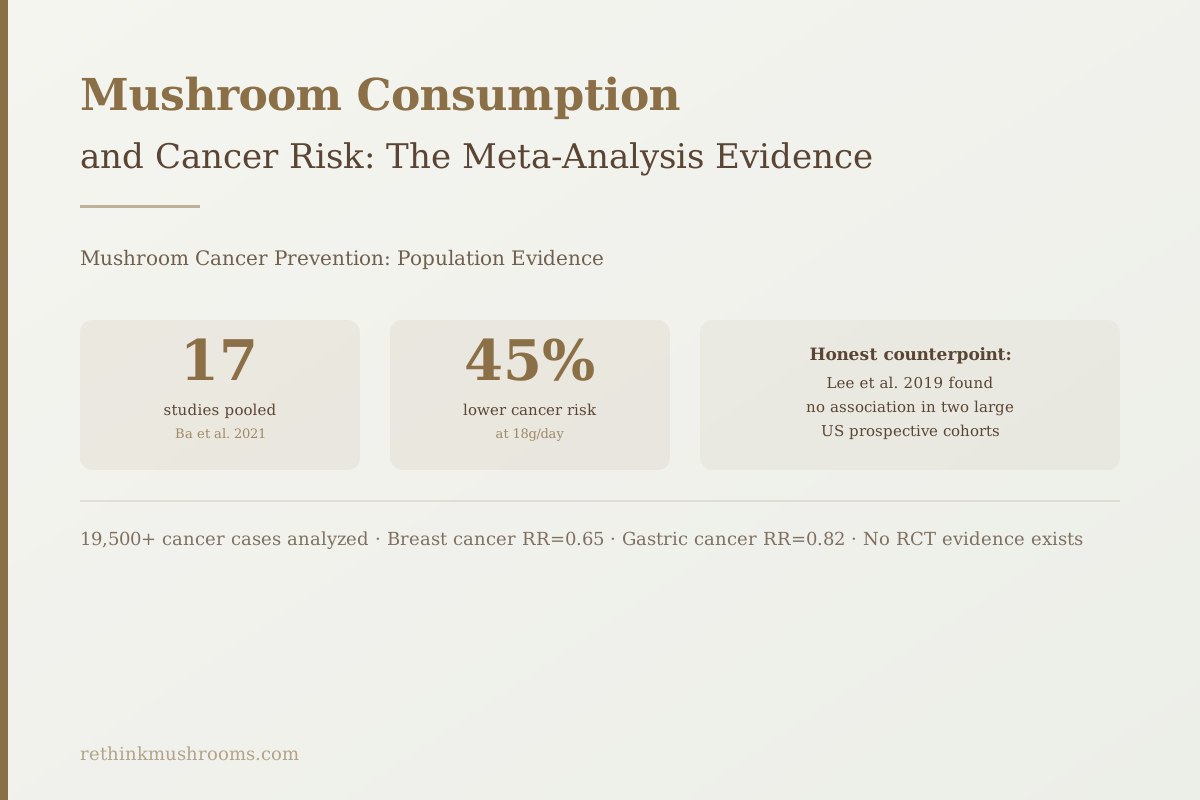
17 studies, 19,500+ cancer cases
Ba et al.'s 2021 meta-analysis pooled 17 observational studies and found a 34% lower cancer risk in the highest vs. lowest mushroom consumption groups, with dose-response evidence showing 45% lower risk at 18g per day.
Ba et al., Advances in Nutrition, 2021
RR=0.66
relative risk for cancer in highest vs. lowest mushroom consumers (Ba et al. 2021)
RR=0.82
relative risk for gastric cancer in a 2023 pooled analysis of population studies
1 null result
from two large US prospective cohorts, a counterpoint every reader deserves to know
Ba et al., Advances in Nutrition, 2021
 View as image ↗
A 2021 systematic review and meta-analysis published in Advances in Nutrition pooled 17 observational studies covering more than 19,500 cancer cases. Its headline finding, that people eating 18 grams of mushrooms per day had a 45% lower cancer risk than those eating none, generated significant press coverage and made mushroom consumption a topic of serious oncology interest. That finding holds up well under scrutiny in some respects. In others, it needs context that the press coverage didn't supply.
This article covers the full population evidence on mushroom consumption and cancer risk: the meta-analysis data, the site-specific findings for breast and gastric cancer, the mortality studies that add a second line of evidence, and the one large US prospective cohort study that found no association at all. The evidence is interesting and coherent enough to be worth understanding in detail. For the full context of how mushrooms are studied as cancer treatment adjuncts, see medicinal mushrooms in cancer treatment: a complete guide.
Key Takeaways
- A 2021 meta-analysis of 17 observational studies found a relative risk of 0.66 (34% lower cancer risk) for highest vs. lowest mushroom consumption groups; 18g/day was associated with 45% lower risk, with a dose-response relationship across intake levels (Ba et al., Advances in Nutrition, 2021)
- The evidence base is almost entirely observational (case-control and cohort studies); no randomized controlled trial has tested mushroom consumption as a cancer prevention intervention in humans
- Breast cancer has the strongest site-specific signal: a separate meta-analysis found dose-response evidence linking mushroom intake to lower breast cancer risk; the Ba 2021 meta-analysis found breast cancer RR=0.65
- Gastric cancer: a 2023 pooled analysis from the StoP Project plus meta-analysis found RR=0.82 for higher vs. lower mushroom intake (Ba et al., 2023)
- Two large US prospective cohorts (Nurses' Health Study + Health Professionals Follow-up Study) found no significant association between mushroom intake and cancer risk. This is the critical honest counterpoint (Lee et al., Cancer Epidemiology, 2019)
- Two NHANES cohort studies and a Korean prospective study found lower all-cause mortality with higher mushroom intake, adding a second line of evidence independent of cancer incidence data
What the 2021 Meta-Analysis Actually Found: Numbers Worth Reading Carefully
The Ba et al. 2021 meta-analysis in Advances in Nutrition is the most comprehensive synthesis of population data on mushroom consumption and cancer risk.[1] Understanding its specific findings, and their limits, is where any honest account of this evidence has to start.
The meta-analysis pooled 17 observational studies covering more than 19,500 cancer cases across multiple countries. The key result: comparing the highest mushroom consumption group against the lowest, the relative risk of cancer was 0.66 (95% CI 0.55-0.78). Translated, that's a 34% lower risk of cancer for high consumers compared to low consumers.
The 45% figure that circulated in media coverage came from the dose-response analysis: 18 grams per day, roughly one-eighth of a cup of mushrooms, was associated with a 45% lower cancer risk. At 10 grams per day, the association was a 17% lower risk. Each gram-per-day increment was associated with approximately 3% lower breast cancer risk in this model.
Two things are worth noting about this structure. First, the dose-response relationship is consistent: the association gets stronger at higher intake, which is what you'd expect if the relationship were real and not entirely confounded. Second, most of the 17 studies in the meta-analysis were case-control studies, which are less rigorous than prospective cohort studies. Case-control studies can be affected by recall bias (people with cancer may remember their diet differently than healthy controls) and selection bias. The prospective cohort studies in the meta-analysis, which follow people forward before cancer develops, showed weaker effects than the case-control studies.
The breakdown of the study evidence shows the important methodological spread:
| Study type | Typical strength | What this means for the findings |
|---|---|---|
| Case-control studies | Moderate: susceptible to recall and selection bias | The majority of studies in the Ba 2021 meta-analysis; show stronger effects |
| Prospective cohort studies | Higher: participants followed forward in time | Fewer in the meta-analysis; show weaker effects |
| Randomized controlled trials | Highest | None exist for mushrooms and cancer prevention |
This doesn't invalidate the meta-analysis finding. It explains why replication in high-quality prospective cohort studies is needed before the numbers can be interpreted as reliable estimates of the true effect.
Breast and Gastric Cancer: Where the Strongest Site-Specific Evidence Points
The Ba 2021 meta-analysis found the strongest association for breast cancer: RR=0.65 in the highest vs. lowest consumption groups.[1] A separate, earlier meta-analysis by Li and colleagues (2014) focused specifically on breast cancer across multiple observational studies and found dose-response evidence linking mushroom intake to lower breast cancer risk, with the highest intake categories showing the largest reductions.[2]
The biological mechanism proposed for the breast cancer association is twofold. First, many mushrooms contain ergothioneine, an antioxidant the human body cannot produce and that accumulates specifically in mitochondria, which are particularly sensitive to oxidative damage in cancer development. Second, white button mushrooms (Agaricus bisporus) contain phytochemicals that inhibit aromatase, the enzyme responsible for converting androgens to estrogen in breast tissue. This would be particularly relevant for hormone receptor-positive breast cancers, where estrogen promotes tumor growth.
For gastric cancer, Ba and colleagues published a 2023 pooled analysis combining data from the Stomach Cancer Pooling (StoP) Project with other observational studies. The result: higher mushroom consumption was associated with a relative risk of 0.82 for gastric cancer compared to lower consumption.[3] An 18% lower risk of gastric cancer is a more modest association than the breast cancer data, but it extends the pattern to a second cancer site with a distinct etiology.
A 2023 scoping review by Dan and colleagues summarized the evidence across gastric, breast, and colorectal cancers, finding consistent signals across all three sites for several mushroom species including shiitake, reishi, and maitake.[4] Colorectal cancer evidence, while present, is less developed than the breast and gastric cancer data.
For readers interested in the biological mechanisms behind these associations, the beta-glucan immune activation pathway is covered in depth in mushroom beta-glucans and immunity: the complete research guide, and the ergothioneine story specifically is in the history of ergothioneine: from discovery to 'longevity vitamin' debate.
The Mortality Studies: A More Robust Measure Than Incidence Alone
Cancer incidence data, meaning who develops cancer, is one way to measure the association. Mortality data is in some ways a cleaner signal: it captures whether people who eat more mushrooms live longer, not just whether they're less likely to be diagnosed.
Two cohort studies published in Nutrition Journal in 2021 by Ba and colleagues examined this question using US National Health and Nutrition Examination Survey (NHANES) data. The first used NHANES III, following a nationally representative US sample prospectively; the second used the continuous NHANES data from 2003 to 2014 and included a meta-analysis of mortality studies alongside the cohort analysis. Both found that higher mushroom intake was associated with lower all-cause and cause-specific mortality.[5][6]
The Korea Genome and Epidemiology Study (KoGES) cohort published by Jung and colleagues in 2023 added geographic breadth to this mortality evidence. This large Korean prospective study found the same pattern: higher edible mushroom intake was inversely associated with all-cause mortality and cause-specific mortality.[7]
Prospective cohort studies are more rigorous than case-control studies because researchers measure exposure (mushroom intake) before the outcome (death or cancer diagnosis) occurs. This design eliminates recall bias and reduces selection bias. The fact that the mortality association appears consistently across a US sample and a Korean sample, using different data collection methods, strengthens the signal.
The sibling article can eating mushrooms prevent cancer? Epidemiological evidence covers the broader epidemiological framework, including how population-level evidence is interpreted in cancer research.
The Null Result That Didn't Make the Press Release
No account of this evidence is complete without Lee et al. (2019), published in Cancer Epidemiology.
Lee and colleagues analyzed data from two of the largest and most methodologically rigorous prospective cohorts in nutrition research: the Nurses' Health Study and the Health Professionals Follow-up Study. These are long-running US cohort studies with detailed dietary assessments and decades of follow-up. Their finding: no significant association between mushroom intake and risk of total cancer or any site-specific cancer.[8]
This is the opposite conclusion from the Ba 2021 meta-analysis headline. Understanding why the two sets of findings diverge requires engaging with the study design differences, not dismissing one or the other.
Several factors could explain why US prospective cohorts show no effect while the global meta-analysis (which includes many Asian studies) shows a positive association:
Baseline intake and variability. Dietary mushroom intake in the US is low and relatively homogeneous. When most of a population eats very little of a food, the "high" consumption group may not be eating enough to see an effect, and the range of exposure across groups is small. Asian populations, particularly Korean and Chinese cohorts in the meta-analysis, consume mushrooms at substantially higher absolute levels, potentially more relevant to any threshold effect.
Mushroom species and preparation. The Asian studies primarily include shiitake, oyster, and medicinal mushroom varieties with high ergothioneine content. US consumption is dominated by white button mushrooms, which have lower ergothioneine. If the protective compound is ergothioneine specifically, US data would systematically underestimate any protective effect.
Measurement challenges. Dietary assessment tools used in US cohorts were not optimized for mushroom intake specifically, potentially misclassifying consumption levels.
None of these explanations are certain. The Lee 2019 null result is a genuine piece of evidence that the association is not universal across populations, and it appropriately reduces confidence in the strongest versions of the cancer-prevention claim.
Why No Randomized Trial Has Tested This, and What That Means
Narayanan and colleagues published a systematic review in 2023 specifically examining clinical trial evidence for medicinal mushroom supplements in cancer. Their conclusion was sobering: while case reports and small trials exist for specific compounds such as PSK from turkey tail and lentinan from shiitake in the context of cancer treatment adjuncts, no randomized controlled trial has been conducted specifically to test whether mushroom consumption or supplementation prevents cancer in healthy people.[9]
This is not an indictment of the observational evidence. RCTs for cancer prevention are logistically and ethically complex: you need a large population, a very long follow-up, and a control arm that doesn't receive the intervention. Cancer takes years to decades to develop. Primary cancer prevention trials exist for interventions like aspirin, vitamin D, and smoking cessation, but they require enormous resources and long timelines. No such trial has been funded for mushroom consumption.
What this means practically: the observational evidence showing consistent associations between mushroom consumption and lower cancer risk cannot be confirmed or refuted by clinical trial evidence because that evidence doesn't exist. The Ba 2021 meta-analysis, the NHANES mortality studies, and the Jung 2023 Korean cohort together create a coherent observational signal. The Lee 2019 null result in US cohorts is a real limitation. Both pieces of information are part of an honest account.
For readers interested in what clinical evidence does exist for mushroom compounds in cancer treatment settings rather than prevention, see how mushrooms support cancer patients: mechanisms and evidence and the evidence for mushroom-based cancer adjuncts: a research review. For the Penn State research program specifically, see the Pennsylvania State Study: mushroom intake and cancer mortality. For a practical look at which mushroom species have the best evidence for cancer prevention, see which mushrooms are best for cancer prevention?.
The Bottom Line
The population evidence on mushroom consumption and cancer risk shows a consistent inverse association across multiple study types and geographic populations, anchored by the 2021 Ba et al. meta-analysis (RR=0.66 for highest vs. lowest intake) and extended to gastric cancer by a 2023 pooled analysis. Mortality data from two NHANES cohorts and a Korean prospective study adds a second line of evidence. The critical counterpoint is the Lee 2019 null result from the Nurses' Health Study and HPFS, two large US prospective cohorts that found no association. No randomized trial has tested mushroom consumption for cancer prevention. The evidence is coherent enough to warrant attention but not strong enough to support a causal claim.
Frequently Asked Questions
Sources & References
- 1RTHM-00671·Ba, Djibril M et al. (2021). “Higher Mushroom Consumption Is Associated with Lower Risk of Cancer: A Systematic Review and Meta-Analysis of Observational Studies..” Advances in nutrition (Bethesda.Study breakdown →PubMed →↩
- 2RTHM-00336·Li, Jiaoyuan et al. (2014). “Dietary mushroom intake may reduce the risk of breast cancer: evidence from a meta-analysis of observational studies..” PloS one.Study breakdown →PubMed →↩
- 3RTHM-00815·Ba, Djibril M et al. (2023). “Mushroom consumption and risk of gastric cancer: a pooled analysis within the stomach cancer pooling project and a combined meta-analysis with other observational studies..” European journal of cancer prevention : the official journal of the European Cancer Prevention Organisation (ECP).Study breakdown →PubMed →↩
- 4RTHM-01682·Dan, Amit et al. (2023). “Therapeutic Effects of Medicinal Mushrooms on Gastric, Breast, and Colorectal Cancer: A Scoping Review..” Cureus.Study breakdown →PubMed →↩
- 5RTHM-00673·Ba, Djibril M et al. (2021). “Association of mushroom consumption with all-cause and cause-specific mortality among American adults: prospective cohort study findings from NHANES III..” Nutrition journal.Study breakdown →PubMed →↩
- 6RTHM-00674·Ba, Djibril M et al. (2021). “Prospective study of dietary mushroom intake and risk of mortality: results from continuous National Health and Nutrition Examination Survey (NHANES) 2003-2014 and a meta-analysis..” Nutrition journal.Study breakdown →PubMed →↩
- 7RTHM-00833·Jung, Hyein et al. (2023). “Edible mushroom intake and risk of all-cause and cause-specific mortality: results from the Korean Genome and Epidemiology Study (KoGES) Cohort..” Food & function.Study breakdown →PubMed →↩
- 8. Source details for this reference are not yet available.
- 9RTHM-01760·Narayanan, Santhosshi et al. (2023). “Medicinal Mushroom Supplements in Cancer: A Systematic Review of Clinical Studies..” Current oncology reports.Study breakdown →PubMed →↩