Mushrooms and Cancer Prevention
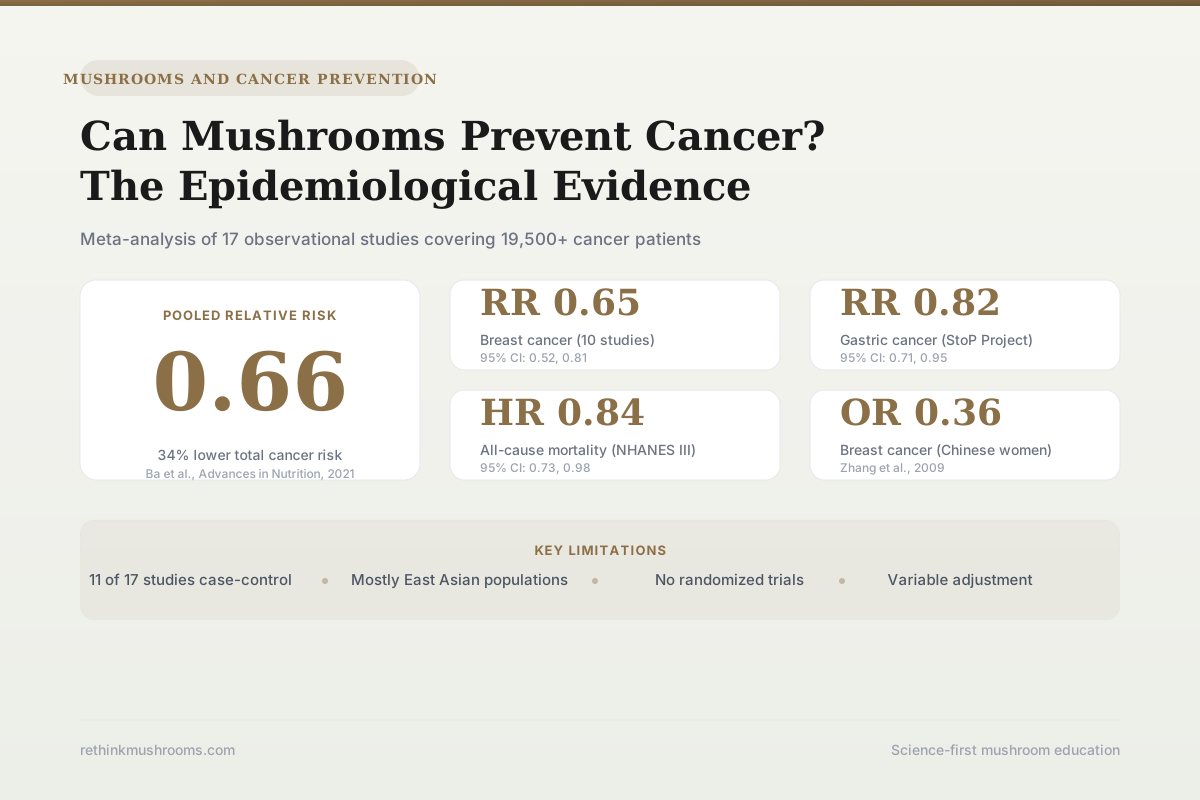
34% lower total cancer risk
Pooled relative risk of 0.66 for the highest versus lowest mushroom consumption groups across 17 observational studies in more than 19,500 cancer patients.
Ba et al., Advances in Nutrition, 2021
17 studies
in the largest meta-analysis (1966–2020)
RR 0.65
for breast cancer at the highest intake
RR 0.82
for gastric cancer in the StoP pooled analysis
Ba et al., Advances in Nutrition, 2021
 View as image ↗
The case for mushrooms as a cancer-preventive food rests almost entirely on observational epidemiology. There has never been a randomized trial assigning humans to eat mushrooms for years and tracking who developed cancer. What we have instead is roughly two dozen case-control and cohort studies, mostly from East Asia, that compare mushroom intake between people who developed cancer and those who did not. The largest synthesis of this literature, a 2021 systematic review and meta-analysis by Ba and colleagues, pooled 17 studies covering more than 19,500 cancer patients and reported a 34% lower risk of total cancer in the highest mushroom consumption groups compared with the lowest.[1] That headline number is real, but the underlying data are uneven, dominated by case-control studies of breast cancer, and concentrated in populations whose mushroom consumption looks nothing like the average Western diet. This article walks through what the epidemiological evidence does and does not support. For a closer look at the dose-response signal, see mushroom consumption and cancer risk reduction: meta-analysis of population studies and daily mushroom consumption and cancer risk reduction.
Key Takeaways
- A meta-analysis of 17 observational studies (1966–2020) found a pooled relative risk of 0.66 (95% CI: 0.55, 0.78) for total cancer comparing highest with lowest mushroom consumption (Ba et al., 2021)
- The same meta-analysis found a stronger association for breast cancer (RR 0.65, 95% CI: 0.52, 0.81; n = 10 studies) than for non-breast cancers combined (RR 0.80, 95% CI: 0.66, 0.97; n = 13 studies) (Ba et al., 2021)
- A pooled analysis within the Stomach Cancer Pooling (StoP) Project of 3,900 cases and 7,792 controls reported RR 0.82 (95% CI: 0.71, 0.95) for gastric cancer at the highest mushroom intake (Ba et al., 2023)
- In Chinese women, daily intake of ≥10 g fresh mushrooms was associated with an OR of 0.36 (95% CI: 0.25, 0.51) for breast cancer compared with non-consumers (Zhang et al., 2009)
- In a US prospective cohort (NHANES III, 15,546 adults, 19.5-year follow-up, 5,826 deaths), mushroom consumers had lower all-cause mortality (HR 0.84, 95% CI: 0.73, 0.98) but no significant association with cancer-specific mortality (Ba et al., 2021)
- Eleven of the 17 studies in the Ba 2021 meta-analysis used case-control designs, which are vulnerable to recall bias and selection bias and tend to overstate effect sizes compared with prospective cohorts
Effect-Size Overview
Mushroom Intake and Cancer Risk — Every Pooled Estimate Sits Left of Null
Relative risk (RR) or odds ratio (OR) for the highest versus lowest mushroom-consumption groups, with 95% confidence intervals. Points to the left of the RR = 1.0 line indicate lower cancer risk. The estimates are consistent in direction but the intervals are wide, and the single Chinese case-control study (Zhang 2009) is far more extreme than the pooled meta-analytic estimates.
How to read it: each point is the central estimate and each bar its 95% confidence interval. All seven estimates fall left of the null line, which is why the direction of the association looks robust. But the pooled meta-analytic estimates (Ba 2021, Ba 2023) cluster near RR 0.66–0.82, while the single Chinese case-control study reports OR 0.36 — the kind of outsized effect that recall and selection bias tend to produce. The mortality row (muted) is a different endpoint: fewer deaths from any cause, not fewer cancers.
Sources: Ba 2021 [1] (RTHM-01323); Zhang 2009 [4] (RTHM-00325); Ba 2023 [6] (RTHM-01659); Ba 2021 all-cause mortality [8] (RTHM-01326). Point positions and whiskers are quantitative; the OR from Zhang 2009 and the RRs from the meta-analyses are not directly comparable across study designs and are plotted together only to show relative magnitude.
What the Largest Meta-Analysis Actually Found
Ba et al. (2021) searched MEDLINE, Web of Science, and the Cochrane Library for observational studies of mushroom intake and cancer published between January 1966 and October 2020. They included any study that reported relative risks, hazard ratios, or odds ratios with 95% confidence intervals for at least two categories of mushroom intake. Seventeen studies met inclusion: 11 case-control and 6 cohort designs. The pooled relative risk for total cancer comparing the highest with the lowest consumption category was 0.66 (95% CI: 0.55, 0.78).[1]
That summary number obscures an important asymmetry. When the authors split the analysis by cancer type, the breast cancer subset (10 studies) yielded a pooled RR of 0.65 (95% CI: 0.52, 0.81), while the non-breast subset (13 studies, encompassing several cancer sites) yielded a weaker pooled RR of 0.80 (95% CI: 0.66, 0.97). When site-specific cancers were examined, breast cancer was the only individual site where the pooled estimate reached statistical significance. The authors attributed this to the small number of studies for any given non-breast site, but it also means the headline 34% reduction is being driven disproportionately by one cancer type studied in one population (East Asian women).
The dose-response analysis added a useful layer. Among the seven studies with sufficient categorical data for trend modeling, there was evidence of a significant nonlinear relationship between mushroom intake and total cancer risk (P-nonlinearity = 0.001), suggesting that the apparent benefit plateaus rather than continuing to grow at very high intake levels. Linear dose-response estimates from earlier breast cancer meta-analyses had suggested approximately 3% lower risk per 1 g/day increase in mushroom intake.[2]
The East Asian Breast Cancer Studies
The strongest individual signals in the literature come from case-control studies of breast cancer in Chinese and Korean women. These are also the studies most vulnerable to the methodological problems described later in this article.
Hong et al. (2008) compared 362 Korean women with histologically confirmed breast cancer to age- and menopause-matched controls. Higher mushroom intake was inversely associated with breast cancer risk after adjustment for education, family history, exercise, BMI, parity, smoking, alcohol, and multivitamin use. The fifth versus first quintile of daily mushroom intake yielded an OR of 0.48 (95% CI: 0.30, 0.78; p-trend = 0.030). When stratified by menopausal status, the association was substantially stronger in postmenopausal women (OR 0.16, 95% CI: 0.04, 0.54) than in premenopausal women, where it was not significant.[3]
Zhang et al. (2009) conducted a larger case-control study in southeast China with 1,009 incident breast cancer cases and 1,009 controls recruited from breast clinics. Daily intake of ≥10 g fresh mushrooms was associated with an OR of 0.36 (95% CI: 0.25, 0.51) compared with non-consumers, and ≥4 g dried mushrooms with an OR of 0.53 (95% CI: 0.38, 0.73). When mushroom consumption was combined with green tea intake (≥1.05 g dried green tea leaves per day), the risk reduction was greater than either food alone, with significant linear trends for the joint effect.[4]
Shin et al. (2010) extended the question by stratifying breast cancers by hormone receptor status in 358 Korean cases and 360 controls. Greater mushroom intake was associated with lower premenopausal breast cancer risk (OR 0.35, 95% CI: 0.13, 0.91 for the highest versus lowest quartile), with the strongest association for ER+/PR+ tumors (OR 0.30, 95% CI: 0.11, 0.79). The hormone receptor pattern was consistent with a mechanism involving estrogen modulation, although it could also reflect chance given the small subgroup numbers.[5]
For the laboratory mechanism that may underlie these associations, see button mushroom and breast cancer: the aromatase inhibition discovery.
Li 2014 Dose-Response Meta-Analysis
Before the Ba 2021 review, the most cited synthesis of mushroom and breast cancer epidemiology was Li et al. (2014), a dose-response meta-analysis pooling eight case-control and two cohort studies (6,890 breast cancer cases). The dose-response model yielded RR 0.97 (95% CI: 0.96, 0.98) per 1 g/day increase in mushroom intake, with the inverse association somewhat stronger in postmenopausal (RR 0.94) than premenopausal (RR 0.96) women. The linear estimate was statistically significant but modest in absolute terms; an additional 10 g/day of mushrooms (a substantial dietary change) corresponded to roughly a 30% reduction in risk by extrapolation.[2]
Beyond Breast Cancer: Gastric, Mortality, and Other Sites
Gastric Cancer: The StoP Pooled Analysis
The Ba 2023 pooled analysis within the Stomach Cancer Pooling (StoP) Project is the largest single examination of mushroom intake and any non-breast cancer. It combined individual-level data from 11 studies covering 3,900 gastric cancer cases and 7,792 controls. Higher mushroom consumption was associated with lower gastric cancer risk (RR 0.82, 95% CI: 0.71, 0.95 for highest versus lowest categories). The authors then combined the StoP result with four previously published studies in a meta-analysis, yielding a pooled RR of 0.77 (95% CI: 0.63, 0.95) across 15 studies. In geographic subgroup analysis, the pooled risk in Western Pacific countries was RR 0.59 (95% CI: 0.40, 0.87), substantially stronger than in Western populations. The authors suggested this could reflect higher antioxidant content of mushroom species commonly eaten in Asia, but it could equally reflect higher absolute intake levels or confounding by other elements of Asian diets.[6]
All-Cause and Cancer-Specific Mortality
Two prospective cohort analyses by the same Penn State research group examined whether mushroom consumption is associated with lower mortality in US adults. The first analyzed NHANES III (15,546 participants, mean follow-up 19.5 years, 5,826 deaths) and found that mushroom consumers had a 16% lower risk of all-cause mortality compared with non-consumers (HR 0.84, 95% CI: 0.73, 0.98) after multivariable adjustment. Substituting one serving of mushrooms per day for one serving of processed or red meat was associated with HR 0.65 (95% CI: 0.50, 0.84) for all-cause mortality. However, when cause-specific mortality was examined, the authors did not observe statistically significant associations between mushroom consumption and cancer-specific death.[7] For more on this cohort, see the pennsylvania state study: mushroom intake and cancer mortality.
The second analysis used continuous NHANES 2003–2014 (30,378 participants, mean follow-up 6.7 years, 2,855 deaths). Here the all-cause mortality association did not reach statistical significance (HR 0.84, 95% CI: 0.67, 1.06), likely because the follow-up was too short. The authors then meta-analyzed their result with four other prospective cohorts (combined n = 601,893 individuals) and reported a pooled all-cause mortality RR of 0.94 (95% CI: 0.91, 0.98).[8]
The Korean Genome and Epidemiology Study (KoGES) cohort followed 152,828 adults aged 40 and older for a mean of 11.6 years, recording 7,085 deaths. Compared with non-consumers, men eating less than 1 serving per week had a 14% lower all-cause mortality (HR 0.858, 95% CI: 0.793, 0.929) and men eating 1–3 servings per week had a 10% lower risk (HR 0.902, 95% CI: 0.819, 0.993). The highest consumption category (≥3 servings per week) did not show further benefit, suggesting a plateau or modest reverse-J shape. Women showed similar patterns for all-cause mortality but no clear association with cardiovascular mortality.[9]
Why the Numbers Are Probably Inflated
The 34% headline figure from Ba 2021 is real in the sense that it reflects the actual pooled estimate from the available studies. But several features of the underlying literature suggest the true causal effect, if any, is smaller.
Case-control dominance. Eleven of the 17 studies in the Ba 2021 meta-analysis used case-control designs. Case-control studies of diet are vulnerable to recall bias because patients with cancer are asked to report their diet from years before diagnosis, and the diagnosis itself can color memory of past food choices. They are also vulnerable to selection bias if controls are recruited from settings (such as hospital outpatient clinics) where dietary patterns differ from the source population. Both biases tend to inflate apparent protective effects of foods perceived as healthy. The cohort studies in the same meta-analysis tended to show weaker associations than the case-control studies, consistent with this pattern.[1]
Geographic concentration. Most of the breast cancer studies were conducted in China, Korea, and Japan, where mushroom intake is higher and dietary patterns differ substantially from Western populations. Mushrooms in these populations are often consumed alongside vegetables, soy foods, and green tea. The protective signal could partly reflect overall dietary patterns rather than mushrooms specifically. The Ba 2023 gastric cancer analysis showed the geographic split clearly: Western Pacific RR 0.59 versus a much weaker effect in Western populations.[6]
Heterogeneous adjustment. The 17 studies in the Ba meta-analysis used widely varying covariate sets. Some adjusted for total energy intake, others did not. Some adjusted for vegetable consumption (which would be necessary to isolate the mushroom effect), others did not. The pooled estimate combines effects estimated under different assumptions about confounding.[1]
Lack of intervention data. No randomized controlled trial has tested whether feeding people mushrooms reduces cancer incidence. The closest is a phase I trial of high-dose button mushroom powder for aromatase inhibition in breast cancer survivors, which showed only transient and modest pharmacodynamic effects. Without an intervention trial, the observational signal cannot be confirmed as causal.[1]
What the Evidence Does and Doesn't Tell Us
The honest reading of the epidemiology is this. Across roughly two dozen observational studies, populations that eat more mushrooms have somewhat lower cancer risk than populations that eat fewer mushrooms. The signal is consistent in direction across studies, dose-responsive in the analyses that have examined dose, and biologically plausible given laboratory data on aromatase inhibition, beta-glucan immunomodulation, and ergothioneine antioxidant activity. The signal is strongest for breast cancer in East Asian populations and reasonably strong for gastric cancer in pooled international data. To explore which mushroom species the available data implicate most strongly, see which mushrooms are best for cancer prevention?.
What the evidence does not tell us is whether eating mushrooms causally reduces cancer incidence at the individual level, by how much, at what dose, or whether the effect generalizes to populations whose baseline diets and cancer profiles differ from the East Asian populations where most studies have been done. The dose-response curves derived from existing data should be treated as descriptive of the studied populations rather than as prescriptions.
The Bottom Line
Pooled epidemiological data suggest that people who eat more mushrooms have lower cancer risk than people who eat fewer mushrooms, with the largest 2021 meta-analysis reporting a 34% reduction in total cancer risk for the highest versus lowest consumption groups. The signal is strongest for breast cancer in East Asian populations and for gastric cancer in pooled international data. The evidence base is dominated by case-control studies vulnerable to recall and selection bias, has not been confirmed by any randomized trial, and may overstate the true causal effect.
Frequently Asked Questions
Sources & References
- 1RTHM-00671·Ba, Djibril M et al. (2021). “Higher Mushroom Consumption Is Associated with Lower Risk of Cancer: A Systematic Review and Meta-Analysis of Observational Studies..” Advances in nutrition (Bethesda.Study breakdown →PubMed →↩
- 2RTHM-00336·Li, Jiaoyuan et al. (2014). “Dietary mushroom intake may reduce the risk of breast cancer: evidence from a meta-analysis of observational studies..” PloS one.Study breakdown →PubMed →↩
- 3RTHM-00134·Hong, Seo Ah et al. (2008). “A case-control study on the dietary intake of mushrooms and breast cancer risk among Korean women..” International journal of cancer.Study breakdown →PubMed →↩
- 4RTHM-00173·Zhang, Min et al. (2009). “Dietary intakes of mushrooms and green tea combine to reduce the risk of breast cancer in Chinese women..” International journal of cancer.Study breakdown →PubMed →↩
- 5RTHM-00197·Shin, Aesun et al. (2010). “Dietary mushroom intake and the risk of breast cancer based on hormone receptor status..” Nutrition and cancer.Study breakdown →PubMed →↩
- 6RTHM-00815·Ba, Djibril M et al. (2023). “Mushroom consumption and risk of gastric cancer: a pooled analysis within the stomach cancer pooling project and a combined meta-analysis with other observational studies..” European journal of cancer prevention : the official journal of the European Cancer Prevention Organisation (ECP).Study breakdown →PubMed →↩
- 7RTHM-00673·Ba, Djibril M et al. (2021). “Association of mushroom consumption with all-cause and cause-specific mortality among American adults: prospective cohort study findings from NHANES III..” Nutrition journal.Study breakdown →PubMed →↩
- 8RTHM-00674·Ba, Djibril M et al. (2021). “Prospective study of dietary mushroom intake and risk of mortality: results from continuous National Health and Nutrition Examination Survey (NHANES) 2003-2014 and a meta-analysis..” Nutrition journal.Study breakdown →PubMed →↩
- 9RTHM-00833·Jung, Hyein et al. (2023). “Edible mushroom intake and risk of all-cause and cause-specific mortality: results from the Korean Genome and Epidemiology Study (KoGES) Cohort..” Food & function.Study breakdown →PubMed →↩