Mushroom Cancer Prevention
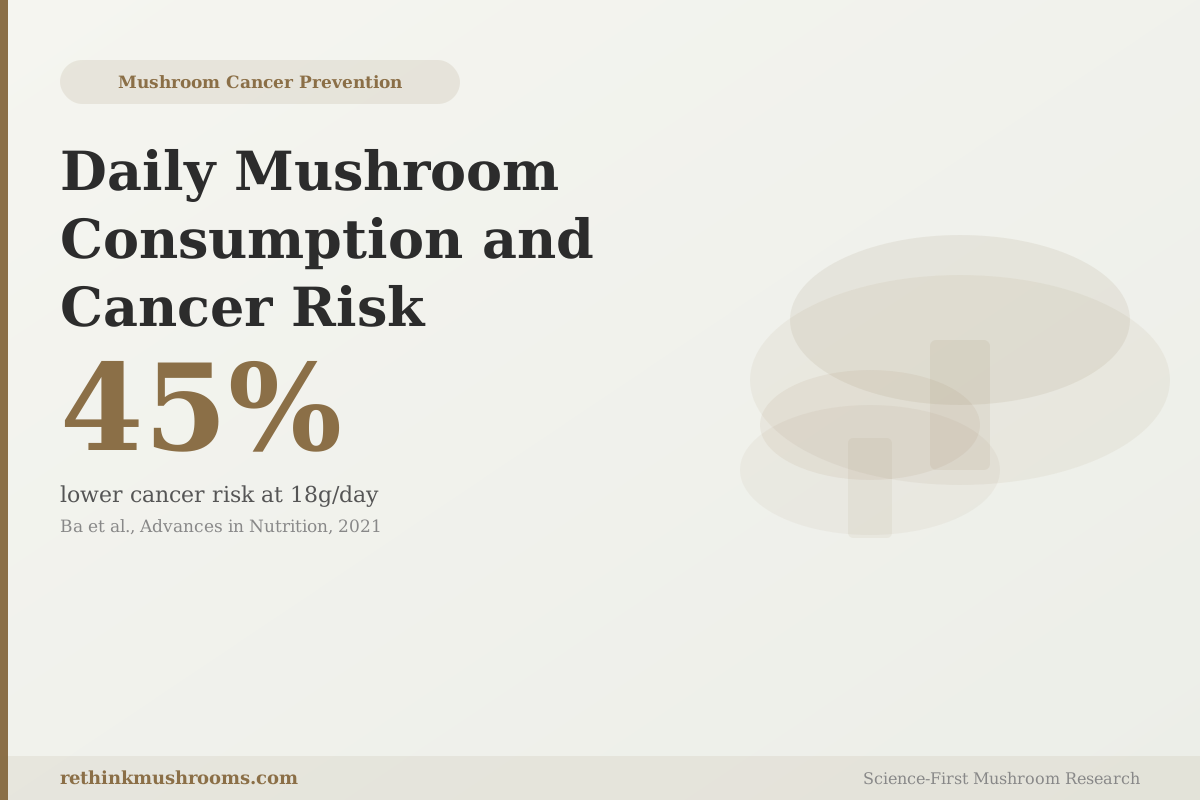
45% — the figure everyone quotes
A 2021 meta-analysis of 17 observational studies is the source of the widely repeated claim that eating 18 grams of mushrooms a day — about three medium button mushrooms — cuts cancer risk by 45%. The same paper's headline pooled estimate is a 34% lower relative risk, and the largest prospective cohort ever to test the question found no association at all.
Ba et al., Advances in Nutrition, 2021
RR 0.66
pooled estimate, highest vs. lowest intake (Ba 2021)
11 of 17
pooled studies were case-control designs
HR 1.06
total cancer in 112,991 US adults (Lee 2019)
Ba et al., Advances in Nutrition, 2021
 View as image ↗
Eighteen grams. That's the weight of three medium white button mushrooms, or about one large portobello cap. A 2021 meta-analysis by Ba and colleagues, pooling 17 observational studies, is the origin of the claim that eating that much every day is linked to a 45% lower cancer risk.[1]
That headline has circulated widely since Penn State publicized the finding. What gets cited far less often is that the paper's own abstract leads with a different number, that 11 of the 17 pooled studies used the design most prone to inflating effect sizes, and that the single largest prospective study ever to ask this question found no association at all.
This article is about the gap between those two versions of the story. It is not medical advice, and nothing here should be used to make decisions about cancer screening or treatment.
For a complete view of mushrooms in cancer biology, including clinical trial evidence and treatment adjuncts, see the complete guide to medicinal mushrooms and cancer. This article focuses specifically on what population data from daily dietary intake shows.
Key Takeaways
- The 2021 Ba meta-analysis of 17 observational studies reports a pooled relative risk of 0.66 (95% CI 0.55–0.78) for total cancer, comparing the highest mushroom consumers to the lowest — a 34% lower relative risk, not 45%
- The 45% figure comes from the same paper's dose-response analysis at 18g/day; that analysis rests on 7 of the 17 studies and is explicitly nonlinear (P-nonlinearity = 0.001), so "about 3% lower risk per extra gram" is a local approximation, not a rate you can extrapolate
- Breast cancer is the only site-specific cancer where the meta-analysis found a significant association: pooled RR 0.65 (95% CI 0.52–0.81) across 10 studies
- 11 of the 17 pooled studies were case-control designs, which the authors list as a limitation because of recall and selection bias
- The critical counterpoint: Lee et al. (2019) followed 112,991 US adults for up to 26 years and documented 22,469 cancers — far more outcome data than any single study in the meta-analysis contributed — and found HR 1.06 (95% CI 0.98–1.14) for total cancer, with a marginal positive association for lung cancer
- The Penn State mortality work is mixed, not confirmatory: NHANES III found a significant all-cause mortality association (HR 0.84), but the same group's continuous NHANES cohort did not (HR 0.84, 95% CI 0.67–1.06)
- A 2023 Korean cohort of 152,828 adults found lower mortality at low and moderate intake (under 1, and 1–3, servings per week), not at the highest intake category
The 45% Figure: What the Meta-Analysis Actually Found
The Ba 2021 meta-analysis is the most comprehensive synthesis of population data on mushroom intake and cancer available. It searched MEDLINE, Web of Science, and the Cochrane Library for studies published between 1966 and October 2020, and pooled 17 observational studies. Comparing the highest mushroom consumption category to the lowest, it found a relative risk of 0.66 (95% CI 0.55–0.78) for cancer at any site — a 34% lower relative risk.[1]
That is the number the abstract leads with. The 45% figure is a different statistic from a different analysis inside the same paper.
Where the 45% Comes From
Two Different Numbers, Two Different Analyses, One Study
The famous 45% figure and the number the paper’s own abstract leads with are not the same statistic. Both come from Ba et al. 2021. The top block is the dose–response analysis; the bottom block is the pooled highest-versus-lowest comparison. Neither is wrong — but only one of them is in the abstract.
The catch: the paper reports that the dose–response relationship is significantly nonlinear(P-nonlinearity = 0.001), and it rests on only 7 of the 17 studies. Nonlinear means the risk reduction per extra gram is not constant, so the frequently repeated “about 3% lower breast cancer risk for every additional gram per day” is a local approximation along a curve, not a rate you can extend upward. Eating 36 g/day does not buy 90%.
Source: Ba et al. 2021, Advances in Nutrition [1] (RTHM-01323, PMID 33724299). The RR 0.66 (95% CI 0.55–0.78) pooled estimate and the P-nonlinearity = 0.001 dose–response result are stated in the abstract. The 10 g and 18 g percentage figures come from the paper’s dose–response analysis as reported in coverage of the study and are not given in the abstract; they are shown in a separate tier for that reason.
The distinction matters because the two numbers travel very differently. The 45% figure is the one that reached the press. The 34% figure is the one in the abstract, with a confidence interval attached.
The meta-analysis also found that when cancers were examined by site, breast cancer was the only site with a significant association — pooled RR 0.65 (95% CI 0.52–0.81) across 10 studies. Non-breast cancers pooled to RR 0.80 (95% CI 0.66–0.97) across 13 studies. The authors note that the absence of significant findings for other individual sites could simply reflect how few studies examined them.
Crucially, the authors list their own limitations plainly: 11 of the 17 studies were case-control designs, which carry potential for recall and selection bias, and the studies varied widely in what they adjusted for.
For a methodological look at how this meta-analysis was built and what its limitations mean, see Mushroom Consumption and Cancer Risk: Meta-Analysis of Population Studies.
Why Study Design Predicts the Answer
Line the population estimates up in order of design strength and a pattern appears that has nothing to do with mushrooms.
Design vs Effect Size
The Better the Study Design, the Smaller the Effect
Cancer incidence estimates only, ordered from the most bias-prone design at the top to the least at the bottom. As the design gets stronger, the estimate slides toward the no-effect line — and in the single largest prospective cohort it crosses it. This is the pattern you would expect if recall and selection bias were inflating the case-control results.
How to read it: each point is the central estimate and each bar its 95% confidence interval. The single Chinese case-control study reports a 64% lower risk (OR 0.36). The pooled meta-analyses — 11 of whose 17 studies were themselves case-control — land around RR 0.65–0.82. The one large prospective cohort that assessed diet before anyone got cancer reports HR 1.06, slightly above the null. Odds ratios, relative risks, and hazard ratios are not strictly interchangeable; they are plotted together to compare magnitude and direction, not to be pooled.
Sources: Zhang 2009 [5] (RTHM-00325); Ba 2021 [1] (RTHM-01323); Ba 2023 [8] (RTHM-01659); Lee 2019 [6] (RTHM-01080). All values as reported in the source abstracts. Endpoint is cancer incidence for every row; mortality endpoints are shown separately.
The gradient is hard to miss. A single Chinese case-control study reports a 64% lower risk. The pooled estimates, most of whose inputs are case-control, land between 35% and 18% lower. The one large prospective cohort reports a hazard ratio slightly above 1.0.
This does not prove the association is an artifact. Effect sizes shrink with better design for many real exposures too. But it does mean that the 45% figure sits at the most optimistic end of a range whose spread is well explained by methodology.
The Dose-Response Curve: What It Does and Doesn't Support
The dose-response analysis is the most practically framed part of the Ba paper, and the most frequently over-read.
As reported from that analysis, 10 grams per day — roughly two small white button mushrooms — was associated with about 17% lower risk, and 18 grams per day with about 45% lower risk.[1] The related figure often quoted alongside these is that each additional gram per day is associated with roughly 3% lower breast cancer risk.
The important caveat is one the paper states directly: the dose-response relationship is significantly nonlinear (P-nonlinearity = 0.001), and it draws on 7 of the 17 studies. Nonlinear means the benefit per additional gram is not constant. A "3% per gram" figure describes the slope somewhere along a curve; it is not a conversion rate. Doubling intake does not double the reduction, and the curve gives no license to extrapolate past the range the studies actually measured.
In food terms, the measured range is unremarkable: 10g/day is about two small mushrooms, 18g/day about three medium ones or a generous side of sautéed mushrooms. People who cook with mushrooms two or three times a week likely average somewhere in this range without trying.
The Penn State Mortality Research: More Mixed Than It Sounds
Cancer incidence data tells you who gets diagnosed. Mortality data tells you who dies. The same Penn State research group published two studies in 2021 that moved from cancer incidence to all-cause mortality, using prospective designs — and these are routinely described as having confirmed the earlier finding.
The record is more mixed than that.
Prospective Mortality Evidence
Four Prospective Analyses, Three Significant Results, One Null
Every prospective analysis of mushroom intake and death, with what it actually found. The endpoint here is all-cause mortality — dying of anything — not cancer incidence. These are the studies most often described as “confirming” the cancer result. They measure something different, and they do not all agree.
NHANES III (US) Ba 2021 [2]
SignificantAll-cause mortality lower in mushroom eaters. Cause-specific mortality showed no significant associations.
Continuous NHANES 2003–2014 (US) Ba 2021 [3]
Not significantSame point estimate as NHANES III, but the confidence interval crosses 1.0. This cohort did not replicate the finding on its own.
Five-cohort meta-analysis Ba 2021 [3]
SignificantSignificant, but the effect is a 6% lower risk of death — an order of magnitude smaller than the headline cancer figures.
KoGES (South Korea) Jung 2023 [4]
SignificantLower all-cause mortality at <1 and 1–3 servings/week in both sexes. The highest category (≥3/week) is not among the levels reported as reaching significance — the gradient is not "more is better."
What this changes: the honest summary is not “two prospective cohorts confirmed the benefit.” It is that one US cohort found a significant mortality association, a second US cohort from the same research group did not, a pooled analysis of five cohorts found a real but small 6% effect, and a large Korean cohort found the signal at low-to-moderate intake rather than the highest. That is a consistent direction with an inconsistent magnitude — and it is about dying, not about getting cancer.
Sources: Ba et al. 2021, Nutrition Journal (NHANES III) [2] (RTHM-01325); Ba et al. 2021, Nutrition Journal (continuous NHANES + meta-analysis) [3] (RTHM-01326); Jung et al. 2023, Food & Function (KoGES) [4] (RTHM-01715). All estimates and sample sizes as reported in the source abstracts.
The NHANES III analysis followed 15,546 adults for a mean of 19.5 years, documented 5,826 deaths, and found that mushroom consumers had a lower risk of all-cause mortality (HR 0.84, 95% CI 0.73–0.98).[2] One detail from that paper is more interesting than the headline: substituting a single daily serving of mushrooms for a serving of processed or red meat was associated with HR 0.65 (95% CI 0.50–0.84). That is a comparison between foods, and it may say as much about the meat as about the mushrooms. When the same analysis examined cause-specific mortality, it found no statistically significant associations.
The follow-up study used the larger continuous NHANES 2003–2014 dataset — 30,378 participants, 2,855 deaths — and found HR 0.84 (95% CI 0.67–1.06) for all-cause mortality. Same point estimate, wider interval, not statistically significant.[3] The significant result in that paper came from a supplementary meta-analysis pooling five cohorts and 601,893 individuals, which produced RR 0.94 (95% CI 0.91–0.98) — a real but small 6% lower risk of death.
So the accurate summary is: one US prospective cohort found a significant mortality association, a second from the same group did not, and pooling five cohorts produced a modest significant effect. That is a coherent picture, but it is not the replication story the coverage implied.
For a full exploration of how the Penn State research program fits together, see The Pennsylvania State Study: Mushroom Intake and Cancer Mortality.
The Same Direction in Korea and China — With a Twist
If the association were an artifact of one study design or one dietary culture, you would expect it to vanish in independent populations. Largely, it does not — though the shape of it is not what you'd predict.
Jung et al. (2023) followed 152,828 Korean adults aged 40 and over in the Korean Genome and Epidemiology Study for a mean of 11.6 years, recording 7,085 deaths. Mushroom eaters had lower all-cause mortality than non-consumers — but the significant associations were at low and moderate intake, not high. In men, consuming less than 1 serving per week gave HR 0.858 (95% CI 0.793–0.929) and 1–3 servings per week gave HR 0.902 (95% CI 0.819–0.993). In women the corresponding figures were HR 0.864 and HR 0.869. The highest intake category (≥3 servings per week) was not among the levels reported as reaching significance. Lower cardiovascular mortality appeared in men only.[4]
That is a genuinely awkward result for a simple dose-response story. If more mushrooms were straightforwardly better, the highest consumers should show the strongest effect. They don't.
Zhang et al. (2009) took a different approach: a case-control study in southeast China comparing 1,009 women with histologically confirmed breast cancer to 1,009 age-matched healthy controls. Women eating at least 10g of fresh mushrooms per day had an odds ratio of 0.36 (95% CI 0.25–0.51) — 64% lower risk. For dried mushrooms, at least 4g per day gave OR 0.53 (95% CI 0.38–0.73). Combining mushrooms with green tea was associated with a further reduction beyond either food alone.[5]
That OR 0.36 is by far the largest effect in this literature, and it comes from the design most vulnerable to producing exactly that. A case-control study also cannot establish whether the mushroom–green tea pattern reflects a pharmacological interaction or simply describes women who eat a traditional diet and differ in a dozen other ways.
Gastric cancer is the other site with pooled evidence. A 2023 pooled analysis within the Stomach Cancer Pooling (StoP) Project combined 3,900 gastric cancer cases and 7,792 controls across 11 studies, finding RR 0.82 (95% CI 0.71–0.95) for the highest versus lowest consumption categories. Combining all 15 available studies gave RR 0.77 (95% CI 0.63–0.95).[8]
The Honest Counterpoint: The Largest Prospective Study Found Nothing
Not all studies agree, and the disagreement comes from the most rigorous work in the field.
Lee, Yang, Keum, Giovannucci, Sun & Chavarro (2019) · Cancer Prevention Research
- Population
- 68,327 women (Nurses' Health Study) and 44,664 men (Health Professionals Follow-up Study), all cancer-free at baseline, followed 1986–2012
- Intervention
- Habitual mushroom consumption, assessed at baseline with a validated food frequency questionnaire
- Comparator
- Five or more servings per week vs. almost never
- Finding
- 22,469 incident cancers over up to 26 years. Total cancer HR 1.06 (95% CI 0.98–1.14) — no significant difference. No association across 16 of 17 site-specific cancers, with a marginal positive association for lung cancer (P trend = 0.05).
null Its point estimate sits slightly above 1.0, meaning the observed direction was fractionally toward higher risk, not lower.
Lee et al. 2019, Cancer Prevention Research 12(8):517-526 (RTHM-01080, PMID 31164344)
This null result deserves serious weight.[6] The Nurses' Health Study and the Health Professionals Follow-up Study are larger and longer than most studies in the Ba meta-analysis, they are prospective, and their dietary assessment methodology is well validated. With 22,469 documented cancers, this one study carries outcome data on the same order as the entire 17-study synthesis.
Two details are worth stating precisely, because they cut both ways. First, mushroom intake was assessed once, at baseline — covariates were updated with biennial questionnaires, but the mushroom exposure was a single snapshot, and habits can drift over 26 years. That is a genuine limitation. Second, the finding was not uniformly null: there was a marginal positive association with lung cancer (P trend = 0.05), meaning the direction there was toward slightly higher risk. With 17 site-specific cancers tested, one marginal result is what chance alone tends to produce, and the authors do not treat it as a signal. But an honest account mentions it.
- Cell and mechanistic studiescompleted
Ergothioneine transport and beta-glucan receptor binding are well characterized in vitro.
- Animal studiescompleted
Preclinical models support both proposed mechanisms.
- Case-control studiescompleted
11 of the 17 studies in the 2021 meta-analysis. Consistently positive, largest effect sizes, most bias-prone.
- Prospective cohortscurrent
Mixed. Lee 2019 null for cancer incidence; NHANES III positive and continuous NHANES null for mortality; KoGES positive at low-moderate intake.
- Randomized controlled trialmissing
No RCT has ever tested whether increasing mushroom intake reduces cancer incidence. None is planned.
- Meta-analysis of RCTsmissing
Impossible without RCTs. The existing meta-analyses pool observational studies only.
The evidence is entirely observational. Every pooled estimate comes from studies that watched what people already ate — none from trials that assigned mushrooms and measured what happened. That ceiling is the single most important fact about this literature.
Ba et al. 2021 [1]; Lee et al. 2019 [6]; Ba et al. 2021 NHANES [2,3]; Jung et al. 2023 [4]
Several explanations for the US/Asia divergence have been proposed. Americans eat predominantly white button, crimini, and portobello mushrooms — all Agaricus bisporus — which has lower ergothioneine concentrations than shiitake, oyster, or maitake. Average US mushroom intake is much lower than in Japan, Korea, or China, which reduces statistical power to detect modest effects. And the surrounding diet differs: mushrooms inside a typical Western diet may not behave like mushrooms inside a vegetable-heavy one.
One piece of data gives that geographic hypothesis more than speculative footing. In the 2023 gastric cancer pooled analysis, the subgroup estimate for Western Pacific countries was RR 0.59 (95% CI 0.40–0.87) across 6 studies — noticeably stronger than the 0.77 all-study estimate. The authors themselves suggest the stronger effect in Asian countries may reflect the higher antioxidant content of the mushroom species eaten there.[8] That is a subgroup analysis, which carries its own risks of over-reading, but it is at least a measured difference rather than a hypothesis alone.
The Proposed Biology: Two Mechanisms That Make the Signal Plausible
Epidemiology identifies correlations. Understanding why one might exist requires mechanistic work, and researchers have focused on two candidates.
Ergothioneine and cellular protection. Mushrooms are the richest dietary source of ergothioneine, a sulfur-containing amino acid with antioxidant properties. What distinguishes it from most dietary antioxidants is that the body maintains a dedicated cellular transporter (OCTN1) to actively accumulate it, concentrating it in tissues facing the highest oxidative stress. That degree of biological specificity is unusual for a dietary compound.
Smith and colleagues (2020) measured 112 plasma metabolites in 3,236 participants from the Malmö Diet and Cancer study who were free of cardiovascular disease and diabetes at baseline. Over a median 21.4 years of follow-up, ergothioneine was the metabolite most strongly connected to a healthy dietary pattern and was associated with lower risk of coronary disease (HR 0.85 per 1 SD increment), cardiovascular mortality (HR 0.79) and overall mortality (HR 0.86).[7]
Two caveats have to travel with that finding. The endpoints were death and cardiovascular disease, not cancer. And the authors explicitly identify ergothioneine as a biomarker of a healthy food pattern — which means it may be marking the diet rather than doing the work. That is precisely the confounding problem the whole field runs into.
Not all mushrooms contain the same amount. Shiitake, oyster, maitake, and king oyster have substantially higher ergothioneine concentrations than the white button mushrooms most Americans eat. If ergothioneine is the active ingredient, species selection matters. For a look at which mushrooms score highest, and why a second mechanism applies specifically to white button mushrooms, see Which Mushrooms Are Best for Cancer Prevention?
For the full scientific history of ergothioneine, including why researchers call it a candidate "longevity vitamin," see The History of Ergothioneine: From Discovery to Longevity Vitamin Debate.
Beta-glucan immune activation. Mushrooms also contain beta-glucans, complex polysaccharides that bind receptors on natural killer cells, macrophages, and dendritic cells, stimulating immune surveillance. In principle this could help the immune system identify and clear abnormal cells before they become clinical cancer. The pathway is mechanistically distinct from ergothioneine's antioxidant role.
For a full look at the beta-glucan research, including clinical evidence for immune activation, see Mushroom Beta-Glucans and Immunity: The Complete Research Guide.
Neither mechanism has been shown, in a human trial, to translate into reduced cancer incidence. Both are biologically plausible pathways supported by preclinical evidence and population correlations. Neither is a proven mechanism.
What the Population Data Actually Shows
The evidence picture is more nuanced than most coverage suggests, and it is worth stating both halves cleanly.
What holds up. Multiple independent studies across the US, Korea, and China point in the same direction: people who eat more mushrooms have somewhat better cancer and mortality outcomes. Breast cancer has the most consistent signal, replicated across several populations. Gastric cancer shows a pooled association across 15 studies. The mechanisms proposed are biologically coherent, and the direction of effect has been remarkably stable across very different dietary cultures.
What doesn't. The largest and best-designed prospective study of cancer incidence found nothing — a hazard ratio of 1.06 across 22,469 cancers. Most of the strongest effect estimates come from case-control designs whose limitations the meta-analysis authors themselves flag. The mortality replication is partial: one NHANES cohort significant, one not. The Korean cohort's effect appears at low-to-moderate intake and not at the highest, which no simple dose-response model predicts. And no randomized trial has ever tested whether increasing mushroom intake reduces cancer incidence — nor is one likely, given the cost and duration such a trial would require.
The reasonable conclusion is narrower than the headlines: mushroom intake is consistently associated with modestly better outcomes in observational data, the association is stronger in Asian populations and in weaker study designs, and causality remains unestablished. Mushrooms are a nutrient-dense, low-calorie food with a plausible mechanistic story and no meaningful downside at dietary amounts. That is a good enough reason to eat them. It is not a reason to treat them as cancer prevention.
Important Context
Diet is not a substitute for cancer screening
Coverage of the 45% figure has encouraged some readers to treat daily mushroom intake as a meaningful cancer-prevention strategy. No randomized trial has tested whether eating more mushrooms lowers cancer incidence, and the largest prospective cohort found no association.
Treat mushrooms as one nutrient-dense food among many, not as a protective intervention. The interventions with established benefit remain screening appropriate to your age and risk profile, not smoking, and maintaining a healthy weight.
Particularly relevant for: Anyone at elevated cancer risk, and anyone currently in cancer treatment or surveillance
Follow the screening schedule your clinician recommends. Discuss any supplement — as opposed to culinary — mushroom use with your care team, particularly during active treatment.
For a broader view of where this fits in the epidemiological literature, see Can Eating Mushrooms Prevent Cancer? Epidemiological Evidence. For readers interested in the distinction between population prevention evidence and clinical evidence for mushrooms as cancer treatment adjuncts, see How Mushrooms Support Cancer Patients: Mechanisms and Evidence.
The Bottom Line
Population studies across the US, Korea, and China consistently link mushroom consumption to modestly lower cancer risk and mortality, with the most replicated signal for breast cancer. But the widely quoted "45% lower risk at 18g/day" comes from a nonlinear dose-response analysis built on 7 studies, while the same meta-analysis's headline pooled estimate is a 34% lower relative risk — and 11 of its 17 inputs were bias-prone case-control designs. The largest prospective cohort ever to test the question followed 112,991 US adults, documented 22,469 cancers, and found no association (HR 1.06). The prospective mortality evidence is mixed rather than confirmatory. No randomized trial has tested the question, and none is planned. Mushrooms are worth eating; they are not established cancer prevention. This article is not medical advice.
Frequently Asked Questions
Sources & References
- 1RTHM-00671·Ba, Djibril M et al. (2021). “Higher Mushroom Consumption Is Associated with Lower Risk of Cancer: A Systematic Review and Meta-Analysis of Observational Studies..” Advances in nutrition (Bethesda.Study breakdown →PubMed →↩
- 2RTHM-00673·Ba, Djibril M et al. (2021). “Association of mushroom consumption with all-cause and cause-specific mortality among American adults: prospective cohort study findings from NHANES III..” Nutrition journal.Study breakdown →PubMed →↩
- 3RTHM-00674·Ba, Djibril M et al. (2021). “Prospective study of dietary mushroom intake and risk of mortality: results from continuous National Health and Nutrition Examination Survey (NHANES) 2003-2014 and a meta-analysis..” Nutrition journal.Study breakdown →PubMed →↩
- 4RTHM-00833·Jung, Hyein et al. (2023). “Edible mushroom intake and risk of all-cause and cause-specific mortality: results from the Korean Genome and Epidemiology Study (KoGES) Cohort..” Food & function.Study breakdown →PubMed →↩
- 5RTHM-00173·Zhang, Min et al. (2009). “Dietary intakes of mushrooms and green tea combine to reduce the risk of breast cancer in Chinese women..” International journal of cancer.Study breakdown →PubMed →↩
- 6RTHM-01080·Lee, Dong Hoon et al. (2019). “Mushroom Consumption and Risk of Total and Site-Specific Cancer in Two Large U.S. Prospective Cohorts..” Cancer prevention research (Philadelphia.Study breakdown →PubMed →↩
- 7RTHM-00655·Smith, Einar et al. (2020). “Ergothioneine is associated with reduced mortality and decreased risk of cardiovascular disease..” Heart (British Cardiac Society).Study breakdown →PubMed →↩
- 8RTHM-00815·Ba, Djibril M et al. (2023). “Mushroom consumption and risk of gastric cancer: a pooled analysis within the stomach cancer pooling project and a combined meta-analysis with other observational studies..” European journal of cancer prevention : the official journal of the European Cancer Prevention Organisation (ECP).Study breakdown →PubMed →↩