Button Mushroom Health Research
CLA identified as key inhibitor
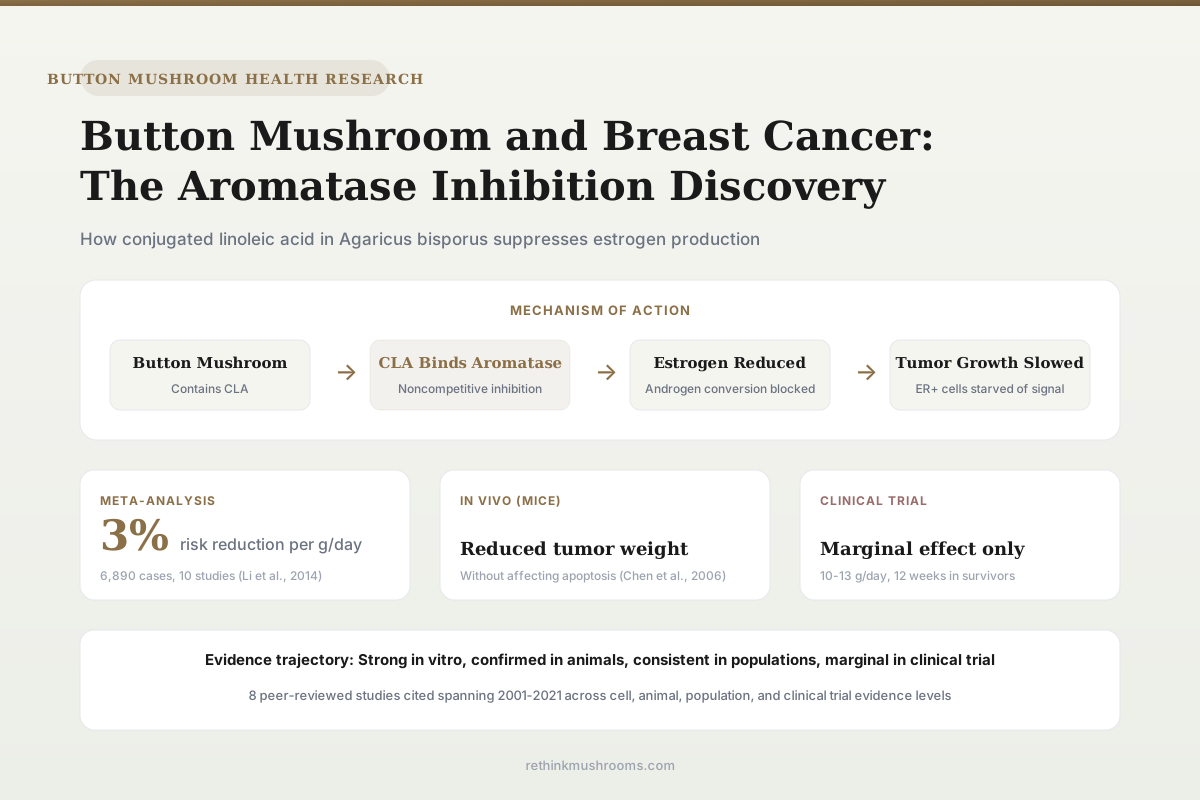
Conjugated linoleic acid from white button mushrooms inhibited aromatase activity and reduced tumor weight in nude mice bearing estrogen receptor-positive breast cancer cells.
Chen et al., Cancer Research, 2006
2001
year aromatase inhibition first reported
6,890
breast cancer cases in the largest meta-analysis
3%/g
reduced risk per gram of daily mushroom intake
Chen et al., Cancer Research, 2006
 View as image ↗
In 2001, Grube et al. reported that aqueous extracts from white button mushrooms (Agaricus bisporus) suppressed aromatase activity in a dose-dependent manner using a human placental microsome assay.[1] Aromatase is the enzyme that converts androgens to estrogens, and its overexpression in breast tissue is a driver of estrogen receptor-positive breast cancer in postmenopausal women. Pharmaceutical aromatase inhibitors (letrozole, anastrozole, exemestane) are a standard treatment for this cancer subtype. The discovery that the world's most commonly consumed mushroom contained natural aromatase inhibitors generated a research line spanning cell studies, animal models, epidemiological investigations, and an early-phase clinical trial. For an overview of button mushroom health effects beyond cancer, see button mushroom health benefits: more than just a salad topping.
The story is more nuanced than the initial headlines suggested. The inhibition is real in cell and animal models. Population studies consistently associate mushroom consumption with modestly reduced breast cancer risk. But the clinical trial in humans showed, at best, transient and marginal aromatase suppression at high doses. The gap between petri dish and patient remains wide.
Key Takeaways
- White button mushroom extract suppressed aromatase activity dose-dependently in human placental microsomes and inhibited proliferation of MCF-7aro breast cancer cells without affecting normal MCF-10A cells (Grube et al., 2001)
- The active aromatase inhibitors in button mushrooms were identified as conjugated linoleic acid (CLA) and its derivatives, which act as noncompetitive inhibitors at the aromatase active site (Chen et al., 2006)
- In nude mice bearing MCF-7aro tumors, mushroom extract reduced both tumor cell proliferation and tumor weight without affecting apoptosis rate (Chen et al., 2006)
- A meta-analysis of 10 studies (6,890 breast cancer cases) found each 1 g/day increase in mushroom intake was associated with a 3% reduction in breast cancer risk (RR = 0.97, 95% CI: 0.96-0.98) (Li et al., 2014)
- A 2021 systematic review of 17 observational studies found mushroom consumption associated with lower cancer risk, with the strongest association specifically for breast cancer (Ba et al., 2021)
- Chinese women consuming 10+ g/day of fresh mushrooms had significantly lower breast cancer risk, with an additional protective effect when combined with green tea intake (Zhang et al., 2009)
The 2001 Discovery: Screening Vegetables for Aromatase Inhibition
Grube et al. (2001) screened heat-stable extracts from multiple vegetables for their ability to inhibit aromatase activity. White button mushrooms showed the strongest dose-dependent suppression. Enzyme kinetics revealed mixed inhibition, suggesting multiple inhibitors or more than one inhibitory mechanism were present in the extract.[1]
The "in cell" experiments used MCF-7aro, an aromatase-transfected breast cancer cell line that models estrogen receptor-positive breast cancer. Mushroom phytochemicals inhibited both aromatase activity and testosterone-induced cell proliferation in MCF-7aro cells. The selectivity was notable: the extract had no effect on MCF-10A, a nontumorigenic breast epithelial cell line, suggesting the anti-proliferative effect was mediated through the aromatase/estrogen pathway rather than general cytotoxicity.
This selectivity distinguished mushroom extract from many dietary compounds that show anticancer activity in vitro but kill both normal and cancer cells indiscriminately. The mushroom effect appeared specific to estrogen-dependent proliferation, which made the aromatase inhibition mechanism biologically coherent rather than an artifact of nonspecific cell toxicity.
Identifying the Active Compounds: Conjugated Linoleic Acid
Chen et al. (2006) published the follow-up study in Cancer Research that identified the specific compounds responsible for aromatase inhibition. Using bioactivity-guided fractionation, they determined that the most potent mushroom chemicals were soluble in ethyl acetate. The major active compounds in this fraction were unsaturated fatty acids: linoleic acid, linolenic acid, and conjugated linoleic acid (CLA).[2]
Testing these compounds individually against aromatase mutants expressed in Chinese hamster ovary cells, Chen et al. found that linoleic acid and CLA inhibited aromatase with similar potency and that mutations at the active site regions affected their interaction. This suggested binding at or near the aromatase active site. Inhibition kinetics, however, classified both compounds as noncompetitive with respect to the natural substrate androstenedione, meaning they bind to a site distinct from where the substrate binds but still reduce enzyme activity.
The critical distinction came from cell proliferation assays. While both linoleic acid and CLA inhibited purified aromatase, only CLA inhibited testosterone-dependent proliferation of MCF-7aro cells. This identified CLA and its derivatives as the physiologically relevant aromatase inhibitors in mushrooms, since inhibiting the isolated enzyme is not useful unless the compound also works in a cellular context.
In Vivo Confirmation
The same study moved to nude mice injected with MCF-7aro cells. Mushroom extract decreased both tumor cell proliferation and tumor weight compared to controls. The mechanism appeared to be growth suppression rather than cell killing, as the rate of apoptosis was not affected. This pattern is consistent with aromatase inhibition reducing the estrogen signal that drives tumor proliferation, rather than direct cytotoxic effects on the cancer cells.
Population Studies: The Epidemiological Signal
Multiple population studies across East Asia have examined the relationship between mushroom consumption and breast cancer risk. These studies did not specifically test button mushrooms or measure aromatase activity, but they provide context for whether dietary mushroom exposure at realistic intake levels is associated with reduced breast cancer incidence.
Zhang et al. (2009) analyzed data from 2,018 Chinese women (1,009 breast cancer cases, 1,009 age-matched controls) in Guangzhou, China. Fresh mushroom intake of 10+ g/day was associated with approximately two-thirds reduction in breast cancer risk compared to intake below 4 g/day, after adjusting for known risk factors. An additional protective effect was observed when mushroom intake was combined with dried green tea consumption, suggesting multiplicative effects on estrogen metabolism.[3]
Shin et al. (2010) examined mushroom intake and breast cancer risk by hormone receptor status in Korean women. The association between higher mushroom consumption and lower breast cancer risk was present across hormone receptor subtypes, suggesting the protective mechanism may extend beyond aromatase inhibition alone.[4] This is relevant because aromatase inhibition should primarily affect estrogen receptor-positive cancers; an association across all subtypes implies additional mechanisms such as immunomodulatory effects of beta-glucans or other mushroom compounds. For more on how beta-glucans interact with cancer immunity, see beta-glucans and anti-tumor immunity: mechanisms explained.
Meta-Analyses
Li et al. (2014) pooled data from eight case-control studies and two cohort studies encompassing 6,890 breast cancer cases. Their dose-response meta-analysis found that each 1 g/day increment in mushroom intake was associated with a 3% reduction in breast cancer risk (RR = 0.97, 95% CI: 0.96-0.98). The association was slightly stronger for postmenopausal women (RR = 0.94) than premenopausal women (RR = 0.96), consistent with a mechanism involving estrogen modulation.[5]
Ba et al. (2021) conducted a broader systematic review covering 17 observational studies and cancer risk across multiple sites. They found that mushroom consumption was associated with lower overall cancer risk, but the strongest individual association was specifically with breast cancer.[6] This specificity aligns with the aromatase inhibition hypothesis, though it does not prove it.
The Clinical Trial Gap
The promising preclinical and epidemiological data led to a phase I dose-finding clinical trial in postmenopausal breast cancer survivors. The trial tested white button mushroom powder at doses of 5, 8, 10, and 13 g/day for 12 weeks. An ex vivo assay measuring aromatase activity in plasma showed suppression of post-prandial fluctuations at the 10 g and 13 g doses, suggesting that anti-aromatase phytochemicals from mushrooms do reach the systemic circulation at dietary intake levels equivalent to 100-130 g of whole mushroom per day.
However, the trial could not identify a dose that met predefined response criteria for clinically meaningful aromatase inhibition. The effect, if present, was transient and modest compared to pharmaceutical aromatase inhibitors, which achieve near-complete estrogen suppression. This result is consistent with the pharmacological reality: dietary CLA concentrations achievable through mushroom consumption are orders of magnitude lower than pharmaceutical aromatase inhibitor doses.
Wong et al. (2020) reviewed the full body of evidence from cell studies through clinical trials and concluded that while the mechanistic data are consistent, the translation from preclinical promise to clinical utility has not been demonstrated.[7] Novaes et al. (2011) reached a similar conclusion in their evidence-based medicine review, noting that clinical evidence remained insufficient to support mushroom supplementation as a breast cancer treatment or prevention strategy.[8]
Why the Gap Between Lab and Clinic?
Several factors explain why strong in vitro aromatase inhibition did not translate to strong clinical effects:
Concentration disparity. Cell studies used mushroom extract concentrations directly applied to cells. In the human body, CLA from dietary mushrooms must survive digestion, absorption, first-pass liver metabolism, and dilution in plasma volume before reaching breast tissue at sufficient concentration to inhibit aromatase. The fraction that reaches breast tissue aromatase at any given time is a small percentage of the ingested dose.
Competition with endogenous substrates. In vitro assays measure inhibition against a fixed substrate concentration. In vivo, aromatase in breast tissue is surrounded by endogenous androgens at physiological concentrations. A noncompetitive inhibitor like CLA does not need to outcompete the substrate for binding, but it must still be present at the active site in sufficient quantities to meaningfully reduce enzyme output.
Duration and accumulation. The population studies measured habitual mushroom consumption over years or decades. The clinical trial tested 12 weeks of supplementation. If the breast cancer risk reduction from mushroom consumption requires years of cumulative exposure (through mechanisms that may include but extend beyond aromatase inhibition), a 12-week trial would miss the effect entirely.
Other active mechanisms. The epidemiological association between mushroom consumption and breast cancer risk may not be driven primarily by aromatase inhibition. Mushrooms contain beta-glucans (immunomodulatory), ergothioneine (antioxidant), selenium, and other bioactive compounds that could collectively contribute to cancer risk reduction through non-aromatase pathways. For related information about the immune function effects of button mushrooms, see button mushroom and immune function: the most consumed mushroom's secret. The aromatase story may be one component of a multi-mechanism dietary effect. For a comparison of different maturity stages of the same species, see white vs. cremini vs. portobello: same species, different benefits?.
What About Vitamin D-Enhanced Button Mushrooms?
UV-exposed button mushrooms contain elevated vitamin D2 levels. Vitamin D status has been independently associated with breast cancer risk in population studies, raising the possibility that UV-treated mushrooms could provide dual mechanisms: aromatase inhibition from CLA plus vitamin D-mediated tumor suppression. This combination has not been tested in any clinical trial. For more on UV-exposed mushroom varieties, see button mushroom and vitamin D: UV-exposed varieties.
The Bottom Line
White button mushrooms contain conjugated linoleic acid that inhibits aromatase activity in cell models and reduces estrogen receptor-positive tumor growth in mice. Population studies consistently associate regular mushroom consumption with modestly reduced breast cancer risk, with a 3% reduction per gram of daily intake in the largest meta-analysis. The mechanism is biologically coherent. An early-phase clinical trial in breast cancer survivors showed only transient, marginal aromatase suppression at high mushroom doses, indicating that the dietary effect may require long-term cumulative exposure or operate through multiple mechanisms beyond aromatase inhibition alone.
Frequently Asked Questions
Sources & References
- 1RTHM-00034·Grube, B J et al. (2001). “White button mushroom phytochemicals inhibit aromatase activity and breast cancer cell proliferation..” The Journal of nutrition.Study breakdown →PubMed →↩
- 2RTHM-00094·Chen, Shiuan et al. (2006). “Anti-aromatase activity of phytochemicals in white button mushrooms (Agaricus bisporus)..” Cancer research.Study breakdown →PubMed →↩
- 3RTHM-00173·Zhang, Min et al. (2009). “Dietary intakes of mushrooms and green tea combine to reduce the risk of breast cancer in Chinese women..” International journal of cancer.Study breakdown →PubMed →↩
- 4RTHM-00197·Shin, Aesun et al. (2010). “Dietary mushroom intake and the risk of breast cancer based on hormone receptor status..” Nutrition and cancer.Study breakdown →PubMed →↩
- 5RTHM-00336·Li, Jiaoyuan et al. (2014). “Dietary mushroom intake may reduce the risk of breast cancer: evidence from a meta-analysis of observational studies..” PloS one.Study breakdown →PubMed →↩
- 6RTHM-00671·Ba, Djibril M et al. (2021). “Higher Mushroom Consumption Is Associated with Lower Risk of Cancer: A Systematic Review and Meta-Analysis of Observational Studies..” Advances in nutrition (Bethesda.Study breakdown →PubMed →↩
- 7RTHM-00664·Wong, Jack Ho et al. (2020). “Mushroom extracts and compounds with suppressive action on breast cancer: evidence from studies using cultured cancer cells, tumor-bearing animals, and clinical trials..” Applied microbiology and biotechnology.Study breakdown →PubMed →↩
- 8RTHM-00228·Novaes, Maria Rita Carvalho Garbi et al. (2011). “The effects of dietary supplementation with Agaricales mushrooms and other medicinal fungi on breast cancer: evidence-based medicine..” Clinics (Sao Paulo.Study breakdown →PubMed →↩