Button Mushroom Health Research
491 mcg/100g vitamin D2
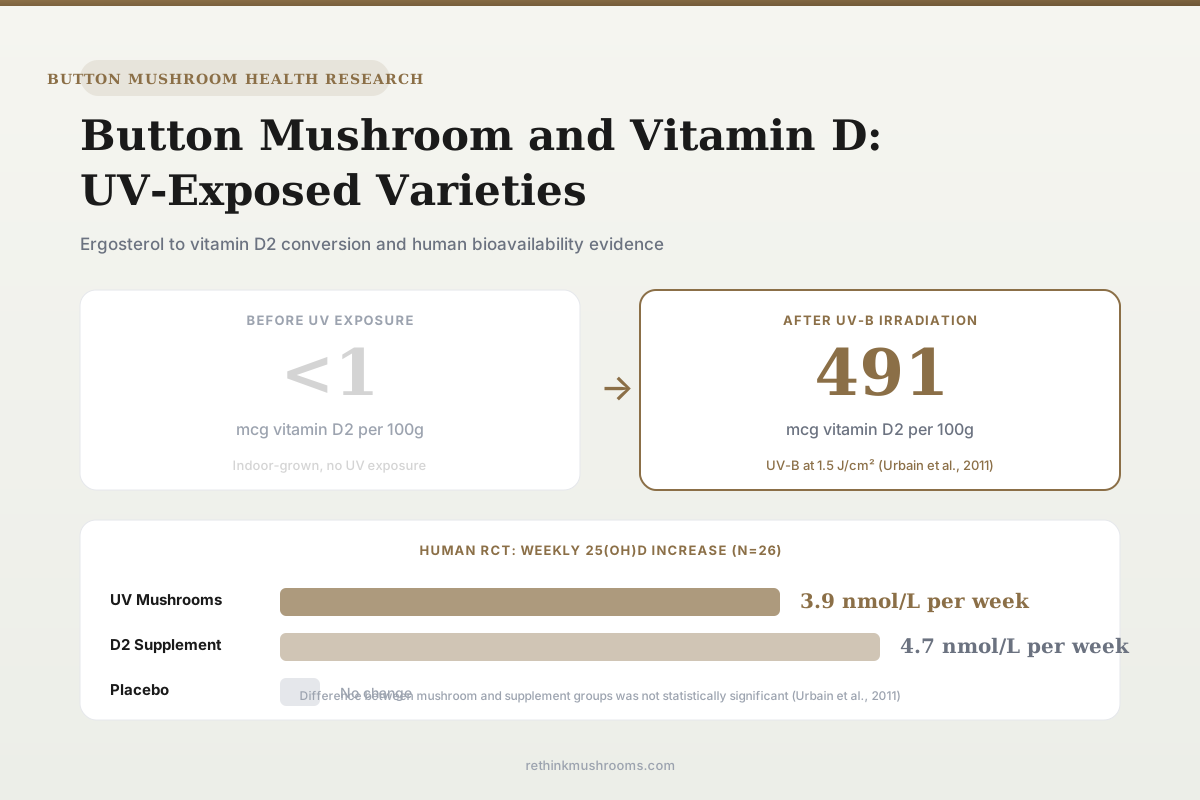
UV-B irradiation at 1.5 J/cm² increased vitamin D2 in button mushrooms from less than 1 to 491 micrograms per 100 grams, producing bioavailability equivalent to a vitamin D2 supplement in a randomized trial.
Urbain et al., Eur J Clin Nutr, 2011
3.9 nmol/L
weekly 25(OH)D increase from mushrooms
4.7 nmol/L
weekly 25(OH)D increase from supplement
D2 only
mushrooms cannot produce D3
Urbain et al., Eur J Clin Nutr, 2011
 View as image ↗
Button mushrooms (Agaricus bisporus) naturally contain almost no vitamin D. Their ergosterol content, however, is high. Ergosterol is a sterol in fungal cell membranes that converts to vitamin D2 (ergocalciferol) when exposed to ultraviolet light, through the same photochemical reaction by which human skin converts 7-dehydrocholesterol to vitamin D3 under sunlight. Koyyalamudi et al. (2009) demonstrated that UV-B treatment of button mushrooms increased vitamin D2 content from near zero to levels capable of providing nutritionally meaningful doses in a single serving.[1] The question that followed was whether this vitamin D2 from mushrooms is absorbed and utilized by the human body as effectively as synthetic supplements.
Two randomized controlled trials and a meta-analysis of six RCTs have addressed this question. The evidence shows that vitamin D2 from UV-treated button mushrooms is bioavailable and can raise serum 25-hydroxyvitamin D levels in deficient populations, but the effect comes with an important caveat: D2 from any source (mushrooms or supplements) displaces D3 in the body, and the net benefit depends on baseline vitamin D status. For more on how button mushrooms interact with other health outcomes, see button mushroom health benefits: more than just a salad topping.
Key Takeaways
- UV-B irradiation at 1.5 J/cm² increased vitamin D2 content of button mushrooms from less than 1 to 491 micrograms per 100 grams (Urbain et al., 2011)
- In a 5-week RCT with 26 vitamin D-deficient young adults, UV-treated mushroom soup raised serum 25(OH)D by 3.9 nmol/L per week, not statistically different from a vitamin D2 supplement at 4.7 nmol/L per week (Urbain et al., 2011)
- A 16-week RCT in 43 prediabetic, D-deficient adults found UV-mushrooms providing 600 IU/day raised 25(OH)D2 but simultaneously decreased 25(OH)D3, leaving total vitamin D status unchanged (Mehrotra et al., 2014)
- A meta-analysis of 6 RCTs found UV-exposed mushrooms raised serum 25(OH)D in European trials (lower baseline D) but not in US trials (higher baseline D), suggesting benefit is concentrated in deficient populations (Cashman et al., 2016)
- Pulsed UV light increased vitamin D2 from near 0 to approximately 25 micrograms per gram of dry weight in button mushroom powder (Koyyalamudi et al., 2009)
- Mushrooms produce only vitamin D2, not D3; D2 has lower potency and shorter half-life in circulation than D3, and high-dose D2 intake reduces circulating D3 levels (Keegan et al., 2013)
The Photochemistry: How UV Light Creates Vitamin D in Mushrooms
Keegan et al. (2013) reviewed the photobiology of vitamin D production in mushrooms. The process mirrors human vitamin D synthesis. UV-B radiation (280-315 nm wavelength) is most efficient at triggering the conversion, though UV-C also works. When ergosterol absorbs UV photons, it undergoes a 6-pi electrocyclic ring-opening reaction to form pre-vitamin D2, which then thermally isomerizes to vitamin D2 (ergocalciferol).[5]
The conversion is dose-dependent. With continued UV exposure beyond the optimal point, vitamin D2 itself undergoes further photodegradation to lumisterol, tachysterol, and other photoproducts. This means there is an exposure optimum: too little UV produces insufficient D2, while too much destroys what was formed and creates potentially undesirable isomers. For fresh button mushrooms, brief UV-B exposure (seconds to minutes at commercial irradiation intensities) is sufficient to reach nutritionally relevant D2 levels.
Wild mushrooms that grow in sunlight naturally contain vitamin D2, sometimes in substantial amounts. Commercially grown button mushrooms are raised in dark growing rooms and contain near-zero vitamin D2 unless deliberately exposed to UV light after harvest. Some retailers now sell "vitamin D mushrooms" that have been UV-treated post-harvest. For a broader discussion of mushroom supplement bioavailability, see bioavailability by supplement form: what gets absorbed?.
First Human Trial: Equivalent to Supplements
Urbain et al. (2011) conducted the first randomized controlled trial comparing vitamin D2 from UV-treated button mushrooms to a standard vitamin D2 supplement. The trial enrolled 26 young adults in Germany with serum 25-hydroxyvitamin D (25(OH)D) at or below 50 nmol/L (indicating deficiency or insufficiency) during winter, when endogenous D3 synthesis from sunlight was minimal.[2]
Participants were randomized to three groups: (a) UV-irradiated mushroom soup providing 28,000 IU vitamin D2 over the study period, (b) a vitamin D2 supplement at the same dose, or (c) placebo. Fresh mushrooms had been irradiated with UV-B at 1.5 J/cm², increasing D2 content from less than 1 to 491 micrograms per 100 grams.
After 2 weeks, serum 25(OH)D was already higher in the mushroom group than placebo (P = 0.001). Over the 5-week study, serum 25(OH)D rose by 3.9 nmol/L per week in the mushroom group and 4.7 nmol/L per week in the supplement group. The difference between mushroom and supplement groups was not statistically significant.
This was a landmark result: vitamin D2 from irradiated button mushrooms was as bioavailable as a pharmaceutical vitamin D2 supplement. The finding established that the D2 in mushrooms is not degraded, sequestered, or blocked during digestion and absorption.
The Prediabetic Trial: D2 Displaces D3
Mehrotra et al. (2014) extended the inquiry to a clinically relevant population: 43 prediabetic adults with vitamin D deficiency. Participants consumed daily meals containing 100 g of fresh sliced cooked mushrooms for 16 weeks. Two groups received UV-B-treated mushrooms providing either 600 IU or 4,000 IU of vitamin D2 per day. Control groups received non-UV-treated mushrooms.[3]
UV-treated mushrooms increased serum 25(OH)D2 in a dose-dependent manner. However, 25(OH)D3 decreased proportionally, leaving total 25(OH)D essentially unchanged. This phenomenon, where D2 intake suppresses circulating D3, is not unique to mushrooms; it occurs with any vitamin D2 source including supplements. The mechanism involves competition for the 25-hydroxylase enzyme in the liver: both D2 and D3 are substrates, and when D2 levels rise, D3 hydroxylation is downregulated.
For the prediabetic participants, this meant that mushroom-derived D2 did not improve overall vitamin D status despite increasing D2 specifically. The clinical implication is that UV-treated mushrooms may be most beneficial for people who are both vitamin D-deficient and not already taking vitamin D3 supplements, since D2 supplementation in people with adequate D3 levels could paradoxically reduce their D3 without net benefit.
Meta-Analysis: Baseline Status Determines Benefit
Cashman et al. (2016) conducted a systematic review and meta-analysis of six randomized controlled trials testing UV-exposed mushrooms on vitamin D status. They reanalyzed biobanked sera from three European-based RCTs and three US-based RCTs using liquid chromatography-tandem mass spectrometry for standardized measurement.[4]
The results split along geographic lines. European trials (where participants had lower baseline 25(OH)D levels due to higher latitude and less fortification) showed a statistically significant increase in serum 25(OH)D from UV-exposed mushrooms. US trials (where participants had higher baseline 25(OH)D due to food fortification and supplement use) showed no significant effect.
This pattern confirms that the benefit of UV-treated mushrooms is concentrated in populations that are genuinely vitamin D-deficient. For people who already have adequate vitamin D status through sun exposure, fortified foods, or D3 supplements, adding UV-treated mushrooms provides no measurable improvement and may displace some circulating D3 with less potent D2. For more on how the same species differs across maturity stages, see white vs. cremini vs. portobello: same species, different benefits?.
D2 vs. D3: The Potency Difference
Leung et al. (2021) reviewed the evidence on vitamin D2 versus D3 potency and addressed this directly in the context of mushroom-derived D2.[6] Vitamin D2 and D3 differ in their side chain structure. D3 (cholecalciferol, from animal sources and human skin synthesis) binds more effectively to the vitamin D binding protein in blood, has a longer circulating half-life, and is converted to the active hormonal form (1,25-dihydroxyvitamin D) more efficiently than D2.
Multiple comparison trials have found that vitamin D3 supplements are 1.5 to 3 times more potent than D2 supplements at raising and maintaining total 25(OH)D levels. This means that the equivalent bioavailability demonstrated by Urbain et al. (comparing mushroom D2 to supplement D2) does not mean equivalence to D3 supplementation. A person taking 1,000 IU of D3 daily would likely maintain higher vitamin D status than a person consuming 1,000 IU of D2 from UV-treated mushrooms.
This does not make mushroom-derived D2 useless. For populations that cannot or will not take D3 supplements (vegans, people in regions without access to affordable supplements), UV-treated mushrooms provide a plant-based, food-form source of vitamin D that demonstrably improves status in deficient individuals. The point is that D2 and D3 are not interchangeable milligram-for-milligram.
The D2/D3 distinction also has implications for how clinical trials are interpreted. When a study reports that UV-treated mushrooms raised 25(OH)D2 by a specific amount, this is not the same as raising total functional vitamin D by that amount. The D2 increase must be weighed against any D3 displacement, and the biological activity of D2 at the tissue level may be lower per unit than D3. Studies that measure only 25(OH)D2 without tracking 25(OH)D3 can overestimate the net vitamin D benefit of mushroom consumption.
Practical Considerations: Stability and Preparation
Koyyalamudi et al. (2009) found that pulsed UV light was effective at increasing vitamin D2 content in both fresh and dried mushroom powder. Four pulses increased D2 content from near 0 to approximately 12 micrograms per gram of dry weight, with 16 pulses reaching approximately 25 micrograms per gram.[1]
Vitamin D2 in mushrooms is relatively stable during cooking and storage. Heat from normal cooking temperatures does not destroy D2, and dried UV-treated mushroom powder retains most of its D2 content for months when stored properly. Brief sunlight or UV lamp exposure of store-bought mushrooms before consumption can produce meaningful D2 increases at home, though the resulting D2 content is variable and dependent on exposure duration, mushroom thickness, and UV intensity.
Commercial UV-treated mushrooms in the US typically provide 400-800 IU (10-20 micrograms) of vitamin D2 per serving. At these levels, one serving provides 50-100% of the daily value for vitamin D. Whether this translates to meaningful improvement in vitamin D status depends entirely on whether the consumer is deficient at baseline.
Home UV treatment is also possible. Placing store-bought mushrooms gill-side up in direct midday sunlight for 15-60 minutes converts ergosterol to vitamin D2. The resulting D2 content is less predictable than commercial irradiation because it depends on UV index, latitude, time of day, and mushroom surface area exposure. Even brief sun exposure on an overcast day produces some D2, but the amounts vary widely. Slicing mushrooms before sun exposure increases surface area and D2 yield. The produced D2 is chemically identical to commercially irradiated D2 and has the same bioavailability. For related information on button mushroom immunity effects, see button mushroom and immune function: the most consumed mushroom's secret. For additional information on aromatase and breast cancer research with button mushrooms, see button mushroom and breast cancer: the aromatase inhibition discovery.
The Bottom Line
UV-treated button mushrooms convert ergosterol to vitamin D2, producing levels that match supplement bioavailability in human trials. The benefit is real but limited: D2 is less potent than D3, high D2 intake displaces circulating D3, and the net improvement in vitamin D status is concentrated in genuinely deficient populations. For people already meeting vitamin D needs through D3 supplements or sun exposure, UV-treated mushrooms add D2 without improving total status. They are most valuable as a vegan, food-based vitamin D source for deficient individuals.
Frequently Asked Questions
Sources & References
- 1RTHM-00159·Koyyalamudi, Sundar Rao et al. (2009). “Vitamin D2 formation and bioavailability from Agaricus bisporus button mushrooms treated with ultraviolet irradiation..” Journal of agricultural and food chemistry.Study breakdown →PubMed →↩
- 2RTHM-00237·Urbain, P et al. (2011). “Bioavailability of vitamin D₂ from UV-B-irradiated button mushrooms in healthy adults deficient in serum 25-hydroxyvitamin D: a randomized controlled trial..” European journal of clinical nutrition.Study breakdown →PubMed →↩
- 3RTHM-00340·Mehrotra, A et al. (2014). “Bioavailability of vitamin D2 from enriched mushrooms in prediabetic adults: a randomized controlled trial..” European journal of clinical nutrition.Study breakdown →PubMed →↩
- 4RTHM-00419·Cashman, Kevin D et al. (2016). “Effect of Ultraviolet Light-Exposed Mushrooms on Vitamin D Status: Liquid Chromatography-Tandem Mass Spectrometry Reanalysis of Biobanked Sera from a Randomized Controlled Trial and a Systematic Review plus Meta-Analysis..” The Journal of nutrition.Study breakdown →PubMed →↩
- 5RTHM-00292·Keegan, Raphael-John H et al. (2013). “Photobiology of vitamin D in mushrooms and its bioavailability in humans..” Dermato-endocrinology.Study breakdown →PubMed →↩
- 6RTHM-00698·Leung, Mei Fong et al. (2021). “Vitamins D and D2 in Cultivated Mushrooms under Ultraviolet Irradiation and Their Bioavailability in Humans: A Mini-Review..” International journal of medicinal mushrooms.Study breakdown →PubMed →↩