Supplement Forms & Delivery
0% digested
Beta-glucans from mushrooms cannot be hydrolyzed by human digestive enzymes. They reach the intestine intact, where macrophages capture and fragment them for immune transport.
Chan et al., J Hematol Oncol, 2009
Chitin Barrier
locks nutrients inside cell walls
1.03 wt%
alkaloids in caps vs 0.52% in stipes
SWE Best
for glucan extraction yield
Chan et al., J Hematol Oncol, 2009
 View as image ↗
The question of what actually gets absorbed from a mushroom supplement depends on three variables: what compounds the product contains, whether the fungal cell wall has been processed to release them, and how the human digestive system handles what arrives. These variables interact differently across supplement forms. A raw mushroom powder, a hot water extract, an ethanol tincture, and a dual-extraction capsule each deliver a different subset of mushroom bioactives to different compartments of the body.[1]
The research on mushroom supplement bioavailability is surprisingly thin. Most studies measure compound content in the product, not absorption in the body. The distinction matters: a supplement can contain large quantities of beta-glucans and still deliver none of them to systemic circulation if the chitin matrix has not been disrupted. For a broader comparison of supplement forms, see capsule vs. powder vs. tincture: bioavailability, cost, and convenience compared.
Key Takeaways
- Beta-glucans are not digested by human pancreatic or brush border enzymes; they reach the small intestine intact, where macrophages capture, internalize, and fragment them for immune cell transport (Chan et al., 2009)
- Ergothioneine from Agaricus bisporus mushrooms is bioavailable as measured by red blood cell uptake in a human crossover study with 10 healthy men (Weigand-Heller et al., 2012)
- Adding dried oyster mushroom powder to rat diets reduced protein digestibility, fat digestibility, and apparent energy availability in a dose-dependent manner (Regula et al., 2016)
- Subcritical water extraction at 200 degrees C produced the highest glucan yield from chaga, outperforming microwave-assisted and ultrasonic-assisted methods (Lazic et al., 2024)
- Beta-glucan branching patterns determine immune-stimulating activity: A. bisporus extracts activated macrophages while A. blazei extracts with different branching did not (Volman et al., 2010)
- Wildcrafted chaga canker contains triterpenoids absent in mycelium-on-grain products marketed as chaga (Windsor et al., 2025)
The Chitin Problem
Fungal cell walls are built from chitin, the same structural polymer found in crustacean shells. Chitin encases the bioactive compounds inside mushroom cells, including beta-glucans, triterpenoids, ergosterol, and various phenolic compounds. Humans lack chitinase enzymes in sufficient quantities to efficiently break down raw chitin in the gut, which means unprocessed mushroom powder delivers its payload poorly.
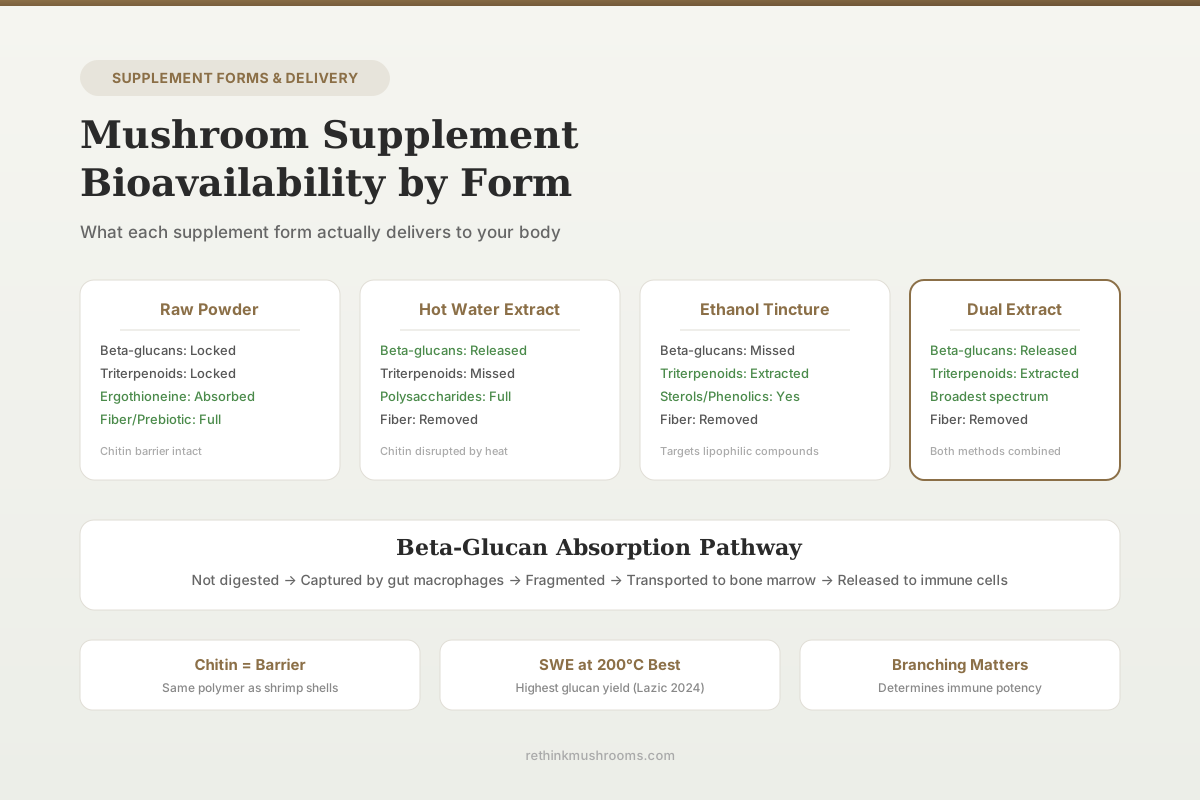
This is the fundamental argument for extraction over raw powdering. Hot water extraction disrupts chitin through thermal hydrolysis, releasing water-soluble polysaccharides (primarily beta-glucans) into solution. Ethanol extraction targets lipophilic compounds (triterpenoids, sterols, some phenolics) that are not water-soluble. Dual extraction combines both methods to capture the widest range of bioactives.
The degree of cell wall disruption varies with processing intensity. Simply drying and grinding mushrooms into powder leaves most chitin intact. Cooking (as in traditional mushroom tea preparation) partially disrupts the matrix. Industrial hot water extraction at elevated temperatures and pressures achieves more complete disruption. Regula et al. (2016) demonstrated this indirectly: adding dried oyster mushroom powder to rat diets reduced digestibility of protein, fat, and overall energy availability in a dose-dependent manner, consistent with chitin acting as a physical barrier to nutrient absorption.[2]
How Beta-Glucans Are Absorbed (They Aren't)
Chan et al. (2009) reviewed the absorption pathway of beta-glucans in detail. The beta-1,3-glycosidic backbone of mushroom glucans cannot be hydrolyzed by pancreatic enzymes or intestinal brush border enzymes. Beta-glucans arrive in the proximal small intestine structurally intact.[1]
What happens next is not classical absorption. Macrophages in the gut-associated lymphoid tissue (Peyer's patches) capture beta-glucan particles. The macrophages internalize and fragment the large polysaccharide chains into smaller pieces. These fragments are transported via the macrophages to bone marrow and the endothelial reticular system. The small beta-glucan fragments are eventually released by macrophages and taken up by neutrophils, natural killer cells, and dendritic cells, triggering both innate and adaptive immune responses.
This pathway has two implications for supplement form. First, the beta-glucans must be free from the chitin matrix to be accessible to gut macrophages. An extract achieves this; a raw powder may not. Second, the particle size and molecular weight of the beta-glucan fragments influence which immune receptors they engage. Dectin-1, complement receptor CR3, and TLR-2/6 all respond to beta-glucans, but with different size preferences.
Volman et al. (2010) demonstrated that structural differences in beta-glucans from different mushroom species produce different immune responses. Extracts from Agaricus bisporus stimulated nitric oxide production by bone marrow-derived macrophages, while extracts from Agaricus blazei and Phellinus linteus had no effect. Structural analysis suggested that the degree of branching in the beta-glucan chain is essential for immune-stimulating activity.[3] This means extraction method matters not just for yield but for the structural integrity of the extracted compounds. For detailed analysis of how structure determines potency, see beta-glucan structure and immune potency: why molecular weight and branching matter.
What Each Form Delivers
Raw Mushroom Powder
Ground dried mushroom material with no extraction step. Contains the full spectrum of compounds but locked behind chitin cell walls. The compounds are present in the powder's chemical analysis (and on the label) but may not be accessible to human digestion. Regula et al. (2016) showed reduced nutrient digestibility from dried mushroom powder, even at modest 4-8% supplementation levels in controlled diets.[2]
Raw powders retain all the fiber, chitin-glucan complex, and structural proteins of the original mushroom. For consumers seeking prebiotic fiber effects rather than systemic immune modulation, this may actually be advantageous, as the non-digestible chitin-glucan complex acts as a fermentation substrate for gut microbiota.
Hot Water Extract
The traditional preparation method (mushroom tea, decoction). Hot water at 80-100 degrees C for extended periods extracts water-soluble polysaccharides, primarily beta-glucans and other polysaccharides. Does not efficiently extract triterpenoids, sterols, or other lipophilic compounds.
Lavi et al. (2010) demonstrated that orally administered glucans from hot water extraction of Pleurotus pulmonarius reduced acute inflammation in a dextran sulfate sodium colitis model, confirming that hot water-extracted glucans retain biological activity through the oral route.[4] For mushrooms whose primary bioactives are polysaccharides (reishi, turkey tail, maitake), hot water extraction captures the relevant compounds. For mushrooms with important triterpenoid content (chaga, reishi), hot water alone misses a significant fraction of the bioactive profile.
Ethanol/Alcohol Tincture
Ethanol preferentially extracts lipophilic compounds: triterpenoids (ganoderic acids from reishi, betulinic acid from chaga), sterols (ergosterol), and phenolic compounds. Does not efficiently extract high-molecular-weight polysaccharides.
Windsor et al. (2025) demonstrated the compositional differences across chaga preparations using complementary analytical techniques. Wildcrafted chaga canker contained triterpenoids (inotodiol, trametenolic acid) and phenolics, while fermented grain products marketed as chaga contained none of these compounds.[5] An ethanol tincture of genuine chaga canker would capture these triterpenoids, while a hot water extract would not. For detailed analysis of how sourcing affects chaga's bioactive content, see betulinic acid content: wild harvest vs. lab-grown chaga.
Dual Extraction
Combines hot water and ethanol extraction sequentially to capture both water-soluble polysaccharides and lipophilic compounds. This approach yields the broadest chemical profile and is the standard for species with both polysaccharide and triterpenoid bioactives (chaga, reishi).
Lazic et al. (2024) compared green extraction technologies for chaga and found that subcritical water extraction (SWE) at 200 degrees C produced the highest glucan yield, total polysaccharide content, and overall extract yield. Microwave-assisted extraction with 50% ethanol produced the highest total phenol content. Different extraction methods optimize for different compound classes, supporting the rationale for dual or multi-step extraction.[6]
Ergothioneine: A Bioavailability Success Story
Not all mushroom compounds face the chitin barrier equally. Weigand-Heller et al. (2012) demonstrated in a randomized, crossover, dose-response human study (n=10) that ergothioneine from Agaricus bisporus mushrooms is bioavailable. Red blood cell uptake of ergothioneine was measured postprandially after consuming 8 g and 16 g mushroom powder meals.[7]
Ergothioneine is a small, water-soluble amino acid with a dedicated transporter (OCTN1/SLC22A4) in human cells. Its small molecular size allows it to pass through partially disrupted cell walls and be absorbed via active transport in the intestinal epithelium. This contrasts with large beta-glucan molecules (molecular weights of 100,000+ Da) that cannot cross the intestinal epithelium and must be processed by macrophages.
The ergothioneine finding illustrates that bioavailability is compound-specific, not form-specific. A raw mushroom powder may deliver ergothioneine effectively while failing to deliver beta-glucans. An extract may deliver beta-glucans but destroy heat-sensitive compounds in the process. No single supplement form optimizes delivery of all bioactive compounds simultaneously. This creates a genuine trade-off for consumers: choosing a form means prioritizing certain compounds over others. A reishi dual-extract capsule may deliver both ganoderic acids and beta-glucans, but at the cost of losing prebiotic fiber and heat-sensitive compounds that raw powder preserves. For a practical comparison of these trade-offs, see mushroom capsules vs. powder vs. tincture: which is best?. For analysis of how convenience and cost factor into the decision, see convenience vs. potency: choosing your mushroom supplement form.
What the Research Still Lacks
The largest gap in this field is the absence of human pharmacokinetic studies measuring systemic appearance of specific mushroom bioactives from different supplement forms. Nearly all published data falls into one of two categories: chemical analysis of the product (what compounds are present in the supplement) or functional outcomes in animals (what biological effects occur after oral dosing). The critical middle step, quantifying how much of each compound reaches human blood, tissues, or target cells from each supplement form, is almost entirely missing.
Weigand-Heller et al. (2012) is one of the few studies to measure actual human absorption, and it focused on a single compound (ergothioneine) from a single source (A. bisporus). No comparable human pharmacokinetic data exists for beta-glucans from any mushroom extract, for triterpenoids from chaga or reishi, or for any comparison of absorption between supplement forms.
This gap means that marketing claims about "superior bioavailability" from any particular extraction method or supplement form rest on indirect evidence. The logic chain (extraction disrupts chitin → disrupted chitin releases beta-glucans → free beta-glucans are captured by gut macrophages → macrophage activation produces immune effects) is mechanistically sound, but it has not been directly validated as a dose-response relationship in humans across supplement forms. For guidance on evaluating supplement quality claims, see 7 red flags in mushroom supplements: what to avoid.
The Bottom Line
Mushroom supplement bioavailability depends on whether the chitin cell wall has been disrupted, which compounds the extraction method targets, and how the human gut processes different molecule sizes. Beta-glucans are not digested but are captured by gut macrophages for immune transport. Ergothioneine is directly absorbed. Triterpenoids require ethanol extraction. No human pharmacokinetic studies compare bioavailability across supplement forms for most mushroom compounds.
Frequently Asked Questions
Sources & References
- 1RTHM-00151·Chan, Godfrey Chi-Fung et al. (2009). “The effects of beta-glucan on human immune and cancer cells..” Journal of hematology & oncology.Study breakdown →PubMed →↩
- 2RTHM-00443·Regula, Julita et al. (2016). “Bioavailability and Digestibility of Nutrients from the Dried Oyster Culinary-Medicinal Mushroom, Pleurotus ostreatus (Agaricomycetes): In Vivo Experiments..” International journal of medicinal mushrooms.Study breakdown →PubMed →↩
- 3RTHM-00200·Volman, Julia J et al. (2010). “Effects of mushroom-derived beta-glucan-rich polysaccharide extracts on nitric oxide production by bone marrow-derived macrophages and nuclear factor-kappaB transactivation in Caco-2 reporter cells: can effects be explained by structure?.” Molecular nutrition & food research.Study breakdown →PubMed →↩
- 4RTHM-00190·Lavi, Iris et al. (2010). “Orally administered glucans from the edible mushroom Pleurotus pulmonarius reduce acute inflammation in dextran sulfate sodium-induced experimental colitis..” The British journal of nutrition.Study breakdown →PubMed →↩
- 5RTHM-02209·Windsor, Coleton et al. (2025). “What This 2025 Chaga Supplement Authentication Study Actually Found.” International journal of molecular sciences.Study breakdown →PubMed →↩
- 6RTHM-00888·Lazić, Vesna et al. (2024). “The Effect of Green Extraction Technologies on the Chemical Composition of Medicinal Chaga Mushroom Extracts..” Journal of fungi (Basel.Study breakdown →PubMed →↩
- 7RTHM-00270·Weigand-Heller, AuBrei J et al. (2012). “The bioavailability of ergothioneine from mushrooms (Agaricus bisporus) and the acute effects on antioxidant capacity and biomarkers of inflammation..” Preventive medicine.Study breakdown →PubMed →↩