Mushroom Supplement Forms
4 forms with different bioavailability
The absorbable dose from a mushroom supplement depends on the form far more than the product label suggests. Hot-water extracts deliver beta-glucans; alcohol extracts deliver triterpenoids; raw powders may deliver little of either.
Cerletti et al., Nutrients, 2021
Hot water
extracts beta-glucans and polysaccharides
Ethanol
extracts triterpenoids and sterols
Raw powder
contains both but may not release them
Cerletti et al., Nutrients, 2021
 View as image ↗
Mushroom supplements come in four principal forms: capsules (encapsulated powder or extract), loose powders (raw or extracted), liquid tinctures (alcohol or dual extraction), and whole dried mushrooms. The labels on each form rarely make clear what is actually in the product, which is the root of the convenience-versus-potency question. A capsule of raw mushroom powder and a capsule of hot-water extracted mushroom can cost the same, weigh the same, and look the same, while delivering an order of magnitude different absorbable dose of the compounds that make medicinal mushrooms worth taking.
This article walks through what each form actually contains, how that maps to the bioactive compound classes that clinical trials have tested, and how to choose a form based on the specific outcome a person is trying to support. For a deeper bioavailability comparison, see bioavailability by supplement form: what gets absorbed?. For a cost-specific comparison, see cost per dose: comparing mushroom supplement forms. For a direct-comparison framing, see capsule vs. powder vs. tincture: bioavailability, cost, and convenience compared.
Key Takeaways
- Hot-water extraction releases beta-glucans, other polysaccharides, and water-soluble small molecules from the fungal cell wall; alcohol extraction releases triterpenoids, sterols, and other lipid-soluble compounds
- Raw mushroom powder contains the same compounds but embedded in intact cell wall chitin, limiting bioavailability; cooking or extraction is required to release the bioactive fraction
- Clinical trials supporting Ganoderma lucidum benefits in fatigue (Zhao et al., 2012; Tang et al., 2005) used spore powder or polysaccharide extracts, not raw fruiting-body powder
- Ergothioneine, the mushroom-characteristic antioxidant, is water-soluble and heat-stable, making it bioavailable from both hot-water extracts and cooked whole mushrooms (Weigand-Heller et al., 2012)
- Vitamin D2 from UV-B treated Agaricus bisporus raised serum 25(OH)D in deficient adults with efficacy comparable to vitamin D2 supplements (Urbain et al., 2011; Koyyalamudi et al., 2009)
- Agaricus blazei extract at clinically-studied doses (Ahn et al., 2004) was an aqueous extract, not a raw mushroom powder; attempts to substitute raw powder do not deliver the same dose of bioactives
- Dual-extraction tinctures (sequential hot-water and ethanol extraction) capture both compound classes in a single product but concentrate them in a small liquid volume, which affects taste and daily-use convenience
The Four Forms and What Each Actually Contains
Whole dried mushroom (cooked)
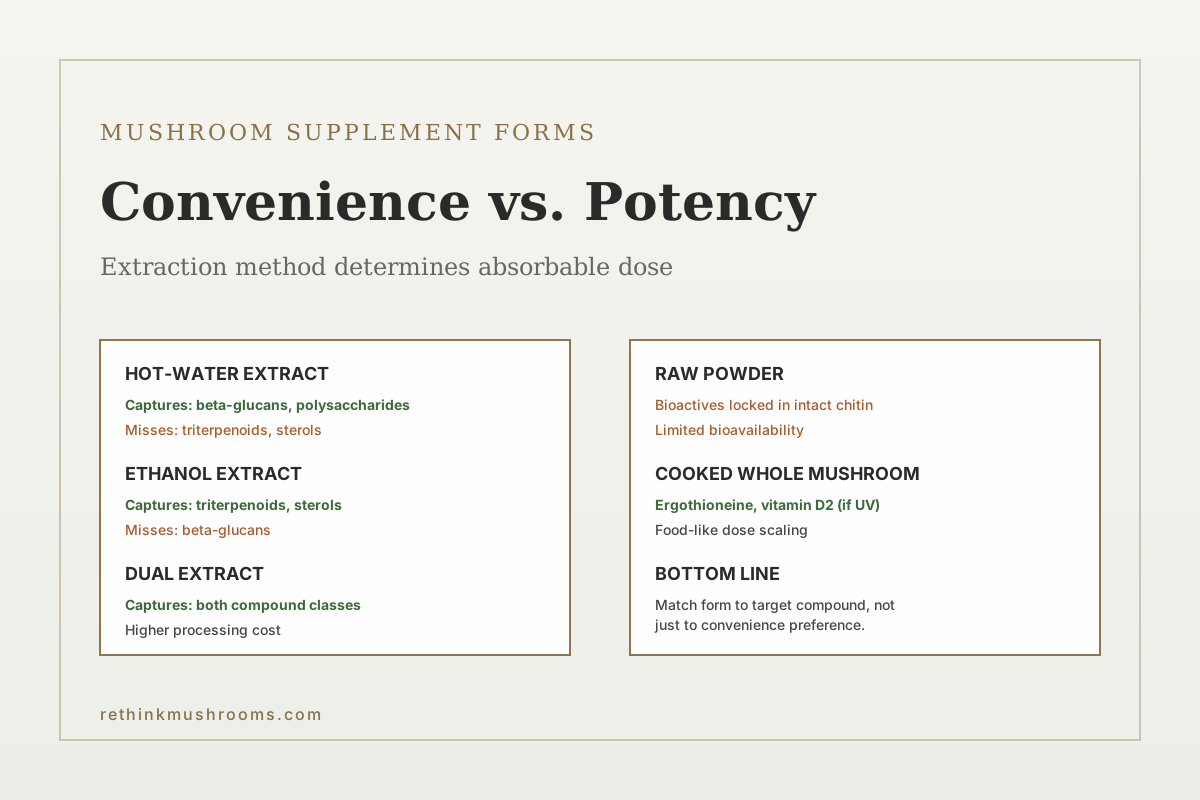
Dried mushroom rehydrated and cooked before eating is the most traditional form. It contains the full complement of mushroom compounds embedded in the intact fungal cell wall matrix. Cooking ruptures the cell wall and releases water-soluble compounds (beta-glucans, polysaccharides, ergothioneine, vitamins), while keeping lipid-soluble compounds (triterpenoids, sterols) largely within the cooked mushroom tissue that is consumed whole. The dose is limited by how much mushroom a person can reasonably eat; several hundred grams of fresh mushroom roughly equals 10-30 grams of dry weight.
Raw mushroom powder
Dried mushroom ground into powder. Chemically similar to the dried mushroom, but physically a powder rather than a cooked food. The important caveat is that the cell wall matrix is intact: raw powder in a capsule does not undergo cooking, and the bioactive compounds remain embedded in chitin. Studies of raw mushroom powder in humans show variable bioavailability, and most of the positive clinical trials in the mushroom literature used extracted preparations rather than raw powder.[1]
Hot-water (aqueous) extract
Mushroom is simmered in hot water for hours, then the liquid is collected and concentrated or dried into a powder. This extraction releases water-soluble compounds including beta-glucans, other polysaccharides, ergothioneine, small peptides, and water-soluble phenolics. It does not efficiently extract triterpenoids, sterols, or other lipid-soluble compounds. Labeled as "hot-water extract," "polysaccharide extract," or just "extract," this is the form used in most Asian medicinal mushroom clinical trials. Tang et al. (2005) used a Ganoderma lucidum polysaccharide extract in a randomized, double-blind, placebo-controlled study of neurasthenia, reporting significant improvement versus placebo.[2]
Alcohol (ethanol) extract
Mushroom is soaked in ethanol, typically at 40-60% concentration, for weeks. This releases lipid-soluble compounds: triterpenoids (especially important for Ganoderma lucidum), sterols, ergosterol, and some phenolics. It does not efficiently extract beta-glucans or most polysaccharides. Labeled as "alcohol extract," "ethanol extract," or "tincture," this form is used when the targeted compounds are the triterpenoid fraction.
Dual extract
Sequential hot-water and ethanol extraction, then the two fractions are recombined. This captures both water-soluble (beta-glucan) and lipid-soluble (triterpenoid) compounds in a single product. Typical labeling is "dual extract" or "full-spectrum extract." The tradeoff is processing cost and product complexity. For some mushrooms (Ganoderma lucidum, Inonotus obliquus), dual extraction is the pharmacologically appropriate form because the relevant clinical effects involve both compound classes.
Convenience Rankings: What Each Form Delivers in Daily Use
Convenience matters because the best supplement is one the person actually takes consistently. The four forms differ significantly.
Capsules: Highest convenience. Pre-measured dose, tasteless, stable at room temperature, portable. Downside: the dose per capsule is limited (typically 250-500 mg of powder or extract), so multi-gram doses require multiple capsules per serving.
Loose powder: Medium convenience. Requires a measuring spoon, usually mixed into coffee, smoothies, or cooking. Higher doses are easy. Flavor can be earthy or bitter depending on species and extraction. Allows easy dose titration.
Tincture: Medium convenience. Dropper-measured dose, held under the tongue for 30-60 seconds (sublingual absorption for some small molecules) or added to liquid. Alcohol content makes it unsuitable for some users. Higher-concentration tinctures can deliver a day's dose in 1-2 mL.
Whole dried mushroom: Lowest convenience for supplementation, highest for culinary use. Requires rehydration and cooking. Doses in the multi-gram range are straightforward if the mushroom is a staple ingredient, but the daily-use compliance is food-like rather than supplement-like.
Potency Rankings: What Actually Reaches the Bloodstream
Potency here means absorbable dose of the target bioactive, not raw weight on the label. This is where the labels most often mislead.
For beta-glucans and polysaccharides: hot-water extract > dual extract > cooked whole mushroom > raw powder. Cerletti et al. (2021) reviewed the human evidence on edible mushrooms and beta-glucans, concluding that beta-glucan bioavailability is strongly form-dependent and that extracted preparations show more consistent serum and biomarker effects than raw mushroom preparations.[1]
For triterpenoids (primarily relevant for Ganoderma lucidum): alcohol extract > dual extract > raw powder > hot-water extract. Triterpenoids are not water-soluble and are poorly extracted by hot water alone.
For ergothioneine: cooked whole mushroom ≈ hot-water extract > dual extract > raw powder. Ergothioneine is water-soluble, heat-stable, and well-absorbed from whole mushroom preparations. Weigand-Heller et al. (2012) measured plasma ergothioneine increases after consumption of Agaricus bisporus and documented meaningful bioavailability with acute effects on antioxidant biomarkers.[3]
For vitamin D2 (UV-exposed mushrooms): UV-treated Agaricus bisporus delivers bioavailable vitamin D2 in whole-mushroom or powder form. Urbain et al. (2011) randomized vitamin D deficient adults and showed that UV-B-irradiated button mushrooms raised serum 25(OH)D comparably to vitamin D2 supplements.[4] Koyyalamudi et al. (2009) showed similar results with demonstrated dose-response.[5]
For Agaricus blazei immunomodulatory effects: hot-water and aqueous extracts have the clinical trial evidence base. Ahn et al. (2004) reported improved natural killer cell activity and quality of life in cancer patients using an Agaricus blazei aqueous extract.[6] The clinical studies on Agaricus blazei all used extracts; raw powder is not the form that was tested.
For Ganoderma lucidum spore powder specifically: spore powder is a distinct form that concentrates specific compounds in the Ganoderma spore, which has a hard coat that typically requires cracking. Zhao et al. (2012) reported improved cancer-related fatigue in breast cancer patients undergoing endocrine therapy using spore powder, demonstrating that the spore is a pharmacologically distinct preparation from fruiting body extract.[7]
Matching Form to Use Case
For immune support via beta-glucans (most adaptogen mushroom claims): Hot-water extract in capsule or powder form. Dose the label specifies, not the label weight. Raw powder does not deliver comparable beta-glucan bioavailability and is a poor value even at lower price points.
For Ganoderma lucidum (specifically for triterpenoid effects): Dual extract or alcohol extract. Hot-water extract alone misses the triterpenoid fraction. Spore powder is a separate preparation with its own evidence base.
For ergothioneine as a dietary antioxidant: Cooked whole mushroom works well, hot-water extract is an effective concentrate, and the Agaricus bisporus species is the best-studied source for daily dietary intake.
For vitamin D via mushrooms: UV-exposed Agaricus bisporus in any form (whole, powder, capsule) works if UV exposure is documented on the label. Untreated mushrooms contain minimal vitamin D2.
For psilocybin-containing mushrooms: This is a distinct category regulated separately and is not a dietary supplement. The relevant clinical work has been done with synthetic psilocybin (e.g., Compass COMP360, Usona) rather than whole mushroom, because dose standardization is critical and whole mushroom is heterogeneous.
For convenience-weighted general mushroom supplementation: Capsule of dual extract from a specified species at a specified potency, with an independent third-party certificate of analysis. Accept a higher per-dose price in exchange for a product that actually delivers what the label claims.
What the Cerletti Review Actually Concluded
Cerletti et al. (2021) conducted a comprehensive review of edible mushrooms and beta-glucans with a focus on human health outcomes. The authors noted that the existing clinical trial literature is small, that effect sizes are generally modest, and that form-dependent bioavailability is a major source of inconsistency across studies. Trials using extracted preparations show more consistent effects than trials using whole mushroom or raw powder. The implication for consumers is that equivalent "mushroom supplement" products on the market can deliver substantially different doses of the bioactive fraction, and the label weight is not a reliable proxy for the absorbable dose.[1]
For the cluster's head-to-head comparison article, see mushroom capsules vs. powder vs. tincture: which is best?.
The Bottom Line
The convenience-versus-potency tradeoff in mushroom supplements reduces to the extraction method and the match between that method and the bioactive compound of interest. Hot-water extracts deliver beta-glucans and polysaccharides that drive most immunomodulatory claims; alcohol extracts deliver triterpenoids relevant for Ganoderma lucidum; dual extracts capture both; raw powder typically delivers less of either than the label weight suggests. The clinical trials that established mushroom supplements' evidence base (Tang 2005, Ahn 2004, Zhao 2012, Weigand-Heller 2012, Urbain 2011) used extracts or whole mushroom, not raw powder, and matching the form to the use case is more important than the capsule-versus-powder-versus-tincture choice within a given form.
Frequently Asked Questions
Sources & References
- 1RTHM-00676·Cerletti, Chiara et al. (2021). “Edible Mushrooms and Beta-Glucans: Impact on Human Health..” Nutrients.Study breakdown →PubMed →↩
- 2RTHM-00088·Tang, Wenbo et al. (2005). “A randomized, double-blind and placebo-controlled study of a Ganoderma lucidum polysaccharide extract in neurasthenia..” Journal of medicinal food.Study breakdown →PubMed →↩
- 3RTHM-00270·Weigand-Heller, AuBrei J et al. (2012). “The bioavailability of ergothioneine from mushrooms (Agaricus bisporus) and the acute effects on antioxidant capacity and biomarkers of inflammation..” Preventive medicine.Study breakdown →PubMed →↩
- 4RTHM-00237·Urbain, P et al. (2011). “Bioavailability of vitamin D₂ from UV-B-irradiated button mushrooms in healthy adults deficient in serum 25-hydroxyvitamin D: a randomized controlled trial..” European journal of clinical nutrition.Study breakdown →PubMed →↩
- 5RTHM-00159·Koyyalamudi, Sundar Rao et al. (2009). “Vitamin D2 formation and bioavailability from Agaricus bisporus button mushrooms treated with ultraviolet irradiation..” Journal of agricultural and food chemistry.Study breakdown →PubMed →↩
- 6RTHM-00066·Ahn, W-S et al. (2004). “Natural killer cell activity and quality of life were improved by consumption of a mushroom extract, Agaricus blazei Murill Kyowa, in gynecological cancer patients undergoing chemotherapy..” International journal of gynecological cancer : official journal of the International Gynecological Cancer Society.Study breakdown →PubMed →↩
- 7RTHM-00276·Zhao, Hong et al. (2012). “Spore Powder of Ganoderma lucidum Improves Cancer-Related Fatigue in Breast Cancer Patients Undergoing Endocrine Therapy: A Pilot Clinical Trial..” Evidence-based complementary and alternative medicine : eCAM.Study breakdown →PubMed →↩