Mushroom Supplement Forms
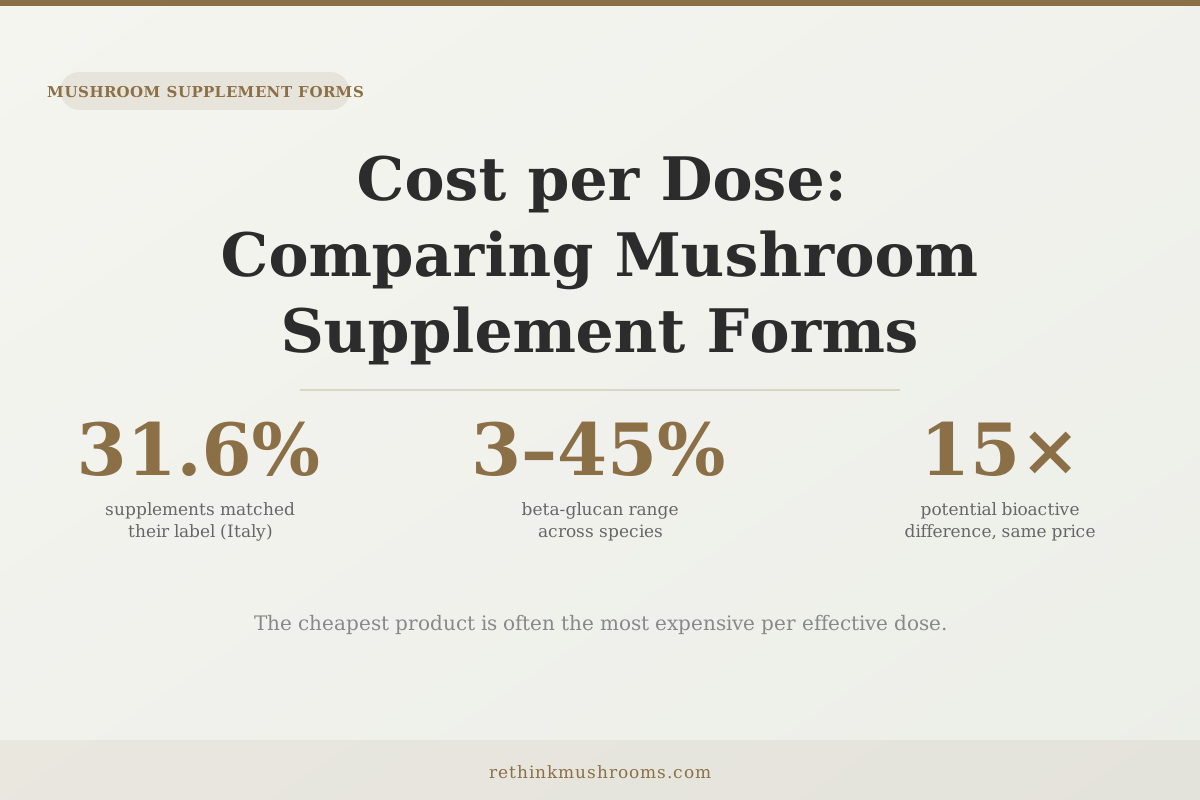
31.6% of supplements matched their label
An independent DNA-barcoding analysis of 19 commercial mushroom supplements sold in Italy found only 6 — 31.6% — contained sequences matching the species shown on the label.
Risoli et al., Nutrients, 2023
26.3%
US Reishi supplements with bioactives matching label claims (Wu et al., Scientific Reports, 2017)
10.5–35%
beta-glucan content range across 21 edible species by Megazyme assay (Mironczuk-Chodakowska & Witkowska, 2020)
Same mg ≠ same dose
two same-weight capsules can differ several-fold in verified bioactive content
Risoli et al., Nutrients, 2023
 View as image ↗
The most expensive mushroom supplement in a store is not necessarily the most cost-effective. Nor is the cheapest. When two products price the same 500mg capsule at different prices, cost comparison is simple. The problem is that a 500mg capsule of one product may contain 200mg of verified beta-glucan from a concentrated fruiting body extract, while a 500mg capsule of another may contain 500mg of mycelium grown on grain substrate, with beta-glucan content measured in low single-digit percentages. Same capsule. Same milligrams. A 20-fold difference in actual bioactive delivery.
Comparing mushroom supplement cost per dose requires a different unit than price per capsule or price per gram. The right unit is cost per milligram of verified beta-glucan. For context on the broader mushroom supplement landscape including coffee and powder formats, see mushroom coffee: what is it and does it actually work?.
Key Takeaways
- An Italian DNA-barcoding audit of 19 commercial mushroom supplements found only 6 (31.6%) matched the species on the label, with two of the matched Ganoderma samples actually showing 100% and 99% homology with G. resinaceum and G. sichuanense rather than G. lucidum (Risoli et al., Nutrients, 2023)
- A 2017 chromatography and saccharide-mapping analysis of 19 US Reishi supplements found only 5 (26.3%) had measured triterpene and polysaccharide content matching label claims (Wu et al., Scientific Reports, 2017)
- Beta-glucan content varies substantially across edible species — a 21-species screen found a ~3-fold range by Megazyme assay (10.5 to 35 g/100 g dry mass), and assay choice can reshuffle the rankings (Mironczuk-Chodakowska & Witkowska, IJERPH, 2020)
- Mycelium and fruiting bodies are not chemically identical, and substrate chemistry, strain, developmental stage, and ecological interactions cause wide variation in metabolite concentrations (Berger et al., Microorganisms, 2022)
- The form premium (tinctures cost 3–5× more per volume than extract powder) is not automatically a quality premium — the extraction method, not the delivery format, determines whether beta-glucans are present
- A simple calculation: (price per serving) ÷ (verified beta-glucan mg per serving) = cost per mg of beta-glucan — this is the one comparison metric that makes different products commensurable
The Label Accuracy Problem That Makes Sticker Price Meaningless
Before comparing cost-per-dose across supplement forms, it's worth establishing that the numbers on most supplement labels aren't reliable enough to anchor a comparison.
Risoli and colleagues tested 19 commercially available mushroom supplements sold in Italy using DNA barcoding, plus assays for ergosterol, aflatoxins, heavy metals, nicotine, and total glucan.[1] Only 6 of the 19 samples produced sequences matching the species claimed on the label. Two of the Ganoderma-labeled products actually showed 100% and 99% homology with G. resinaceum and G. sichuanense, not G. lucidum. The grain substrate used in mycelium products contributes starch to any analytical readout, so a "mushroom powder" derived from mycelium-on-grain is substantially grain starch, not mushroom bioactives.
This is not a European-specific problem. Wu and colleagues tested 19 Reishi (Ganoderma lucidum) dietary supplements sold in the United States using chromatographic methods and saccharide mapping.[2] Only 5 of the 19 products — 26.3% — had measured triterpene and polysaccharide content matching their label claims. The authors concluded that quality consistency of G. lucidum dietary supplements in the U.S. market was poor and warranted careful investigation.
The implication for cost comparison: if you compare a $20 bottle to a $50 bottle based on price alone, and the $20 bottle contains no meaningful bioactives, you have not found a good deal. You have paid for packaging and marketing with negligible return on the actual health objective.
This is why cost-per-dose analysis begins with verified content, not listed content.
Why Beta-Glucan Content Is the Right Unit for Cost Comparison
Beta-glucans are the best-studied bioactive class in medicinal mushrooms. They are the compounds responsible for immune modulation, prebiotic activity, and the majority of the effects documented in clinical trials. They are water-soluble, heat-stable, and measurable with standardized analytical methods. When a supplement claims to support immune health via mushroom compounds, beta-glucans are the relevant bioactive to verify.
The problem: beta-glucan content is not uniform across mushroom species. Mirończuk-Chodakowska and Witkowska measured beta-glucan content across 21 edible species and found a roughly 3-fold range by Megazyme assay, from 10.50 g/100 g dry mass in Macrolepiota procera to 34.97 g/100 g in Tricholoma portentosum — and the cultivated reference Pleurotus ostreatus reached 40.34 g/100 g.[3] Assay choice also reshuffles species rankings: a Congo red workflow targeting triple-helix beta-glucans gave very different leaders than the Megazyme readout. Either way, "500 mg of mushroom powder" carries a wide range of possible bioactive content depending on species and assay.
Mycelium-on-grain products land at the low end. Berger and colleagues' 2022 review notes that substrate chemistry, strain, developmental stage, and ecological interactions cause wide variation in metabolite concentrations in both mycelial cells and fruiting bodies — so even within a species, content depends heavily on how it was grown.[4]
Cost per gram of powder, cost per capsule, or cost per milliliter of tincture are all metrics that ignore this variation entirely. Two products priced identically at $0.50 per capsule may be delivering $0.50 worth of effective bioactive — or $0.03 worth.
How to Calculate Cost Per Effective Dose
The comparison methodology is straightforward once you have verified beta-glucan data:
Step 1: Find the beta-glucan percentage. Look for a stated beta-glucan percentage on the label or certificate of analysis (COA). This should specify the testing method — the most common are enzymatic assays (Megazyme or AOAC standard methods) or HPLC. A label that says only "polysaccharides" without specifying beta-glucans may be including alpha-glucans (including starch) in the count, which inflates the number.
Step 2: Calculate mg beta-glucan per serving. Multiply the serving size (mg) by the beta-glucan percentage. Example: 500mg serving at 30% beta-glucan = 150mg beta-glucan per serving.
Step 3: Calculate cost per mg beta-glucan. Divide price per serving by mg beta-glucan per serving. Example: $0.60 per capsule ÷ 150mg = $0.004 per mg beta-glucan.
Worked comparison:
| Product | Serving | Stated content | Verified beta-glucan % | mg beta-glucan | Cost/serving | Cost/mg beta-glucan |
|---|---|---|---|---|---|---|
| Budget powder (mycelium on grain) | 1,000mg | "Mushroom extract" | ~4% | 40mg | $0.25 | $0.0063 |
| Mid-range capsule (fruiting body, unverified) | 500mg | "20% polysaccharides" | Unknown | Unknown | $0.50 | Cannot calculate |
| Quality extract (fruiting body, 3rd party verified) | 500mg | "30% beta-glucan (verified)" | 30% | 150mg | $1.00 | $0.0067 |
In this example, the budget product and the quality extract cost almost exactly the same per milligram of beta-glucan. The quality product costs 4× more per capsule but delivers nearly 4× more bioactive content per capsule. The mid-range product cannot be evaluated at all — "polysaccharides" including starch is not a meaningful beta-glucan claim.
For guidance on reading extraction method claims on labels, see hot water vs. alcohol extraction: which compounds each captures.
The Form Premium: When You're Paying for Convenience, Not Potency
Tinctures typically cost 3-5x more per volume than an equivalent serving of extract powder. Capsules cost more than bulk powder. These price differences reflect manufacturing complexity, packaging, and convenience — not necessarily bioactive potency.
The specific case where form matters most is tinctures: alcohol-based single extracts do not capture beta-glucans at all. Beta-glucans are water-soluble; they require hot water extraction to release from the cell walls. An alcohol-only tincture bypasses this step and captures fat-soluble compounds (primarily triterpenes in species like Reishi) while leaving beta-glucans behind.
This means:
- An alcohol-only tincture has zero beta-glucan content, regardless of price
- A hot-water tincture or extract has beta-glucan content, but you need to verify the percentage
- A dual-extract tincture (hot water plus alcohol) captures both beta-glucans and triterpenes
For more on dual extraction and which compound classes each method captures, see dual extraction: why it matters for full-spectrum mushroom products.
The practical upshot: the form premium in tinctures is sometimes justified (dual-extract tinctures have genuine potency advantages for species where triterpenes matter, like Reishi) and sometimes is not (alcohol-only tinctures of primarily beta-glucan species like turkey tail are overpriced relative to a verified extract powder, since they're capturing the wrong compound class).
What Batch-to-Batch Variation Means for Your Calculation
The beta-glucan percentage on a label is a snapshot, not a guarantee. Berger and colleagues' 2022 review documents that substrate chemistry, strain, developmental stage, and ecological interactions all shift metabolite content in mushrooms — so a product that tested at 30% beta-glucan in one batch may test differently in another if any of those variables changed.[4]
This variation is why COAs from third-party testing are more meaningful than label claims alone — and why looking for a current COA (ideally from the last 12 months) matters more than a COA from three years ago that the company uses indefinitely.
For products without third-party testing, the only available proxy is reputation and manufacturing transparency. Companies that publish COAs for current batches, specify the extraction method, and identify the testing laboratory are providing information that allows meaningful cost comparison. Companies that list only "mushroom extract" without specifying species, origin, extraction method, or verified bioactive percentage cannot be evaluated on cost-per-effective-dose terms at all.
Label Claims You Can and Can't Trust
The two label-accuracy audits above (Risoli 2023 and Wu 2017) tell the same story from different angles: a substantial share of commercial mushroom supplements either contain a different species than the label claims or carry bioactive content that does not match label claims. The label claims that provide useful cost comparison information:
- Beta-glucan percentage — specifically stated as beta-glucan (not "polysaccharides"), with testing method cited
- Fruiting body vs. mycelium — affects baseline beta-glucan content substantially
- Extraction ratio — "10:1 extract" means 10g mushroom per 1g extract, which concentrates bioactives; raw powder has no concentration
- Third-party COA available — a published certificate of analysis from an independent lab
The label claims that don't help:
- "Polysaccharides" without beta-glucan specification — may include alpha-glucans from grain substrate
- "Full spectrum" — a marketing term, not an analytical measure
- Milligrams per serving without percentage — tells you the volume of powder but not the bioactive content
- Species name alone without extraction information — two products with the same species can differ 10-fold in bioactive content
For the complete guide to evaluating mushroom supplement quality using these criteria, see fruiting body vs. mycelium: the great mushroom supplement debate.
And for evaluating whether a product's beta-glucan claims are methodologically sound, see how to test for beta-glucans in mushroom supplements.
The Bottom Line
Cost-per-dose comparison for mushroom supplements is only meaningful when based on verified beta-glucan content, not price per capsule or gram. Two quality audits (Risoli 2023, Italy; Wu 2017, US Reishi) found that under one-third of commercial mushroom supplements contain species or bioactives matching their labels — making sticker price an unreliable proxy for value. Beta-glucan content varies roughly 3-fold across edible species by Megazyme assay (Mironczuk-Chodakowska 2020), and substrate chemistry, strain, and developmental stage further shift content within a species (Berger 2022). The calculation is straightforward: cost per serving ÷ verified beta-glucan mg per serving = cost per mg of bioactive. Tinctures carry a form premium that is only justified for dual-extract products capturing both beta-glucans and triterpenes; alcohol-only tinctures contain no beta-glucans regardless of price.
Frequently Asked Questions
Sources & References
- 1RTHM-01778·Risoli, Samuele et al. (2023). “Mushroom-Based Supplements in Italy: Let's Open Pandora's Box..” Nutrients.Study breakdown →PubMed →↩
- 2RTHM-00499·Wu, Ding-Tao et al. (2017). “Evaluation on quality consistency of Ganoderma lucidum dietary supplements collected in the United States..” Scientific reports.Study breakdown →PubMed →↩
- 3RTHM-00637·Mirończuk-Chodakowska, Iwona et al. (2020). “Evaluation of Polish wild Mushrooms as Beta-Glucan Sources..” International journal of environmental research and public health.Study breakdown →PubMed →↩
- 4RTHM-00743·Berger, Ralf G et al. (2022). “Mycelium vs. Fruiting Bodies of Edible Fungi-A Comparison of Metabolites..” Microorganisms.Study breakdown →PubMed →↩