Supplement Forms & Delivery
0 head-to-head trials
Not a single clinical study has measured the same mushroom compound in human blood after dosing a capsule, powder, and tincture of identical material. The comparison runs on chemistry, not pharmacokinetics.
Review of published literature, 2026
Chitin Barrier
locks bioactives in raw powder
Dual Extraction
needed for both compound classes
Cost per Gram
favors extracted powder
Review of published literature, 2026
 View as image ↗
The mushroom capsule vs powder vs tincture question sits at the center of almost every functional mushroom purchase decision, and the honest answer is that no clinical trial has compared the three formats head-to-head for absorption or outcomes in humans. What the published research does cover is the chemistry that happens upstream of any format: how extraction disrupts fungal cell walls, which solvents release which compounds, and how those compounds move through the human gut once they arrive. For the mechanistic foundation behind all three formats, see mushroom supplement bioavailability by form.
Format itself is a secondary variable. A dual-extracted powder encapsulated in gelatin delivers the same bioactives as the identical extract dissolved under the tongue, assuming both products started from the same raw material and the same extraction process. The real differences between capsule, powder, and tincture show up in dosing accuracy, cost per gram of active compound, shelf life, and the practical friction of taking them every day for months. Those variables can determine whether a regimen actually gets taken.
Key Takeaways
- Beta-glucans are not absorbed through the gut wall regardless of format; they are captured by macrophages in Peyer's patches and fragmented for transport to bone marrow (Chan et al., 2009)
- Unextracted mushroom powder reduced protein, fat, and energy digestibility in a dose-dependent manner in rats, consistent with chitin acting as a physical barrier to nutrient absorption (Regula et al., 2016)
- Ergothioneine from Agaricus bisporus powder was measurably absorbed into human red blood cells after 8 g and 16 g meals, showing that small-molecule mushroom bioactives can bypass the chitin problem (Weigand-Heller et al., 2012)
- Ultrasonic-assisted aqueous ethanol co-extraction from Ganoderma lucidum produced higher antioxidant capacity than water extraction alone, confirming dual extraction captures a broader compound profile (Zheng et al., 2020)
- Subcritical water extraction at 200 degrees C gave the highest glucan yield from chaga, while microwave-assisted 50% ethanol extraction gave the highest total phenol content (Lazic et al., 2024)
- Edible mushrooms and their beta-glucans require extraction to become bioaccessible because human digestive enzymes cannot efficiently hydrolyze the chitin cell wall (Cerletti et al., 2021)
The Three Formats, Defined by Chemistry
Before comparing anything, the three formats need to be defined by what they actually contain, not by the container they arrive in.
A mushroom capsule is a vegetable cellulose or gelatin shell filled with either raw dried mushroom powder or an extracted powder. These two fillings are chemically different products in the same delivery vehicle. Raw powder capsules contain the full mushroom spectrum locked behind chitin walls. Extracted powder capsules contain concentrated bioactives that have already been released from the cell wall through hot water, ethanol, or dual extraction.[1]
A mushroom powder is either dried mushroom material that has been ground (unextracted) or an extracted powder sold loose rather than in capsules. The extract ratio on the label (10:1, 15:1, 20:1) indicates how much raw mushroom produced one unit of extract powder. A genuine 10:1 extract requires 10 kg of starting mushroom to produce 1 kg of finished powder. For detailed guidance on evaluating these claims, see 10:1 extract ratios: what they mean and what they don't.
A mushroom tincture is mushroom material soaked in a solvent, most commonly ethanol or an alcohol-water mixture, for weeks to months, then strained. The liquid contains whatever the solvent dissolved. Single-alcohol tinctures capture triterpenoids and sterols but miss water-soluble beta-glucans. Dual-extraction tinctures perform a hot water extraction first, then combine that liquid with an ethanol extract, producing a final product that contains both compound classes.
The critical point: a dual-extracted powder in a capsule and a dual-extracted tincture of the same species at the same dose contain essentially the same bioactive compounds. The debate over format collapses once you control for extraction. What remains is a practical comparison of how the three formats perform in real use.
Bioavailability: What the Evidence Actually Shows
No published human pharmacokinetic study has compared plasma appearance of any mushroom compound across capsule, powder, and tincture formats. The claim that any one format is "more bioavailable" than another rests entirely on indirect evidence and pharmaceutical analogy.
What the research does show is that bioavailability is compound-specific, not format-specific. Chan et al. (2009) described the absorption pathway for beta-glucans in detail. The beta-1,3-glycosidic backbone cannot be hydrolyzed by human pancreatic or brush border enzymes, so beta-glucans arrive in the small intestine structurally intact. Macrophages in Peyer's patches capture the glucan particles, internalize them, fragment the large polysaccharide chains into smaller pieces, and transport those fragments to bone marrow and the endothelial reticular system. The fragments are eventually released to neutrophils, natural killer cells, and dendritic cells.[1]
This pathway is indifferent to whether the beta-glucans arrived in a capsule, a loose powder, or a liquid tincture. What matters is whether the glucans are free from the chitin matrix when they reach the gut macrophages. Cerletti et al. (2021) reviewed the bioaccessibility literature and reached the same conclusion: the chitin cell wall is the binding constraint, and the extraction process (not the final delivery format) determines whether the glucans are accessible.[2]
Regula et al. (2016) demonstrated the chitin barrier in vivo. Adding dried oyster mushroom powder to rat diets reduced protein digestibility, fat digestibility, and overall energy availability in a dose-dependent manner. The effect scaled with the amount of unextracted powder added, consistent with chitin physically blocking access to nutrients.[3] A raw powder in a capsule faces the same barrier as the same powder stirred into a smoothie. Neither format solves the extraction problem.
A small number of mushroom compounds escape the chitin trap because they are small enough to diffuse out of partially disrupted cells and have dedicated transporters. Ergothioneine is the clearest example. Weigand-Heller et al. (2012) ran a randomized crossover dose-response study in 10 healthy men and measured ergothioneine uptake into red blood cells after meals containing 8 g and 16 g of Agaricus bisporus mushroom powder. Postprandial red blood cell ergothioneine increased measurably at both doses, demonstrating that a small-molecule mushroom bioactive can be absorbed from an unextracted powder via the OCTN1/SLC22A4 transporter.[4] The same ergothioneine would be absorbed from a capsule or a tincture at comparable efficiency.
Tinctures are sometimes marketed as offering superior sublingual absorption. For large molecules like beta-glucans (molecular weights from 100,000 to over 1,000,000 daltons), sublingual absorption is not physiologically possible. The buccal mucosa admits small lipophilic molecules, not high-molecular-weight polysaccharides. For small triterpenoids and phenolics, sublingual delivery could theoretically offer a modest pharmacokinetic advantage by bypassing first-pass metabolism, but this has never been measured for any specific mushroom compound.
The Comparison Table
Pulling the chemistry together into a practical comparison:
| Factor | Raw Powder Capsules | Extracted Powder (loose or in capsules) | Dual-Extraction Tincture |
|---|---|---|---|
| Beta-glucan delivery | Low (chitin blocks release) | High (extraction disrupts chitin) | High (hot water step releases glucans) |
| Triterpenoid delivery | Low to none | High (if dual-extracted) | High (ethanol step captures triterpenoids) |
| Ergothioneine delivery | Moderate (small molecules diffuse) | Moderate to high | Moderate (heat may degrade some) |
| Dosing precision | High (each capsule is measured) | High in capsules, lower loose | Moderate (drops or milliliters) |
| Onset speed | 30 to 60 minutes | 30 to 60 minutes | 10 to 30 minutes (liquid absorbed faster) |
| Taste | None (capsule masks) | Earthy, sometimes bitter | Strong alcohol and mushroom |
| Shelf life | 2 to 3 years | 2 to 3 years | 3 to 5 years (alcohol preservative) |
| Cost per gram of extract | Lowest | Lowest to moderate | Highest (packaging, alcohol, volume) |
The comparison exposes the genuine trade-offs. Capsules (if filled with extract) win on convenience and precision. Loose extract powder wins on cost. Tinctures win on shelf life and arguably onset speed for small compounds, but pay a substantial cost premium per gram of active material. Raw powder capsules underperform across every bioavailability dimension except ergothioneine delivery, which is the only compound class that consistently survives the chitin barrier.
Cost per Dose: Where the Format Really Differs
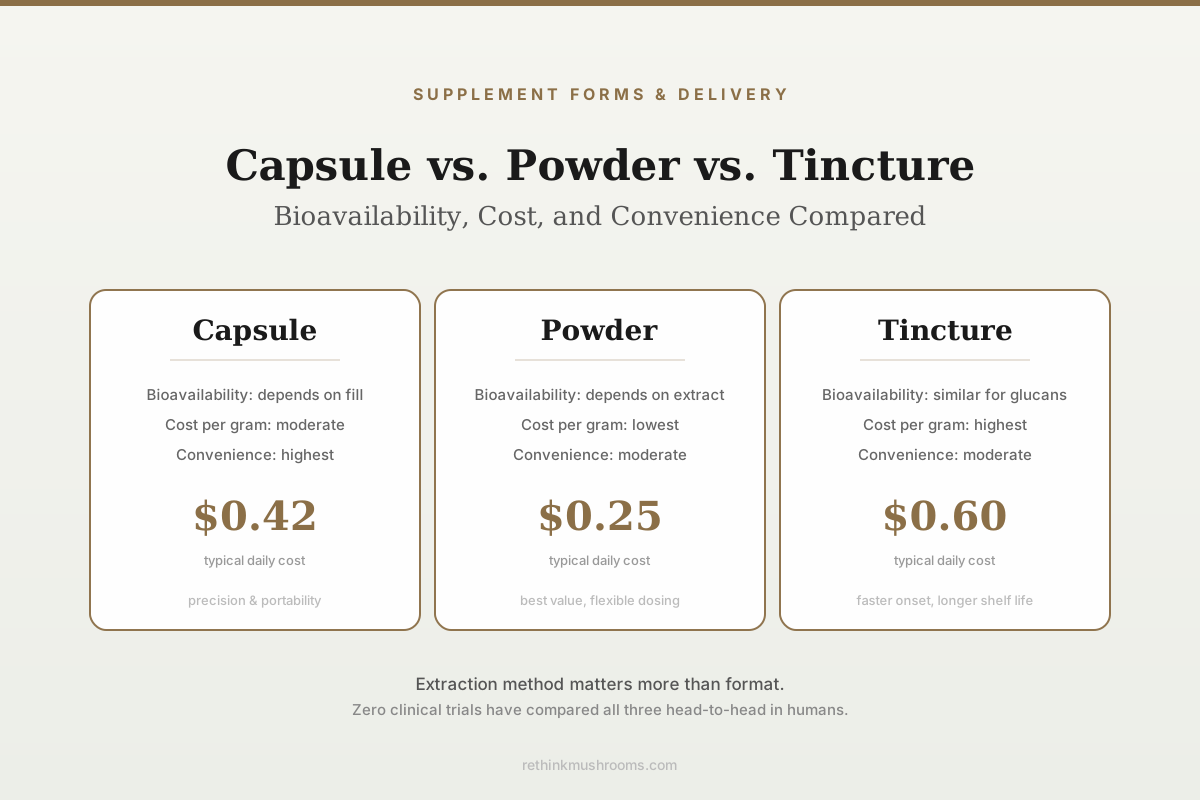
Cost is where the three formats separate most clearly. A typical reishi extract provides a useful worked example. A 100 g bag of dual-extracted reishi powder (10:1 ratio) sells for $25 to $45 from reputable vendors. At a 1 g daily dose, that is 100 days of supply for roughly $0.25 to $0.45 per day.
A 120-capsule bottle of the same extract at 500 mg per capsule (two capsules per daily dose) typically retails for $25 to $35. That is 60 days of supply at $0.42 to $0.58 per day. The capsule premium pays for the capsule shell, encapsulation labor, and marketing.
A 60 mL bottle of dual-extraction reishi tincture typically retails for $25 to $45. At a 1 mL daily dose (roughly 30 drops), that is 60 days of supply at $0.42 to $0.75 per day. Critically, the tincture's labeled "equivalent dry weight" is often lower than what you would get from the same spend on extract powder. A 1 mL dose of tincture labeled "1:5 strength" delivers 200 mg of dry mushroom equivalent, compared to the 500 mg to 1 g of extract powder in a capsule dose.
On a per-gram-of-bioactive basis, loose extract powder is consistently the cheapest format, capsules add 20 to 50% for convenience, and tinctures add 50 to 150% for the packaging, alcohol, and smaller payload per dose. For a deeper analysis of this math, see cost per dose: comparing mushroom supplement forms.
Quality claims complicate every direct price comparison. A cheap raw-powder capsule product costs less per capsule than a dual-extracted capsule but delivers a fraction of the bioactive content, so cost per gram of actual beta-glucan can be higher even at a lower sticker price. The only honest way to compare cost is to identify the extraction method, the beta-glucan or triterpenoid percentage, and the dose of actual bioactive compound per serving. For guidance on spotting misleading labels, see 7 red flags in mushroom supplements: what to avoid.
Convenience: The Factor That Determines Adherence
The supplement you actually take every day outperforms the supplement you forget in the cupboard. Convenience is not a minor consideration; it is often the deciding factor for a year-long regimen.
Capsules win on portability, taste neutrality, and dosing precision. A pill bottle fits in a bag or suitcase and does not leak. Two capsules at breakfast requires no measuring, no liquid, and no timing around meals. This makes capsules the default format for most long-term users of single-species supplements.
Loose extract powders win on flexibility. A spoonful of extract powder can go into coffee, smoothies, soup, or tea, and the dose can be adjusted up or down without opening multiple capsules. For people already using blenders or hot drinks daily, powder adds no friction. For people who travel or skip breakfast, powder creates daily friction that capsules avoid.
Tinctures win on speed of onset for small lipophilic compounds and on shelf stability after opening. A dropper is fast to use but requires sublingual contact for 30 to 60 seconds to offer the mucosal absorption advantage, and the taste of most mushroom tinctures (strongly alcoholic, earthy, often bitter) is the most common complaint from first-time users. Tinctures are also vulnerable to accidental spillage and are regulated or restricted on some international flights because of the alcohol content. For help choosing between these trade-offs, see convenience vs. potency: choosing your mushroom supplement form.
Which format produces the highest adherence in real use depends heavily on personality and routine. A person with an established morning supplement stack will adhere to capsules. A person already making a daily smoothie will adhere to powder. A person who wants fast onset and travels often may prefer a compact tincture despite the higher cost. There is no universal answer, and supplement research cannot settle a question that depends on individual habit.
What Determines Effectiveness Across All Three Formats
The variables that actually determine whether any mushroom supplement works have little to do with whether it arrives as capsule, powder, or tincture.
Extraction method is the first and largest variable. A dual-extracted product in any format outperforms an unextracted product in any format. Zheng et al. (2020) showed that ultrasonic-assisted aqueous ethanol co-extraction from Ganoderma lucidum produced higher antioxidant capacity than water extraction alone, because the combined solvent captured both water-soluble polysaccharides and alcohol-soluble triterpenoids.[5] Lazic et al. (2024) found that different extraction technologies optimize for different compound classes in chaga: subcritical water extraction at 200 degrees C gave the highest glucan yield, while microwave-assisted 50% ethanol extraction gave the highest total phenol content.[6] Neither extraction method, nor any final format, captures everything at once.
Species chemistry is the second variable. Polysaccharide-dominant species (turkey tail, maitake) benefit most from hot water extraction. Triterpenoid-dominant species (chaga, reishi) benefit most from dual extraction. A water-only reishi tincture misses the ganoderic acids that drive much of its studied activity. An ethanol-only turkey tail tincture misses the polysaccharides that are the point of turkey tail. For a deeper comparison across the three formats and their practical trade-offs, see mushroom capsules vs. powder vs. tincture: which is best?.
Standardization is the third variable. A product that reports a beta-glucan percentage, a triterpenoid content, or a specific compound concentration gives the consumer something to compare. A product that reports only a proprietary blend or a "full spectrum" claim does not. Windsor et al. (2025) demonstrated why this matters: wildcrafted chaga canker contained triterpenoids (inotodiol, trametenolic acid) and phenolics that were completely absent from fermented-grain products marketed as chaga.[7] The same label can describe chemically different products across all three formats.
Sourcing is the fourth variable. Fruiting bodies and mycelium grown on grain have different compound profiles, and this difference is often larger than any format effect. A fruiting body product in any format outperforms a mycelium-on-grain product in any format for most species, because the grain substrate dilutes the bioactive concentration. The label term "mushroom mycelium" without specifying whether the grain substrate has been removed is a warning sign. For how to decode labels, see mushroom wisdom, mycelium biomass, and other label terms decoded.
Where the Research Still Lacks Direct Evidence
The capsule vs powder vs tincture question has two layers of missing evidence. First, no human pharmacokinetic study has measured plasma or tissue appearance of a specific mushroom compound from all three formats in the same participants. Weigand-Heller et al. (2012) is the closest existing data, and it measured only one compound (ergothioneine) from one format (powder in a meal).[4] Second, no randomized controlled trial has compared clinical outcomes (immune markers, sleep, cognition, or any other endpoint) between the three formats at matched doses.
Until those studies exist, the comparison between formats rests on indirect evidence: what the chemistry predicts, what analogous pharmaceutical formulations do, and what functional outcomes animal studies show after oral dosing. The mechanistic case that extraction (not format) is the primary variable is strong. The claim that any specific format is clinically superior to another is unsupported by direct evidence.
This matters for consumer expectations. Marketing that promises a tincture is "more bioavailable than a capsule" or that a capsule is "more reliable than a powder" is describing plausible mechanisms, not measured outcomes. The more honest framing is that extraction determines what reaches the gut, and format determines how easily the product is consumed every day. Both matter, but they matter at different steps in the chain.
The Bottom Line
Capsules, powders, and tinctures are delivery formats for mushroom supplements, and no human study has compared them head-to-head for absorption or clinical outcomes. Bioavailability depends on whether the product was extracted (breaking the chitin cell wall) and which solvents were used, not on the format itself. Dual-extracted powder in capsules and dual-extracted tinctures deliver comparable bioactives when matched for dose. Cost per gram favors loose extract powder, convenience favors capsules, and onset speed slightly favors tinctures for small compounds.
Frequently Asked Questions
Sources & References
- 1RTHM-00151·Chan, Godfrey Chi-Fung et al. (2009). “The effects of beta-glucan on human immune and cancer cells..” Journal of hematology & oncology.Study breakdown →PubMed →↩
- 2RTHM-00676·Cerletti, Chiara et al. (2021). “Edible Mushrooms and Beta-Glucans: Impact on Human Health..” Nutrients.Study breakdown →PubMed →↩
- 3RTHM-00443·Regula, Julita et al. (2016). “Bioavailability and Digestibility of Nutrients from the Dried Oyster Culinary-Medicinal Mushroom, Pleurotus ostreatus (Agaricomycetes): In Vivo Experiments..” International journal of medicinal mushrooms.Study breakdown →PubMed →↩
- 4RTHM-00270·Weigand-Heller, AuBrei J et al. (2012). “The bioavailability of ergothioneine from mushrooms (Agaricus bisporus) and the acute effects on antioxidant capacity and biomarkers of inflammation..” Preventive medicine.Study breakdown →PubMed →↩
- 5RTHM-00668·Zheng, Shizhong et al. (2020). “Optimization of ultrasonic-assisted extraction of polysaccharides and triterpenoids from the medicinal mushroom Ganoderma lucidum and evaluation of their in vitro antioxidant capacities..” PloS one.Study breakdown →PubMed →↩
- 6RTHM-00888·Lazić, Vesna et al. (2024). “The Effect of Green Extraction Technologies on the Chemical Composition of Medicinal Chaga Mushroom Extracts..” Journal of fungi (Basel.Study breakdown →PubMed →↩
- 7RTHM-02209·Windsor, Coleton et al. (2025). “What This 2025 Chaga Supplement Authentication Study Actually Found.” International journal of molecular sciences.Study breakdown →PubMed →↩