Supplement Labels and Quality
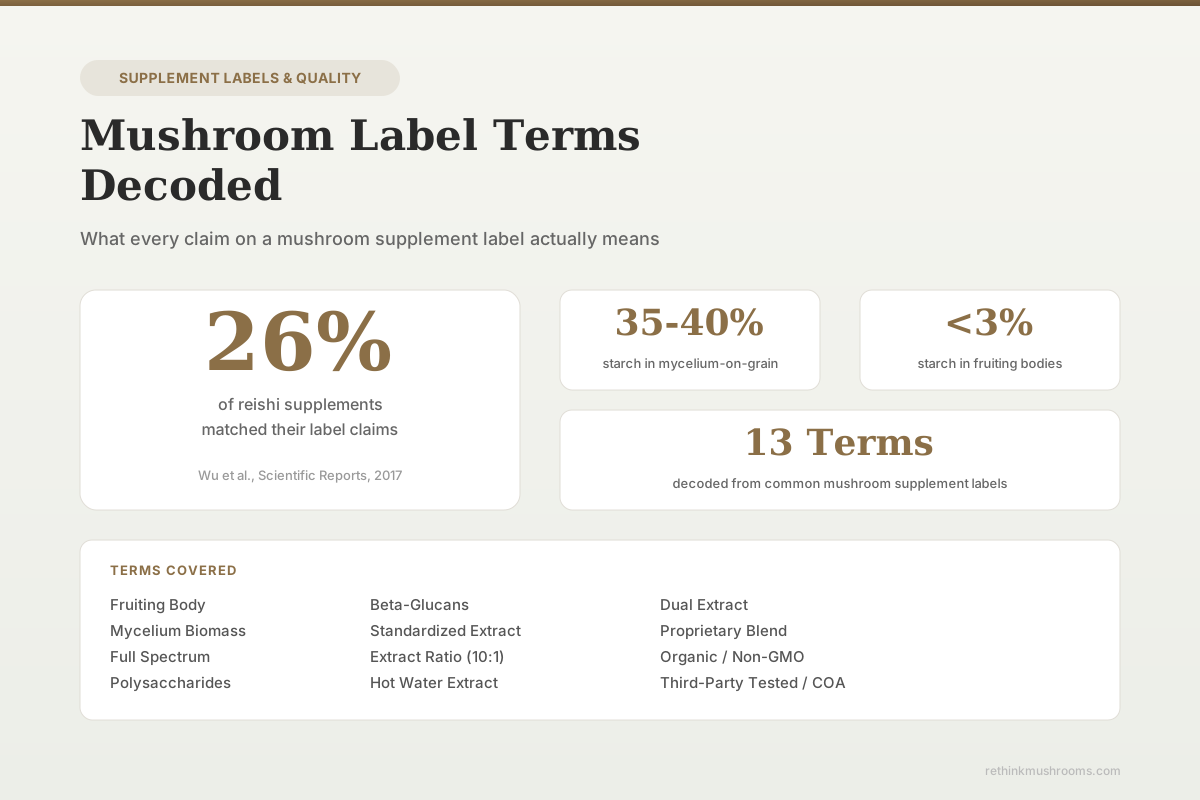
26% Passed Testing
A 2017 study tested 19 reishi supplement products sold in the United States. Only 5 (26.3%) had ingredients that matched their labels. The rest failed on triterpene content, polysaccharide profiles, or both.
Wu et al., Scientific Reports, 2017
13 of 19
products contained starch-like fillers
8 of 19
matched authentic reishi triterpene fingerprints
13 Terms Decoded
common label claims explained
Wu et al., Scientific Reports, 2017
 View as image ↗
Walk into any health food store and pick up a mushroom supplement. The label will have terms like "mycelium biomass," "full spectrum," "1,000mg mushroom complex," and "standardized to 30% polysaccharides." These phrases sound scientific. Most of them tell you very little about what is inside the bottle.
A 2017 analysis published in Scientific Reports tested 19 reishi (Ganoderma lucidum) supplements purchased in the United States.[1] Only 5 of those 19 products (26.3%) had measurable ingredients that matched what their labels claimed. The other 14 failed on triterpene content, polysaccharide composition, or both. That means roughly 3 out of 4 reishi supplements on shelves did not contain what they said they did. For context on how beta-glucan percentages on labels translate to actual potency, that topic gets its own deep dive. If you want a broader walkthrough, the step-by-step label reading guide covers the full process.
Key Takeaways
- Only 26.3% of reishi supplements tested in a 2017 audit matched their label claims for triterpenes and polysaccharides; 13 of 19 products tested positive for starch-like fillers before enzymatic digestion (Wu et al., Scientific Reports, 2017)
- Mushroom fruiting bodies and mycelium-on-grain products differ chemically: a validated AOAC method can separate beta-glucans from alpha-glucans (starch and glycogen), making the distinction quantifiable (McCleary and Draga, Journal of AOAC International, 2016)
- "Polysaccharides" on a label can include starch from grain filler, not just bioactive beta-glucans from mushrooms
- A 2025 multi-analytical study found "stark compositional deviations" between wildcrafted chaga and fermented grain products labeled as chaga (Windsor et al., IJMS, 2025; authors employed by chaga supplement company Nammex)
- DNA barcoding of seven supplements sold as Ganoderma lucidum found Ganoderma lingzhi DNA in all of them — a taxonomic mismatch with the species named on the label (Gunnels et al., PLOS ONE, 2020)
- The Megazyme assay can separately measure beta-glucans and alpha-glucans (starch), but most supplement labels do not report this breakdown
"Fruiting Body" vs "Mycelium" vs "Mycelium Biomass"
These three terms describe fundamentally different products, but labels often blur the lines.
A fruiting body is the part of a mushroom you can see and pick. The cap, the stem, the spore-bearing structure. When researchers study medicinal mushrooms, the fruiting body is what most traditional use and most published research is based on. Fungi store carbohydrate as glycogen and trehalose rather than as starch, so authentic fruiting-body material contains high concentrations of beta-glucans (the primary bioactive polysaccharides) and only minor amounts of starch. The 2017 Wu et al. reishi audit, for example, found no detectable starch-like signal in the authenticated Ganoderma lucidum fruiting-body reference material it benchmarked retail products against.[1]
Mycelium is the root-like network of the fungus. It grows underground or through whatever substrate it feeds on. In nature, mycelium breaks down organic matter and absorbs nutrients. In supplement manufacturing, mycelium is typically grown on sterilized grain (rice, oats, or sorghum).
Mycelium biomass is the term that matters most. When a label says "mycelium biomass," it usually means the mycelium was grown on grain and the entire mass, mycelium plus the grain it grew on, was dried, ground, and put into capsules. The grain is not separated from the fungal tissue. McCleary and Draga published a validated method for measuring beta-glucan in mushroom and mycelial products in the Journal of AOAC International in 2016.[2] Their method measures total glucan, then separately measures alpha-glucan (starch and glycogen), with beta-glucan determined by the difference. The same method can be applied to grain-based mycelial products to detect starch from the substrate; in the Wu et al. reishi audit, an iodine starch screen plus alpha-amylase digestion flagged starch-like polysaccharides in 13 of 19 products before digestion, with the signal disappearing after digestion — the chemical signature of grain filler rather than authentic Ganoderma material.[1]
A 2022 review in Microorganisms compared metabolite profiles between mycelium and fruiting bodies across three popular species (button mushroom, oyster mushroom, shiitake).[3] Berger and colleagues found that substrate chemistry, strain, and developmental stage all caused wide variation in metabolite concentrations. The composition of mycelium depends heavily on what it was grown on. Fruiting body composition is more consistent across growing conditions.
"Full Spectrum"
"Full spectrum" implies you are getting every part of the mushroom: fruiting body, mycelium, spores, and all their compounds. In practice, this term has no regulated definition. A product labeled "full spectrum" could contain 90% grain filler with trace amounts of mycelium and no fruiting body at all. There is no legal requirement for the term to mean any specific ratio of components.
Without a label that specifies the exact breakdown (such as "contains 60% fruiting body, 40% mycelium"), "full spectrum" is a marketing phrase, not a quality indicator.
"Polysaccharides" vs "Beta-Glucans"
This distinction is the single most important thing to understand on a mushroom supplement label.
Polysaccharides is a broad category. It includes beta-glucans (the bioactive compounds in medicinal mushrooms), but it also includes alpha-glucans. Alpha-glucans include starch and glycogen. Starch comes from grain. If a mycelium product was grown on rice and the label says "standardized to 50% polysaccharides," a large portion of those polysaccharides may be rice starch, not mushroom beta-glucans.
Beta-glucans are the specific polysaccharides responsible for most of the documented immune-modulating activity of medicinal mushrooms. A 2021 review by Cerletti and colleagues in Nutrients examined the evidence for beta-glucan effects on human health.[4] The bioactive forms are (1,3)- and (1,6)-linked beta-D-glucans. These are structurally distinct from the alpha-glucans in grain starch.
Mironczuk-Chodakowska and colleagues measured beta-glucan content across wild-growing Polish mushroom species in a 2017 study.[5] Total beta-glucan content ranged from 13.5 g per 100 g dry mass in Agaricus bisporus (button mushroom) to 40.9 g per 100 g dry mass in Tricholomopsis rutilans. The (1,3)-(1,6)-beta-D-glucan fraction, the most biologically relevant type, ranged from 3.9 g per 100 g dry mass in Agaricus bisporus (cremini) to 16.8 g per 100 g dry mass in Auricularia auricula-judae (wood ear). A follow-up 2020 study by the same group, comparing 18 wild species and 3 commercial reference mushrooms with both Megazyme and Congo red methods, found that beta-glucan readouts can shift substantially with assay choice: Tricholoma portentosum topped the Megazyme ranking at 34.97 g/100 g while Lactarius deliciosus topped the Congo red ranking at 17.11 g/100 g.[6] These ranges give a baseline for what genuine fruiting-body material can contain — and a reminder that the assay behind a label number matters as much as the number itself.
A label that lists "polysaccharides" without specifying "beta-glucans" separately is telling you less than it appears to. Look for labels that state a specific beta-glucan percentage measured by a validated method.
"Standardized Extract" and "Extract Ratio"
A standardized extract means the manufacturer claims each batch contains a consistent level of a specific compound. "Standardized to 30% beta-glucans" means every capsule should deliver that percentage. This is the most useful claim a label can make, if the testing method behind it is reliable.
An extract ratio like "10:1" or "8:1" means 10 kg (or 8 kg) of raw mushroom material was concentrated into 1 kg of extract. Higher ratios sound more potent. The problem is that extract ratios say nothing about what was extracted. A 10:1 extract could concentrate beta-glucans, or it could concentrate starch. Without a stated beta-glucan percentage alongside the ratio, the number is meaningless for evaluating quality.
Zheng and colleagues optimized ultrasonic-assisted extraction of polysaccharides and triterpenoids from Ganoderma lucidum in a 2020 study published in PLOS ONE.[7] They found that extraction method significantly affected the yield and antioxidant capacity of the resulting compounds. Hot water extraction, ethanol extraction, and ultrasonic-assisted extraction all produced different profiles. The extract ratio on a label tells you nothing about which method was used or what the final product contains.
"Hot Water Extract" and "Dual Extract"
Hot water extraction is the traditional method for pulling beta-glucans out of mushroom cell walls. Mushroom cells are encased in chitin, the same material that makes insect exoskeletons hard. Without extraction, those beta-glucans pass through the human digestive system locked inside chitin walls. Hot water breaks down the chitin and releases water-soluble compounds, primarily beta-glucans and some proteins.
Dual extraction uses both hot water and alcohol (ethanol). The alcohol step pulls out compounds that are not water-soluble, mainly triterpenes. Triterpenes are the bitter compounds in reishi and chaga that have shown anti-inflammatory and cytotoxic activity in lab studies. If a product contains a species known for its triterpene content (reishi, chaga, or antrodia), dual extraction captures a fuller range of bioactive compounds than hot water alone.
A label that says "hot water extract" is telling you the product went through an extraction process, which is better than raw powder. A label that says "dual extract" is telling you both water-soluble and alcohol-soluble compounds were targeted. Neither term tells you the final beta-glucan or triterpene concentration. The percentage matters more than the method.
"1,000mg Mushroom Complex" and Proprietary Blends
A "mushroom complex" that lists 10 species at 1,000mg total gives each species an average of 100mg per serving. At that dose, most species would deliver negligible amounts of any bioactive compound. Multi-species blends spread the dose too thin to match the amounts used in published research.
Proprietary blends make this worse. When a label lists ingredients under a proprietary blend, it only has to list the total weight. It does not have to tell you how much of each ingredient is in the blend. A "500mg Lion's Mane and Reishi Blend" could be 490mg lion's mane and 10mg reishi, or the reverse. You cannot tell from the label.
The research cited in studies on specific mushroom species typically uses single-species extracts at doses ranging from 500mg to 3,000mg per day. A blend diluted across 10 species at 1,000mg total does not replicate those study conditions.
"Organic" and "Non-GMO"
Both terms have regulated definitions, which makes them more reliable than most label claims. USDA Organic certification means the growing substrate (the grain or material the mushroom was grown on) met organic standards. It does not guarantee the product is a fruiting body extract. It does not guarantee beta-glucan content. An organic mycelium-on-grain product is still a mycelium-on-grain product.
Non-GMO means the source material was not genetically modified. Since mushrooms themselves are not currently produced from GMO organisms, this label applies primarily to the grain substrate used for mycelium cultivation. It is accurate but not a differentiator of quality.
"Third-Party Tested" and "Certificate of Analysis"
Third-party tested means an independent lab, not the manufacturer, analyzed the product. This is a positive signal, but the value depends entirely on what was tested. A third-party test for heavy metals and microbial contamination is useful. A third-party test that measures only total polysaccharides (which includes starch) is less informative than one that measures beta-glucans specifically.
A Certificate of Analysis (COA) is the actual lab report. Companies that make COAs available on their website or by request are providing a higher level of transparency. The most useful COAs include beta-glucan content measured by the Megazyme method (or equivalent validated assay), starch content, heavy metal levels, and microbial testing results.
What the Lab Data Shows About Label Accuracy
The Wu et al. 2017 reishi study is not an isolated finding.[1] Their chromatographic analysis revealed that triterpenes specific to Ganoderma lucidum were only detectable in 8 of 19 products (42.1%) by HPTLC fingerprinting. Thirteen of 19 products contained starch, which should not be present in a pure reishi fruiting body product.
A 2020 DNA barcoding study by Gunnels and colleagues in PLOS ONE used ITS (internal transcribed spacer) sequencing to authenticate commercial reishi supplements at the species level.[8] They found that ITS barcoding can reliably identify Ganoderma species and reported that all seven powdered or dried products they tested — each sold as Ganoderma lucidum — actually contained Ganoderma lingzhi DNA. G. lingzhi is the East Asian species commonly traded as "reishi"; G. lucidum sensu stricto is a different European species. The mismatch is taxonomic rather than fraudulent in most cases, but it does mean the species name on the label is not what is in the bottle.
Windsor and colleagues published a multi-analytical supplement comparison in 2025, examining chaga (Inonotus obliquus) products using six complementary analytical techniques.[9] They compared wildcrafted chaga canker against commercial fermented grain products labeled as "chaga." The results showed "stark compositional deviations." Wildcrafted chaga contained triterpenoids (inotodiol, trametenolic acid) and phenolics. Fermented grain products contained significant starch, lacked key triterpenoids, and had metabolic profiles that more closely resembled their grain substrates than actual chaga. The iodine-starch assay confirmed starch-rich composition in fermented grain products and its absence in authentic chaga canker. Reader note: five of the six authors are employed by Nammex, a chaga supplement supplier with a direct commercial interest in distinguishing wildcrafted product from grain-based competitors. The chemistry methods are standard, the conclusions are consistent with independent reishi audits like Wu 2017, and the paper's conflict-of-interest disclosure is explicit — but the framing should be read with that incentive in mind.
Lopez-Garcia and colleagues demonstrated in 2016 that MALDI-TOF mass spectrometry could characterize polysaccharide profiles from commercial mushroom supplements without purification or derivatization.[10] This type of rapid analytical technique could eventually enable faster quality screening across the supplement market.
How to Evaluate a Label in Practice
Given everything above, here is what the terms on a label actually tell you:
| Label Term | What It Tells You | What It Does Not Tell You |
|---|---|---|
| Fruiting body | Product is made from the mushroom itself | Beta-glucan concentration, extraction method |
| Mycelium biomass | Product includes grain substrate | How much is fungus vs grain |
| Full spectrum | Nothing specific | Ratio of components, beta-glucan content |
| Polysaccharides: 50% | Broad carbohydrate content | Whether that includes starch from grain |
| Beta-glucans: 30% | Specific bioactive content | Testing method used |
| 10:1 extract | Concentration ratio | What compounds were concentrated |
| Hot water extract | Extraction method used | Final compound concentrations |
| Dual extract | Both water and alcohol extraction | Final triterpene or beta-glucan levels |
| Third-party tested | Independent lab tested it | What they tested for |
The most informative labels combine specific claims: "fruiting body, hot water extract, standardized to 30% beta-glucans, third-party tested with COA available." Each term adds a layer of information. A label missing most of these layers is asking you to take its quality on faith. For a broader look at the difference between Supplement Facts and Nutrition Facts panels, those formats carry their own distinctions. And the complete guide to reading a mushroom supplement label covers how polysaccharides, beta-glucans, and red flags all fit together.
The Bottom Line
Mushroom supplement labels use terms that sound precise but often obscure more than they reveal. "Polysaccharides" can include grain starch. "Full spectrum" has no regulated meaning. "Mycelium biomass" carries the starch signature of its grain substrate, which validated assays like the Megazyme method can flag. Published lab analyses show that a significant fraction of commercial products do not match their label claims — only 5 of 19 reishi supplements in one 2017 audit matched theirs. The most reliable indicators are specific beta-glucan percentages measured by validated methods, fruiting body sourcing, and available Certificates of Analysis.
Frequently Asked Questions
Sources & References
- 1RTHM-00499·Wu, Ding-Tao et al. (2017). “Evaluation on quality consistency of Ganoderma lucidum dietary supplements collected in the United States..” Scientific reports.Study breakdown →PubMed →↩
- 2RTHM-00438·McCleary, Barry V et al. (2016). “Measurement of β-Glucan in Mushrooms and Mycelial Products..” Journal of AOAC International.Study breakdown →PubMed →↩
- 3RTHM-00743·Berger, Ralf G et al. (2022). “Mycelium vs. Fruiting Bodies of Edible Fungi-A Comparison of Metabolites..” Microorganisms.Study breakdown →PubMed →↩
- 4RTHM-00676·Cerletti, Chiara et al. (2021). “Edible Mushrooms and Beta-Glucans: Impact on Human Health..” Nutrients.Study breakdown →PubMed →↩
- 5RTHM-00484·Mirończuk-Chodakowska, Iwona et al. (2017). “Quantitative evaluation of 1,3,1,6 β-D-glucan contents in wild-growing species of edible Polish mushrooms..” Roczniki Panstwowego Zakladu Higieny.Study breakdown →PubMed →↩
- 6RTHM-00637·Mirończuk-Chodakowska, Iwona et al. (2020). “Evaluation of Polish wild Mushrooms as Beta-Glucan Sources..” International journal of environmental research and public health.Study breakdown →PubMed →↩
- 7RTHM-00668·Zheng, Shizhong et al. (2020). “Optimization of ultrasonic-assisted extraction of polysaccharides and triterpenoids from the medicinal mushroom Ganoderma lucidum and evaluation of their in vitro antioxidant capacities..” PloS one.Study breakdown →PubMed →↩
- 8RTHM-00615·Gunnels, Tess et al. (2020). “The ITS region provides a reliable DNA barcode for identifying reishi/lingzhi (Ganoderma) from herbal supplements..” PloS one.Study breakdown →PubMed →↩
- 9RTHM-02209·Windsor, Coleton et al. (2025). “What This 2025 Chaga Supplement Authentication Study Actually Found.” International journal of molecular sciences.Study breakdown →PubMed →↩
- 10RTHM-00437·López-García, Marta et al. (2016). “MALDI-TOF to compare polysaccharide profiles from commercial health supplements of different mushroom species..” Food chemistry.Study breakdown →PubMed →↩