Mushroom Supplement Quality
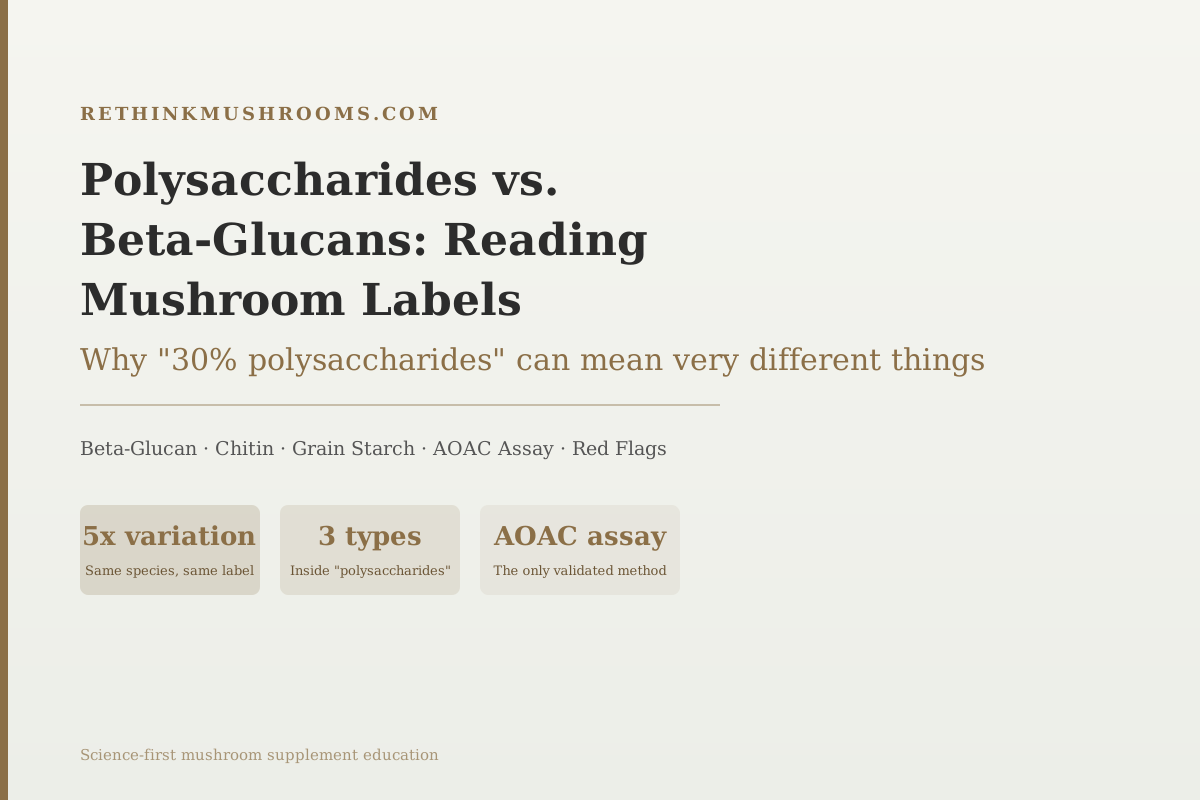
5x variation
The same Ganoderma lucidum species grown on different wood substrates showed up to 5-fold variation in beta-glucan content, explaining why two supplements with identical labels can contain dramatically different amounts of the compounds that matter.
Cortina-Escribano et al., Molecules, 2020
3.9–16.8%
the measured range of specifically bioactive (1→3),(1→6)-β-D-glucan across eight wild mushroom species as a percentage of dry mass; total β-glucan ran higher (13.5–40.9%), which is why a generic 'mushroom blend' polysaccharide claim tells you little (Miroñczuk-Chodakowska et al., 2017)
AOAC assay
the only validated method for measuring true (1→3),(1→6)-beta-D-glucan specifically, as established by McCleary et al. in 2016; this is what separates a real beta-glucan claim from a polysaccharide estimate
3 types
of carbohydrates that brands routinely count as 'polysaccharides': true beta-glucan (the bioactive), chitin (structural, not the same), and in mycelium-on-grain products, grain starch
Cortina-Escribano et al., Molecules, 2020
 View as image ↗
Picture two reishi supplements sitting side by side. Both labels say "30% polysaccharides." One contains a fruiting body extract with 25% actual beta-glucan. The other is a mycelium-on-grain product with 5% beta-glucan and 25% grain starch, and that grain starch is being counted in the polysaccharide number. Both labels are technically truthful. Both are practically useless for comparing what you're actually getting.
The word "polysaccharides" on a mushroom supplement label is not a quality claim. It is a category of carbohydrate compounds that includes the genuinely bioactive beta-glucans alongside structural compounds and, in some product types, grain starch from the growing substrate. Understanding exactly what's in that number is the most important thing you can do when reading a mushroom supplement label.
This article covers the chemistry and the red flags. For a step-by-step walkthrough of the whole Supplement Facts panel, see how to read a mushroom supplement label: a step-by-step guide. For the full buyer's guide, see how to choose a mushroom supplement: the science-based buyer's guide.
Key Takeaways
- "Polysaccharides" on a mushroom label includes beta-glucan, chitin, and in mycelium-on-grain products, grain starch; all three get counted, but only beta-glucan is the primary bioactive compound
- McCleary et al. established the AOAC-validated enzymatic assay in 2016 that specifically isolates (1→3),(1→6)-beta-D-glucan from starch and chitin; without this specific assay, a polysaccharide percentage tells you very little
- Measured beta-glucan content varies widely by species: mean total β-glucan ran 13.5–40.9% of dry mass and the specifically bioactive (1→3),(1→6)-β-D-glucan fraction only 3.9–16.8% across eight wild species (Miroñczuk-Chodakowska et al., 2017); a raw-powder "50% beta-glucan" claim exceeds anything measured there and deserves a batch COA to back it up
- The same Ganoderma lucidum grown under different conditions showed up to 5x variation in beta-glucan content (Cortina-Escribano et al., 2020); batch-specific COA data is the only way to know actual content
- "10:1 extract ratio" tells you the weight reduction in processing, not the beta-glucan concentration; it is not a quality signal for bioactive content
- A legitimate beta-glucan claim requires: specific percentage (not just "polysaccharides"), testing by an accredited third-party lab using AOAC-recognized assay methods, and a certificate of analysis (COA) available per batch
Why "Polysaccharides 30%" Might Mean Almost Nothing
Polysaccharide is a chemical category, not a compound name. It means any carbohydrate made of many sugar units linked together. Starch is a polysaccharide. Cellulose is a polysaccharide. Chitin is a polysaccharide. And beta-glucan (the compound in medicinal mushrooms that the clinical research is actually about) is also a polysaccharide.
When a mushroom supplement lists "polysaccharides 30%," it is reporting the total percentage of all carbohydrate polymers in the product. The bioactive beta-glucan fraction could be 25% of that, or 50% of that, or 5% of that, depending on species, growing method, and extraction approach. Without a specific beta-glucan assay, the polysaccharide number does not tell you.
The scientific foundation here is a 2016 paper by McCleary and colleagues that established the official AOAC-validated method for measuring (1→3),(1→6)-beta-D-glucan specifically in mushrooms and mycelial products.[1] The assay works by enzymatically digesting starch (using amyloglucosidase) and chitin before measuring what remains. This means the McCleary method reports only true fungal beta-glucan: not starch, not chitin, not all carbohydrates combined. That distinction is what makes a beta-glucan number meaningful.
A polysaccharide percentage, by contrast, typically measures total carbohydrate polymers. The two numbers are not interchangeable, and products that report only polysaccharides are not reporting what the clinical research is measuring.
The Three Carbohydrates Hiding Inside "Polysaccharides"
Three distinct carbohydrate types contribute to a mushroom product's polysaccharide reading. Understanding each one explains why the same percentage can represent very different actual products.
What “Polysaccharides” Contains
One Label Number, Three Different Carbohydrates
A total-polysaccharide assay counts beta-glucan, chitin, and (in grain-grown products) starch together. Only the beta-glucan fraction is the bioactive the clinical research measures. Two products can carry the same “polysaccharides” figure while differing enormously in what actually matters.
Fruiting body extract
Grown on wood; no digestible grain starch
Same “polysaccharides” number, very different bottle
Mycelium on grain
Mycelium never separated from the rice/oat substrate
Same “polysaccharides” number, very different bottle
Proportions are illustrative — actual composition varies by product and is only knowable from a batch certificate of analysis using the AOAC beta-glucan assay, which enzymatically removes starch and chitin before measuring true fungal beta-glucan.
Mechanism: McCleary & Draga (2016), J. AOAC Int. (starch subtraction); Nitschke et al. (2011), Food Chem. (chitin fraction); Lo et al. (2012), fruiting body vs. mycelium composition
True beta-glucan: the bioactive fraction
The (1→3),(1→6)-beta-D-glucan structure specific to fungi is the compound linked to immune modulation, macrophage activation, and the outcomes measured in clinical trials. This is what you want measured specifically. In a quality fruiting body extract, this should represent the majority of the polysaccharide reading. In poorly sourced products, it may be a small fraction of it.
Chitin: structural polymer, not the immune activator
Mushroom cell walls are built largely from chitin, the same structural carbohydrate found in insect exoskeletons. Chitin is a polysaccharide. Nitschke and colleagues validated a method specifically for quantifying chitin in edible mushrooms in 2011, noting that chitin can account for a significant portion of the total carbohydrate content in mushroom material.[6] Chitin has some dietary fiber properties, but it is not the immune-active beta-glucan. When a total polysaccharide assay is used instead of a beta-glucan-specific assay, chitin contributes to the reading.
Grain starch: the mycelium-on-grain problem
Some mushroom products are made from mycelium grown on grain, typically brown rice or oats. The mycelium is never separated from the grain before processing, meaning the final powder contains significant amounts of grain starch. Starch is a polysaccharide. A comparison of bioactive compound concentrations in fruiting bodies versus mycelium across multiple species found that mycelium products showed substantially different profiles; in grain-grown products, carbohydrate readings are heavily influenced by the grain substrate rather than fungal compounds.[5]
This is how a mycelium-on-grain product can legitimately label "30% polysaccharides" while containing a fraction of the actual fungal beta-glucan found in a fruiting body extract at the same percentage.
How Different Assays Produce Different Numbers from the Same Sample
The measurement method used to test a mushroom extract is as important as the number reported. Kanno and colleagues demonstrated in 2020 that different analytical methods applied to the same mushroom sample produce dramatically different results for beta-glucan content, confirming that assay methodology choice directly determines the number on a label.[4]
The gold standard is the AOAC-validated enzymatic method developed by McCleary et al., the same approach used by the Megazyme testing kit, which is widely used by third-party labs and referenced in quality-conscious brand COAs.[1] The Megazyme name appears on legitimate COAs because it refers to the reagent kit based on the validated enzymatic method.
Lower-cost colorimetric assays (phenol-sulfuric acid, anthrone) measure total carbohydrates. They're faster and cheaper, but they do not discriminate between starch, chitin, and beta-glucan. Some companies use these simpler methods to generate their polysaccharide percentage and present it as equivalent to a beta-glucan reading. It is not.
When reading a COA, look for the specific assay method named. "Total polysaccharides by colorimetric assay" is not equivalent to "beta-glucan by AOAC 32-23.01 enzymatic method." If the assay method is not specified on the COA, the number cannot be interpreted with confidence.
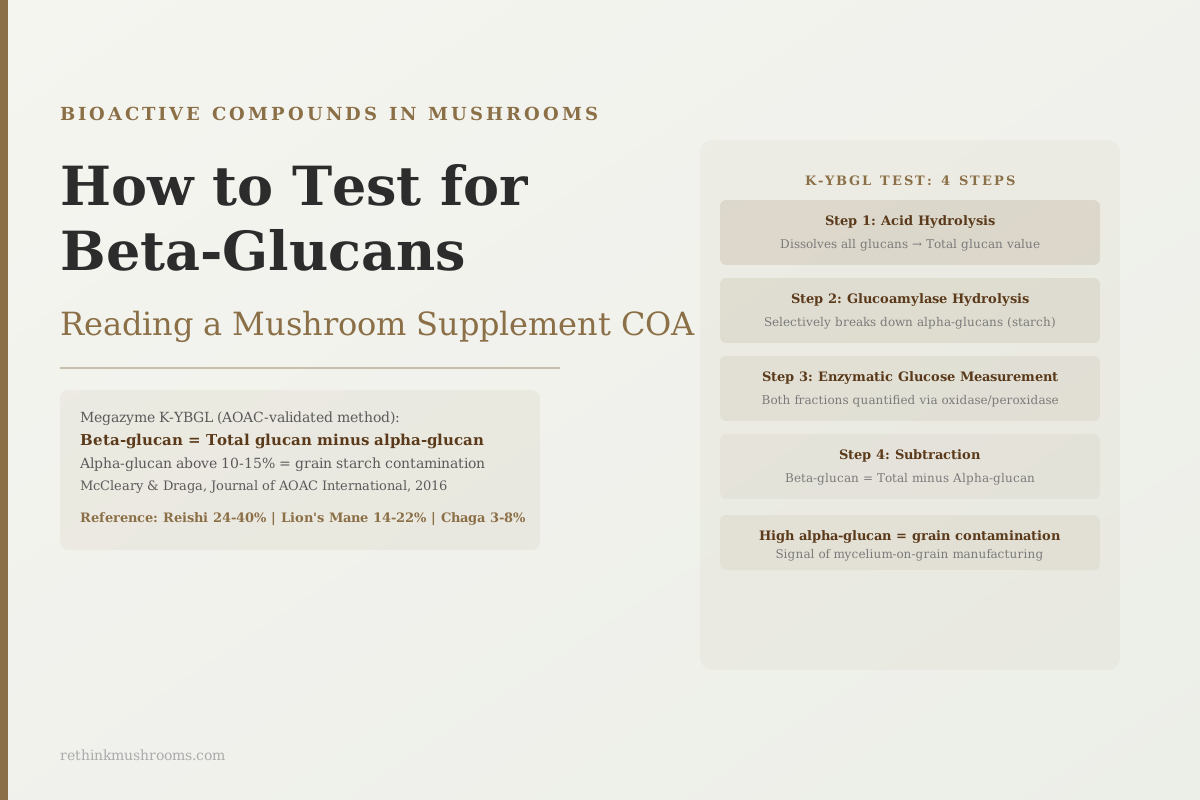
How to Read a COA
The K-YBGL Subtraction, and What the Alpha-Glucan Column Reveals
Reading the alpha-glucan value
Fruiting body or cleanly processed mycelium
Wood substrates contain no digestible starch; endogenous mushroom glycogen is low.
Meaningful grain starch present
Indicates a mycelium-on-grain product where substrate was not fully separated.
Substantial substrate contamination
Most of the reported "glucan" is starch regardless of the beta-glucan figure shown alongside it.
A COA that reports only "polysaccharides %" or a single "beta-glucan %" without the alpha-glucan breakdown cannot tell you how much of that number is active compound versus grain starch.
Method: McCleary & Draga (2016), J. AOAC International — Megazyme K-YBGL assay
 View as image ↗
How Growing Conditions Explain 5x Variation in Identical Species
Even when a brand correctly reports beta-glucan using the validated assay, that number reflects a specific batch under specific conditions. Cortina-Escribano and colleagues studied how substrate type and environmental treatment affected beta-glucan content in Ganoderma lucidum fruiting bodies and found variation of up to five-fold based on growing conditions alone.[3]
The study tested the same strain across different wood substrates and with versus without cold treatment. The same genetic species, the same extraction process, and the beta-glucan content varied dramatically from one growing condition to another. This is why a brand's average beta-glucan content does not tell you about the specific batch in your bottle.
Cortina-Escribano et al. (2020) · Molecules
- Population
- Ganoderma lucidum (reishi) fruiting bodies, multiple boreal strains
- Intervention
- Different wood substrates (birch, aspen, spruce, pine, larch) with and without cold-shock treatment
- Finding
- Beta-glucan content of the same species varied up to five-fold depending on wood substrate and cold treatment; birch and aspen substrates paired with the highest-performing strain produced the greatest content.
narrow-scope A cultivation study, not a supplement comparison, but it establishes why a brand's average beta-glucan figure cannot describe the specific batch in your bottle.
Cortina-Escribano et al., Molecules, 2020
Lam and colleagues found that processing method also matters: cooking and drying significantly changed the relative concentrations of beta-glucan versus total polysaccharides in oyster mushrooms, meaning that raw mushroom data does not translate directly to extract product data.[7]
Natural species ranges add another layer. Miroñczuk-Chodakowska and colleagues measured beta-glucan in eight wild mushroom species and found mean total β-glucan ranging from 13.5% to 40.9% of dry mass, while the specifically bioactive (1→3),(1→6)-β-D-glucan fraction ran only 3.9% to 16.8%; even in the highest species, that bioactive fraction was just 40–54% of the total β-glucan figure.[2] This gives you a reference for plausibility. Raw fruiting bodies did not exceed roughly 41% total β-glucan in that data, so a raw-powder claim above that is implausible; a concentrated extract can legitimately run higher, but the only way to confirm the number for a specific batch is a COA using the AOAC beta-glucan assay.
Fact Check
Myth vs. evidence
The claim
“Polysaccharides 30% means 30% of the active mushroom compound.”
A common way shoppers read mushroom supplement labels
What research shows
Misleading"Polysaccharides" is a total-carbohydrate category that lumps bioactive beta-glucan together with structural chitin and, in mycelium-on-grain products, grain starch. The bioactive fraction can be most of that number or a small slice of it.
The AOAC enzymatic assay exists precisely because it removes starch and chitin before measuring true (1→3),(1→6)-β-D-glucan; a total-polysaccharide figure does none of that.
McCleary & Draga, J. AOAC International, 2016
5 Red Flags on a Mushroom Supplement Label
The following patterns on a label or product page each indicate a quality or transparency problem:
Red flag 1: "Polysaccharides" listed without a specific beta-glucan percentage
This is the most common misleading claim in the mushroom supplement market. A polysaccharide percentage without a corresponding beta-glucan percentage does not tell you what fraction of that number represents the bioactive compound. A legitimate quality claim specifies beta-glucan content using a validated assay.
Red flag 2: "Mushroom extract" without specifying fruiting body or mycelium
The source material determines the compound profile. Fruiting body and mycelium have different bioactive profiles, and mycelium-on-grain products have a specific starch inflation problem. A label that says "mushroom extract" or "mushroom powder" without specifying the source is not giving you the information needed to evaluate quality. For details on this specific issue, see how to spot a mycelium-on-grain supplement: label red flags and the starch filler problem: why mycelium on grain may be mostly rice.
Red flag 3: "10:1 extract ratio" presented as a quality signal
A 10:1 extract ratio means 10kg of raw material was concentrated to produce 1kg of extract. It describes a concentration process, not a compound content. A 10:1 extract of low-quality raw material can still have lower beta-glucan content than a 5:1 extract of high-quality raw material. Extract ratio, by itself, says nothing about beta-glucan concentration in the finished product.
Red flag 4: No COA available on request or on the website
A certificate of analysis from a third-party accredited lab, specific to the batch, is the only way to verify what a product actually contains. A brand unwilling to share batch COAs has something to hide. The COA should specify: assay method used, beta-glucan percentage, heavy metals screen, and microbial testing results. For more on evaluating third-party testing, see third-party testing for mushroom supplements: why it matters.
Red flag 5: "Proprietary blend" with no individual species dosages
Some products list a blend of multiple mushroom species under a single total weight. Individual species dosages within the blend are not disclosed. This structure allows brands to include trace amounts of high-value species (lion's mane, reishi) while filling the blend volume with cheaper material. Without species-level dosage disclosure, you cannot evaluate whether a dose is in the range studied clinically.
What Legitimate Beta-Glucan Testing Actually Looks Like
A valid beta-glucan claim on a mushroom supplement has three components: the compound measured is specifically named as (1→3),(1→6)-beta-D-glucan (or beta-glucan, clearly distinguished from polysaccharides), the assay method is specified (McCleary/Megazyme enzymatic method, AOAC 32-23.01, or equivalent), and the result comes from a batch-specific third-party COA rather than a one-time internal test.
The Megazyme name on a COA is a useful proxy. The Megazyme beta-glucan assay kit implements the enzymatic method that McCleary et al. validated for AOAC certification: the same approach that removes starch and chitin before measuring beta-glucan. Not every lab uses Megazyme specifically, but any legitimate assay should follow the same principle: starch removal before glucan measurement.
A brand with genuine quality claims will have these data accessible. COAs should be downloadable from the product page or available by batch number. The batch number on the bottle should match the batch number on the COA.
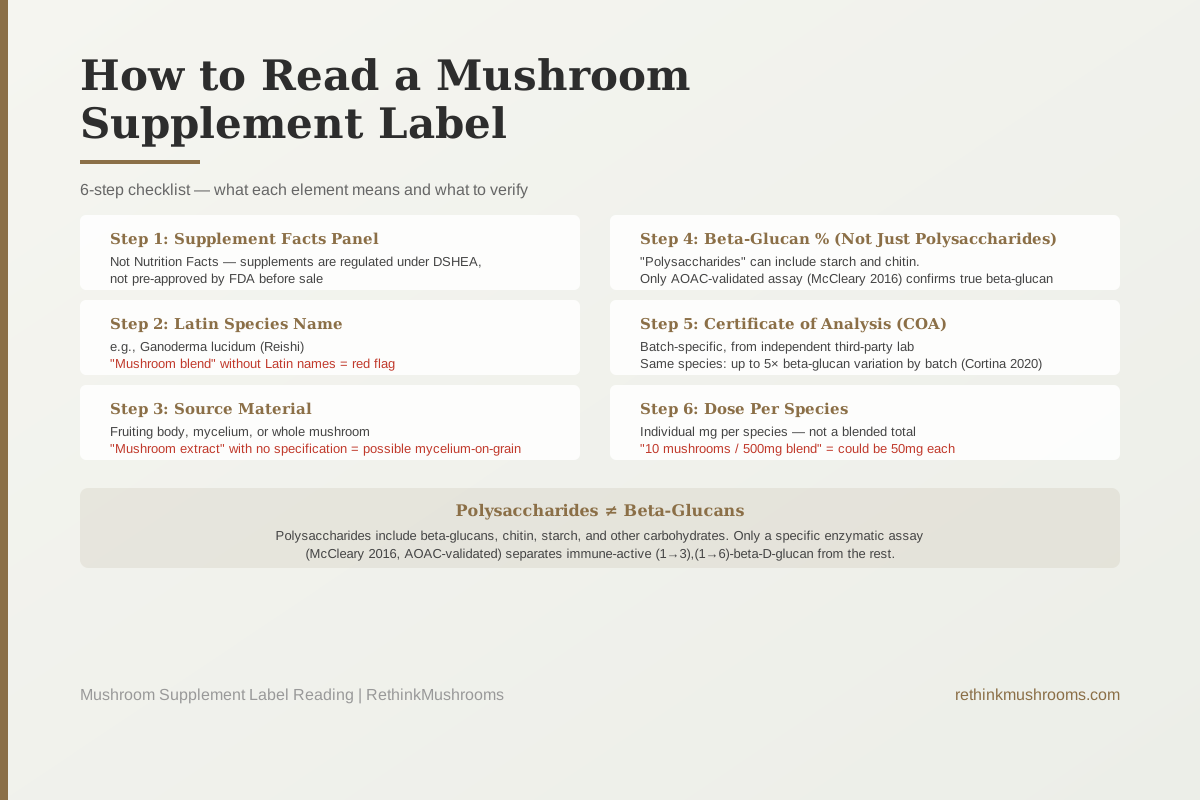
Anatomy of a Label
Where the Six Checks Live on a Real Supplement Facts Panel
Supplement Facts panel
Not "Nutrition Facts." Confirms it is regulated as a dietary supplement under DSHEA.
Latin species name
Ganoderma lucidum, not just "Reishi" or "Mushroom Blend." No Latin name means no verifiable species.
Source material
"Fruiting body," "mycelium," or "whole mushroom." "Extract" alone can hide mycelium-on-grain.
Beta-glucan %, not "polysaccharides"
A specific validated assay (Megazyme AOAC). "Polysaccharides" can include starch and chitin.
Certificate of Analysis
Batch-specific, from a named third-party lab. The only per-bottle verification of content.
mg per species + serving size
Individual doses, not a blended proprietary total that hides tiny per-species amounts.
This is what a label passing all six checks looks like: Latin names, source material, a beta-glucan percentage from a named assay, per-species mg, and a batch-specific third-party COA. Few products show all six.
Illustrative panel — values shown as an example of a compliant label
 View as image ↗
For a broader evaluation framework, see how beta-glucan testing works: Megazyme and other methods. For the full supplement selection checklist, see how to choose a mushroom supplement: the science-based buyer's guide.
The Bottom Line
"Polysaccharides" on a mushroom supplement label is not equivalent to "beta-glucans." Polysaccharides include true fungal beta-glucan alongside chitin and, in mycelium-on-grain products, grain starch. The AOAC-validated enzymatic assay (McCleary et al., 2016) is the only method that isolates (1→3),(1→6)-beta-D-glucan specifically. Beta-glucan content in the same species can vary up to five-fold based on growing conditions (Cortina-Escribano et al., 2020), making batch-specific COA data the only reliable quality verification. Red flags include polysaccharide claims without beta-glucan specifics, unspecified source material, extract ratio claims without compound data, and absence of third-party COAs.
Frequently Asked Questions
Sources & References
- 1RTHM-00438·McCleary, Barry V et al. (2016). “Measurement of β-Glucan in Mushrooms and Mycelial Products..” Journal of AOAC International.Study breakdown →PubMed →↩
- 2RTHM-00484·Mirończuk-Chodakowska, Iwona et al. (2017). “Quantitative evaluation of 1,3,1,6 β-D-glucan contents in wild-growing species of edible Polish mushrooms..” Roczniki Panstwowego Zakladu Higieny.Study breakdown →PubMed →↩
- 3RTHM-01183·Cortina-Escribano, Marta et al. (2020). “Effect of Strain, Wood Substrate and Cold Treatment on the Yield and β-Glucan Content of Ganoderma lucidum Fruiting Bodies..” Molecules (Basel.Study breakdown →PubMed →↩
- 4RTHM-00625·Kanno, Takashi et al. (2020). “Quantification of β-Glucan from Culinary-Medicinal Mushrooms Using Novel Artificial β-Glucan Recognition Protein..” International journal of medicinal mushrooms.Study breakdown →PubMed →↩
- 5RTHM-00256·Lo, Yu-Chang et al. (2012). “Comparative study of contents of several bioactive components in fruiting bodies and mycelia of culinary-medicinal mushrooms..” International journal of medicinal mushrooms.Study breakdown →PubMed →↩
- 6RTHM-00424·Nitschke, Jörg et al. (2011). “A new method for the quantification of chitin and chitosan in edible mushrooms..” Carbohydrate research.Study breakdown →PubMed →↩
- 7RTHM-00384·Lam, Yu Shan et al. (2015). “Determination of Lovastatin, β-glucan, Total Polyphenols, and Antioxidant Activity in Raw and Processed Oyster Culinary-Medicinal Mushroom, Pleurotus ostreatus (Higher Basidiomycetes)..” International journal of medicinal mushrooms.Study breakdown →PubMed →↩