Mushroom Supplement Quality & Sourcing
5× beta-glucan variation from growing conditions
The same Ganoderma species grown on different substrates showed up to 5 times variation in beta-glucan content, meaning two identically labeled products can differ dramatically.
Cortina-Escribano et al., Molecules, 2020
polysaccharides ≠ beta-glucans
they're measured differently
COA per batch
the only real verification
Latin name required
for species verification
Cortina-Escribano et al., Molecules, 2020
 View as image ↗
A mushroom supplement label can look authoritative and still tell you almost nothing useful. The regulatory rules that govern what must appear on a Supplement Facts panel were not written with mushroom bioactive specificity in mind. As a result, a label can show "Reishi Extract, 400mg, 30% polysaccharides" and be technically compliant while providing no meaningful information about the actual beta-glucan content.
This guide walks through a Supplement Facts panel element by element, explaining what each part legally means, what it does not tell you, and what to look for at each step.
For the complete buyer's guide, see How to Choose a Mushroom Supplement: The Science-Based Buyer's Guide.
Key Takeaways
- "Polysaccharides" and "beta-glucans" are not the same thing on a supplement label: polysaccharides include starch, chitin, and other carbohydrates that may not be biologically active; only a specific validated assay (the AOAC method established by McCleary 2016) can confirm actual (1→3),(1→6)-beta-D-glucan content
- A Supplement Facts panel is required for dietary supplements in the US under DSHEA (1994); the FDA does not pre-approve the claims on these panels, meaning companies self-certify their own labels
- The species should be listed by Latin name (e.g., Ganoderma lucidum, Hericium erinaceus); products listing "mushroom blend" without Latin name species breakdowns cannot be verified for species identity
- Source material should specify "fruiting body," "mycelium," or "whole mushroom"; products labeled only "mushroom extract" with no specification may be hiding mycelium-on-grain products with diluted beta-glucan from grain starch
- A Certificate of Analysis (COA) from a third-party laboratory is the only way to verify actual beta-glucan content per batch; the same species grown under different conditions can show up to 5 times variation in beta-glucan (Cortina-Escribano 2020)
- Extract ratios such as "10:1" indicate concentration by raw weight but say nothing about beta-glucan percentage; a 10:1 ratio tells you how concentrated the extract is, not how potent it is for immune function
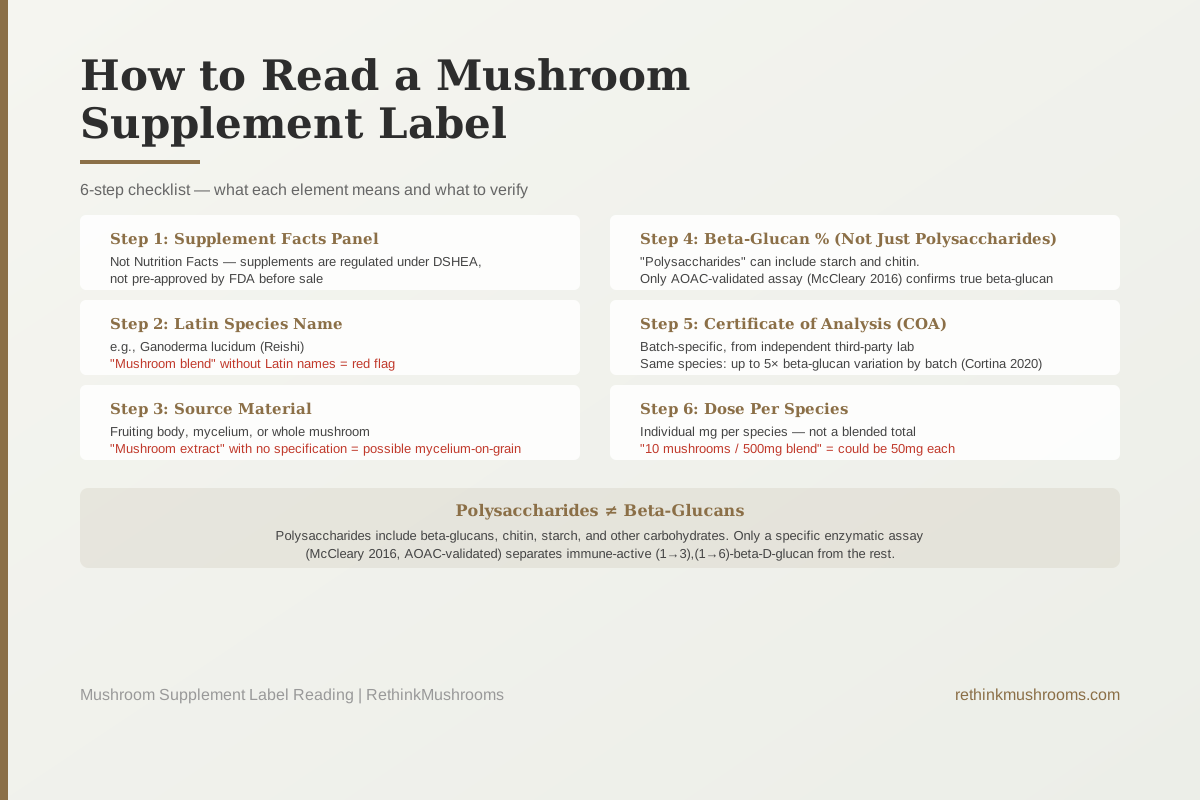
6 Things to Check on a Mushroom Supplement Label
The fastest version of this guide:
- Supplement Facts box visible (not Nutrition Facts)
- Latin species name listed for each ingredient
- Source material specified (fruiting body or mycelium)
- Beta-glucan % listed (not just polysaccharides)
- COA available from a third-party lab
- Serving size and mg per species clearly stated
Each of these is explained in detail below.
Anatomy of a Label
Where the Six Checks Live on a Real Supplement Facts Panel
Supplement Facts panel
Not "Nutrition Facts." Confirms it is regulated as a dietary supplement under DSHEA.
Latin species name
Ganoderma lucidum, not just "Reishi" or "Mushroom Blend." No Latin name means no verifiable species.
Source material
"Fruiting body," "mycelium," or "whole mushroom." "Extract" alone can hide mycelium-on-grain.
Beta-glucan %, not "polysaccharides"
A specific validated assay (Megazyme AOAC). "Polysaccharides" can include starch and chitin.
Certificate of Analysis
Batch-specific, from a named third-party lab. The only per-bottle verification of content.
mg per species + serving size
Individual doses, not a blended proprietary total that hides tiny per-species amounts.
This is what a label passing all six checks looks like: Latin names, source material, a beta-glucan percentage from a named assay, per-species mg, and a batch-specific third-party COA. Few products show all six.
Illustrative panel — values shown as an example of a compliant label
View as image ↗Step 1: Find the Supplement Facts Panel
The first thing to check is which box appears on the label: Supplement Facts or Nutrition Facts.
Nutrition Facts panels appear on conventional foods. Supplement Facts panels appear on dietary supplements, which are regulated under the Dietary Supplement Health and Education Act of 1994 (DSHEA). Mushroom supplements are dietary supplements, and their labels must contain a Supplement Facts box.
The regulatory difference matters because dietary supplements under DSHEA are not pre-approved by the FDA before going to market. A company can put a mushroom product on store shelves and include claims in the Supplement Facts panel without FDA review of those claims. The FDA monitors for violations after products are already sold but does not certify quality claims in advance. This means the Supplement Facts panel is a starting point for evaluation, not a quality guarantee.
For a detailed breakdown of the regulatory differences, see Supplement Facts vs. Nutrition Facts: What to Look For.
Step 2: Check the Latin Species Name
Inside the Supplement Facts panel, each ingredient should be listed with both the common name and the Latin (scientific) binomial name.
For mushrooms, the Latin name matters because common names are inconsistently used. "Reishi" can refer to Ganoderma lucidum or other Ganoderma species with different bioactive profiles. "Turkey Tail" typically refers to Trametes versicolor, but "turkey tail" could theoretically describe other bracket fungi. "Chaga" most often refers to Inonotus obliquus but is sometimes applied to other species.
If a product lists "Mushroom Blend" or "Proprietary Mushroom Complex" without specifying Latin names for each species and the mg dose per species, it is providing no verifiable species information. This is the first red flag.
The label should show something like: Ganoderma lucidum (Reishi) fruiting body extract 400mg. If you cannot determine which species you are taking or in what quantity, you cannot assess what research applies to that product.
Step 3: Verify the Source Material
The source material tells you what part of the mushroom was used: the fruiting body, the mycelium, or both.
This matters because fruiting bodies and mycelium have different bioactive profiles. Fruiting bodies are the visible mushroom structures that contain higher concentrations of the specific polysaccharides studied in clinical research. Mycelium grown on grain substrate can contain meaningful beta-glucan, but it also contains alpha-glucan, which is starch from the grain the mycelium was grown on. Alpha-glucan is not the same as the immune-active beta-glucan found in mushroom cell walls.
A study published in 2015 by Lam and colleagues found that processing methods, including the substrate and drying conditions used, significantly changed the ratio of beta-glucan to total polysaccharides in oyster mushrooms.[3] Products measuring "total polysaccharides" in mycelium-on-grain products may be partly measuring grain starch, not mushroom beta-glucan.
The label should specify "fruiting body," "mycelium," or "whole mushroom." Products that say only "mushroom extract" or "mushroom powder" without specifying the source material may be avoiding disclosure of mycelium-on-grain content.
For more on this distinction, see Fruiting Body vs. Mycelium on Grain: The Consumer Guide and How to Spot a Mycelium-on-Grain Supplement: Label Red Flags.
Step 4: Find the Beta-Glucan Claim (and Why It Must Not Say Only "Polysaccharides")
This is the most technically important step.
"Polysaccharides" is a broad chemical category that includes many types of long-chain carbohydrate molecules. In mushrooms, the biologically significant fraction is a specific type of polysaccharide called (1→3),(1→6)-beta-D-glucan, the form of beta-glucan that has been studied for immune system interactions. But polysaccharides also include chitin (the structural compound in mushroom cell walls), alpha-glucan starch from grain substrates, and other carbohydrates that do not interact with the same immune pathways.
When a label says "30% polysaccharides," it could mean:
- 30% true immune-active beta-glucan, with a proper measurement assay
- 30% mixed carbohydrates including starch and chitin, measured by a non-specific colorimetric test
- Some combination that falls between these extremes
In 2016, McCleary and colleagues published a validated method in the Journal of AOAC International for specifically measuring (1→3),(1→6)-beta-D-glucan in mushroom and mycelial products, now the gold-standard reference assay for the field.[1] The method works by enzymatically digesting starch (using amyloglucosidase) before measuring glucan, ensuring that grain starch in mycelium-on-grain products does not inflate the beta-glucan reading. Without this kind of assay specificity, a "polysaccharide" percentage is not a meaningful beta-glucan claim.
What to look for: the label should say "beta-glucan" not just "polysaccharides," and ideally specify the assay used (Megazyme AOAC method or equivalent). If only "polysaccharides" is listed, ask for the COA (step 5) to see whether a specific beta-glucan assay was used.
For a deeper explanation of how beta-glucan testing works, see How Beta-Glucan Testing Works: Megazyme and Other Methods and How to Read a Mushroom Supplement Label: Polysaccharides, Beta-Glucans, and Red Flags.
Step 5: Find and Read the Certificate of Analysis
A Certificate of Analysis (COA) is a document from an independent third-party laboratory showing what was actually measured in a specific batch of product.
The COA matters because supplement labels show brand claims; the COA shows verified measurements. Beyond that, growing conditions significantly affect beta-glucan content even within the same species. A 2020 study by Cortina-Escribano and colleagues compared Ganoderma lucidum grown on different wood substrates and with and without cold treatment, finding up to 5 times variation in beta-glucan content across the same species under different growing conditions.[2]
This means a brand's generic claim that their Reishi contains "25% beta-glucan" may accurately describe one batch and significantly misrepresent another if growing conditions changed between batches. Batch-specific COAs are the only way to verify that a particular bottle actually contains what the label claims.
What to look for: The COA should be accessible on the company website or available upon request. It should show:
- Product name and batch or lot number
- Specific compounds tested (beta-glucan or beta-D-glucan, not just total polysaccharides)
- Testing laboratory name (should be a recognized independent lab, not the company's own facility)
- Date of testing
A COA from the company's in-house lab does not provide independent verification. Third-party laboratory testing from a recognized facility is the meaningful standard.
For more on why third-party testing matters, see Third-Party Testing for Mushroom Supplements: Why It Matters.
Step 6: Check the Serving Size and Dose Per Species
The last element to verify is what you are actually getting per serving.
Serving size should be clearly stated (e.g., 2 capsules) with the mg of each species listed separately. Products that list 10 mushroom species in a 500mg proprietary blend may contain only 50mg per species, well below the doses used in research.
Common research doses are substantially higher than many supplement serving sizes. Clinical trials on Lion's Mane for cognitive function have used 3,000mg per day. Reishi trials for immune effects have used 1,800mg per day. A supplement with 200mg of each species in a blend is not delivering research-equivalent doses.
What to look for: individual mg doses per species, not a blended total. If you cannot determine how much of each species you are consuming per serving, the dosing is not transparent.
What a Good Mushroom Supplement Label Looks Like
A label that passes all six checks would show, for each ingredient:
- Latin species name (e.g., Lentinula edodes)
- Source material (fruiting body extract)
- Mg per serving (e.g., 500mg per capsule)
- Specific beta-glucan percentage (e.g., "beta-glucan 35%" with Megazyme assay specified)
- COA accessible on the company website by lot number
- Third-party laboratory name visible on the COA
Few products meet all six criteria. Most products meet some. The goal of this checklist is to identify which standards a given product reaches and which it does not, allowing comparison against the research evidence.
For the full decision framework on choosing a mushroom supplement, see How to Choose a Mushroom Supplement: The Science-Based Buyer's Guide. For the specific red flags in broader supplement quality, see 7 Red Flags in Mushroom Supplements: What to Avoid.
The Bottom Line
Mushroom supplement labels are regulated under DSHEA and are not pre-approved by the FDA, meaning quality claims are self-certified. Six elements to check: the Supplement Facts panel versus Nutrition Facts, Latin species names, source material (fruiting body versus mycelium), a beta-glucan percentage from a validated assay rather than just polysaccharides, a batch-specific COA from an independent laboratory, and individual mg doses per species. The same Ganoderma grown under different conditions showed up to 5 times beta-glucan variation (Cortina-Escribano 2020), which is why batch-specific verification matters.
Frequently Asked Questions
Sources & References
- 1RTHM-00438·McCleary, Barry V et al. (2016). “Measurement of β-Glucan in Mushrooms and Mycelial Products..” Journal of AOAC International.Study breakdown →PubMed →↩
- 2RTHM-01183·Cortina-Escribano, Marta et al. (2020). “Effect of Strain, Wood Substrate and Cold Treatment on the Yield and β-Glucan Content of Ganoderma lucidum Fruiting Bodies..” Molecules (Basel.Study breakdown →PubMed →↩
- 3RTHM-00384·Lam, Yu Shan et al. (2015). “Determination of Lovastatin, β-glucan, Total Polyphenols, and Antioxidant Activity in Raw and Processed Oyster Culinary-Medicinal Mushroom, Pleurotus ostreatus (Higher Basidiomycetes)..” International journal of medicinal mushrooms.Study breakdown →PubMed →↩